
The ocean has always been the silent engine of our planet’s stability. For millennia, it has absorbed the feverish heat of the sun and the excess carbon dioxide exhaled by the Earth’s geological and biological processes. But in the Anthropocene, the ocean is gasping. It has absorbed roughly 30% of human-made carbon dioxide emissions and 90% of the excess heat generated by global warming. The result is a marine environment that is hotter, more acidic, and less oxygenated than at any point in recent history.
Yet, in the cool, sun-dappled columns of the world’s coastlines and the open expanse of the high seas, a solution is growing. It is slimy, often overlooked, and occasionally treated as a nuisance on tourist beaches. It is seaweed.
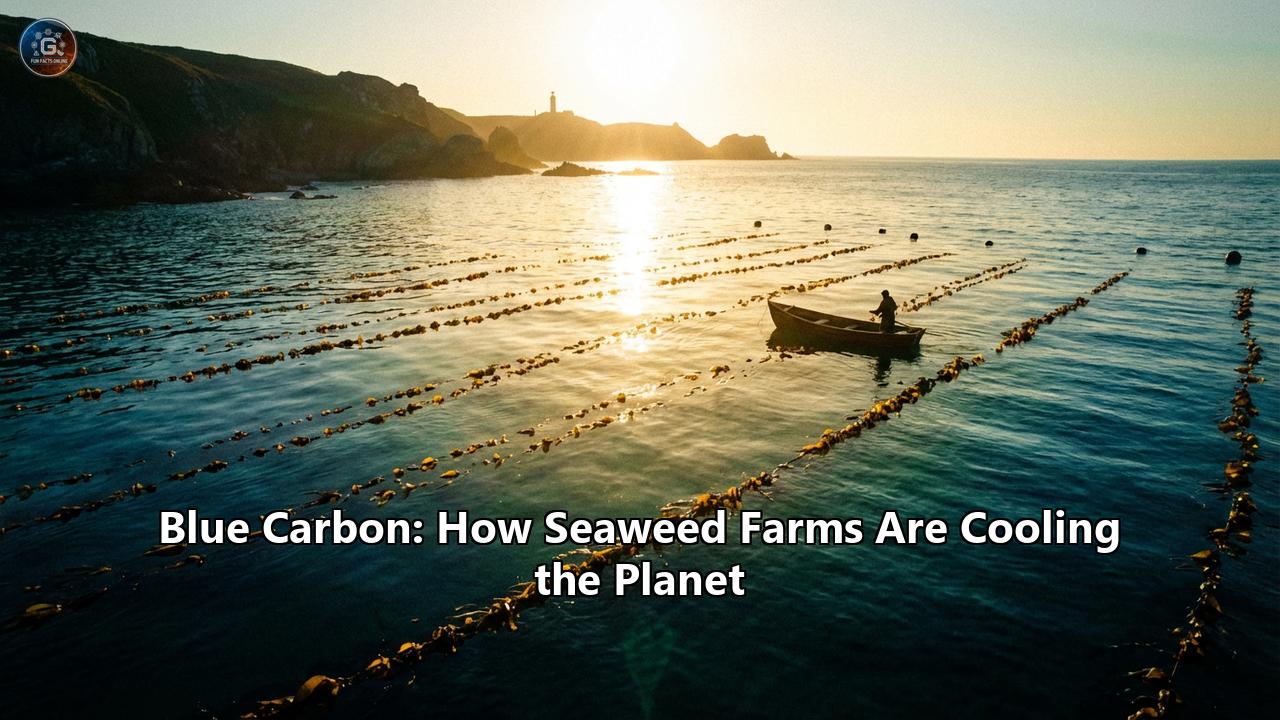
This is the story of the Blue Carbon revolution—a global movement of scientists, engineers, entrepreneurs, and farmers who believe that the answer to cooling a burning planet lies not just in high-tech carbon capture facilities, but in the fast-growing, photosynthesizing forests of the sea. From the kelp lines of the North Atlantic to the tropical red algae farms of the Pacific, seaweed is emerging as a biological powerhouse capable of sequestering carbon, regenerating marine ecosystems, and decarbonizing the global economy.
Part I: The Blue Carbon Frontier
To understand why seaweed is generating such intense excitement, one must first understand the concept of "Blue Carbon." For decades, climate policy focused on "Green Carbon"—the carbon stored in terrestrial forests, soils, and peatlands. Protecting the Amazon rainforest was, and remains, a primary directive. However, terrestrial forests are vulnerable. They burn, they are logged, and they are susceptible to drought.
Blue Carbon refers to the carbon captured by the world’s ocean and coastal ecosystems. Historically, this definition was limited to mangroves, salt marshes, and seagrass meadows. These coastal wetlands are incredibly efficient, burying carbon in their sediments at rates up to ten times higher than mature tropical rainforests. But they cover a relatively small sliver of the planet.
Enter macroalgae—seaweed.
For a long time, seaweed was excluded from Blue Carbon accounting. The logic was that seaweed, unlike mangroves, grows on rocks or ropes, not in soil. It was assumed that when seaweed died, it simply dissolved or was eaten, releasing its carbon back into the water immediately.
However, groundbreaking research published in Nature Climate Change in 2025 and preceding studies has shattered this assumption. We now know that seaweed farms act as a conveyor belt. As the algae grow, they slough off organic matter—leaves, slime, dissolved carbon—which drifts down to the seafloor. In deep waters, or in the sediments beneath farms, this carbon can be locked away for centuries.
The potential scale is staggering. The ocean covers 71% of the Earth. While we are running out of arable land for tree planting, the ocean offers a three-dimensional growing space that requires no fresh water, no fertilizer, and no pesticides. The "seaforestation" of the ocean is not just a poetic concept; it is a measurable, scalable climate intervention.
Part II: The Biology of the Miracle Crop
Seaweed is not a plant in the biological sense; it is macroalgae. This distinction is crucial because it explains its phenomenal growth rate. Land plants must waste energy building structural support—roots to hold the soil, trunks to fight gravity. Seaweed is buoyed by the water. It needs no roots, only a "holdfast" to anchor it. Every square inch of its tissue is photosynthetic.
This allows certain species, like the Giant Kelp (Macrocystis pyrifera), to grow up to two feet per day. It is one of the fastest-growing organisms on Earth. In doing so, it sucks up carbon dioxide and dissolved nutrients (nitrogen and phosphorus) from the water column with voracious efficiency.
The diversity of seaweed is vast, but for the purpose of planetary cooling, we focus on three main categories:
- The Browns (Phaeophyceae): These include the massive kelps. They are the heavy lifters of biomass production. They create underwater cathedrals, towering 100 feet from the seafloor. They are cold-water specialists and are the primary focus for large-scale carbon sinking projects.
- The Reds (Rhodophyceae): These are generally smaller and grow in warmer waters. They are high in proteins and carbohydrates. The star of this group is Asparagopsis taxiformis, a species that has recently been found to possess near-magical properties in reducing methane emissions from livestock.
- The Greens (Chlorophyceae): Examples include Ulva (sea lettuce). These are incredibly hardy and efficient at cleaning water. They are the rapid responders, often blooming where nutrient pollution is high.
The mechanism of "cooling" provided by these organisms is twofold: the direct removal of greenhouse gases (CO2) from the atmosphere (via the ocean surface) and the physical alteration of the local environment, including albedo modification and wave energy dampening.
Part III: The Mechanics of Sequestration
How exactly does a seaweed farm cool the planet? The primary pathway is through the Biological Pump.
In the surface ocean, seaweed uses sunlight to convert dissolved CO2 into organic carbon (biomass). As the ocean draws down CO2, it creates a deficit in the surface water, causing more atmospheric CO2 to diffuse into the ocean to restore equilibrium. Thus, the seaweed is effectively scrubbing the sky.
But storage is the challenge. If we harvest the seaweed and eat it, the carbon returns to the atmosphere through our respiration. If we let it rot on the beach, the same happens. For seaweed to be a "negative emission" technology, the carbon must be sequestered for a timeline relevant to climate change (100 to 1,000+ years).
Current research identifies three major pathways for this sequestration:
- Deep Sea Sinking: This is the most controversial and ambitious method. The idea, championed by organizations like Ocean Visions and startups like Running Tide, is to grow massive floating islands of kelp or Sargassum in the open ocean. Once the seaweed reaches maturity, it is intentionally sunk to the abyssal plain (depths greater than 1,000 meters). At these depths, the water is under immense pressure and moves incredibly slowly. Carbon trapped here can remain out of contact with the atmosphere for centuries.
- Refractory Carbon Export: As seaweed grows, it constantly leaks dissolved organic carbon (DOC). Some of this carbon is "labile" (easily eaten by bacteria), but a portion is "refractory"—complex molecules that bacteria find too difficult to break down. This refractory carbon drifts in the ocean currents, effectively removed from the carbon cycle for long periods.
- Sediment Burial: The 2025 study led by Oceans 2050 provided the "smoking gun" for this pathway. By analyzing sediment cores from 20 seaweed farms across the globe, researchers found that carbon from the farms was accumulating in the mud below. The farms were exporting carbon into the soil just like a mangrove forest. This validated the idea that even if the crop is harvested, the process of farming it contributes to permanent sequestration.
Part IV: The Methane Breakers
While carbon dioxide is the most prevalent greenhouse gas, methane is the most potent in the short term—over 80 times more effective at trapping heat than CO2 over a 20-year period. A massive percentage of anthropogenic methane comes from enteric fermentation: cow burps.
There are roughly 1.5 billion cattle on Earth. If cattle were a country, they would be the third-largest emitter of greenhouse gases.
This is where the red seaweed Asparagopsis taxiformis enters the narrative. In a discovery that felt almost serendipitous, researchers in Australia found that when a tiny amount of this seaweed is added to cattle feed (as little as 0.2% to 0.5% of the diet), it practically eliminates methane production.
The seaweed contains bromoform, a compound that inhibits the specific enzyme in the cow’s gut microbes that produces methane. Early studies raised concerns about the stability of bromoform and its potential toxicity, but recent breakthroughs in 2024 and 2025 by companies like CH4 Global and Symbrosia have refined the processing. They found that using the whole seaweed, rather than extracting the chemical, is significantly more effective and stable.
If we can scale the farming of Asparagopsis to feed the world's cattle, the cooling effect would be immediate. Unlike CO2, which lingers for centuries, methane breaks down in about a decade. Cutting methane now is the fastest lever we can pull to slow global warming in our lifetimes. This has sparked a "gold rush" for tropical seaweed farming, with pilot projects springing up from Vietnam to Hawaii.
Part V: Marine Permaculture and the Restoration of Upwelling
Perhaps the most visionary concept in the field comes from Dr. Brian Von Herzen and the Climate Foundation. Their approach, known as Marine Permaculture, addresses a fundamental breakdown in the ocean's circulation.
Global warming has stratified the oceans. The surface water is heating up, forming a warm "lid" that sits on top of the colder, nutrient-rich water below. This prevents natural upwelling—the mixing process that brings nutrients to the surface. Without nutrients, plankton and seaweed die. This creates "ocean deserts" of clear, blue, lifeless water.
Marine Permaculture arrays are lightweight, lattice-like structures submerged roughly 25 meters below the surface. They are seeded with kelp. The genius lies in a wave-powered pump attached to the array. The motion of the waves drives a simple valve that pulls cold, nutrient-dense water from 500 meters deep and irrigates the kelp forest above.
This technology does three things simultaneously:
- It grows biomass: The kelp thrives on the upwelled nutrients.
- It restores ecosystems: The kelp forest provides habitat for forage fish, which attract tuna, whales, and seabirds, effectively regenerating a fishery in a desert.
- It cools the surface: By bringing up cold water, the arrays can locally lower sea surface temperatures. If deployed at a massive scale (imagine thousands of hectares of these arrays), they could theoretically reduce thermal stress on nearby coral reefs, preventing bleaching events.
The Climate Foundation has successfully tested these arrays in the Philippines, helping subsistence seaweed farmers whose crops were failing due to marine heatwaves. It is a prime example of climate adaptation and mitigation working hand-in-hand.
Part VI: Beyond Carbon—The Ecosystem Services
To view seaweed only as a carbon stick is to miss half the picture. The "cooling" of the planet is also about resilience. Seaweed farms provide critical ecosystem services that buffer the impacts of climate change that are already locked in.
Fighting Ocean Acidification:As the ocean absorbs CO2, its pH drops, causing acidification. This is catastrophic for calcifying organisms—oysters, mussels, corals, and tiny plankton—whose shells begin to dissolve or fail to form.
Seaweed is a localized buffer. Through photosynthesis, it strips CO2 out of the water column so rapidly that it raises the pH of the water immediately surrounding the farm. This creates a "halo of health." Integrated Multi-Trophic Aquaculture (IMTA) scientists are now co-locating shellfish farms with seaweed farms. The seaweed sweetens the water, allowing the oysters to grow thicker, harder shells.
Biodiversity Hotspots:Monoculture on land (like a cornfield) is usually a biodiversity desert. In the ocean, a seaweed farm is a hanging garden. The ropes and fronds provide structure in the water column. They become nurseries for juvenile fish, hiding spots for invertebrates, and hunting grounds for seals and otters. A study by The Nature Conservancy found that seaweed farms host significantly higher biodiversity than the surrounding sandy bottom.
Nutrient Remediation:Coastal zones are suffering from eutrophication—an excess of nitrogen and phosphorus from agricultural runoff (fertilizers) and sewage. This causes toxic algae blooms that kill fish. Seaweed loves these nutrients. Farming seaweed in polluted estuaries acts as a "bio-filter," soaking up the excess nitrogen and cleaning the water. It turns pollution into a valuable crop.
Part VII: The Economic Engine—From Plastics to Fuel
For the seaweed revolution to scale, it cannot rely solely on philanthropy or government subsidies. It needs a market. Fortunately, the bio-economy is hungry for seaweed.
Bioplastics:We are drowning in plastic. Seaweed offers a biodegradable alternative. Companies like Notpla (winner of the Earthshot Prize) have developed seaweed-based sachets that can hold water or sauces and are fully edible. If you throw them on the ground, they disappear in weeks, not centuries. The market for seaweed bioplastics is projected to grow at a CAGR of nearly 17% over the next decade.
Bio-stimulants and Fertilizers:Synthetic fertilizers are a major source of greenhouse gases (nitrous oxide). Seaweed extracts act as powerful bio-stimulants for land crops, improving yield and drought tolerance without the carbon footprint of Haber-Bosch nitrogen.
Biofuels:The dream of seaweed biofuel has existed since the oil crisis of the 1970s. It has always been technically possible but economically difficult due to the high water content of seaweed. However, the Department of Energy’s ARPA-E program (MARINER) has invested heavily in automating harvest technologies to bring the cost down. As we move toward a world where liquid fuels are reserved for aviation and shipping (sectors that cannot easily electrify), seaweed-derived methanol or bio-crude becomes an increasingly attractive option.
Part VIII: Scaling Up—The Industrial Challenge
If seaweed is so perfect, why hasn’t it saved us yet? The answer lies in scale.
Currently, the vast majority of the world’s seaweed is farmed in Asia (China, Indonesia, the Philippines) by smallholders using labor-intensive methods. Farmers tie seedlings to ropes by hand and harvest them by hand. To impact the climate, we need to move from "gardening" to "farming" at an industrial scale.
This transition is happening. In the North Atlantic, companies like Ocean Rainforest (Faroe Islands) are deploying mechanized rigs that can withstand the brutal waves of the open ocean. In Namibia, Kelp Blue is planting giant forests of Macrocystis off the coast, aiming to capture millions of tons of carbon while producing bio-stimulants.
But moving offshore is an engineering nightmare. The open ocean is a hostile environment. Storms can rip million-dollar arrays to shreds overnight. Developing anchors and substrates that are durable, cheap, and safe for marine life is the primary engineering hurdle of the decade.
Furthermore, there is the logistical challenge of the harvest. Seaweed is heavy and wet (90% water). Transporting it to shore is energy-intensive. This has led to concepts of "at-sea processing"—floating factories that squeeze the water out of the kelp or convert it to oil right on the farm, transporting only the valuable concentrate.
Part IX: The Controversy and the Risks
No climate intervention is without risk, and Blue Carbon is no exception. As investment pours into the sector, scientists are urging caution.
The "Permanence" Question:The carbon credit market demands certainty. If you sell a credit for a ton of carbon, you must prove it stays out of the atmosphere for 100+ years. Proving that sinking seaweed actually keeps the carbon down there is difficult. Deep-sea currents are complex. There is a fear that sinking biomass could disturb the delicate, slow-moving ecosystems of the abyssal plain, potentially smothering deep-sea life or causing oxygen depletion (hypoxia) as the seaweed rots.
In 2024, a group of scientists called for a moratorium on deep-sea sinking until the ecological impacts are better understood. They argue that we should focus on using seaweed to replace fossil-fuel-intensive products (like plastic and fertilizer) rather than treating the ocean floor as a landfill.
The Monoculture Risk:Just as planting only eucalyptus trees on land is bad for biodiversity, planting only one type of kelp over thousands of square miles could have unforeseen consequences. It could deplete nutrients for wild phytoplankton, the base of the marine food web. It could facilitate the spread of diseases or invasive species. "Responsible Sea-forestation" requires a mosaic approach, using native species and monitoring genetic diversity.
Part X: The Policy Landscape and the Future
The final piece of the puzzle is political and financial. For years, the Blue Carbon market was the Wild West. There were no standardized methodologies for measuring how much carbon a seaweed farm sequestered.
This is changing. Organizations like Verra and the Gold Standard are developing rigorous protocols. The EU is working on certification for carbon removals that explicitly includes marine approaches.
We are standing at the precipice of a new relationship with the ocean. For the last century, we treated the ocean as a resource to be plundered or a dump for our waste. Seaweed farming represents a shift toward a regenerative economy—one where we work with the ocean’s natural cycles to heal the atmosphere.
The vision is compelling: vast, emerald forests floating in the deep ocean, buffering the waves during storms, de-acidifying the water for coral reefs, providing safe harbor for whales and tuna, and silently, ceaselessly, pulling the carbon of the industrial age back into the deep.
It will not be a silver bullet. We must still decarbonize our energy grid and stop burning fossil fuels. But seaweed offers us something rare in the climate fight: a solution that heals as it works. It is a technology that has been perfected over hundreds of millions of years of evolution, waiting for us to notice. The Blue Carbon revolution has begun, and it may just be the lifeline our warming planet needs.
Deep Dive: The Global Projects Leading the Way
To truly appreciate the momentum of this sector, we must look at the specific projects defining the frontier.
1. The Faroe Islands: Ocean RainforestIn the churning, gray waters of the North Atlantic, Ocean Rainforest has pioneered the "Macrocystis-style" rig for Saccharina latissima (Sugar Kelp). Their design is a feat of hydrodynamics, designed to bend and flow with 8-meter waves rather than resisting them. They are currently leading the "SeaMark" project, a massive EU-funded initiative to scale up seaweed production for high-value products. They are proving that seaweed farming is not just a tropical, artisanal activity but a viable heavy industry for the North.
2. Namibia: Kelp BlueOff the coast of Luderitz, Namibia, the water is cold and nutrient-rich, fed by the Benguela current. Here, Kelp Blue has planted forests of Giant Kelp. Their model is unique: they harvest only the canopy (the top few feet) of the kelp, leaving the rest of the plant to continue growing and sequestering carbon. The harvested canopy is processed into agri-feed and bio-stimulants, the sale of which funds the operation. It is a "profit-for-purpose" model that aims to sequester millions of tons of carbon while creating jobs in a developing nation.
3. Australia: Sea ForestTasmania is the epicenter of the Asparagopsis revolution. Sea Forest is one of the first companies to cultivate this methane-busting seaweed at a commercial scale. They have converted old abalone and shrimp farms into seaweed hatcheries. Their challenge is biological: Asparagopsis has a complex, three-stage life cycle that is notoriously difficult to manipulate in captivity. Their success in closing this life cycle is a scientific breakthrough that unlocks the potential for global methane reduction.
4. Maine, USA: Running TideRunning Tide represents the most aggressive, Silicon Valley-style approach. They developed "carbon buoys"—biodegradable floats coated in kelp spores. They release these buoys into open ocean currents (like the Gulf Stream). The kelp grows as it drifts, and eventually, the buoy degrades and floods, sinking the mature kelp to the bottom. It is a low-infrastructure, high-volume approach. While they have faced scrutiny regarding the verification of their sinking locations, their ambition has forced the industry to think bigger.
The Science of "Refugia"
One of the most touching aspects of the seaweed story is the concept of "refugia." We know that climate change is coming for the coral reefs. We know that acidification will make it hard for shellfish to survive.
But inside a dense kelp forest, the chemistry of the world is different. The water is higher in pH (less acidic) and richer in oxygen. Scientists envision a future where seaweed farms act as "arks"—safe havens where sensitive marine species can survive the worst decades of the Anthropocene. When the climate (hopefully) stabilizes, these populations can recolonize the surrounding ocean.
This turns the seaweed farmer into a conservationist. Every rope of kelp is a lifeline for the ocean’s biodiversity.
The Road to 2050
The High Level Panel for a Sustainable Ocean Economy estimates that ocean-based solutions could provide up to 21% of the emission reductions needed to limit warming to 1.5°C. Seaweed is a major chunk of that percentage.
But getting there requires a transformation of our relationship with the sea. It requires "Marine Spatial Planning"—zoning the ocean so that wind farms, shipping lanes, conservation areas, and seaweed farms can coexist. It requires a new generation of "ocean farmers," retraining fishermen who have lost their livelihoods to depleted stocks.
It requires us to eat differently. Kelp burgers, seaweed salads, and algae-based protein shakes must move from niche health food stores to mainstream supermarkets.
And ultimately, it requires hope. The narrative of climate change is often one of despair—of melting ice and burning forests. The narrative of Blue Carbon is one of regeneration. It reminds us that the Earth is resilient. If we give the ocean a helping hand—if we plant the seeds and protect the forests—it will do what it has done for eons: regulate the climate and sustain life.
Seaweed farms are not just cooling the planet; they are buying us time. And in the race against climate change, time is the most valuable resource of all.
Reference:
- https://www.oceanrainforest.com/projects-overview
- https://discovery.kaust.edu.sa/en/article/6245/seaweed-sinks-deep-taking-carbon-with-it/
- https://oceanium.world/news/biodiversity/
- https://www.esgtoday.com/groundbreaking-research-confirms-seaweed-farmings-potential-as-a-blue-carbon-solution/
- https://www.hereon.de/institutes/carbon_cycles/fluxes_across_interfaces/projects/118866/index.php.en
- https://www.climatefoundation.org/marine-permaculture.html
- https://thefishsite.com/articles/can-submersible-seaweed-platforms-help-regenerate-ecosystems-and-provide-economic-returns-marine-permaculture
- https://www.youtube.com/watch?v=q_rBig3mhM0
- https://criticaldebateshsgj.scholasticahq.com/article/128383-evaluating-seaweed-as-a-sustainable-solution-a-path-toward-eco-friendly-bioplastics-and-biofuels
- https://www.iaea.org/newscenter/news/study-reveals-potential-of-seaweed-farms-as-carbon-storage-solution
- https://www.fisheries.noaa.gov/news/ocean-rainforest-farms-seaweed-southern-california
- https://oceanvisions.org/our-programs/macroalgaeresearchframework/
- https://seaweedecologylab.ucsd.edu/research/seaweed-as-a-tool-for-methane-reduction-in-livestock/
- https://cleantechnica.com/2025/01/28/seaweed-farms-are-an-important-carbon-sequestration-strategy/
- https://worldbiomarketinsights.com/new-study-shows-whole-asparagopsis-outperforms-bromoform-in-reducing-methane-emissions-from-cattle/
- https://www.youtube.com/watch?v=hAtUpVtLbsU
- https://www.stockholmresilience.org/research/research-stories/2024-03-14-dumping-seaweed-in-the-deep-ocean-is-a-bad-idea.-heres-why.html
- https://www.researchgate.net/publication/373105300_Time_to_Include_Blue_Carbon_from_Seaweed_in_Voluntary_Carbon_Removal_Certification
- https://solve.mit.edu/solutions/83471