
The history of human spaceflight has largely been a story of "visiting." From the suborbital hops of the Mercury program to the frenetic, dust-kicking days of Apollo, humanity has touched the void and retreated. Even the International Space Station (ISS), a marvel of continuous occupation for over two decades, sits safely within the protective magnetic embrace of our planet, a mere 250 miles overhead. It is a laboratory in the suburbs of Earth.
We are now standing on the precipice of a new epoch: the Gateway Era.
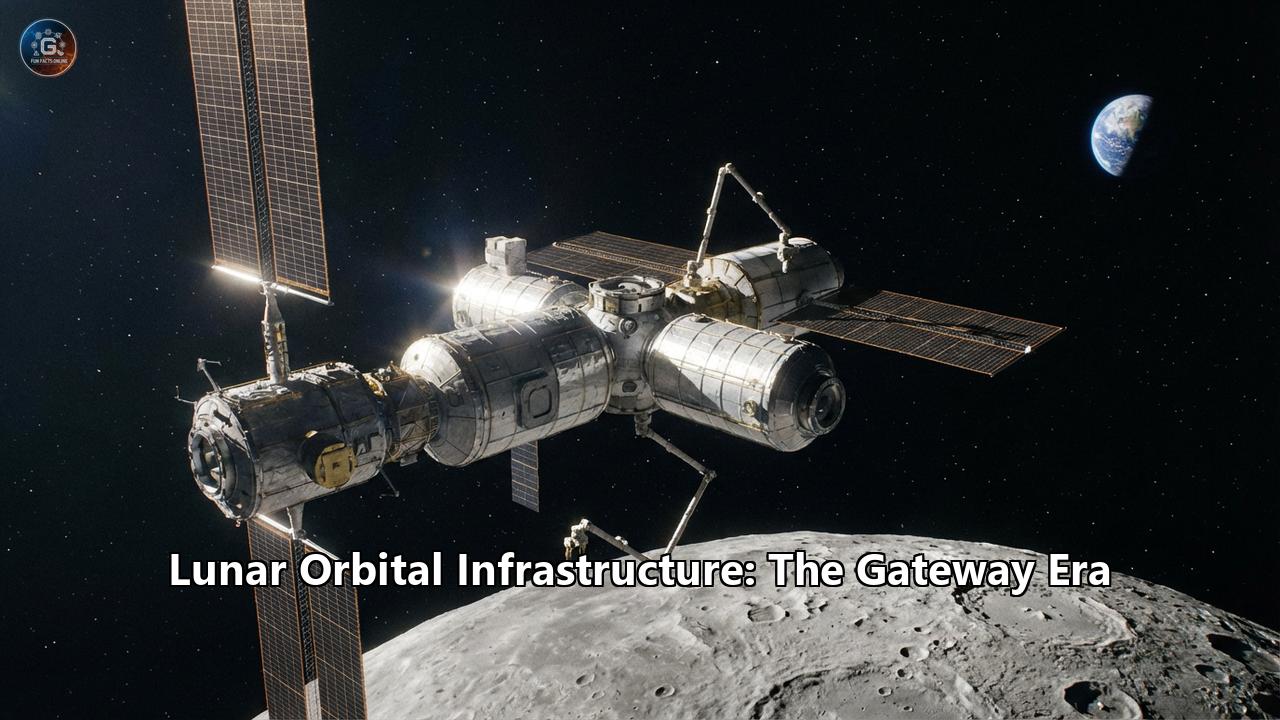
This is not just about returning to the Moon; it is about building the permanent infrastructure of the solar system. At the heart of this ambition lies the Lunar Gateway, a space station that will serve not as a destination, but as a door. Suspended in a unique, gravitationally balanced dance between the Earth and the Moon, Gateway represents the first outpost of a true deep-space civilization. It is a machine designed to survive the harsh radiation of interplanetary space, a harbor for the ships that will land on the lunar surface, and the crucible where we will forge the technologies necessary to cross the abyss to Mars.
This article explores the comprehensive reality of the Lunar Gateway—its modules, its exotic orbit, the science it will enable, and the daily life of the first humans to call deep space their home.
Part I: The Architecture of a Deep Space Harbor
Unlike the ISS, which spreads out like a football field of solar wings and pressurized cans, Gateway is compact, purposeful, and austere. It is not a sprawling city in space; it is a frontier fort. Its design is dictated by the tyranny of the rocket equation and the harsh realities of deep space logistics. Every cubic centimeter is accounted for, every gram of aluminum paid for in fuel.
The Power and Propulsion Element (PPE): The Solar Electric Heart
The spine of the Gateway is the Power and Propulsion Element (PPE). Built by Maxar Technologies, this module is the most powerful solar electric spacecraft ever flown. In the vacuum of space, power is life, and the PPE is a 60-kilowatt power plant that hums with the energy of the sun.
Traditional chemical rockets are like dragsters: they burn massive amounts of fuel in seconds for explosive acceleration. The PPE is different. It uses Hall-effect thrusters—advanced electric engines that ionize xenon gas and accelerate it out of the back of the spacecraft using magnetic fields. The thrust is gentle, roughly the force of holding a single sheet of paper in your hand, but it can be sustained for thousands of hours. Over time, this gentle push builds up tremendous speed, allowing Gateway to maintain its unique orbit and even move to different orbits around the Moon with extreme fuel efficiency.
The PPE is also the station's communication nervous system. It carries the high-gain antennas that will blast data back to Earth at rates of up to 100 Megabits per second, a broadband connection that spans nearly 400,000 kilometers.
HALO: The First Permanent Home
Attached to the PPE is the Habitation and Logistics Outpost (HALO), the first pressurized module where astronauts will live. Built by Northrop Grumman with a pressurized shell from Thales Alenia Space in Italy, HALO is the size of a small studio apartment.
Walking—or rather, floating—through HALO will feel distinct from the ISS. The module is derived from the Cygnus cargo spacecraft, expanded and hardened for human habitation. Inside, the walls are lined with stowage lockers, life support machinery, and docking ports. It is a multi-purpose room in the truest sense: it is the kitchen, the gym, the laboratory, and the bedroom for the visiting crews.
As of 2025, the primary structure of HALO has been welded and stress-tested in Turin, Italy, and shipped to Arizona for final outfitting. It is real hardware, not just a rendering. When it launches, potentially as early as 2027 aboard a SpaceX Falcon Heavy rocket along with the PPE, it will mark the first time humanity has placed a permanent habitat in deep space.
I-Hab: The International Quarter
Following the initial deployment, the European Space Agency (ESA) and the Japan Aerospace Exploration Agency (JAXA) will contribute the International Habitation Module, or I-Hab. While HALO provides the initial foothold, I-Hab makes the station livable for longer durations.
I-Hab brings roughly 10 cubic meters of additional habitable volume—about the size of a medium campervan. It will house the station's main environmental control and life support systems (ECLSS), largely provided by JAXA. These systems are the lungs and kidneys of the station, recycling air and water with an efficiency that must eventually rival the 98% recovery rates achieved on the ISS if we are to survive the trip to Mars.
The interior of I-Hab is designed with the psychological needs of the crew in mind. It will feature private sleeping quarters, a galley for communal dining, and deployable radiator wings to shed the waste heat of human survival. It represents the "international" promise of the Artemis program, ensuring that the return to the Moon is a global endeavor.
ESPRIT: The View from the Moon
One of the most anticipated additions is ESA's ESPRIT module (European System Providing Refueling, Infrastructure and Telecommunications). ESPRIT consists of two parts. The "Lunar Link" will be pre-attached to HALO and provide ultra-high-speed communications with assets on the lunar surface. The second part, the "Lunar View" module, will arrive later.
Lunar View is exactly what its name suggests. It will provide a windowed habitation corridor, offering astronauts a view that no human has ever seen from a space station: the jagged, cratered horizon of the Moon below, and the small, fragile blue marble of Earth hanging in the eternal blackness above. This module also serves a critical logistical function, carrying additional xenon and hydrazine fuel to replenish the PPE, extending the station's life to 15 years and beyond.
Part II: The Near-Rectilinear Halo Orbit (NRHO)
Location is everything, even in space. The Gateway will not orbit the Moon in a simple circle like the Apollo Command Modules did. Instead, it will reside in a "Near-Rectilinear Halo Orbit" (NRHO). To the uninitiated, this orbit looks bizarre—a highly elliptical, seven-day loop that brings the station as close as 1,500 kilometers to the lunar North Pole and swings it out as far as 70,000 kilometers over the South Pole.
The Mathematical Sweet Spot
Why choose such a strange path? The NRHO is a solution to a complex gravitational puzzle. It is a "balance point" between the Earth and the Moon.
- Constant Communication: In a low lunar orbit, a spacecraft is behind the Moon for half the time, cutting off contact with Earth. In the NRHO, Gateway is visible from Earth 99% of the time, allowing for constant communication with Mission Control.
- Access to the South Pole: The orbit's apolune (furthest point) hangs over the lunar South Pole, the target destination for the Artemis landings. From this vantage point, Gateway has a direct line of sight to the explorers on the surface for long durations, acting as an indispensable relay satellite.
- Low Station-Keeping Costs: The orbit is dynamically stable. It sits on the edge of a gravitational "well," meaning it takes very little fuel to stay there—less than 10 meters per second of delta-v per year. This allows the station to remain in orbit for decades with minimal maintenance.
- Eclipse Avoidance: Solar power is critical. The NRHO is perpendicular to the Earth-Moon line, meaning the station almost never passes into the Earth's shadow. It enjoys perpetual sunlight, feeding its hungry solar arrays without the need for massive battery banks to survive long nights.
The Staging Point
The NRHO acts as a "celestial turnstile." It is energetically cheap to get into from Earth, and surprisingly easy to leave to go down to the lunar surface or out to Mars.
For an Artemis mission, the Orion spacecraft will launch from Earth and rendezvous with Gateway in this halo orbit. Once docked, the crew will transfer to a waiting Human Landing System (HLS)—like SpaceX’s Starship—that is also docked to the station. They will ride the HLS down to the surface, conduct their mission, and then launch back up to Gateway. There, they will crawl back into Orion, undock, and head home.
Gateway allows the "commuter" vehicle (Orion) to be optimized for deep space travel, while the "taxi" vehicle (Starship HLS) is optimized for landing and taking off. Neither has to do the job of the other.
Part III: Life in the Halo
What will it be like to live on Gateway?
Imagine living in a space no larger than a school bus with three other people, floating in a silence profound enough to hear your own heartbeat. You are 384,000 kilometers from the nearest hospital, grocery store, or breath of fresh air.
The Tyranny of Volume
Unlike the ISS, where an astronaut can float from the Columbus module to the Cupola to find some alone time, Gateway is intimate. The total habitable volume of the initial HALO and I-Hab configuration is roughly 125 cubic meters. Privacy will be a luxury. The sleeping quarters in I-Hab are essentially closet-sized phone booths where an astronaut can zip themselves into a sleeping bag tethered to the wall.
Personal hygiene and exercise—critical to preventing bone loss in microgravity—will be adapted for the cramped quarters. The exercise device will likely be a compact flywheel system, similar to the ARED on the ISS but significantly smaller. The vibration isolation systems must be exquisite; in such a small, lightweight structure, a rhythmic workout could shake the entire station, disturbing sensitive scientific experiments.
The View of the Void
The psychological experience of Gateway will be fundamentally different from LEO. On the ISS, the Earth dominates the sky. It is a massive, shifting tapestry of clouds, oceans, and continents that fills the viewports. It is a constant reminder of connection.
From Gateway, Earth is a marble. It is a small, blue-and-white sphere that can be covered by a thumb held at arm's length. The rest of the sky is an abyss of stars. This "breakaway phenomenon"—the visual confirmation of being truly alone in the dark—is a psychological hurdle that NASA and its partners are preparing for. The "Lunar View" windows in the ESPRIT module will provide a critical psychological anchor, allowing astronauts to see the Moon in high fidelity, offering a destination and a sense of place.
The Comm Delay
While the communication delay at the Moon is only about 1.3 seconds each way (roughly a 3-second round trip), it is noticeable. It kills the possibility of seamless, interrupting conversation with the ground. Every interaction with Mission Control becomes transactional. "Houston, this is Gateway. We are initiating the checklist. Over." ... three seconds of silence ... "Copy Gateway, proceed."
This slight lag is the training wheels for Mars. Future missions will use Gateway to simulate the 20-minute delays of a Mars mission. The crew will be put into "dormancy modes" where they must solve problems autonomously without immediate help from Earth. They will learn to trust their training and their systems, because on the way to the Red Planet, no one can hear you scream—at least, not for twenty minutes.
Part IV: The Science of Survival
Gateway is often criticized by skeptics as an unnecessary toll booth on the way to the Moon. Why stop there when you can go direct? The answer lies in the science. Gateway is not just a bus stop; it is a high-fidelity laboratory for deep space survival.
Radiation: The Invisible Killer
The ISS orbits within the Van Allen radiation belts, a magnetic shield that protects the crew from the worst of the sun's fury. Gateway is out in the wild. It is exposed to the full spectrum of Galactic Cosmic Rays (GCRs) and Solar Particle Events (SPEs).
Three primary instruments will stand guard:
- HERMES (NASA): The Heliophysics Environmental and Radiation Measurement Experiment Suite. Mounted on the outside of HALO, it is a space weather station. It will monitor the solar wind and magnetic fields, acting as a sentinel to warn astronauts of incoming solar storms.
- ERSA (ESA): The European Radiation Sensors Array. It measures the "hard" radiation—the high-energy particles that penetrate spacecraft hulls and human bodies.
- IDA (ESA/JAXA): The Internal Dosimeter Array. Located inside the station, it measures how much radiation actually makes it through the shielding and into the crew's bodies.
By comparing the data from HERMES/ERSA (outside) and IDA (inside), scientists will learn exactly how effective the station's shielding is. This data is the "blood price" of going to Mars. We must understand the dose before we send humans on a 9-month cruise through the void.
Biological Sentinels
The unique radiation environment of the NRHO offers a testing ground that cannot be replicated on Earth or the ISS. NASA has plans to send "biological sentinels" to Gateway—experiments involving yeast, microorganisms, and potentially human organoids (tissue chips mimicking human organs).
We know that microgravity changes how cells repair their DNA. We know radiation damages DNA. But we don't fully understand the synergy of the two. Does the lack of gravity make cells more vulnerable to radiation? Gateway is the only place we can find out before committing a crew to a Mars mission. Imagine a rack of test tubes containing heart tissue cells, living on Gateway for six months, bombarded by cosmic rays. Analyzing those cells will tell us if a human heart can withstand the journey to the Red Planet.
The Mars Shakedown
The ultimate scientific experiment on Gateway is the ship itself. The station is a "Mars Transit Habitat" prototype. The life support systems are designed to operate for long periods without resupply. The recycling rates for oxygen and water are being pushed to their theoretical limits.
Before we launch a crew to Mars, we might conduct a "Mars Simulation" on Gateway. A crew of four could live on the station for 300 days—the approximate transit time to Mars. They would have no resupply ships. They would operate with a simulated 20-minute communication delay. If the toilet breaks, they fix it or they die (simulated). If the water recycler clogs, they have to synthesize a repair. It is a dress rehearsal where the safety net is 3 days away (back to Earth) rather than 9 months away.
Part V: The Lunar Comm Hub and the "Internet of the Moon"
As humans return to the lunar surface, they will not be going to the flat, equatorial plains of Apollo. They are going to the South Pole—a region of jagged peaks and deep, shadowed craters. In these craters, direct line-of-sight communication with Earth is often impossible. The crater walls block the radio waves.
This is where Gateway's Lunar Link comes in.
Provided by ESA and Thales Alenia Space, Lunar Link transforms Gateway into a satellite relay tower. It operates in the S-band and Ka-band frequencies. When an astronaut is down in a shadowed crater chipping away at billion-year-old ice, their suit radio will beam voice and data up to Gateway, soaring high overhead in its halo orbit. Gateway will instantly catch that signal, amplify it, and blast it back to Earth via its massive high-gain antennas.
The system is designed to handle high-definition video, telemetry, and biometric data simultaneously. It is the beginning of the "LunaNet"—an internet for the Moon. Future rovers, commercial landers, and scientific packages will ping Gateway to phone home. It is the infrastructure that turns a series of isolated landings into a connected exploration campaign.
Part VI: Logistics and the Commercial Ecosystem
A station cannot survive without supplies. Food, water, spare parts, and scientific experiments must be delivered regularly. This logistical chain is opening a new market for commercial space companies.
Dragon XL
NASA has contracted SpaceX to provide the "Gateway Logistics Services" (GLS). The vehicle of choice is the Dragon XL. Unlike the sleek Crew Dragon or the cargo Dragon that visits the ISS, Dragon XL is a workhorse designed solely for deep space. It will launch on a Falcon Heavy rocket, carrying over 5 metric tons of pressurized and unpressurized cargo.
Dragon XL is not designed to return to Earth. It is a one-way freighter. Once it arrives at Gateway, it will dock and stay there for 6 to 12 months. During this time, it serves as a "closet"—a massive extension of the station's storage volume. The crew will unpack the fresh supplies and slowly fill the Dragon XL with trash and waste. At the end of its mission, it will undock and be disposed of, likely crashing into the lunar surface or entering a heliocentric graveyard orbit.
The Starship Question
The elephant in the room—or rather, the whale in the orbit—is SpaceX’s Starship. NASA has selected Starship as the Human Landing System (HLS) for the Artemis III and IV missions.
The sheer scale of Starship dwarfs Gateway. The Starship HLS has a habitable volume of roughly 1,000 cubic meters, nearly nearly that of the entire ISS. When Starship docks to Gateway, it will look like a skyscraper attached to a garden shed.
This disparity has led to interesting discussions in the aerospace community. Why build a small station when you have a massive ship? The answer is specialization. Starship is a transporter; Gateway is a platform. Gateway provides the stable port, the continuous science, and the international "neutral ground" that anchors the coalition. However, the operational reality of Artemis IV will be a sight to behold: the Orion capsule (tiny), docked to Gateway (small), docked to Starship (enormous). The crew will transfer from the cramped Orion, through the Gateway airlock, into the cavernous Starship, and then descend to the Moon.
Part VII: The International and Commercial Future
Gateway is the physical manifestation of the Artemis Accords. It is a political stabilizer. It is much harder to cancel a space program when you have binding international treaties and hardware from Europe, Japan, Canada, and the UAE already built and integrated.
- Canada: Providing the Canadarm3. This next-generation robotic arm is smarter and more autonomous than its predecessors. It can crawl inchworm-style around the exterior of the station, inspecting the hull, helping to dock visiting vehicles, and deploying external science payloads without the crew needing to go on a spacewalk.
- UAE: The Mohammed Bin Rashid Space Centre (MBRSC) is providing the Crew and Science Airlock. This is the doorway to the void. It will allow astronauts to perform Extra-Vehicular Activities (EVAs) to maintain the station and will also have a small scientific airlock to deploy CubeSats or expose experiments to the vacuum.
Commercial Utilization
NASA envisions Gateway as an open platform. Just as Nanoracks operates a commercial airlock on the ISS, Gateway will eventually host commercial experiments. Pharmaceutical companies could test drug stability in deep space radiation. Materials science firms could test new alloys in the unadulterated vacuum and thermal extremes of the lunar orbit. The "Gateway Payload Users Guide" released by NASA outlines standard interfaces for these future commercial users.
Conclusion: The Door Is Open
The Lunar Gateway is more than the sum of its aluminum cans and solar panels. It is a shift in mindset. For fifty years, we have treated the Moon as a place to go and come back from. Gateway treats the Moon as a place to be.
It is the first structure humans will build that is not trapped in Earth's immediate gravity well. It is a foothold in the deep ocean of space. When the lights of HALO flicker on for the first time, powered by the silent thrust of the PPE, they will signal that humanity has finally decided to pack its bags and stay.
The era of visiting is over. The era of the Gateway has begun.
Reference:
- https://ntrs.nasa.gov/api/citations/20210019019/downloads/ICSSC_2021%20Gateway%20PPE%20Comm%20Links.pdf
- https://en.wikipedia.org/wiki/Lunar_Gateway
- https://ntrs.nasa.gov/api/citations/20210018935/downloads/GW_Comm_ICSSC_Paper.pdf
- https://ntrs.nasa.gov/api/citations/20220019162/downloads/NrhoOrbitMaintenance.pdf
- https://www.nasa.gov/reference/gateway-about/
- https://www.youtube.com/watch?v=StfIu_GeAbQ
- https://www.thalesaleniaspace.com/en/news/lunar-gateways-halo-pressurized-module-preparation-shipment-united-states
- https://www.esa.int/Science_Exploration/Human_and_Robotic_Exploration/Gateway_Lunar_I-Hab
- https://sites.nationalacademies.org/cs/groups/depssite/documents/webpage/deps_189332.pdf
- https://ntrs.nasa.gov/api/citations/20240016087/downloads/Users%20Guide.pdf?attachment=true
- https://www.esa.int/Science_Exploration/Human_and_Robotic_Exploration/Gateway_Lunar_Link
- https://www.researchgate.net/publication/398285284_Lunar_Link_Connecting_Gateway_to_the_Moon_Development_status
- https://www.universetoday.com/articles/lunar-gateways-core-halo-module-enters-the-clean-room
- https://satelliteprome.com/news/nasa-and-mbrsc-announce-artemis-lunar-gateway-airlock/
- https://en.wikipedia.org/wiki/Crew_and_Science_Airlock_Module