
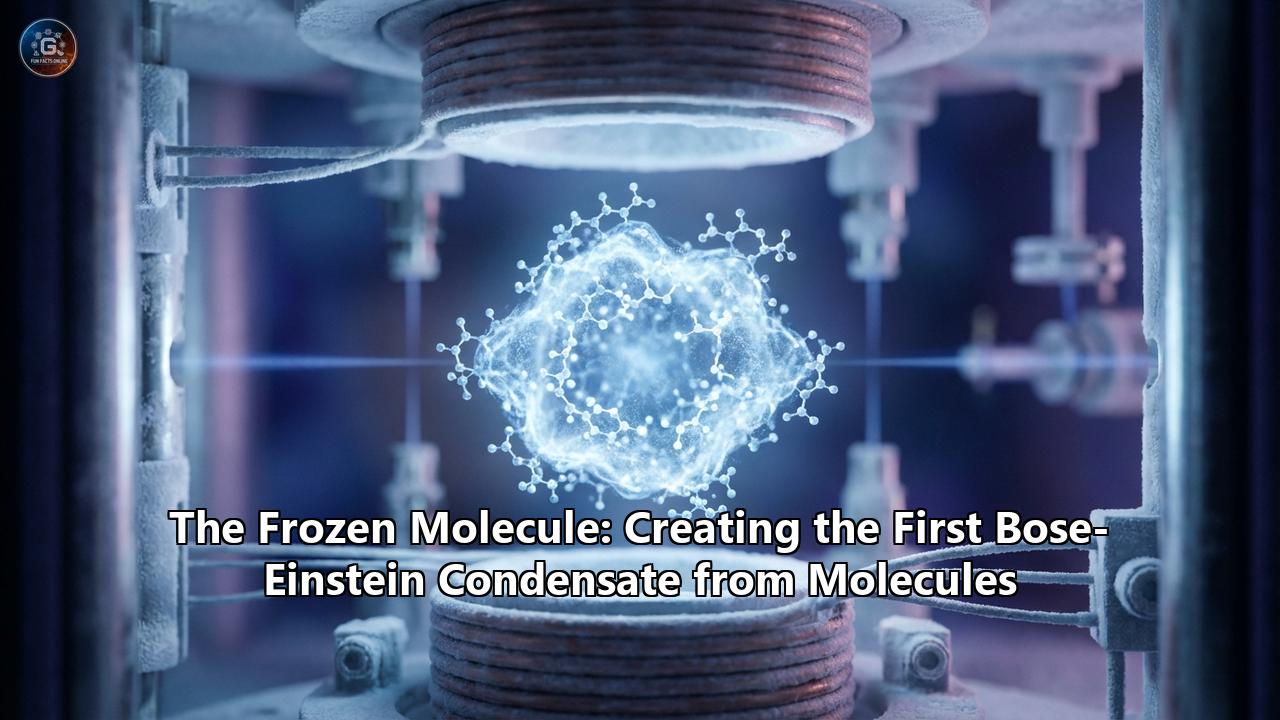
In the frigid vacuum of a laboratory at Columbia University, a century-old dream of physics has finally materialized, not with a bang, but with a silent, spectral synchronization. For the first time in history, scientists have coaxed molecules—complex, rotating, vibrating partnerships of atoms—into a single, unified quantum state known as a Bose-Einstein Condensate (BEC).
This achievement, published in Nature in June 2024 by a team led by Professor Sebastian Will, marks a paradigm shift in our ability to control the natural world. While physicists have been making BECs from individual atoms since 1995, doing so with molecules was long considered an insurmountable "Mount Everest" of quantum mechanics. Molecules are notoriously unruly; they spin, they wobble, and when they collide, they tend to stick together and destroy the very delicate state scientists try to create.
By cooling a gas of sodium-cesium (NaCs) molecules to a temperature of just 6 nanokelvin—mere billionths of a degree above absolute zero—the Columbia team has frozen time in a way previously thought impossible. For two breathtaking seconds, these molecules ceased to act as individuals and began to move as one giant "super-molecule," opening the door to a new era of quantum simulation, exotic superconductivity, and a deeper understanding of the universe’s fundamental building blocks.
This is the story of that frozen molecule: the century of theory that predicted it, the decades of failure that preceded it, and the ingenious "microwave shield" that finally made it possible.
Part I: The Century-Long Quest
To understand the magnitude of this breakthrough, we must step back to 1924. The world was a different place; quantum mechanics was in its infancy, a radical and unsettling new theory that suggested particles could behave like waves. It was in this intellectual ferment that Satyendra Nath Bose, an Indian physicist, sent a letter to Albert Einstein. Bose had derived a new way to count photon states, and Einstein, realizing the profound implications, extended Bose's work to matter itself.
Einstein predicted that if a gas of bosons (particles with integer spin) were cooled to sufficiently low temperatures, they would lose their individual identities. Their wave functions—the mathematical descriptions of their position and momentum—would expand and overlap until the entire cloud of atoms locked into the lowest possible energy state. They would become a single quantum entity, a "fifth state of matter" distinct from solid, liquid, gas, or plasma.
The Atomic Age of BECsFor 70 years, this remained a theoretical curiosity. The technology simply didn't exist to reach the temperatures required—less than a millionth of a degree above absolute zero. It wasn't until 1995 that Eric Cornell, Carl Wieman, and Wolfgang Ketterle finally achieved the first atomic BECs using rubidium and sodium atoms. The world celebrated; the trio won the Nobel Prize in 2001.
Suddenly, physicists had a "magnifying glass" for quantum mechanics. They could poke and prod these atomic clouds to study superfluidity (flow without friction) and quantum interference. But atoms are simple. They are essentially smooth, featureless spheres that interact only when they bump into each other—what physicists call "contact interactions."
The Molecular DreamWhile atomic BECs were revolutionary, they were limited. Real-world materials—like the high-temperature superconductors that could revolutionize energy grids, or the magnetic materials used in hard drives—are made of molecules or ions that interact over long distances. To simulate these complex systems, you need a quantum gas that does the same. You need molecules.
Molecules are dipolar. Because they are made of two different atoms (like sodium and cesium), they have a "plus" end and a "minus" end. This creates an electric dipole moment, allowing them to interact with their neighbors from afar, much like magnets snapping together or repelling each other across a table. This long-range interaction is the "holy grail" for quantum simulators.
But for decades, this grail was poisoned. Every attempt to cool molecules to BEC temperatures ended in disaster. The field entered what some researchers grimly called the "Dark Ages" of molecular cooling.
Part II: The Problem of the Sticky Collision
Why is it so hard to freeze a molecule? The answer lies in complexity.
An atom is like a marble; it has kinetic energy (motion), but not much else. You can slow it down with lasers, and it gets cold. A molecule, however, is like a tumbling dumbbell. It can vibrate (the atoms bouncing back and forth like they are on a spring) and it can rotate. These "internal degrees of freedom" are reservoirs for energy. Even if you slow the molecule's motion through space, it might still be spinning wildly or vibrating internally.
The "Sticky" TrapThe real killer, however, was a phenomenon known as "sticky collisions." In the quest for a BEC, the standard cooling method is "evaporative cooling." You trap a gas of particles and lower the walls of the trap, allowing the hottest, most energetic particles to escape. The remaining particles collide, share their energy, and settle into a lower average temperature—much like blowing on a hot cup of coffee to cool it down.
For this to work, particles must bounce off each other elastically, like billiard balls. But when two ultracold molecules collide, they don't bounce. Because of their complex internal structures, they tend to get tangled up. They form a transient "collision complex," effectively sticking together for a few milliseconds.
In the quantum world, a few milliseconds is an eternity. During this time, three things can happen, and all of them are bad:
- Chemical Reaction: They might rearrange into new molecules (though NaCs is chemically stable in its ground state, this was a major issue for other species like KRb).
- Light Scattering: If there is any trapping light present, the complex can absorb a photon, heat up, and blast out of the trap.
- Three-Body Recombination: A third molecule might hit the sticky pair, kicking them all out of the trap with a burst of kinetic energy.
For twenty years, this was the story of molecular physics: Scientists would cool molecules down to a certain point, but as soon as they tried to increase the density (a requirement for BEC), the molecules would collide, stick, and vanish. The sample would disappear before it could ever condense.
Part III: The Columbia Breakthrough—How They Did It
Professor Sebastian Will and his team at Columbia, including postdocs and students like Niccolò Bigagli and Ian Stevenson, decided to stop fighting the collisions and start controlling them. Their approach didn't involve better cooling lasers or deeper traps; it involved building a "force field" around each molecule.
Step 1: The Atomic DanceThe experiment begins not with molecules, but with atoms. In a vacuum chamber, the team uses lasers to cool clouds of Sodium (Na) and Cesium (Cs) atoms separately. These are alkali metals, the "favorite children" of atomic physics. Using a magneto-optical trap (MOT), they cool these atoms to near absolute zero.
Step 2: The Feshbach MagicOnce the atoms are cold, the team mixes them. But sodium and cesium don't naturally want to bond at these energies. To force the issue, the team uses a "Feshbach resonance." By applying a precise magnetic field (around 864 Gauss), they tune the energy levels of the free atoms to match the energy of a weakly bound molecular state. Suddenly, the atoms pair up.
They are now molecules, but they are "fluffy"—weakly bound, vibrating like crazy, and enormous in size. To get them to the ground state (the lowest possible energy), the team uses a technique called STIRAP (Stimulated Raman Adiabatic Passage). Two lasers pulse the molecules, transferring them from their fluffy, high-energy state to the absolute ground state. Now, they are stable, deeply bound NaCs molecules.
Step 3: The Double Microwave ShieldThis is where the magic happens. The molecules are cold, but they are still vulnerable to those fatal sticky collisions. To protect them, the team turned to microwaves.
The concept of "microwave shielding" had been proposed theoretically by Tijs Karman, a collaborator from Radboud University in the Netherlands. The idea is to use microwaves to mix the rotational states of the molecules.
Imagine each molecule as a small magnet. If you apply a microwave field with a specific frequency (blue-detuned from a rotational transition), you induce an oscillating dipole in the molecule. This creates a repulsive potential—an invisible barrier—that surrounds each molecule. When two molecules approach each other, they feel this barrier and bounce off before they can get close enough to stick.
However, the Columbia team found that a single microwave field wasn't enough; it still allowed for some "three-body" losses where three molecules would collide and eject each other.
Their innovation was Double Microwave Shielding. They applied two microwave fields with different frequencies and polarizations. This complex electromagnetic dressing did two things:
- Perfect Shield: It created a robust barrier that suppressed two-body sticky collisions by a factor of over 200.
- Tunability: It allowed the researchers to tune the "scattering length" (how strongly the molecules interact) independently of the shielding. This is crucial for evaporative cooling.
With the shield in place, the team could finally perform evaporative cooling. They lowered the trap depth. The hottest molecules escaped. The remaining molecules, protected by their microwave shields, collided elastically, sharing their energy and getting colder and colder.
As the temperature dropped past 100 nanokelvin, then 50, then 10, the researchers watched the "phase space density"—the metric that tells you how packed the quantum waves are—skyrocket.
Finally, at 6 nanokelvin, the phase transition occurred. The thermal cloud of molecules collapsed into a sharp, dense peak in the center of the trap. A Bose-Einstein Condensate of molecules was born.
Part IV: Physics of the Frozen
What exactly have they created?
The molecular BEC consisted of about 2,000 sodium-cesium molecules. While this sounds small compared to atomic BECs (which can have millions of atoms), it is a massive number for this type of experiment.
Stability: Perhaps the most shocking result was the stability. The condensate lasted for two seconds. In the context of ultracold molecules, where lifetimes were previously measured in milliseconds, two seconds is an epoch. It is enough time to run complex experiments, probe the state, and let the physics evolve. Temperature: At 6 nanokelvin, these molecules are among the coldest objects in the known universe. At this temperature, the "thermal de Broglie wavelength" of the molecules becomes larger than the distance between them. The waves overlap, and the system can no longer be described by classical statistics. Dipolar Nature: Unlike atomic BECs, this molecular BEC is dipolar. The NaCs molecules have a strong electric dipole moment. This means they are not just a "soup" of particles; they are a structured fluid. The interactions are anisotropic—they repel each other if they are side-by-side but attract if they are head-to-tail (relative to the field). This richness is what makes the achievement so significant.Part V: A New Frontier—Applications
Why did scientists spend decades chasing this? It wasn't just for the record books. A molecular BEC is a master key to several locked doors in physics.
1. Quantum Simulation of Real MaterialsWe struggle to understand materials like high-temperature superconductors because the quantum mechanics involving billions of interacting electrons is too complex for even the most powerful supercomputers. A molecular BEC can serve as a "quantum simulator."
By trapping these dipolar molecules in an optical lattice (a grid made of laser light), scientists can create a model crystal. The molecules act like electrons, but because they interact over long distances (via the dipole force), they can simulate the complex correlations found in real solids. We can "program" the material by changing the laser and microwave fields, potentially solving the mystery of superconductivity or designing new materials from the ground up.
2. SupersolidsA supersolid is a paradoxical state of matter that is both a crystal (with a rigid structure) and a superfluid (flowing with zero viscosity). While signs of supersolidity have been seen in magnetic atoms, the strong interactions of a molecular BEC make it the perfect playground to create and study this exotic phase. The molecules could self-assemble into droplets that arrange themselves in a crystal pattern while still flowing through each other.
3. Ultracold Chemistry ("Super-Chemistry")Chemistry is usually a chaotic, thermal process—molecules smash together and exchange atoms. In a BEC, chemistry becomes coherent. All molecules are in the exact same quantum state. This leads to the possibility of "super-chemistry," where reactions occur collectively, faster and more efficiently than classical laws allow. Scientists could use this to study the fundamental quantum rules that govern how chemical bonds break and form, in slow motion and high definition.
4. Fundamental PhysicsThese frozen molecules are incredibly sensitive to external fields. This makes them excellent candidates for precision measurement. They could be used to test fundamental symmetries of the universe, such as searching for the electric dipole moment of the electron (which would hint at physics beyond the Standard Model) or detecting variations in fundamental constants.
Conclusion: The End of the Beginning
The creation of the first molecular Bose-Einstein Condensate is not just a technical victory; it is a gateway. For nearly 30 years, atomic physics has dominated the ultracold landscape. Now, we have entered the molecular era.
Sebastian Will and his team have proven that the complexity of molecules—the very thing that made them so hard to cool—can be tamed and harnessed. By using microwaves to shield the molecules, they have turned a chaotic gas into a disciplined, coherent quantum army.
As we look forward, the labs at Columbia and around the world will begin to use these frozen molecules to simulate the impossible, measuring the unmeasurable, and perhaps, discovering states of matter that we haven't even dared to dream of yet. The molecule is frozen, but the field of quantum science has never been hotter.
Reference:
- https://quantum.columbia.edu/news/microwave-shield-yields-ultracold-dipolar-molecules
- https://www.researchgate.net/publication/398269171_Formation_of_bosonic_23Na41K_Feshbach_molecules
- https://pmc.ncbi.nlm.nih.gov/articles/PMC9884084/
- https://pubs.acs.org/doi/10.1021/acs.jpca.2c08095
- https://www.researchgate.net/publication/365613345_Ultracold_Sticky_Collisions_Theoretical_and_Experimental_Status
- https://pubs.acs.org/doi/abs/10.1021/acs.jpca.2c08095
- https://en.wikipedia.org/wiki/Feshbach_resonance
- https://www.youtube.com/watch?v=S1YTOC_EqnQ
- https://arxiv.org/html/2501.03170v2
- https://dspace.mit.edu/bitstream/handle/1721.1/141994/2102.04365.pdf?sequence=2&isAllowed=y
- https://www.researchgate.net/figure/Microwave-shielding-of-NaCs-molecules-A-Illustration-of-the-trapped-molecular-gas_fig1_369623635
- https://arxiv.org/abs/2501.08095
- https://www.emergentmind.com/papers/2501.08095
- https://arxiv.org/html/2501.08095v2
- https://en.wikipedia.org/wiki/Quantum_mind