
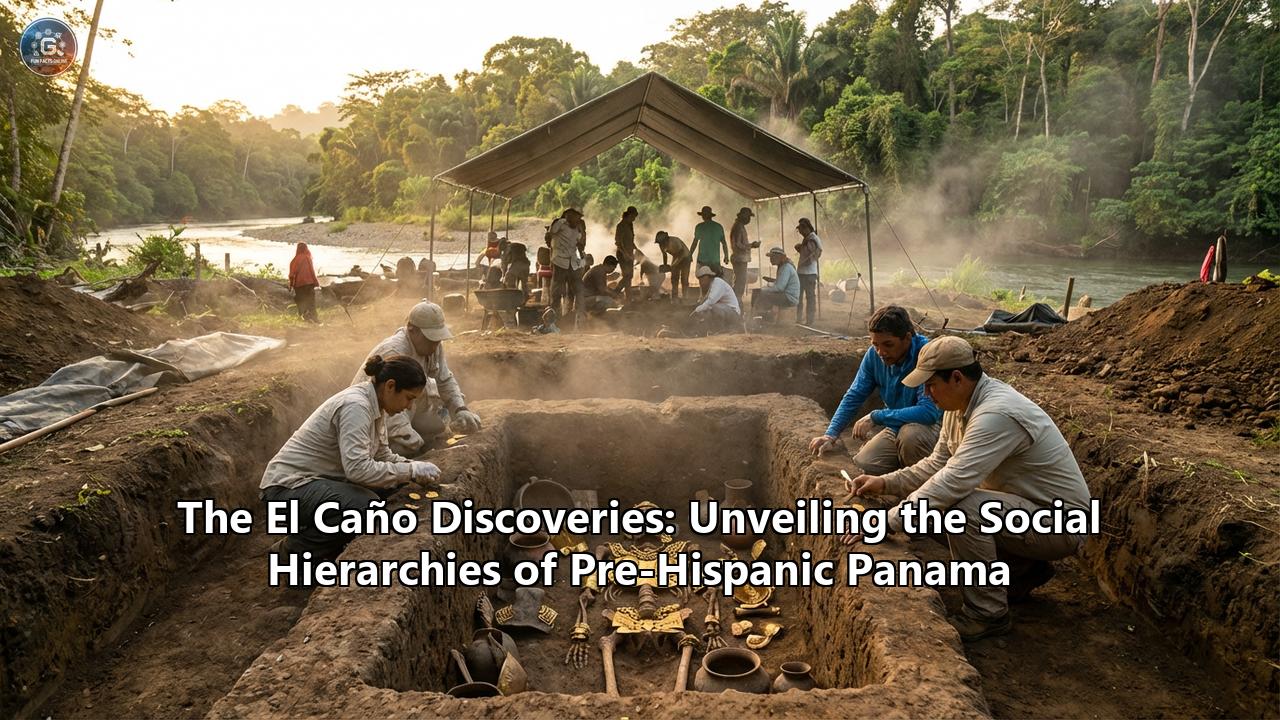
Nestled in the lush, tropical lowlands of the Coclé province in central Panama, the El Caño Archaeological Park stands as a silent testament to a world that flourished long before European galleons ever breached the horizon. For centuries, the dense vegetation of the Rio Grande valley concealed the secrets of the Gran Coclé culture, a society characterized by dazzling artistic achievements, profound spiritual beliefs, and a fiercely rigid social hierarchy. While the legends of El Dorado often draw the imagination toward the Andes or the deep Amazon, the reality of golden lords and staggering displays of ancient wealth finds one of its most vivid expressions here on the Panamanian isthmus. The discoveries at El Caño have not merely unearthed exquisite artifacts; they have shattered long-held archaeological assumptions, peeling back the layers of earth to reveal the complex, stratified, and often brutal realities of pre-Hispanic Central American chiefdoms.
To fully grasp the magnitude of the El Caño discoveries, one must first look at the historical timeline of its excavation—a journey that is almost as fascinating as the artifacts themselves. The site first brushed against the modern historical record in 1925 when Hyatt Verrill, an American explorer and adventurer, noticed unusual stone monoliths protruding from the earth along the banks of the Rio Grande. Intrigued by these megalithic clues, Verrill dug up three skeletons and removed various sculptures and artifacts, shipping them off to the United States. His crude excavations were largely ignored by the broader academic community at the time. The spotlight instead shifted just a few miles away to Sitio Conte, another extraordinarily rich Coclé burial site excavated in the 1930s and 1940s, which yielded spectacular gold hoards and firmly established the "Gran Coclé" semiotic and cultural tradition in the archaeological lexicon.
For decades, El Caño languished in relative obscurity. In the 1970s, formal investigations were finally launched by American archaeologists seeking to verify the accounts of early Spanish conquistadors. The Spanish chronicles vividly described encounters with indigenous civilizations ruled by paramount elites who differentiated themselves from commoners by adorning their bodies with shimmering golden chest plates and intricate jewelry crafted by highly skilled artisans. Yet, the 1970s excavations at El Caño yielded only the remains of 16 individuals and relatively simple grave goods, failing to produce the fabulous wealth described in the chronicles. The site seemed to be merely a ceremonial center or a cemetery for lower-status individuals.
This narrative was dramatically upended in 2008 when Panamanian archaeologist Dr. Julia Mayo, armed with modern technological surveying methods and a relentless drive, began a new systematic excavation. Serving as the director of the El Caño Foundation, Dr. Mayo hypothesized that previous excavations had simply missed the true heart of the necropolis. Her instincts were proven spectacularly correct. Between 2010 and 2016, Mayo’s team uncovered a series of high-status tombs dating between 700 and 1000 CE that would completely rewrite the history of the region.
The society revealed by Dr. Mayo’s excavations was one of stark divisions, an intricate chiefdom where power, wealth, and spiritual authority were concentrated in the hands of a select few. The Gran Coclé culture, which inhabited the central provinces of Panama, was not a state-level empire like the Maya to the north or the Inca to the south. Instead, it was a network of powerful, localized chiefdoms. These societies engaged in extensive trade networks, evidenced by the spread of Cubitá style ceramics and the exchange of precious materials, but they were bound together by a shared cosmological worldview and a strict social order.
The necropolis at El Caño was the ultimate physical manifestation of this social hierarchy. Built and utilized over a span of about 300 years, the cemetery was strictly organized. It featured stone structures, including basalt columns and causeways, earthen mounds, and clearly delineated burial zones. The sheer scale of the elite tombs, designated by numbers such as Tomb 7 or Tomb 9, demonstrated that the ruling class utilized public ceremony and monumental mortuary practices to legitimize their terrestrial power and secure their divine status in the afterlife.
One of the most defining and chilling aspects of the El Caño burials is the practice of multiple and simultaneous interments. When a paramount chief or high-ranking lord died, he did not enter the afterlife alone. The archaeological record reveals that these lords were accompanied by anywhere from 8 to over 40 individuals in a single grave. These were not concurrent natural deaths. The accompanying bodies belonged to retainers, warriors, servants, or captives who were sacrificed specifically to serve as companions and attendants to the deceased lord in the next world.
This practice highlights a worldview where death was not a final cessation of existence, but a transition to another realm where earthly social status remained entirely intact and necessary. The paramount lord would need his servants, his wives, and his guards in the afterlife just as he did in the physical world. For instance, in 2011, the world was captivated when Dr. Mayo’s team uncovered the body of a warrior chief, resplendent in gold artifacts, lying face down atop a bed of 25 carefully arranged human bodies. The spatial arrangement of the bodies, the varying quality of their grave goods, and the demographic profile of the sacrificed individuals paint a vivid, if macabre, picture of a highly stratified society where human life was deeply subordinate to the spiritual and political needs of the elite.
The sheer volume and unparalleled craftsmanship of the funerary trousseaus found at El Caño are central to understanding the economic and cultural sophistication of the Gran Coclé people. The elites were buried with an astonishing array of artifacts made from gold, tumbaga (an alloy of gold and copper), bone, resin, whale teeth, and intricately painted ceramics.
Early in 2024, the archaeological community was stunned by yet another landmark discovery at El Caño: Tomb No. 9. Dating back to approximately 750 to 800 CE, this grave contained the remains of an immensely important Coclé lord, estimated to have died between the ages of 30 and 40. He was found buried face down—a customary high-status burial posture in this culture—resting directly on top of the body of a woman, with up to 32 other sacrificed individuals surrounding them.
What truly distinguished Tomb 9 was the breathtaking cache of golden artifacts and ceremonial objects. The inventory read like a mythical dragon’s hoard: five heavy golden breastplates (pectorals), two belts made entirely of spherical gold beads, four golden bracelets, earrings shaped like human figures and double-headed crocodiles, necklaces of circular gold beads, and a striking set of five earrings crafted from the teeth of sperm whales and plated in gold.
The iconography etched, hammered, and cast into these gold pieces provides an invaluable window into the animistic and shamanic belief systems of pre-Hispanic Panama. The Coclé did not merely create art for aesthetic pleasure; their metallurgy was deeply symbolic. The surfaces of the golden pectorals are alive with depictions of mythological creatures and hybrid beasts—entities that combine the features of bats, crocodiles, sharks, fish, birds, and butterflies.
Researchers, including Mercedes Guinea, have pointed out that these specific animals were not chosen at random. The Coclé revered creatures that could traverse multiple elemental domains—earth, air, water, and fire—or animals that possessed heightened senses, such as the bat's ability to navigate in total darkness. These traits were fundamentally associated with shamanic power. The hybrid beasts represented mutability, transformation, and the perilous journey of the soul transitioning from the world of the living to the realm of the ancestors.
This shamanic connection was further solidified by a unique find within Tomb 9. Initially, archaeologists discovered a set of hollow deer bone tubes and believed them to be musical flutes, leading the press to dub the deceased the "Lord of the Flutes". However, closer macroscopic and contextual inspection led Dr. Mayo to reclassify these objects as "healing tubes". In many indigenous shamanic traditions, such tubes are utilized during intense rituals to inhale and exhale the smoke of burning medicinal or hallucinogenic herbs.
Coupled with a small, exquisite gold figurine depicting an otherworldly entity with a bat's nose and ears, the presence of these tubes strongly suggests that the lord buried in Tomb 9 was not merely a secular political leader or a military chieftain, but a powerful shaman or medicine man. In Coclé society, political power and spiritual authority were inextricably linked. The shaman-chief was viewed as a vital intercessor who could enter trance states through rhythmic music, dance, and mind-altering substances to communicate with the spirit world. His role was to receive divine visions, cure spiritual and physical ailments, and ensure the cosmic balance of his community. When such a figure died, his journey to the afterlife required an immense concentration of wealth and human energy to ensure his safe passage and his continued protection over the living.
While the glittering gold naturally captures the public's imagination, the true scientific value of El Caño lies in the meticulous, multidisciplinary approach adopted by Dr. Mayo and her international team. Modern archaeology is a far cry from the treasure-hunting days of Hyatt Verrill. Today, every grain of soil, every fragment of charcoal, and every microscopic scratch on a tooth is analyzed to reconstruct the past.
Physical and biological anthropologists have been instrumental in decoding the lives of the people buried at El Caño. For instance, biological anthropologist Beatrice Di Biase has engaged in a painstaking study of the dental remains recovered from multiple tombs, including Tomb 9. By taking precise measurements of the teeth—often repairing fragmented enamel with specialized solvents—she aims to determine the genetic diversity of the necropolis. Her research seeks to answer a critical question: Were the individuals buried here drawn from a single, tightly-knit local community, or was El Caño a centralized, pan-regional sacred site where elites and captives from various distant settlements were brought for interment?
Similarly, isotopic analysis is revolutionizing our understanding of pre-Columbian Panamanian diets and migration patterns. By analyzing the ratios of strontium, carbon, and nitrogen isotopes embedded in human bones and tooth enamel, scientists can determine where an individual was born, where they grew up, and what they ate. These studies are crucial for understanding the societal diversification and the complex exchange networks that characterized the Isthmo-Colombian area from 200 BCE up until Spanish contact. They reveal a population that was highly mobile, engaging in widespread trade of salt, dried fish, ceramics, and metalwork across the rugged terrain and coastal waterways.
Furthermore, the study of the environment itself has yielded profound insights. Archaeobotanists analyzing wood charcoal fragments from the El Caño funerary contexts have reconstructed the ancient landscape, providing evidence of how the Coclé managed tropical forest resources to construct their ceremonial structures, wooden biers, and the pyres that likely played a role in their mortuary rituals. The integration of pXRF (portable X-ray fluorescence) technology has allowed scientists to chemically characterize the pigments used on the elaborate polychrome ceramics and the pyrite used in highly reflective mosaic mirrors, tracing these materials back to their geological origins and proving interactions that may have stretched as far as the Maya regions of Mesoamerica.
The preservation of this immense data is also stepping into the future. Recognizing that the sheer volume of artifacts—numbering in the thousands—makes physical exhibition of every piece impossible, the El Caño Foundation partnered with Global Digital Heritage. Using advanced photogrammetry and 3D scanning technology, researchers have digitized hundreds of artifacts, creating high-resolution models. This digital repository ensures that scholars around the globe can study the exact dimensions, tool marks, and iconographic details of the artifacts without risking damage to the fragile originals, thus democratizing the access to Panama's cultural heritage.
Today, the El Caño Archaeological Park is not just an active excavation site; it is an open-air classroom and a vibrant museum. The newly renovated museum on the premises provides visitors—both local Panamanians and international tourists—with a profound, scientifically grounded look into the worldview of the region's original inhabitants. By carefully leaving some skeletons and artifacts in situ (or placing accurate replicas in the exact positions they were found), the park allows visitors to stand at the edge of the excavation pits and look down into the deep past, experiencing the visceral reality of a chief's burial just as the archaeologists found it.
The impact of El Caño extends far beyond the academic sphere; it has fundamentally altered the cultural landscape of the region. For the people of Panama, particularly in the Coclé province, these discoveries are a source of immense national pride. They challenge the Eurocentric narrative that complex history in the Americas only existed in the monumental stone pyramids of Mexico or the mountain citadels of Peru. El Caño proves that the pre-Hispanic societies of the Central American isthmus were brilliantly complex, boasting master craftsmen, sophisticated trade networks, and a rich, deeply codified spiritual life.
As excavations continue into the future, propelled by cultural cooperation agreements and relentless scientific curiosity, Tomb 9 will certainly not be the last secret the earth yields. The Rio Grande valley remains heavily laden with the echoes of ancient ceremonies, the rhythmic chanting of long-dead shamans, and the silent gleam of gold in the dark earth. The discoveries at El Caño have pulled back the veil on a spectacular civilization, reminding us that human history is a tapestry woven with threads of incredible ingenuity, profound spirituality, and staggering complexity, waiting only for the careful brush of an archaeologist to bring it back to the light.
Reference:
- https://en.wikipedia.org/wiki/El_Ca%C3%B1o_Archaeological_Park
- https://www.smithsonianmag.com/smart-news/this-1200-year-old-tomb-in-panama-contains-a-treasure-trove-of-artifacts-and-up-to-32-bodies-180983977/
- https://trowelblazers.com/2020/11/02/julia-mayo/
- https://archaeologymag.com/2024/03/major-tomb-filled-with-gold-artifacts-in-el-cano-archaeological-park/
- https://www.researchgate.net/profile/Julia-Mayo-2
- https://www.heritagedaily.com/2024/03/major-tomb-discovery-at-el-cano-archaeological-park/150870
- https://journals.plos.org/plosone/article?id=10.1371/journal.pone.0335678
- https://globaldigitalheritage.org/project/el-cano/
- http://oda-fec.org/nata-english/view/ls_ov_clasificacion.php?idpadre=31&paginacion=60&npag=31
- https://archaeology.org/issues/january-february-2025/collection/a-golden-shaman/top-10-discoveries-of-2024/
- https://www.finestresullarte.info/en/archaeology/panama-pre-hispanic-tomb-discovered-filled-with-gold-artifacts-and-pottery
- https://ticotimes.net/2026/02/20/more-than-1000-year-old-tomb-found-at-el-cano-in-panama
- https://www.vanguardngr.com/2026/02/tomb-more-than-1000-years-old-found-in-panama/
- https://www.thevisitorpanama.info/eng/2023/09/23/el-cano-archaeological-park-a-journey-to-a-civilization-that-lived-thousands-of-years-ago-in-cocle/
- https://www.globalgiving.org/projects/rescue-the-el-cano-archaeological-park-museum/reports/