
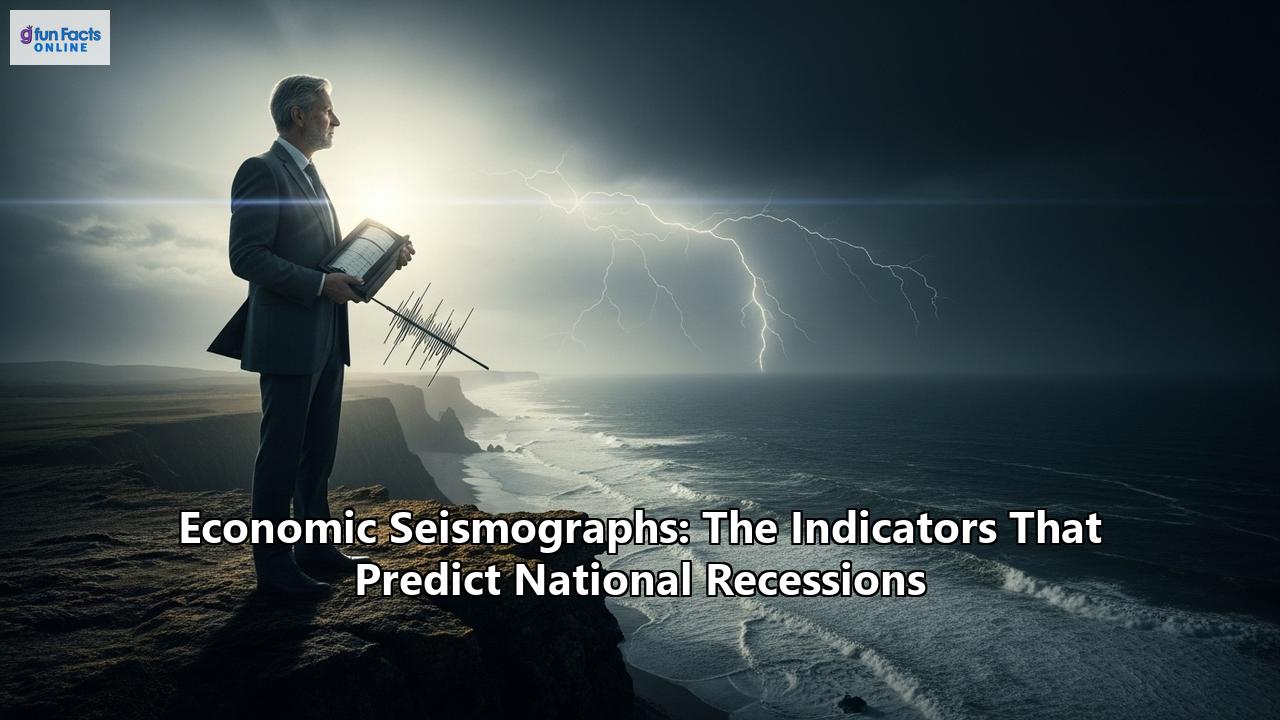
In an ever-fluctuating global economy, the specter of a national recession looms as a significant threat to individuals, businesses, and governments alike. A recession, formally defined by the National Bureau of Economic Research (NBER) as a "significant decline in economic activity spread across the economy, lasting more than a few months," can lead to job losses, diminished investment returns, and squeezed corporate profits. While predicting the precise timing and severity of a downturn is a famously difficult endeavor, economists and investors closely monitor a set of key indicators, or "economic seismographs," that have historically provided advance warning of an impending contraction. These signals, when read in concert, can offer valuable insights into the health of the economy and the potential for a looming recession.
The Oracle of the Bond Market: The Inverted Yield Curve
Among the most reliable and closely watched recession predictors is the inversion of the yield curve. Normally, long-term government bonds carry higher yields (interest rates) than short-term ones to compensate investors for the added risk of tying up their money for a longer period. An inverted yield curve occurs when this pattern reverses, and short-term yields become higher than long-term yields.
This phenomenon signals a lack of confidence in the near-term economic outlook. Investors, anticipating a slowdown and future interest rate cuts by the central bank, flock to the safety of long-term bonds, driving their prices up and their yields down. Historically, an inverted yield curve, particularly the spread between the 10-year and 2-year Treasury notes, has preceded every U.S. recession since the 1970s, with a lead time ranging from six to 24 months. The spread between the 10-year Treasury and the 3-month T-bill is another version favored by some economists for its predictive power. While not an infallible guarantee, a sustained inversion of the yield curve is a powerful red flag that has consistently signaled market pessimism about future economic growth.
The Labor Market's Pulse: Unemployment and the Sahm Rule
The health of the labor market is a fundamental pillar of economic stability. When businesses are optimistic about the future, they hire; when they anticipate a slowdown, hiring freezes and layoffs often ensue. Consequently, a rising unemployment rate is a classic, though often more concurrent or slightly lagging, indicator of a recession.
Two key metrics provide a timely pulse of the labor market:
- Initial Jobless Claims: This weekly report details the number of individuals filing for unemployment benefits for the first time. A sustained increase of 20-25% from its recent low can be an early warning sign of a weakening job market and a potential recession.
- The Sahm Rule: Developed by economist Claudia Sahm, this simple yet effective rule posits that a recession is likely imminent or already underway when the three-month moving average of the national unemployment rate rises by 0.5 percentage points or more relative to its low during the previous 12 months. This rule has an impressive historical track record for identifying the start of recessions with remarkable timeliness, often before they are officially declared by the NBER. The logic is straightforward: significant job losses curtail consumer spending, which accounts for roughly 70% of U.S. GDP, creating a negative feedback loop.
Consumer Sentiment and Spending: The Engine of the Economy
If the labor market reflects consumers' ability to spend, consumer confidence gauges their willingness to do so. Organizations like the Conference Board and the University of Michigan conduct regular surveys to measure consumer sentiment. A significant drop in these indices can foreshadow a pullback in consumer spending, a primary driver of economic growth.
When consumers are worried about their job security or financial prospects, they tend to save more and spend less, particularly on discretionary items. This can lead to a decrease in demand for goods and services, prompting businesses to cut back on production and investment, further slowing the economy.
The View from the Factory Floor: Manufacturing and Industrial Production
The manufacturing sector is often a bellwether for the broader economy. The Purchasing Managers' Index (PMI), compiled by the Institute for Supply Management (ISM), is a key indicator derived from a monthly survey of supply chain managers across the country. A PMI reading above 50 indicates expansion in the manufacturing sector, while a reading below 50 signals contraction. A sustained period of contraction can be a sign of weakening demand and an impending economic downturn.
Similarly, a decline in industrial output, which measures the production of factories, mines, and utilities, can also signal a recession. When companies reduce production, it has a ripple effect throughout the economy, leading to lower sales, reduced hiring, and potentially layoffs.
The Market's Mood: Stock Prices and Financial Conditions
The stock market is often described as a forward-looking mechanism, as investors base their valuations on expectations of future corporate earnings and economic growth. A significant and sustained decline in the stock market, often defined as a drop of 20% or more from its peak (a bear market), can reflect growing investor pessimism about the future and can sometimes precede a recession.
Beyond stock prices, broader financial conditions play a crucial role. The Chicago Fed's National Financial Conditions Index (NFCI) combines 105 measures of risk, credit, and leverage into a single weekly reading. Positive values of the NFCI are historically associated with tighter-than-average financial conditions, which have often coincided with recessions.
Composite Indicators: A Chorus of Warning Bells
Because no single indicator is perfect, economists often turn to composite indices that amalgamate several leading indicators into a single figure. The Conference Board's Leading Economic Index (LEI) is a prime example, incorporating data on manufacturing orders, building permits, average weekly hours worked, and the yield spread, among others. A persistent decline in the LEI is considered a strong signal of an impending recession.
The rationale behind using a composite index is that a confluence of warning signs across multiple indicators provides a more convincing and reliable picture of an impending slowdown than any single metric in isolation.
Other Important Seismographs
Several other economic indicators serve as valuable, albeit sometimes less prominent, recession predictors:
- Gross Domestic Product (GDP): While a decline in real GDP is the technical measure used to define a recession (often cited as two consecutive quarters of negative growth), it is considered a lagging indicator as the data is released with a delay. However, a slowdown in the rate of GDP growth can be an early sign of trouble.
- Housing Market: A slowdown in new housing starts and a decline in home prices can signal economic weakness. The housing sector is highly sensitive to interest rates, and a downturn here can have far-reaching effects on the broader economy.
- Corporate Profits: A decline in corporate profits can lead to reduced business investment, hiring, and stock buybacks, all of which can contribute to an economic slowdown.
- Price of Gold: During times of economic uncertainty, investors often flock to gold as a store of value, driving up its price.
The Art and Science of Prediction
Predicting a recession is not an exact science; it is a complex art that involves interpreting a wide array of data and understanding the intricate relationships between different sectors of the economy. As some economists have noted, economic models have shown some ability to predict recessions in the past, but even the best models cannot anticipate unique events that have no historical precedent. The economy is a dynamic system, and the "this time is different" syndrome is a constant peril for forecasters.
Ultimately, a prudent approach to recession forecasting involves looking for a consistent pattern of weakness across multiple indicators. An inverted yield curve, coupled with falling consumer confidence, rising jobless claims, and a contracting manufacturing sector, paints a far more compelling picture of an impending downturn than any one of these signals alone. By understanding these economic seismographs, we can better prepare for the financial tremors that may lie ahead.
Reference:
- https://www.focus-economics.com/blog/economic-indicators-for-recession/
- https://www.stlouisfed.org/on-the-economy/2025/may/making-sense-recession-probabilities
- https://en.wikipedia.org/wiki/Recession
- https://www.acapam.com/blog/how-to-predict-a-recession-before-it-happens/
- https://www.kansascityfed.org/documents/1184/1999-How%20Reliable%20Are%20Recession%20Prediction%20Models%3F.pdf
- https://fedinprint.org/item/fedker/31521
- https://www.td.com/ca/en/investing/direct-investing/articles/recession-indicators
- https://www.morningstar.com/business/insights/blog/markets/leading-recession-indicators
- https://smartasset.com/investing/recession-definition
- https://www.forbes.com/sites/bill_stone/2025/03/23/five-critical-indicators-to-gauge-recession-risk/
- https://www.belfercenter.org/research-analysis/how-forecast-recession
- https://www.quora.com/Can-recessions-be-accurately-predicted-What-methods-are-used-and-how-reliable-have-they-been-in-the-past
- https://privatebank.jpmorgan.com/nam/en/insights/markets-and-investing/five-factors-we-use-to-track-recession-risk-and-what-they-say-now
- https://www.chicagofed.org/-/media/publications/economic-perspectives/1991/ep-nov-dec1991-part2-watson-pdf.pdf