
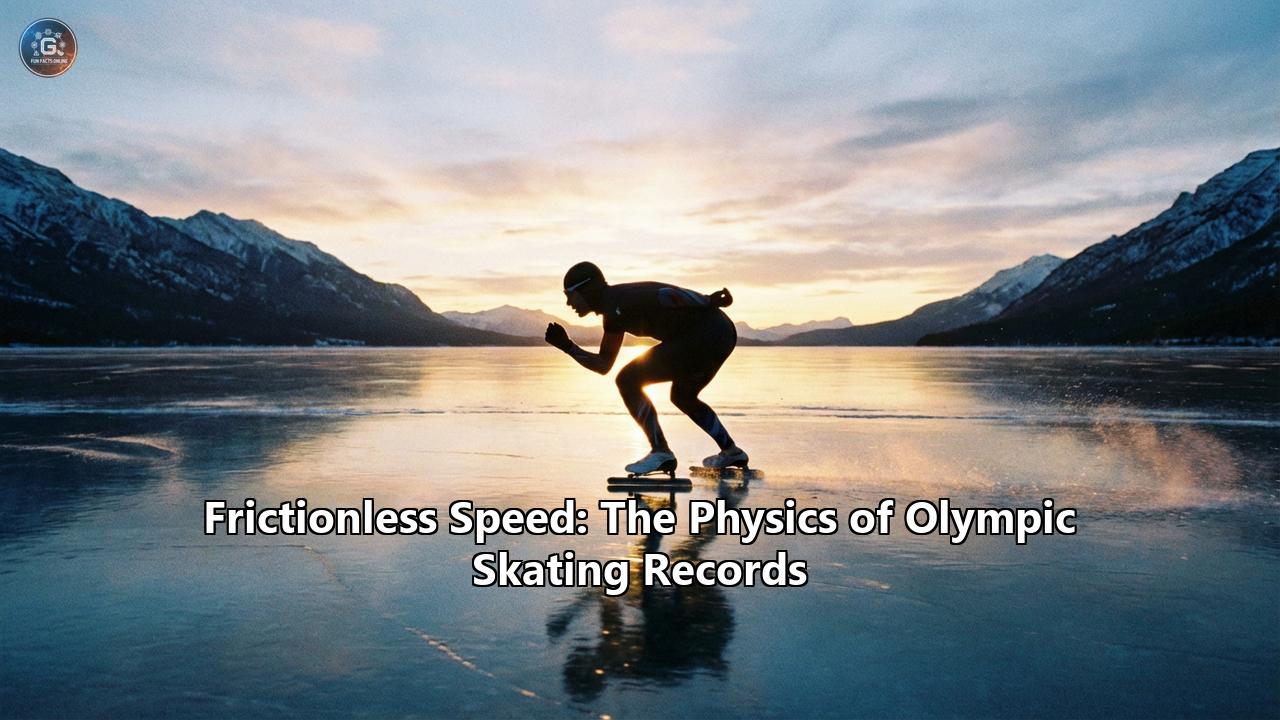
The roar of the crowd in an Olympic oval is a sound unlike any other—a resonant, cavernous boom that seems to hang in the chilled air. But if you were to strip away the cheering, the cowbells, and the announcer’s voice, you would hear the true soundtrack of the Winter Games: the rhythmic clack-clack-clack of clap skates striking the ice, the violent scratch of a figure skater’s toe pick biting into the frozen surface, and the silent, deadly hiss of air rushing over a speed skater’s spandex-clad body.
To the casual observer, skating is an aesthetic marvel, a blend of grace and power. To the physicist, however, it is a chaotic battlefield of forces. It is a war against friction, a negotiation with gravity, and a desperate race against air resistance. Every world record set on the ice is a triumph of engineering and biomechanics as much as it is a feat of athleticism. From the molecular slush that allows a blade to glide to the aerospace-grade aerodynamics of a racing suit, the story of Olympic skating is, at its heart, a story of physics.
Part I: The Miracle of the Glide – The Physics of Ice
Before a skater can even think about a triple axel or a 500-meter sprint, they must contend with the most fundamental mystery of the sport: Why is ice slippery?
For over a century, physics textbooks offered a simple, elegant explanation that turned out to be mostly wrong. The theory was "pressure melting." The idea was that the thin blade of a skate concentrates the skater’s entire body weight onto a tiny surface area, creating immense pressure. This pressure, the theory went, lowered the melting point of the ice just enough to create a thin film of water, upon which the skater glided.
It sounds plausible, but the math doesn't hold up. A 160-pound skater on a standard blade generates a pressure of roughly 400 atmospheres. While substantial, this is only enough to lower the melting point of ice by a fraction of a degree—perhaps to -3.5°C. Yet, skaters glide effortlessly on ice that is -10°C or colder. If pressure melting were the only factor, skating on a bitter February morning in an outdoor rink would be like trying to slide across a concrete sidewalk.
The Quasi-Liquid Layer and Friction MeltingThe truth lies in a combination of two more complex phenomena: "friction melting" and the "quasi-liquid layer."
Ice, it turns out, is not a static solid. At the molecular level, the surface of an ice crystal is chaotic. While the water molecules deep inside the ice crystal are locked in a rigid hexagonal lattice, the molecules at the very surface are untethered. They vibrate and rotate, forming a disordered layer that behaves more like a liquid than a solid, even at temperatures well below freezing. This "quasi-liquid layer" is only a few molecules thick, but it provides a natural lubrication.
When a skater pushes off, they engage the second engine of slipperyness: friction melting. As the steel blade drags across the ice, the friction generates heat. This is not the heat of a fire, but a microscopic flash of thermal energy that instantly melts the ice directly beneath the blade. This creates a thicker, temporary film of water—a hydrodynamic lubricant—that reduces the coefficient of friction to near zero.
This is why a skater’s blade is the temperature it is. If the ice is too cold (below -20°C), the friction cannot generate enough heat to melt the surface, and the ice feels "gritty" or "slow," like skating on sandpaper. If the ice is too warm (near 0°C), the layer of water becomes too thick, creating a "suction" effect that drags on the blade, a phenomenon known as capillary drag.
The Ice Meister’s Dark ArtThis delicate thermal balance makes the job of the Olympic "Ice Meister" one of the most stressful in sports. Mark Messer, the legendary ice technician from the Calgary Olympic Oval (often called "The Fastest Ice on Earth"), knows that the difference between a gold medal and a fall is often a fraction of a degree.
For long-track speed skating, the ice must be hard and fast. Messer and his colleagues aim for an ice surface temperature of around -7°C to -9°C. This hardness minimizes the friction coefficient, allowing the skate to glide with minimal resistance. However, it must be just soft enough to allow the sharp edge of the blade to "bite" during the push-off phase. If the ice is too hard, the blade will skid out under the immense lateral force of a sprinter’s stride, causing a blowout.
Figure skating demands a completely different canvas. Figure skaters need "soft" ice, typically kept at -3°C to -4°C. The warmer ice allows their deeply curved blades to carve intricate edges without skidding and provides a softer landing surface for the massive impact forces of a quadruple jump. If a figure skater were to attempt a Quad Lutz on speed skating ice, the brittle surface would likely shatter under the toe-pick impact, potentially causing a catastrophic injury.
The water itself is a variable. Olympic ice is not made from tap water. It is built layer by microscopic layer using purified, deionized water. Impurities like minerals and dissolved air bubbles act as defects in the crystal lattice, creating friction and weak points. The "fastest" ice is dense, crystal-clear, and chemically pure—a single, massive crystal of frozen water.
Part II: The Speed Skater’s Equation – Aerodynamics and Mechanics
In speed skating, the enemy is the air.
At elite speeds of 60 km/h (37 mph), a human being is a terribly un-aerodynamic shape. Over 80% of a speed skater’s energy output is spent simply pushing air molecules out of the way. This is why the sport has become a hotbed of aerospace engineering, leading to one of the most dramatic technological evolutions in Olympic history.
The Altitude AdvantageBefore we discuss the suits or the skates, we must discuss the venue. The "Holy Grail" of speed skating records is altitude. The physics is simple: air density decreases as you go higher. Less dense air means fewer molecules colliding with the skater, which means less drag.
This is why the Olympic Ovals in Calgary (1,045 meters elevation) and Salt Lake City (1,425 meters) are known as "Highland" tracks, while venues like Sochi or Heerenveen are "Lowland" tracks. The difference is quantifiable. A skater performing the exact same physical exertion will finish a 1,000-meter race roughly 1 to 1.5 seconds faster in Salt Lake City than at sea level. In a sport decided by thousandths of a second, this is an eternity.
When the 2014 Olympics were held in Sochi (near sea level), physicists correctly predicted that no world records would be broken. The air was simply too "thick." Conversely, the 2002 Salt Lake City Games saw a massacre of the record books, often referred to as the "Salt Lake Miracle."
The Clap Skate RevolutionThe single greatest mechanical leap in skating history occurred in the mid-1990s with the introduction of the clap skate.
For a century, skates were fixed: the blade was rigidly attached to the boot at both the heel and the toe. This design had a major biomechanical flaw. To push off, a skater extends their leg backward. With a fixed blade, as the leg extends, the heel of the skate must eventually lift off the ice. As soon as the heel lifts, the blade tip digs into the ice, cutting short the "gliding" phase of the push. The skater is forced to pick up their foot early to avoid tripping over the toe.
Dutch biomechanist Gerrit Jan van Ingen Schenau saw this as wasted energy. He developed a skate where the blade was attached only at the toe by a hinge. The heel was free to lift.
The physics of the clap skate changed everything. Now, as the skater extended their leg, the blade could remain flat on the ice even as the heel lifted. This extended the "push" phase of the stride effectively lengthening the skater's leg. It allowed the skater to continue applying force against the ice for a fraction of a second longer with every stroke.
When the clap skate debuted at the 1998 Nagano Olympics, the results were shocking. World records didn’t just fall; they were obliterated. In the men’s 1,500m, the record improved by over two seconds—a margin previously that would take a decade to achieve. It was a rare moment where a change in mechanical linkage instantly upgraded the human engine.
The Suit Controversy: Engineering the Boundary LayerIf the skate manages friction with the ice, the suit manages friction with the air.
When air flows over a moving object, it forms a "boundary layer." If this layer flows smoothly (laminar flow), drag is low. But on a human body—with its curves, shoulders, and hips—the air tends to separate from the surface, creating a turbulent wake of low pressure behind the skater. This "pressure drag" pulls the skater backward.
To combat this, engineers borrow a trick from golf balls. A smooth golf ball travels half the distance of a dimpled one. The dimples create a tiny layer of turbulence near the surface, which paradoxically helps the air "stick" to the ball longer, delaying separation and reducing the size of the drag-inducing wake.
Speed skating suits are designed with this principle in mind. They use textured fabrics, rubberized patches, and even "trip strips" (zigzag patterns) placed on the forehead, shins, and forearms to trip the air into a turbulent boundary layer.
But aerodynamics is a fickle mistress. In the lead-up to the 2014 Sochi Olympics, the US team partnered with Lockheed Martin to create the "Mach 39" suit. It was touted as the fastest suit ever made, with vents on the back to release heat and specialized dimpling.
It was a disaster. The US team, expected to medal heavily, failed completely. Skaters complained that the vents allowed air to enter the suit, puffing it up like a parachute. The suit, designed in a static wind tunnel, failed to account for the dynamic, shifting posture of a tired skater. It was a harsh lesson in physics: theoretical aerodynamics must survive the chaotic reality of human movement.
The Crossover: Centripetal Force and the "Slingshot"Watch a speed skater on the straightaway, and you see power. Watch them in the corner, and you see physics on the edge of catastrophe.
The corners are where races are won or lost. Here, the skater is fighting centripetal force—the need to constantly accelerate toward the center of the circle to maintain a curved path. To do this, they lean at precarious angles, sometimes exceeding 50 degrees relative to the ice.
The physics of the "crossover" step is brilliant. By crossing the outer leg over the inner leg, the skater can maintain continuous power generation while leaning. The incredible lean angle allows the skater to use the ice’s reaction force to push them not just forward, but inward, countering the centrifugal "pull" that wants to throw them into the padding.
Short track skaters take this to the extreme. Because their track is tighter (111 meters vs. 400 meters), the centripetal forces are massive. They rely on their hand touching the ice to create a third point of contact, stabilizing their extreme lean. They are essentially falling into the turn, trusting their speed to keep them upright.
Part III: Defying Gravity – The Physics of Figure Skating
If speed skating is about minimizing friction, figure skating is about exploiting it to generate vertical velocity and rotational momentum. The modern era of figure skating is defined by the "Quad Revolution"—the race to add more and more rotations to jumps.
The Angular Momentum TrapA figure skater entering a jump is a study in conservation of angular momentum. The equation is simple: $L = I \times \omega$.
- $L$ is Angular Momentum (the total "spinning energy").
- $I$ is Moment of Inertia (how spread out the skater's mass is).
- $\omega$ (omega) is Angular Velocity (how fast they spin).
Angular momentum is conserved. This means that once the skater leaves the ice, $L$ is fixed. They cannot generate more spin in the air. To spin faster ($\omega$), they must drastically reduce their moment of inertia ($I$).
This is why skaters pull their arms and legs in so tightly. A skater with arms extended has a high moment of inertia. By snapping their arms to their chest and crossing their legs, they reduce their radius. To compensate, their rotation speed accelerates violently. A skater in a tight scratch spin can rotate at 5 to 6 revolutions per second—faster than a helicopter blade.
The Quadruple Jump ProblemThe difference between a Triple and a Quadruple jump is a math problem that pushes human physiology to its breaking point.
To complete a Quad, a skater needs two things:
- Time in the air (Hang Time): This is determined solely by vertical velocity at takeoff.
- Rotation Speed: This is determined by torque at takeoff and body position in the air.
The cruel irony of physics is that these two goals often conflict. To jump higher (more hang time), you need more muscle mass in the legs. But more muscle mass in the legs increases your moment of inertia, making it harder to spin fast.
This is why the "Quintuple jump" (5 rotations) is considered the theoretical limit of the human body.
- Hang Time Limit: The average elite skater stays in the air for about 0.6 to 0.7 seconds. To add a fifth rotation without spinning faster, a skater would need to jump significantly higher—roughly 50 inches off the ice. For context, NBA superstar LeBron James has a vertical leap of about 40 inches. And he isn't wearing heavy steel blades or moving on slippery ice.
- Rotation Speed Limit: To land a Quintuple with current jump heights, a skater would need to spin at incredible speeds, creating G-forces that could cause blood to pool in the extremities, potentially leading to loss of consciousness (red-out) or simply tearing the connective tissues of the knee upon landing.
The Quad Axel, first successfully landed in competition by American Ilia Malinin in 2022, is the hardest jump in the world because of its unique takeoff.
Unlike other jumps where the skater takes off skating backward (allowing them to use the toe pick to vault), the Axel requires a forward takeoff. The skater launches from the outside edge of one foot. Because they are moving forward, they must complete an extra half-rotation (4.5 rotations for a Quad Axel) to land backward.
The physics of the Axel launch involves transferring linear momentum (gliding forward) into vertical and rotational momentum using nothing but the friction of a single metal edge. The skater must "brake" their forward motion instantly by turning the blade sideways, vaulting over the toe pick. It is a violent conversion of energy. Malinin’s success is due to his uncanny ability to generate massive vertical height (high $t$) while instantaneously snapping into a tight rotational axis (high $\omega$).
The Landing: 8x Body WeightWhat goes up must come down. The landing of a Quad jump subjects the skater’s body to impact forces of 5 to 8 times their body weight. For a 150-pound skater, that is over 1,000 pounds of force slamming into a single ankle, on a blade just 4 millimeters thick.
This repetitive trauma is why stress fractures are the plague of figure skating. The boot must be stiff enough to support the ankle against this crushing force (acting like a cast), but flexible enough to allow the knee bend required to absorb the shock. If the skater lands with a locked knee, the force travels straight up the skeletal chain to the hip and spine.
Part IV: Future Physics – The Next Frontier
As we look toward the 2026 Milano Cortina Games and beyond, physics continues to drive the sport.
Technological Doping?The line between equipment and cheating is blurring. In speed skating, "haptic suits" (which vibrate to tell a skater if their posture is too high) are banned in competition but used in training. New blade materials, like carbon fiber runners with diamond-polished steel edges, are reducing friction further.
In figure skating, AI is being used to analyze jump physics in real-time. Systems like OOFSkate use computer vision to track the skater’s center of mass and rotation speed, giving coaches data that was previously invisible. This allows for optimization of takeoff angles to the single degree.
The 1:40 Barrier and the QuintIn speed skating, the 1500m world record sits at 1:40.17 (Kjeld Nuis). Breaking the 1:40 barrier will likely require a perfect storm: a high-altitude track, low barometric pressure (a stormy day lowers air density further), and perhaps a new evolution in suit texture technology.
In figure skating, the Quintuple jump looms. Biomechanists believe it is possible, but it may require a "genetic freak"—a skater with the fast-twitch muscle fibers of a sprinter, the slight build of a jockey (to minimize moment of inertia), and the durability to survive the landings.
Conclusion
When you watch the Winter Olympics, you are watching a grand experiment. You are seeing how far the human body can be pushed when aided by the laws of physics.
The speed skater crouched at the starting line is a projectile waiting to be fired, wrapped in a suit designed by aerospace engineers, balancing on blades that melt the ice beneath them. The figure skater spinning in a blur is a living gyroscope, fighting to conserve momentum while defying the crushing gravity of the landing.
They are not just athletes. They are physicists in motion, writing equations on the ice with steel and sweat, forever chasing the elusive limit of frictionless speed.
Reference:
- https://www.wgbh.org/news/2018-02-19/the-experts-known-as-ice-meisters-create-perfect-olympic-skating-surfaces
- https://www.livescience.com/61793-ice-skating-quintuple-axel.html
- https://www.danielyeow.com/2009/on-skating-at-altitude/
- https://www.cbsnews.com/news/winter-olympics-2014-are-high-tech-suits-to-blame-for-as-us-speed-skaters-struggles/
- https://slate.com/culture/2014/02/under-armour-mach-39-speedskating-suit-the-worst-product-placement-in-history.html
- https://www.inverse.com/article/41406-the-quintuple-is-the-almost-impossible-future-of-figure-skating
- https://slate.com/culture/2022/02/figure-skating-quintuple-jumps-quints-possible-doable-physics.html
- https://www.inverse.com/article/41298-2018-winter-olympics-tech-equipment
- https://www.smithsonianmag.com/science-nature/how-physics-keeps-figure-skaters-gracefully-aloft-180968051/