
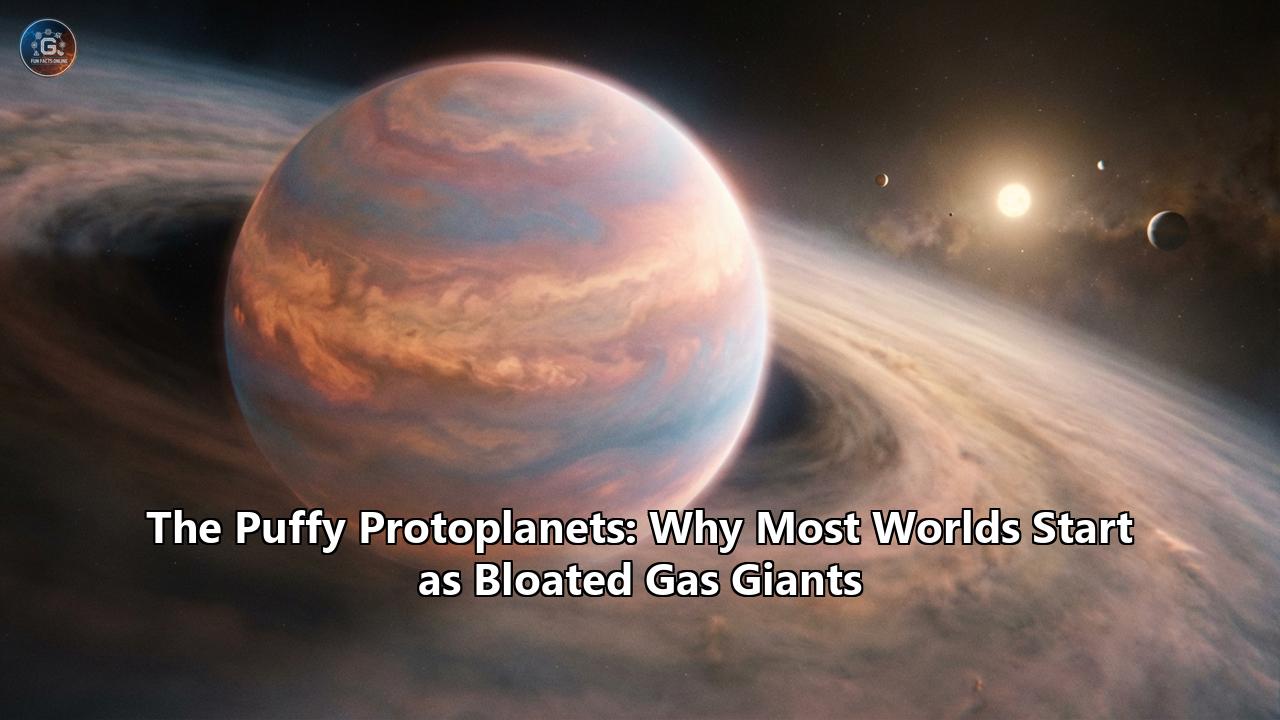
The universe is a place of violent, transformative magic, but perhaps no trick is as startling as the one it plays on its youngest worlds. For decades, our understanding of planetary formation was neat, orderly, and largely based on the finished products we saw in our own solar system: small, rocky worlds huddled near the fire of the Sun, and gargantuan gas giants ruling the cold outer dark. But in the last twenty years, a revolution has swept through astronomy, driven by space telescopes that have peered into the nurseries of the galaxy. They have returned with a confusing, delightful, and paradigm-shifting discovery: the "Super-Puffs."
These worlds defy easy categorization. They are planets the size of Jupiter with the mass of a mere few Earths, possessing densities comparable to cotton candy or Styrofoam. They are swollen, bloated, immense spheres of tenuous gas that seem to float against the black backdrop of space like dandelion seeds. At first, they were dismissed as anomalies, freaks of stellar nature. But as the catalog of exoplanets has grown into the thousands, a new and provocative theory has emerged, one that rewrites the biography of nearly every planet in the cosmos, potentially including our own Earth.
The theory suggests that "puffiness" is not an anomaly, but a standard phase of planetary adolescence. It proposes that most worlds—even those that eventually become hard, rocky spheres—begin their lives as bloated gas giants, swaddled in immense, suffocating blankets of primordial hydrogen and helium. The story of planetary evolution, then, is not just one of accumulation, but of dramatic loss—a cosmic diet on a grand scale where worlds are stripped, boiled, and eroded down to their cores.
Part I: The Cotton Candy Mysteries
To understand why we now believe planets start as giants, we must look at the anomalies that broke our models. The poster child for this phenomenon is the Kepler-51 system, located about 2,600 light-years away in the constellation Cygnus. Orbiting a young, Sun-like star are three planets—Kepler-51b, c, and d. When astronomers first measured their radii, they found them to be comparable to Saturn and Jupiter. Naturally, they assumed these were gas giants with crushing gravity and metallic hydrogen cores.
But when they measured the planets' masses using the gravitational tug they exerted on each other, the results were baffling. These "giants" were practically ghosts. Kepler-51b, for instance, is about the size of Saturn but has a mass only a few times that of Earth. Its density is less than 0.1 grams per cubic centimeter. For comparison, water is 1 g/cm³, and Saturn, the least dense planet in our solar system, is roughly 0.7 g/cm³. You could not only float Kepler-51b in a bathtub; it would float on top of the foam.
These "Super-Puffs" presented a physics problem. How does a planet with such feeble gravity hold onto an atmosphere so voluminous that it inflates the world to the size of Jupiter? The answer lies in their youth and their heat. The Kepler-51 system is young—only about 500 million years old, compared to our Sun's 4.6 billion years. These planets are still hot from the violence of their formation, and their atmospheres are essentially "hot starts"—high-entropy envelopes of gas that haven't yet cooled and contracted.
Think of a soufflé fresh out of the oven. It is tall, airy, and magnificent. But let it sit for an hour, and it collapses into a dense, flat disk. Planets, it turns out, are cosmic soufflés. The Super-Puffs are not a rare, exotic species of planet; they are simply normal planets caught in the brief, fleeting moment before they deflate.
Part II: The Mechanics of the Bloat
To understand how a world becomes a puffy protoplanet, we have to go back to the protoplanetary disk—the swirling accumulation of dust and gas that surrounds a newborn star. In the standard "Core Accretion" model, planets begin as dust grains sticking together to form pebbles, then boulders, then planetesimals. Eventually, a rocky core forms.
Once this core reaches a critical mass—roughly ten times the mass of Earth—its gravity becomes strong enough to start pulling in gas from the surrounding disk. This is a runaway process. Hydrogen and helium, the most abundant elements in the universe, flood down onto the core. If the gas disk lasts long enough, the planet becomes a true gas giant like Jupiter, with a mass so high it can hold onto this gas forever.
But what if the gas disk dissipates before the planet can grow into a Jupiter? Or what if the core is just small enough that it can grab a lot of gas, but not keep it indefinitely?
This is where the "puffy" phase begins. When a planet first captures this gas, the envelope is incredibly hot. The energy of accretion—rocks slamming into the core, gas falling down the gravity well—generates immense heat. In the vacuum of space, gas expands when heated. These young worlds are radiating away the heat of their birth, and this internal luminosity acts like a pump, inflating their hydrogen atmospheres to ridiculous proportions.
At this stage, the distinction between a "rocky planet" and a "gas giant" is blurred. A world with a rocky core the size of Earth might be trapped inside a hydrogen envelope that extends out for ten Earth radii. To an observer, it looks like a gas giant. It has no solid surface visible from space, just a thick, opaque haze. It is only time, and the ruthlessness of its parent star, that will reveal its true nature.
Part III: The Great Atmospheric Escape
The universe is hostile to puffy things. As these bloated worlds orbit their stars, they are subjected to a relentless assault that will determine their destiny. This process is known as atmospheric escape, and it is the primary sculptor of the planetary population we see today.
Young stars are violent. They spin fast, possess powerful magnetic fields, and blast their systems with high levels of X-ray and Extreme Ultraviolet (XUV) radiation. This high-energy light doesn't just warm the planet; it attacks the atmosphere.
When an XUV photon hits a hydrogen molecule in the upper atmosphere of a puffy planet, it imparts enough energy to break the molecular bond and send the atoms flying. If these atoms gain enough speed to overcome the planet's escape velocity, they are lost to space forever. This is called photoevaporation.
We have actually caught this murder in progress. The exoplanet WASP-121b, a "hot Jupiter," has been observed by the James Webb Space Telescope trailing massive plumes of helium gas. It is literally evaporating before our eyes. For smaller, puffy worlds, this process is even more catastrophic. Lacking the deep gravitational well of a Jupiter, they cannot hold onto their inflated envelopes against the stellar wind.
There is also a second, internal enemy: the planet's own heat. This mechanism, known as core-powered mass loss, suggests that the heat radiating from the cooling rocky core is enough to push the light hydrogen atmosphere away, even without the star's help. It’s a slow leak that persists for billions of years, gradually deflating the world.
This "cosmic diet" explains one of the most famous features in exoplanet demographics: the Radius Valley.
When astronomers count exoplanets by size, they see a strange gap. There are many "Super-Earths" (rocky worlds about 1.5 times Earth's size) and many "Sub-Neptunes" (gassy worlds about 2.5 times Earth's size). But there are very few planets in between. This gap is the Radius Valley.
The puffy protoplanet hypothesis explains this perfectly. Planets that start with a little bit of gas eventually lose it all and shrink down to become bare rocky Super-Earths. Planets that start with a lot of gas manage to keep some of it, shrinking only enough to become Sub-Neptunes. The "in-between" size is unstable; you either lose the envelope entirely or you have enough mass to keep a significant layer. It’s a binary outcome driven by the physics of evaporation.
Part IV: Earth’s Secret Past as a Gas Giant
This brings us to the most tantalizing implication of the theory: What about us? Did Earth, Mars, and Venus start as puffy protoplanets?
For a long time, the consensus was that the inner solar system was too hot and the gas too sparse for the terrestrial planets to have ever accumulated significant hydrogen atmospheres. We were thought to be "born dry and rocky," accumulating our thin secondary atmospheres (nitrogen, carbon dioxide, water vapor) later through volcanic outgassing and comet impacts.
But recent evidence is overturning this view. It is now looking increasingly likely that the embryonic Earth did capture a primordial hydrogen atmosphere from the solar nebula. We may have briefly been a "Mini-Neptune," a hot, pressurized world hidden beneath a blanket of hydrogen hundreds of times thicker than our current air.
The evidence for this is hidden deep underground. Geochemists studying the Earth’s mantle and core have found chemical signatures that are difficult to explain if Earth formed solely from dry rocks. Specifically, the density of Earth's core is lower than it should be if it were pure iron-nickel. It suffers from a "density deficit"—it contains lighter elements.
One of the best candidates for this light element is hydrogen. But how does hydrogen get into the iron core? Hydrogen is a gas; iron is a metal. They don't usually mix. However, under the crushing pressure of a thick, primordial hydrogen atmosphere, the rules of chemistry change.
If early Earth was covered in a magma ocean (which it was) and blanketed by a puffy hydrogen atmosphere (which models now suggest), the hydrogen would have dissolved into the magma like carbon dioxide dissolves into soda. This hydrogen-saturated magma would then circulate down to the core. Models published in Nature in 2023 suggest that this interaction between a primordial H2 atmosphere and the magma ocean can explain not only the light elements in our core but also the oxidation state of our mantle and the origin of our water.
In this scenario, Earth’s water was not just delivered by comets later on. Instead, it was manufactured right here. The hydrogen from the puffy atmosphere reacted with oxygen in the magma to form water. When the atmosphere was eventually stripped away by the young Sun’s ferocity, the water remained trapped in the mantle, eventually outgassing to form our oceans.
We are, in essence, the remnant core of a failed gas giant. The blue skies of Earth are the result of a billions-year-long process of stripping away the grey, choking shroud of our infancy.
Part V: Visualizing the Alien Skies
What would it have been like to stand on the surface of one of these young, puffy worlds?
If you could survive the heat—temperatures on these young worlds often exceed 1,000 degrees Celsius—the view would be claustrophobic. Unlike the transparent atmospheres of modern Earth or Mars, the envelopes of puffy protoplanets are often filled with high-altitude hazes.
On the Super-Puffs like Kepler-51, the "surface" (where the gas becomes optically thick) is not a hard crust, but a transition into darkness. High in the atmosphere, photochemical reactions driven by the star’s UV light turn methane and other hydrocarbons into a thick smog, similar to Titan but much hotter. These hazes would scatter light in strange ways. Instead of a blue sky, you might see a dull, flat ochre or a milky white void that obscures the stars and the sun.
As you descended, the pressure would mount rapidly. You would pass through layers of exotic clouds—perhaps salt clouds (potassium chloride) or silicate clouds (vaporized rock) that rain liquid sand. The "air" would be a soup of hydrogen and helium, odorless and colorless but incredibly thick.
Seen from space, these worlds are not the banded, colorful jewels like Jupiter. The haze layers flatten their spectra, making them appear featureless and uniform. They are ghostly, pale marbles, perhaps glowing faintly red from their own internal heat on the night side.
However, the most spectacular visual would be the death of the atmosphere. If you could see in the ultraviolet spectrum, these worlds would look like comets. A planet undergoing hydrodynamic escape trails a massive tail of gas behind it. This tail can be millions of kilometers long, a spiraling ribbon of hydrogen being ripped away by the stellar wind. On the day side, the heat causes the atmosphere to boil up, expanding outward in a supersonic wind that flows toward the night side and then out into the void. It is a violent, chaotic shedding of skin.
Part VI: The Implications for Life
The realization that puffy protoplanets are common has profound implications for the search for life. Initially, it might seem like bad news. If a planet starts with a suffocating hydrogen envelope, does that ruin its chances for habitability?
Not necessarily. In fact, it might be a prerequisite.
As we saw with the Earth theories, the "puffy phase" might be the chemical factory that creates a habitable composition. The reaction of the hydrogen envelope with the rocky surface creates water. It also creates a "reduced" mantle state that is favorable for the later release of gases like methane and ammonia, which are crucial prebiotic molecules.
Furthermore, the loss of the atmosphere is a self-regulating process. If a planet loses too much, it becomes a dry rock like Mercury. If it keeps too much, it remains a Mini-Neptune with crushing pressures where life as we know it is impossible. But if the timing is just right—if the star strips away the thick envelope just as the planet cools, leaving behind a secondary atmosphere of water and nitrogen—you get a recipe for a habitable world.
This "Goldilocks evolution" means that habitability is not just about where a planet is (the Habitable Zone), but how it evolved. A planet in the perfect orbit might be lifeless if it didn't undergo the puffy phase to generate water. Conversely, a planet might be lifeless if it failed to shed its puffy coat.
Part VII: The Future of Discovery
We are currently in the Golden Age of exoplanet characterization. The James Webb Space Telescope (JWST) is finally giving us the ability to sniff the atmospheres of these puffy worlds. Unlike the Hubble Space Telescope, which struggled to see through the thick hazes of Super-Puffs, JWST’s infrared vision can peer deeper.
Initial observations of systems like V1298 Tauri (a young planetary system, roughly 20 million years old) are confirming our suspicions. These planets are enormous for their mass, caught in the act of contraction. By watching these teenage solar systems, we are essentially watching a time-lapse movie of our own solar system’s history.
In the coming decade, we expect to find thousands more of these worlds. We will map the "evaporation desert"—the regions around stars where planets have been stripped bare. We will analyze the tails of dying atmospheres to see exactly what heavy elements are being dragged up from the interior. And we will refine our models to understand exactly how much "puff" Earth had, and how lucky we were to lose it.
Conclusion: The Universal Diet
The story of the puffy protoplanets is a story of transformation. It teaches us that planets are not static sculptures of rock and gas, but dynamic, evolving beasts. They are born bloated, hot, and chaotic, and they spend their lives being chiseled by the light of their stars.
Most worlds, it seems, start as gas giants. The rocky islands of the cosmos—the Earths, the Venuses, the Marses—are merely the survivors, the remnant cores left behind after the great evaporation. We are the leftovers. But in that process of stripping away the excess, the universe carved out something delicate, wet, and uniquely capable of hosting life.
So the next time you look at the gas giants Jupiter and Saturn, respect them. They are the ones who kept their "baby fat," the ones who never grew out of their puffy phase. And when you look at the ground beneath your feet, remember that it was once buried under a sky of hydrogen thousands of miles deep, a core waiting for the sun to set it free.
Further Reading & Technical Context
For those interested in the deeper science behind this article, several key areas of astrophysical research underpin the "Puffy Protoplanet" narrative.
1. The Entropy of Formation (Hot Start vs. Cold Start)The "puffiness" of a young planet is largely a function of its initial entropy. In thermodynamics, entropy relates to the amount of disorder or heat content.
- Hot Start (High Entropy): In the disk instability model (or rapid gas accretion), gas collapses quickly, trapping heat. This results in a planet with a large radius and high luminosity. These are the "Super-Puffs."
- Cold Start (Low Entropy): In the core accretion model, gas falls onto the core through a shock front, which can radiate away much of the heat. These planets start smaller and denser.
The existence of Super-Puffs like Kepler-51b strongly favors "hot start" scenarios or specific accretion conditions where heat is trapped efficiently (high opacity atmospheres).
2. Photoevaporation and the "Radius Gap"The Fulton Gap (or Radius Valley), discovered in 2017 using Kepler data, is a scarcity of planets with radii between 1.5 and 2.0 Earth radii.
- Below the gap: Super-Earths (rocky, stripped cores).
- Above the gap: Sub-Neptunes (rocky cores with H/He envelopes).
This bimodal distribution is the strongest statistical evidence that many Super-Earths are actually "failed" gas giants that lost their atmospheres. Models by Owen & Wu (2013, 2017) and Gupta & Schlichting (2019) show that a population of puffy planets evolving under XUV radiation naturally reproduces this gap.
3. The "Boil-Off" RegimeFor very young, low-mass planets (like the Super-Puffs), the atmospheric loss isn't just driven by X-rays (photoevaporation). The atmosphere is so fluffy and loosely bound that the planet's own internal heat can drive a "boil-off." This spontaneous mass loss happens rapidly after the protoplanetary disk disperses, shrinking the planet significantly before photoevaporation even takes over as the dominant mechanism.
4. Young Star VariabilityThe "puffy" phase coincides with the period when the host star is most active. Young stars (T-Tauri phase) can emit X-ray fluxes 100 to 1000 times higher than the modern Sun. This synchronicity is crucial; just as the planet is most vulnerable (most bloated), the star is most aggressive. This interplay defines the final architecture of the planetary system.
5. Detection BiasesIt is worth noting that "Super-Puffs" are easier to detect in some ways because their large radii block more starlight during transit. However, their low masses make them hard to confirm with radial velocity methods (which measure the star's wobble). This discrepancy led to early skepticism, but the "transmission spectroscopy" (analyzing light passing through the atmosphere) has confirmed their gaseous nature, even if the flat spectra indicate high-altitude hazes/dust.
Glossary of Terms
- Protoplanetary Disk: The rotating circumstellar disk of dense gas and dust surrounding a young newly formed star from which planets are formed.
- Core Accretion: The standard model of planet formation where a solid core forms first and then attracts a gaseous envelope.
- Hydrodynamic Escape: A thermal atmospheric escape mechanism where the upper atmosphere heats up and expands as a fluid, flowing away from the planet (like a solar wind).
- Exoplanet: A planet outside our solar system.
- Radius Valley (Fulton Gap): An observed dip in the number of exoplanets with sizes between 1.5 and 2 Earth radii, separating rocky Super-Earths from gaseous Sub-Neptunes.
- Bond Albedo: The fraction of power in the total electromagnetic radiation incident on an astronomical body that is scattered back out into space.
- Scale Height: The vertical distance over which the density and pressure of the atmosphere fall by a factor of e (about 2.718). Super-puffs have enormous scale heights.
By viewing our galaxy through the lens of the "Puffy Protoplanet" hypothesis, we see a universe that is dynamic, destructive, and ultimately, responsible for the creation of the rocky worlds we call home. The ghosts of gas giants are everywhere—we are standing on one.
Reference:
- https://www.colorado.edu/today/2019/12/19/behold-super-puffs-planets-fluffy-cotton-candy
- https://www.space.com/kepler-51d-superpuff-exoplanet
- https://www.sciencealert.com/adorably-named-super-puff-planets-are-like-nothing-in-the-solar-system
- https://www.slashgear.com/cotton-candy-super-puff-worlds-found-in-kepler-51-star-system-27604585/
- https://en.wikipedia.org/wiki/Super-puff
- https://www.youtube.com/watch?v=thY02K1huQ4
- https://www.researchgate.net/publication/394791176_Modeling_tails_of_escaping_gas_in_exoplanet_atmospheres_with_Harmonica
- https://aasnova.org/2021/03/15/spotting-a-faint-escaping-atmosphere/
- https://www.miragenews.com/webb-telescope-reveals-spectacular-atmospheric-1586999/
- https://courses.lumenlearning.com/suny-earthscience/chapter/early-earth/
- https://www.colorado.edu/today/2005/04/05/cu-study-shows-early-earth-atmosphere-hydrogen-rich-favorable-life
- https://www.reddit.com/r/Aritzia/comments/1oucc3i/has_the_quality_of_the_super_puff_gone_downhill/
- https://gabb.com/blog/teen-slang/
- https://www.reddit.com/r/Aritzia/comments/ryl5c1/super_puff_upgrades_throughout_the_years/
- https://cmns.umd.edu/news-events/news/early-earth-had-hazy-methane-filled-atmosphere
- https://academic.oup.com/mnras/article/543/2/917/8242164
- https://aasnova.org/2016/04/06/the-birth-of-super-earths-and-super-puffs/
- https://www.sciencealert.com/nasa-telescopes-reveal-the-atmosphere-of-a-strange-hybrid-exoplanet
- https://space.umich.edu/new-from-jwst-an-exoplanet-atmosphere-as-never-seen-before/