
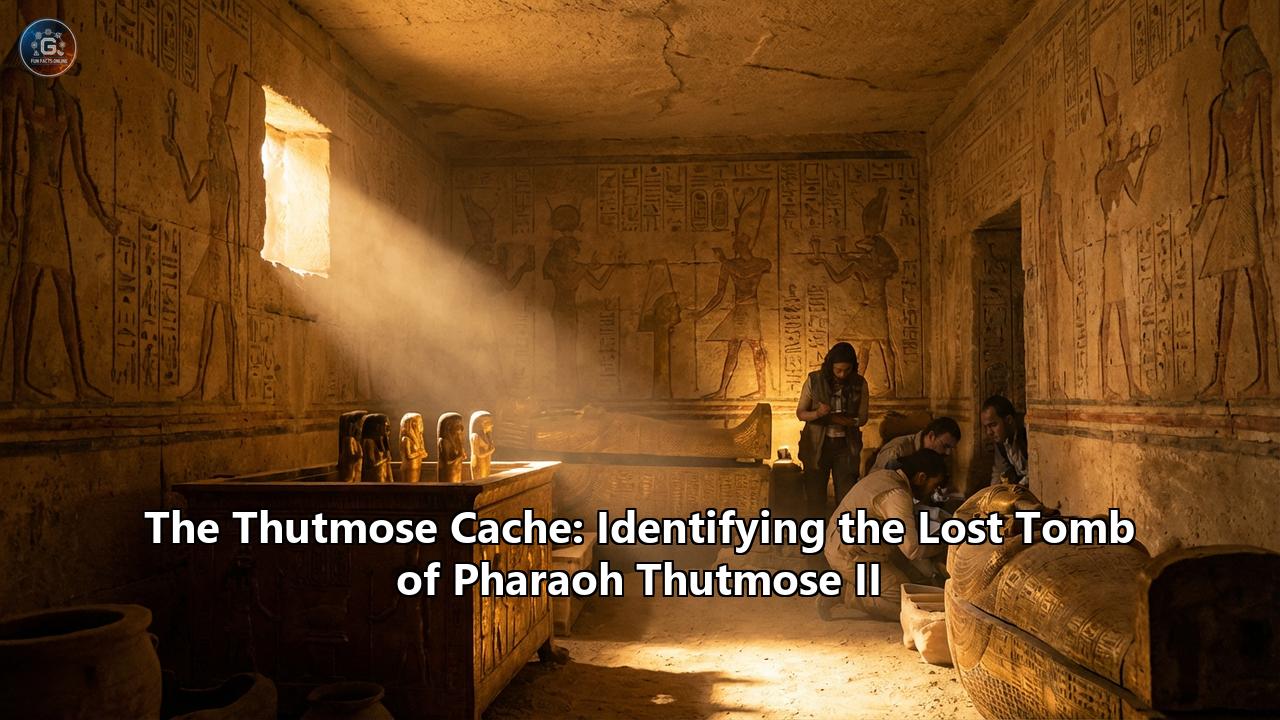
In the sun-drenched, dust-swept hills of the Theban Necropolis, a mystery that has baffled Egyptologists for over a century has finally been laid to rest. For decades, the Kings of the Eighteenth Dynasty—the "Golden Age" of ancient Egypt—were all accounted for, their tombs mapped and cataloged in the Valley of the Kings. All, that is, except one. Thutmose II, the fourth pharaoh of this illustrious lineage, remained a phantom. His mummy sat in a museum, a refugee found in a 19th-century cache, but his eternal home—the sacred space carved to launch his soul to the afterlife—was missing.
For over a hundred years, the question remained: Where was the Falcon in the Nest buried?
The answer, it turns out, was not in the famous Valley of the Kings, but hidden in a rugged, forgotten cleft of the Western Wadis, beneath the path of an ancient waterfall. The discovery of Tomb Wadi C-4—now confirmed as the lost tomb of Thutmose II—is a detective story three millennia in the making. It is a tale of a king overshadowed by his ambitious wife, a tomb ravaged by flash floods, and a modern archaeological triumph that rewrites the history of the New Kingdom.
This is the full, comprehensive story of the search, the discovery, and the secrets of the Thutmose Cache.
Part I: The Phantom Pharaoh
The Shadow of Giants
To understand the significance of this discovery, one must first understand the man himself—or rather, the enigma that was Thutmose II. In the annals of history, he has long been relegated to the role of a placeholder. He was the son of the great warrior Thutmose I and the father of the Napoleon of Egypt, Thutmose III. But most famously, he was the husband and half-brother of Hatshepsut, the woman who would declare herself King.
Thutmose II ascended the throne around 1493 B.C.E., a young man described in inscriptions as a "hawk in the nest." His reign was brief, likely no more than three to thirteen years, and traditional narratives have painted him as frail, passive, and dominated by his powerful wife. Yet, the archaeological record hints at a more complex reality. He led campaigns into Nubia to crush rebellions; he dispatched expeditions to the Sinai; his name appears on monuments at Karnak. He was a divine ruler of a burgeoning empire, yet upon his death, he seemed to vanish from the landscape.
While the tombs of his father (KV38) and his son (KV34) were located in the prestigious Valley of the Kings, Thutmose II’s tomb was nowhere to be found. Early excavators like Howard Carter and Victor Loret scoured the cliffs, finding the resting places of nearly every other major player of the 18th Dynasty. The absence of Thutmose II became a glaring hole in the map of the Theban Necropolis.
The Mummy in the Cache
The mystery was compounded in 1881 with the discovery of the Royal Cache at Deir el-Bahari (DB320). In this hidden cliff-side tomb, priests of the 21st Dynasty had stashed dozens of royal mummies to protect them from tomb robbers. Among the illustrious dead—Ramses the Great, Seti I, Amenhotep I—lay a mummy labeled as Thutmose II.
The body, however, raised more questions than answers. The mummy was badly damaged by ancient robbers; his left arm was broken, his body hacked at in search of amulets. But it was the forensics that puzzled scientists. The mummy appeared to be that of a man in his thirties, plagued by a skin disease, possibly smallpox or a parasitic infection. This physical evidence clashed with the historical theory of a frail youth who died young. Was this truly Thutmose II? And if so, where had he been moved from?
The "Thutmose Cache" thus became a dual mystery: the identity of the body in the box, and the location of the tomb from which it was torn.
Part II: The False Leads and the Western Wadis
The Candidate: KV42
For much of the 20th century, archaeologists believed they might have already found his tomb without realizing it. KV42, a tomb in the Valley of the Kings, was a prime suspect. It was unfinished, with a cartouche-shaped burial chamber typical of the era. It contained an unfinished quartzite sarcophagus.
However, the "smoking gun" was missing. Foundation deposits found by Howard Carter in 1921 bore the name of Merytre-Hatshepsut, the wife of Thutmose III, not Thutmose II. The walls were unadorned, the chamber unused by its intended owner. The academic consensus shifted: KV42 was not the King’s tomb. The search was back to square one.
Into the Wild: The Western Wadis
In the early 21st century, attention shifted away from the crowded Valley of the Kings to the Western Wadis, a rugged, desolate area of the Theban mountain range known in Arabic as Gabbanat el-Qurud (The Cemetery of the Monkeys). This area was historically associated with the queens and minor royals of the 18th Dynasty. It is a harsh landscape of soaring cliffs and deep ravines, prone to violent flash floods during rare desert storms.
It was here, miles from the tourist crowds, that the New Kingdom Research Foundation, a mission affiliated with the University of Cambridge and led by the tenacious archaeologist Dr. Piers Litherland, began a systematic survey.
The team was looking for the missing pieces of the Thutmoside family puzzle. They knew that Thutmose III had buried his foreign wives in this area (in the famous Wady D tomb). The logic was sound: if the main Valley was full or politically complicated, perhaps the earlier Thutmosides had utilized these remote cliffs.
Part III: The Discovery of Tomb C-4
The "Debris of Centuries"
In October 2022, the team focused on a site beneath a sheer cliff face, directly under the path of an ancient, dried-up waterfall. It seemed an unlikely place for a tomb—a geological funnel for water and debris. Yet, as they cleared the mountains of rubble, the outline of a rock-cut staircase emerged.
For three seasons, the team excavated. The work was brutal. They were essentially digging out a drain that had been clogged with thousands of years of flood deposits—layers of concrete-hard mud and limestone chips.
Initially, the expectations were modest. "We thought it was a tomb of a royal wife or a princess," Dr. Litherland later admitted. The location, adjacent to other queens' tombs, suggested a consort. But as they descended deeper, the architecture began to speak a different language.
The staircase was too grand. The corridor was too wide. And then, they reached the burial chamber.
The Blue Ceiling
The breakthrough came when the team breached the main chamber. Though the room was filled with debris, a glimpse of the ceiling froze the archaeologists in their tracks.
Peeking through the dust was a patch of blue paint adorned with yellow stars.
In the iconography of the New Kingdom, this celestial ceiling was a prerogative of kings. It represented the night sky, the realm of the goddess Nut, into which the pharaoh would be reborn. Commoners and minor royals did not sleep under the stars of the netherworld; only a Pharaoh did.
"At that moment," Dr. Litherland recalled, "we knew. This wasn't a queen. This was a King."
The Smoking Gun: The Alabaster Jars
The tomb, designated Wadi C-4, had been thoroughly looted in antiquity. The sarcophagus was gone, the golden masks melted down, the furniture stolen. However, the looters—and the floods—had left behind fragments of history.
Sifting through the flood deposits, the team found the "smoking gun" that every archaeologist dreams of: shards of alabaster canopic jars and vessels.
Cleaning the fragments revealed hieroglyphic inscriptions. The mesmerizing shapes of the ibis and the sun disk appeared: Djehutymes (Thutmose). And alongside it, the cartouche of his Great Royal Wife, Hatshepsut.
The inscriptions referred to Thutmose II as the "Good God" and the "Lord of the Two Lands." There was no doubt remaining. This was the original, long-lost tomb of Thutmose II.
Part IV: Inside the Lost Tomb
Architecture of the Afterlife
Tomb C-4 is a marvel of early 18th Dynasty engineering, serving as a "missing link" in the evolution of royal tombs.
- The Orientation: Unlike the "bent axis" tombs of the early dynasty (like his father’s), C-4 shows a transition toward straighter axes, though it retains the intimate, hidden nature of the era.
- The Waterfall Trap: The most striking feature is its location. The tomb was cut directly into the bedrock at the base of a natural water run-off. This was a fatal flaw. The architects likely chose it for its dramatic, secluded beauty, or perhaps its alignment with sacred geography. However, it doomed the tomb to destruction.
- The Decoration: Though much of the plaster has fallen away, traces of the Amduat (The Book of the Hidden Chamber) were found on the walls. The Amduat maps the twelve hours of the night, guiding the sun god (and the deceased king) through the perils of the underworld to dawn. The presence of the Amduat is the final seal of royal ownership.
The Flood Theory
The excavation revealed why Thutmose II was "lost" to history. Stratigraphic analysis of the mud inside the tomb suggests a catastrophe occurred shortly after the King’s burial—perhaps as little as six years later.
A massive storm hit the Theban mountain. Water cascaded down the waterfall, smashing into the tomb entrance. The floodwaters, carrying tons of rocks and mud, burst into the corridors, smashing the funerary equipment and burying the King’s sarcophagus in sludge.
This event likely triggered the first "cache" operation. The priests or the officials of the reigning Pharaoh (likely Hatshepsut or young Thutmose III) would have had to mount a rescue mission. They entered the muddy, ruined tomb, retrieved the mummy of their father/husband, and salvaged what little grave goods survived.
This explains why the mummy ended up in the DB320 cache centuries later. He was a refugee twice over: first evicted by nature, then by men protecting him from robbers.
Part V: Rewriting History
Hatshepsut’s Devotion
One of the most compelling aspects of the discovery is the light it sheds on the relationship between Thutmose II and Hatshepsut. Popular history often casts Hatshepsut as the "wicked stepmother" or the ambitious usurper who shoved her weak husband aside.
The artifacts in Wadi C-4 tell a different story. The alabaster vessels were high-quality, expensive, and inscribed with her name alongside his. The tomb, while not as massive as later Ramesside tombs, was a fitting house of eternity, decorated with the sacred texts required for his resurrection.
Hatshepsut did not bury him in a pauper’s grave. She buried him as a King. The discovery suggests a partnership, a respectful transition of power where she honored his memory before eventually ascending the throne herself.
The Missing Link in the Valley
The location of C-4 in the Western Wadis also forces a rethink of the sacred geography of Thebes. We now know that the Western Wadis were not just for queens. For a brief period in the mid-18th Dynasty, this rugged canyon was a Royal Necropolis in its own right, a "Valley of the Kings: Part Two" that was abandoned, likely due to the flooding issues that destroyed Thutmose II’s tomb. This explains why Thutmose III moved back to the main Valley—he learned from the hydrological disaster that befell his father.
Part VI: The Thutmose Cache and the Future
The discovery of Wadi C-4 is being hailed by the Supreme Council of Antiquities as the most significant find since Tutankhamun. But unlike Tut’s tomb, which dazzled with gold, Thutmose II’s tomb dazzles with information.
It solves the topographical puzzle of the 18th Dynasty. It provides a context for the mummy in the museum. It offers a timeline of the natural history of the region (ancient climate change and flash floods).
As the excavation continues, the team hopes to find more: perhaps shabti figures, fragments of the sarcophagus, or jewelry dropped by the rescue party in the mud. Every sifted bucket of dust brings us closer to the man behind the mummy.
Conclusion: The Hawk Returns to the Nest
For 3,500 years, Thutmose II was a king without a castle, a ruler whose legacy was washed away by the rains and overshadowed by the brilliance of his family. The "Thutmose Cache" was a misnomer—he wasn't hiding; he was simply waiting.
The discovery of Tomb C-4 restores his dignity. It places him back on the map of Egyptian history, not as a footnote, but as a Pharaoh who commanded the stars on his ceiling and the devotion of his queen. The "Falcon in the Nest" has finally been found, and the Golden Age of Egypt shines a little brighter for it.
Reference:
- https://the-ancient-pharaohs.blogspot.com/2017/03/kv42-tomb-of-hatshepsut-meryet-ra-part.html
- https://www.cam.ac.uk/stories/tale-of-thutmose-tomb
- https://egypt-museum.com/discovery-of-thutmose-iis-tomb/
- https://kids.kiddle.co/KV42
- https://www.ancient-origins.net/ancient-places-africa/db320-uncovering-impressive-cache-hidden-pharaohs-005190
- https://en.wikipedia.org/wiki/Royal_Cache
- https://en.wikipedia.org/wiki/Thutmose_II
- https://ib205.tripod.com/kv42.html
- https://en.wikipedia.org/wiki/KV42
- https://thedebrief.org/lost-for-3500-years-archaeologists-unearth-long-missing-tomb-of-pharaoh-thutmose-ii/
- https://www.smithsonianmag.com/smart-news/archaeologists-say-theyve-discovered-the-first-ancient-egyptian-pharaohs-tomb-since-tutankhamuns-in-1922-180986097/
- https://archaeologymag.com/2025/02/long-lost-tomb-of-pharaoh-thutmose-ii/
- https://www.aljazeera.com/news/2025/2/19/thutmose-ii-tomb-is-egypts-biggest-archaeological-discovery-since-1922
- https://www.theguardian.com/world/2025/feb/19/first-new-pharaohs-tomb-to-be-found-in-over-a-century-discovered-in-egypt
- https://archaeology.org/news/2025/02/20/tomb-of-thutmose-ii-discovered-in-egypt/