
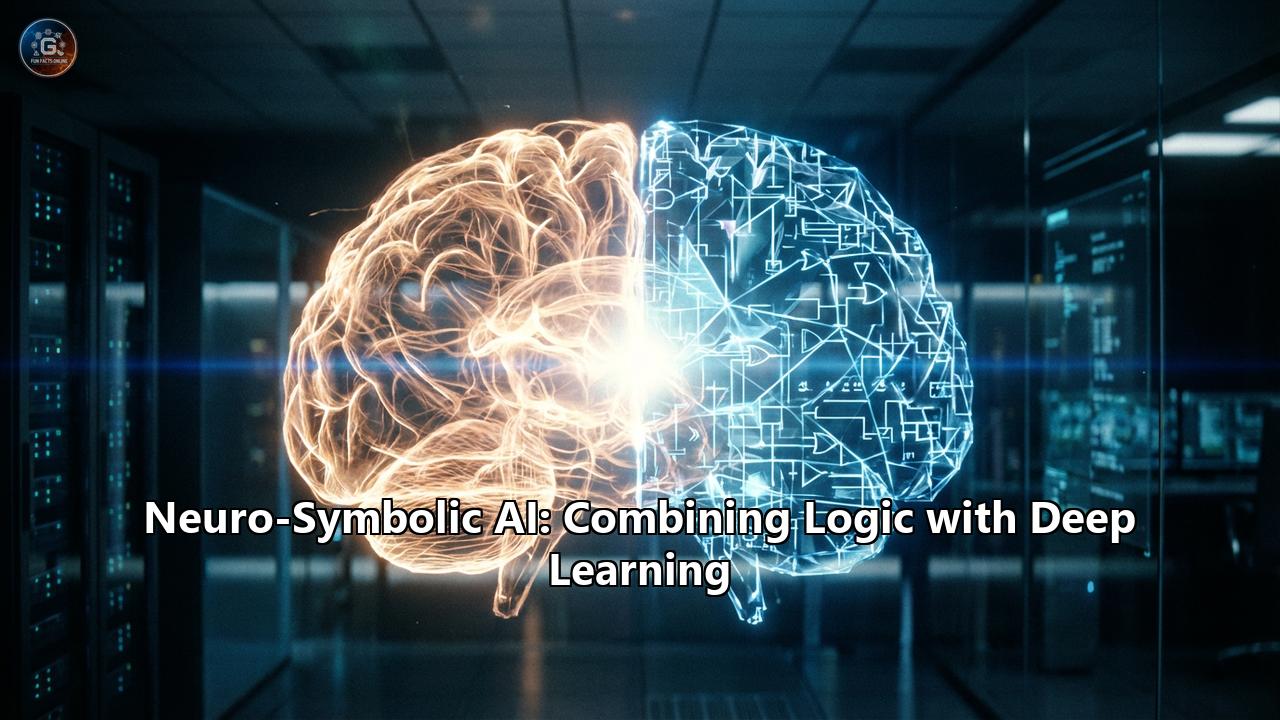
For the past decade, the field of Artificial Intelligence has been dominated by a single narrative: the triumph of Deep Learning. From the moment AlexNet crushed the competition at ImageNet in 2012 to the release of GPT-4 and Gemini, the "connectionist" paradigm—modeled loosely on the biological brain's dense web of neurons—has swept aside all rivals. These systems are the undisputed masters of intuition. They can identify a face in a crowd, write a sonnet in the style of Shakespeare, and predict the next token in a sequence with uncanny accuracy. They represent "System 1" thinking, as described by Nobel laureate Daniel Kahneman: fast, automatic, intuitive, and unconscious.
But for all their brilliance, these models suffer from a profound fragility. They are statistical mimics, not logical thinkers. A Large Language Model (LLM) can write a convincing proof of a mathematical theorem that contains a subtle, fatal logical flaw, and it will do so with the same confidence as when it recites the capital of France. They struggle with abstraction, compositionality, and rigorous reasoning. They are black boxes, their decisions buried in billions of opaque parameters, unexplainable to the humans who rely on them.
Enter Neuro-Symbolic AI, the herald of the "Third Wave" of Artificial Intelligence.
Neuro-Symbolic AI is not merely a new architecture; it is a philosophical reconciliation. It seeks to marry the learning capability and perceptual power of neural networks (System 1) with the reasoning, logic, and explainability of symbolic AI (System 2). It aims to build machines that can not only recognize a stop sign but understand why they must stop; machines that can learn from data but also follow the immutable laws of physics or the statutory rules of finance.
This article serves as a definitive chronicle of this emerging field. We will journey through the history of the "AI Wars," dissect the intricate mechanics of technologies like Logic Tensor Networks and Neural Theorem Provers, explore the cutting-edge breakthroughs of AlphaGeometry and AlphaProof, and examine real-world deployments in drug discovery and financial crime prevention. This is the story of how we are teaching machines to think, not just predict.
Part I: The Great Schism – A Historical Context
To understand the necessity of Neuro-Symbolic AI, one must first understand the decades-long civil war that has defined computer science.
The Era of Symbols (The First Wave)
In the beginning, there was logic. The "Good Old-Fashioned AI" (GOFAI) of the 1950s through the 1980s was built on the manipulation of symbols. Pioneers like John McCarthy and Marvin Minsky believed that intelligence could be reduced to the formal manipulation of abstract symbols according to explicit rules.
- The Philosophy: Intelligence is top-down. You define the rules of the world (e.g., Bird(x) -> CanFly(x)), and the machine deduces the consequences.
- The Triumph: These systems were incredibly robust within closed domains. IBM’s Deep Blue, which defeated Garry Kasparov, was fundamentally a symbolic search engine, evaluating millions of future board states based on hard-coded rules of chess. Expert systems in medicine (like MYCIN) could diagnose blood infections better than junior doctors by following a decision tree of "IF-THEN" rules.
- The Failure: The "Symbol Grounding Problem." A symbolic system knows that Bird(x) implies CanFly(x), but it has no idea what a "bird" actually looks like. It cannot perceive the world. Furthermore, the world is messy. Bird(x) -> CanFly(x) is true until you meet a penguin, an ostrich, or a bird with a broken wing. Encoding every exception into a rule-based system created the "knowledge acquisition bottleneck," leading to the collapse of the expert system market in the late 1980s—the first AI Winter.
The Era of Neurons (The Second Wave)
Rising from the ashes was Connectionism. Instead of hard-coding rules, researchers like Geoffrey Hinton, Yann LeCun, and Yoshua Bengio proposed that intelligence should emerge bottom-up from the data.
- The Philosophy: Don't tell the computer what a bird is. Show it a million pictures of birds and let it figure out the statistical patterns of pixels that distinguish a bird from a toaster.
- The Triumph: This approach, powered by the explosion of data and GPUs, gave us the Deep Learning revolution. It solved the perception problem. Machines could now "see" and "hear."
- The Failure: The "Black Box" and the "Reasoning Gap." Deep neural networks are opaque. They rely on correlation, not causation. A famous anecdote involves a neural network trained to distinguish wolves from huskies; it achieved high accuracy not by learning the features of the animals, but by detecting snow in the background (since most wolf photos were taken in winter). When presented with a husky in snow, it failed. It had no concept of "wolf," only a statistical correlation with white backgrounds.
The Neuro-Symbolic Synthesis (The Third Wave)
We are now standing on the precipice of the Third Wave. The goal is to create a hybrid system that possesses the "best of both worlds":
- Perception (Neural): The ability to handle messy, unstructured data (images, text, audio) and map it to symbolic concepts.
- Reasoning (Symbolic): The ability to manipulate those concepts using logic, causality, and planning, ensuring correctness and explainability.
As cognitive scientist Gary Marcus argues, "We cannot construct rich cognitive models in an adequate, automated way without the triumvirate of hybrid architecture, rich prior knowledge, and sophisticated techniques for reasoning."
Part II: The Mechanics of the Hybrid Mind
How do you actually connect a neural network, which deals in continuous vectors and floating-point numbers, with a symbolic system, which deals in discrete truths and false-hoods? This is the central engineering challenge of Neuro-Symbolic AI. Several distinct architectures have emerged to bridge this gap.
1. Logic Tensor Networks (LTN): The Differentiable Bridge
Logic Tensor Networks (LTNs) represent one of the most elegant mathematical solutions to the integration problem. Developed by researchers including Luciano Serafini and Artur d’Avila Garcez, LTNs propose a radical idea: Logic itself can be made differentiable.
In classical logic, a statement is either True (1) or False (0). This discreteness is the enemy of backpropagation, the algorithm used to train neural networks, which requires smooth, continuous slopes (gradients) to learn. LTNs solve this by using Real Logic (or Fuzzy Logic).
- Grounding: In an LTN, every symbolic concept is "grounded" onto a tensor (a multi-dimensional vector) in the neural network.
A constant (e.g., Socrates) is a vector in embedding space.
A predicate (e.g., IsHuman(x)) is a neural network (a binary classifier) that maps the vector x to a real number between [0, 1].
- Fuzzy Operators: Logical connectives are replaced by differentiable mathematical operations known as t-norms and s-norms.
AND ($A \land B$): In classical logic, this is $\min(A, B)$. In LTN, it might be the product $A \times B$ or the Lukasiewicz t-norm $\max(0, A + B - 1)$.
IMPLICATION ($A \rightarrow B$): This becomes a measure of how much the truth of A is "contained" within B.
- The Learning Loop: The beauty of LTN is that the "loss function" (the error signal) is simply the negation of the satisfiability of the logical formulas. If the knowledge base says For all x, Human(x) -> Mortal(x), the network tries to adjust the embeddings of x and the weights of the Human and Mortal classifiers so that this equation outputs a value close to 1.0 for every data point.
2. DeepProbLog: The Probabilistic Programmer
While LTNs focus on fuzzy truth, DeepProbLog focuses on uncertainty and probability. It extends the logic programming language Prolog, which was the darling of the 1970s.
Prolog solves problems by querying a database of facts and rules. DeepProbLog adds a twist: the "facts" can be the output of a neural network.
- The Neural Predicate: You can define a predicate digit(Image, Value) where the probability of Value being true is determined by a Convolutional Neural Network (CNN) processing the Image.
- The Arithmetic Circuit: When you ask DeepProbLog a query (e.g., "What is the sum of these two images?"), it builds a reasoning graph—specifically an arithmetic circuit or a Sentential Decision Diagram (SDD). This graph traces every possible logical path to the answer.
- Backpropagation through Logic: Because the graph is just a series of additions and multiplications of probabilities, you can send the error signal backwards through the logic graph, right into the neural network.
Imagine you show the system two images of handwritten digits (say, a 3 and a 5) and tell it the sum is 8. You do not tell it that the first image is a 3 or the second is a 5.
DeepProbLog uses the logic rule sum(X, Y, Z) :- digit(Img1, X), digit(Img2, Y), Z is X+Y.
It realizes that the only way for the sum to be 8 is if the images are (0,8), (1,7), (3,5), etc. Over thousands of examples, it triangulates the truth. It learns to recognize the digits "3" and "5" purely from the supervision of the sum, guided by the logical rules of addition.
3. The Neuro-Symbolic Concept Learner (NS-CL)
The Neuro-Symbolic Concept Learner (NS-CL), developed by researchers at MIT and IBM, addresses the problem of visual reasoning and language understanding. It is designed to learn like a child: looking at the world and hearing descriptions, without needing explicit labels for every object.
The architecture is a trilogy of modules:
- Visual Perception: A ResNet-based module looks at an image (e.g., a red cube and a blue sphere) and extracts object-based representations (vectors describing "Object A" and "Object B").
- Semantic Parsing: A sequence-to-sequence model translates a natural language question ("Is the red object to the left of the sphere?") into an executable symbolic program.
Input: "Is there a red sphere?"
Program: Exist(Filter(Scene, Color=Red, Shape=Sphere))
- Symbolic Execution: A quasi-symbolic engine executes this program on the object vectors.
NS-CL uses "Curriculum Learning." It starts with short, simple questions ("What color is this?"). By solving these, it learns the concepts of "Red" and "Blue" in its vector space. Once it solidifies these concepts, it moves to harder questions ("Is the red object left of the blue one?"), using the frozen concepts of color to learn the new concept of "Left."
This mimics human cognitive development. We don't learn complex spatial reasoning before we learn basic object identification.
Part III: The Flagship – AlphaGeometry and AlphaProof
If the architectures above are the engines, AlphaGeometry and AlphaProof are the moon rockets. Developed by Google DeepMind and unveiled between 2024 and 2025, these systems represent the state-of-the-art in Neuro-Symbolic AI, cracking problems that were previously thought to be the exclusive domain of human genius.
AlphaGeometry: The Olympiad Solver
In January 2024, DeepMind published a paper in Nature introducing AlphaGeometry. The challenge was Euclidean geometry problems from the International Mathematical Olympiad (IMO), the most prestigious high school math competition in the world.
Geometry is uniquely difficult for AI. It requires a visual understanding of space (System 1) and rigorous, multi-step logical deduction (System 2). Pure symbolic engines (like Wu’s method) get stuck because they can’t "see" the auxiliary constructions—the extra line or point you need to draw to make the solution obvious. Pure LLMs fail because they hallucinate; they might claim a triangle is isosceles when it isn't.
The Architecture:AlphaGeometry uses a dual-process system:
- The Symbolic Deduction Engine (DD+AR): This is the "slow" thinker. It uses Deductive Database (DD) and Algebraic Reasoning (AR). It takes the known facts (Point A is on Line B) and exhaustively deduces everything that must be true based on the axioms of geometry. It is perfectly rigorous but not creative. It inevitably hits a wall where no new facts can be deduced.
- The Neural Language Model (The "Intuition"): This is the "fast" thinker. When the symbolic engine gets stuck, the Neural Language Model (a Transformer trained on geometry data) looks at the problem state and suggests an auxiliary construction. It might say, "Try constructing a point D such that ABCD is a parallelogram."
The system enters a loop:
- Symbolic Engine: "I'm stuck."
- Neural Model: "Try drawing line segment XY."
- Symbolic Engine: "Okay, with XY, I can now deduce logical facts A, B, and C... I'm stuck again."
- Neural Model: "Try adding a circle through points X, Y, Z."
The genius of AlphaGeometry was its training data. There are very few human-written geometry proofs readable by machines. DeepMind bypassed this by generating 100 million synthetic theorems.
They worked backward:
- Generate a random mess of points and lines.
- Use the symbolic engine to find all true relationships in this mess.
- Work backward to find the minimal set of "premises" needed to prove those relationships.
- Train the Language Model on these synthetic "Premise -> Conclusion" pairs.
On a benchmark of 30 IMO geometry problems, AlphaGeometry solved 25. The previous state-of-the-art symbolic solver managed only 10. The average human Gold Medalist solves 25.9. AlphaGeometry 2, released in 2025 using the Gemini architecture, pushed this even further, solving 84% of historical geometry problems from the last two decades.
AlphaProof: The Formal Reasoning Engine
While AlphaGeometry conquered shapes, AlphaProof (2025) conquered general mathematical reasoning. It targets the Lean programming language—a "proof assistant" that verifies mathematical proofs with absolute certainty.
The Autoformalization Challenge:Most math is written in natural language (English + LaTeX). Computers can't rigorously check this. Lean requires code. AlphaProof bridges this by using a Gemini-based model fine-tuned to translate natural language math into Lean code (autoformalization).
The Reinforcement Learning Loop:AlphaProof is built on the AlphaZero algorithm (the same one that mastered Go and Chess).
- Generation: The network generates a candidate proof in Lean.
- Verification: The Lean compiler checks if the proof is valid.
If Valid: The proof is added to the training set (Gold standard).
If Invalid: The error message is used as feedback.
- Search: It uses Monte Carlo Tree Search (MCTS) to explore the space of possible proof steps, guided by a neural value function that estimates how "promising" a step is.
In the 2024 International Mathematical Olympiad, the combined force of AlphaProof (Algebra, Number Theory) and AlphaGeometry 2 (Geometry) achieved a score of 28/42. This is a Silver Medal performance—the first time an AI has achieved medal-level capability in the hardest math competition on Earth. Notably, AlphaProof solved the "Problem 6"—traditionally the hardest problem—which only five human contestants solved.
Part IV: Real-World Applications – Beyond the Classroom
While solving math problems is an impressive demonstration of reasoning, the true value of Neuro-Symbolic AI lies in its application to the messy, high-stakes problems of the real world: curing diseases and protecting global finance.
1. Healthcare: The Interpretable Cure
In drug discovery, the cost of failure is billions of dollars. Traditional "Black Box" AI can predict that a molecule might be a good drug, but it often cannot explain why, leading to failures in late-stage clinical trials due to unforeseen toxicity or lack of efficacy.
Case Study: MARS (MoA Retrieval System)In late 2024, researchers introduced MARS, a neuro-symbolic framework designed for Mechanism of Action (MoA) deconvolution.
- The Problem: We have a drug that works (phenotypic screening shows it kills cancer cells), but we don't know the biological target.
- The Solution: MARS uses a Knowledge Graph (KG)—a symbolic map of proteins, genes, and pathways. It combines this with a neural network that learns "rule weights."
- The "Why": Instead of just outputting "Target X," MARS outputs a logical path: "Drug A targets Protein B, which regulates Gene C, which is known to drive Tumor Growth."
- The Result: The 2024 study showed MARS achieved state-of-the-art performance while avoiding "reasoning shortcuts" (where AI guesses based on popularity of proteins rather than biological logic).
BenchSci, a Toronto-based company, deploys a massive neuro-symbolic engine used by top pharmaceutical companies (like Sanofi and Roche). Their platform, ASCEND, does not just read text; it "comprehends" experiments.
- The Neural: LLMs read millions of scientific papers to extract entities (antibodies, proteins, viruses).
- The Symbolic: These entities are mapped to a curated biological ontology (a rigorous rule-based structure).
- The Benefit: A scientist can ask, "Show me an antibody for Protein X that works in Western Blot for mouse tissue." The system reasons through the ontology to ensure the antibody matches the specific experimental context, saving millions of hours of wasted lab work.
VeriSIM Life utilizes a "Drug Decision Engine" called BIOiSIM. This is a classic neuro-symbolic hybrid.
- Symbolic: It incorporates mechanistic mathematical models of biology (differential equations describing how a liver metabolizes a chemical).
- Neural: It uses deep learning to estimate parameters for these equations from sparse data.
- This allows them to simulate clinical trials "in silico" (on a chip) before testing on humans, predicting drug repurposing opportunities (e.g., using a skin patch delivery for a drug originally designed as a pill).
2. Finance: The Logic of Money
The financial sector is governed by strict regulations (KYC, AML). A "Black Box" AI cannot tell a regulator, "I denied this loan because my neurons fired in a certain pattern." It must cite the specific risk factor or law.
Case Study: FraudGCN (2024)Financial fraud is a network problem. Fraudsters rarely work alone; they form rings. In 2024, researchers published FraudGCN, a system for detecting accounting fraud.
- The Graph: It models companies as nodes in a graph, connected by supply chains, auditors, and shared executives.
- The Neuro-Symbolic Twist: It uses Graph Neural Networks (GNNs) to learn suspicious patterns in the topology (the shape) of the network. However, it constrains these patterns with symbolic rules derived from accounting principles (e.g., "Revenue cannot grow by 500% if assets remain flat").
- Performance: Tested on Chinese listed companies, it outperformed traditional models by nearly 4%, a massive margin in financial terms.
In 2025, major global banks began deploying Neuro-Symbolic Enforcement Engines for AML.
- System 1: Transformer models analyze the time-series data of transactions to spot anomalies (e.g., a sudden burst of transfers at 3 AM).
- System 2: These anomalies are passed to a Knowledge Graph that encodes banking regulations and sanctions lists.
- The Outcome: The system doesn't just flag a transaction; it generates a suspicious activity report (SAR) narrative: "Flagged because User A transferred $9,000 (just below the $10k reporting limit) to a known shell company node, violating Rule 404-B." This reduces false positives, which cost banks billions in manual review time.
Companies like CausaLens are pushing "Causal AI," a subset of neuro-symbolic AI. In 2025, this became critical for risk management. Standard AI sees that "When ice cream sales go up, shark attacks go up" (correlation due to summer). Causal AI understands there is no link. In finance, this prevents models from crashing when market correlations break down (as they did during Covid-19). Causal AI builds a "Causal Graph" of the economy, allowing banks to simulate "Counterfactuals": "What would happen to our portfolio if inflation hits 8% but unemployment stays low?"
Part V: The Challenges of the Synthesis
Despite the triumphs, the road to a fully Neuro-Symbolic future is paved with difficulties.
- The Integration Gap (Discrete vs. Continuous): Neural networks rely on gradient descent, which requires a smooth, continuous landscape. Logic is discrete (step-like). Bridging this without losing the precision of logic or the learnability of the network is the primary mathematical hurdle. Techniques like the "Gumbel-Softmax" relaxation or Reinforcement Learning (as used in AlphaProof) are the current patches, but a unified mathematical theory is still elusive.
- Scalability of Logic: Symbolic reasoning is computationally expensive. Checking all logical consequences of a set of rules works for 100 rules, but not for the "Common Sense" of the real world, which might require millions of rules. This is the N-P Hard problem. AlphaGeometry skirts this by using a fast neural guide, but for general knowledge, the "reasoning lag" is real.
- The Symbol Grounding Problem 2.0: In the age of LLMs, we have "Semantic Parsing" that maps text to symbols. But does the LLM really understand the symbol Apple? Or is it just mapping the token "Apple" to the token Apple? True grounding requires a sensorimotor connection to the physical world—something robotics researchers are trying to solve with "VLM-Nav" (Visual-Language-Model Navigation).
Part VI: The Horizon – AGI and Beyond
Where does this lead? Many researchers, including IBM’s Artie/Garcez and the DeepMind team, believe Neuro-Symbolic AI is the necessary path to Artificial General Intelligence (AGI).
Temporal Reasoning and "Mental Time Travel":Current LLMs live in a static "now." New frameworks like NeSTR (Neuro-Symbolic Temporal Reasoning), proposed in late 2025, aim to give AI a timeline. They use symbolic logic to enforce temporal consistency ("If A happened before B, and B before C, A must be before C") over the fluid generation of the LLM. This is crucial for long-term planning agents.
Agentic AI:The future is "Agentic"—AI that takes action. An agent needs a neural perception of the environment but a symbolic "planner" to ensure its actions are safe and logical. We are moving toward Neuro-Symbolic Operating Systems, where the "Kernel" is a symbolic logic verifier that prevents the "Application" (the Neural Network) from executing harmful or illogical commands.
ConclusionWe are witnessing the end of the "Black Box" era. The Third Wave of AI is not a rejection of Deep Learning, but a maturation of it. By endowing our neural networks with the ancient power of logic, we are creating systems that are not just smart, but wise; not just powerful, but trustworthy. From the Silver Medal at the Math Olympiad to the molecule that cures a rare disease, Neuro-Symbolic AI is proving that the future of intelligence is hybrid. The machine is finally learning to think.
Reference:
- https://www.dainallen.com/post/neurosymbolic-ai-because-probably-doesn-t-cut-it-when-handling-your-money
- https://ai.plainenglish.io/causal-ai-in-finance-the-shift-from-what-to-why-21a5ebe18ff6
- https://www.oreateai.com/blog/bridging-times-gap-how-neurosymbolic-ai-is-sharpening-llms-temporal-smarts/98a88e36e2f56db952d192f9ac1222fe
- https://www.forbes.com/councils/forbestechcouncil/2024/09/23/neurosymbolic-ai-20-practical-real-world-applications/
- https://arxiv.org/abs/2410.05289
- https://ajithp.com/2025/07/27/neuro-symbolic-ai-multimodal-reasoning/
- https://www.youtube.com/watch?v=G0JW4wSxLLQ
- https://arxiv.org/html/2502.11269v1
- https://www.researchgate.net/publication/386453921_Neurosymbolic_AI_Revolutionizing_Fraud_Prevention_Systems
- https://www.verisimlife.com/solutions/drug-repurposing
- https://www.verisimlife.com/
- https://www.pymnts.com/fraud-prevention/2024/new-ai-system-aims-to-detect-financial-fraud-across-corporate-networks/