
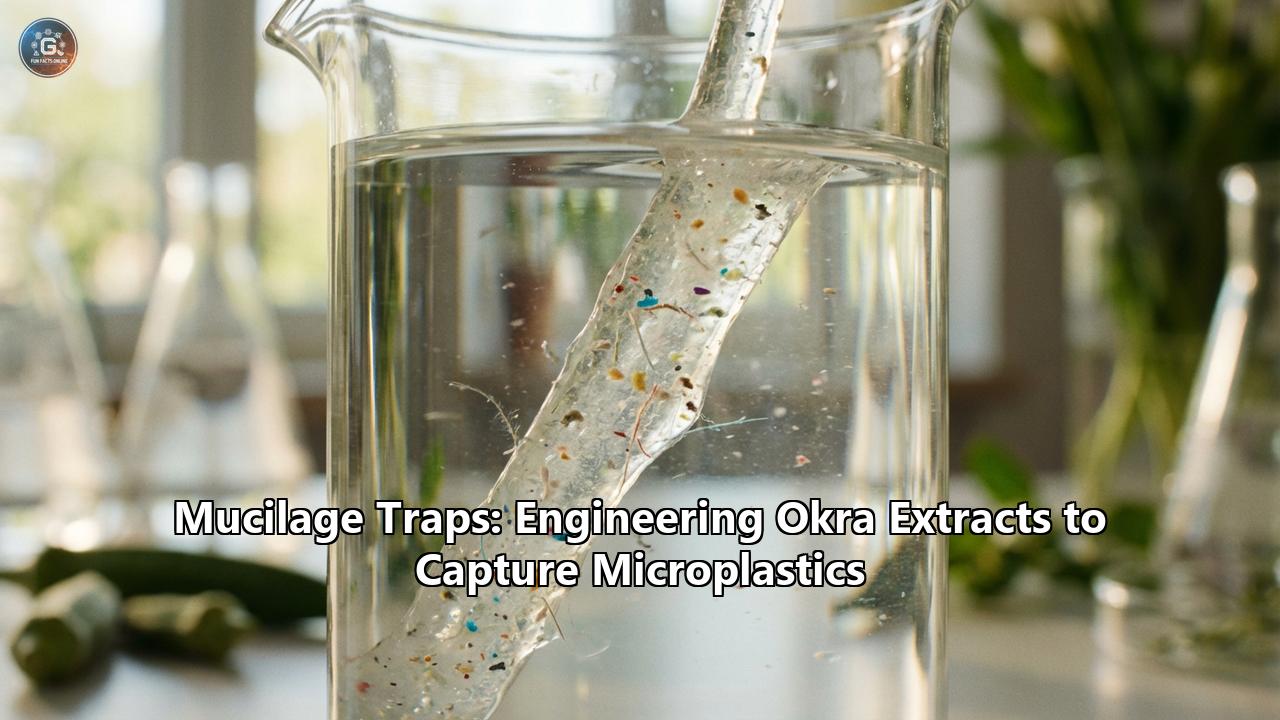
Introduction: The Solution on Your Dinner Plate
If you have ever sliced into a fresh pod of okra (Abelmoschus esculentus), you know the sensation: a sticky, viscous slime that clings to the knife and stretches into impossible strings. For chefs, this mucilage is a thickening agent for gumbo. For children, it’s a reason to push the vegetable to the side of the plate. But for environmental engineers and chemical scientists, this "goo" has recently revealed itself to be something far more valuable.
It is a weapon.
In the ongoing war against microplastics—the insidious, microscopic polymer fragments that now saturate our oceans, cloud our drinking water, and course through our own bloodstreams—okra slime has emerged as an unlikely hero. Recent breakthroughs in bio-engineering have demonstrated that the polysaccharides found in okra and fenugreek are not just culinary quirks; they are highly sophisticated molecular nets. When engineered correctly, these plant extracts can capture up to 90% of microplastics from contaminated water, outperforming the toxic synthetic chemicals that have dominated the water treatment industry for decades.
This is not a home remedy. It is the dawn of "Mucilage Trap" technology, a rapidly maturing field that marries ancient botany with cutting-edge chemical engineering. This article will take you deep into the science of slime, exploring how researchers are turning a common vegetable into a high-tech filtration system that could save our water supply.
Part I: The Invisible Enemy
The Scale of the Microplastic Crisis
To understand why okra extracts are such a revolutionary development, we must first understand the enemy they are fighting. Microplastics are defined as plastic particles smaller than 5 millimeters, but many are microscopic, invisible to the naked eye.
As of late 2025, the statistics are staggering:
- Ubiquity: Microplastics have been found in the deepest trenches of the Mariana, the pristine snows of Antarctica, and the placentas of unborn infants.
- Ingestion: The average human ingests approximately a credit card’s worth of plastic (5 grams) every week through water, food, and air.
- Toxicity: These particles act as "rafts" for dangerous pathogens and absorb toxic persistent organic pollutants (POPs) from the environment, delivering a concentrated dose of poison to whatever eats them.
The Failure of Conventional Treatment
For decades, municipal wastewater treatment plants (WWTPs) have relied on a chemical process called flocculation. To remove suspended particles, plants add synthetic flocculants—most commonly polyacrylamide (PAM). These chemicals act like glue, binding small particles together into larger clumps ("flocs") that sink and can be filtered out.
While effective at clearing mud and dirt, PAM has a dark side:
- Toxicity: Under certain conditions, PAM can break down into acrylamide, a potent neurotoxin and probable human carcinogen.
- Microplastic Inefficiency: Synthetic flocculants are designed for organic matter, not plastic. They often struggle to bind with the smooth, hydrophobic surfaces of polyethylene or polystyrene fragments.
- Secondary Pollution: We are essentially using a synthetic polymer (PAM) to try and clean up other synthetic polymers, creating a cycle of chemical dependency.
The water treatment industry has been desperate for a "Green Flocculant"—something non-toxic, biodegradable, and capable of grabbing plastic. Enter the Okra.
Part II: The Science of Slime
Deconstructing the Mucilage
What makes okra slimy? The secret lies in a group of complex carbohydrates called polysaccharides. Specifically, okra mucilage is rich in pectin (specifically rhamnogalacturonan-I) and galactomannans.
Imagine these polysaccharides as long, tangled molecular chains. In their natural state within the plant, they store water and protect seeds. But when introduced to contaminated water, they perform a feat of physics known as Bridging Flocculation.
The Mechanism:- The Net: When okra powder is dissolved in water, the long polysaccharide chains uncoil, forming a microscopic web.
- The Lure (Charge Neutralization): Most microplastics carry a negative surface charge, which causes them to repel each other and stay suspended in water. Okra polysaccharides have specific functional groups (like hydroxyl and carboxyl groups) that can interact with these charges.
- The Trap (Bridging): The long chains of the okra molecule physically hook onto multiple microplastic particles at once. Like a spiderweb catching flies, the mucilage pulls these isolated particles together.
- The Sink: As more microplastics get tangled in the "okra web," the cluster becomes heavy. Gravity takes over, and the entire mass—the "floc"—sinks to the bottom of the tank, leaving clear water above.
The Fenugreek Factor
While okra is the star, it works best with a partner. Researchers at Tarleton State University, led by Dr. Rajani Srinivasan, discovered that fenugreek (Trigonella foenum-graecum) adds a crucial boost.
Fenugreek seeds contain a different type of galactomannan structure that is chemically distinct from okra's pectin-heavy slime.
- Okra is excellent at bridging larger gaps and working in salty environments (like ocean water).
- Fenugreek forms a tighter, denser gel that is incredibly effective in groundwater systems.
When combined, they create a hybrid trap. The okra provides the long-reach "arms" to grab distant particles, while the fenugreek acts as the "glue" that holds the clump together, preventing it from breaking apart during filtration.
Part III: The Breakdown – Efficacy and Results
The 2022-2025 Research Breakthroughs
The journey from "cooking ingredient" to "industrial chemical" was solidified by a series of landmark studies culminating in 2025.
1. The "Recipe" for RemovalIn controlled laboratory settings, the efficacy numbers are groundbreaking. Dr. Srinivasan’s team tested various combinations against standard microplastics (like polystyrene beads) in different water types. The results were published in ACS Omega:
- Ocean Water: Okra extract alone was the champion, removing 80% of microplastics. Its molecular structure remains stable even in high-salinity environments where synthetic chemicals often fail.
- Groundwater: Fenugreek extract took the lead, removing nearly 90% of contaminants.
- Freshwater: The "Goldilocks" solution was a 1:1 blend of Okra and Fenugreek, which achieved removal rates of 77% to 93% depending on the specific plastic types.
Time is money in water treatment. Synthetic chemicals usually require rapid mixing followed by long settling times.
- The Bio-Flocculant Advantage: The Okra-Fenugreek blend reached maximum efficiency in just 30 minutes.
- Comparison: To achieve similar results, polyacrylamide (PAM) often requires higher dosages and leaves behind non-biodegradable sludge.
Perhaps the most important metric is safety. Even if a small amount of okra extract remains in the treated water, it is harmless. It is food. Conversely, residual acrylamide from synthetic treatment is a regulated health hazard.
Part IV: Engineering the Ultimate Trap
You cannot simply throw whole okra pods into a wastewater tank and expect results. The "Engineering" in "Engineering Okra Extracts" refers to the sophisticated processing required to turn a vegetable into a reliable industrial product.
1. Advanced Extraction: Beyond Boiling
Early experiments involved simple water soaking (maceration), but this is too slow for industry. Modern engineering utilizes Microwave-Assisted Extraction (MAE).
- The Process: Okra pods are subjected to controlled microwave radiation. This bursts the cell walls instantly, releasing the mucilage without degrading the polymer chains.
- The Result: MAE increases the yield of active polysaccharides by nearly 50% compared to traditional soaking and reduces extraction time from hours to minutes.
2. Chemical Modification
Bio-engineers are now "tuning" okra polysaccharides. By using enzymes or mild chemical treatments, they can graft new functional groups onto the okra backbone.
- Cationization: Adding positive charges to the naturally neutral/negative okra polymer increases its magnetic-like attraction to negatively charged microplastics.
- Cross-linking: creating 3D networks of okra polymers that act like a molecular sieve, trapping particles physically as well as chemically.
3. The Powder Form Factor
For scalability, the slimy extract must be dried. However, heat destroys the delicate polymer chains. Engineers use Lyophilization (Freeze-Drying) or Spray Drying to convert the mucilage into a fine, shelf-stable powder.
- Logistics: A water treatment plant doesn't need to store rotting vegetables. They store sacks of white "Okra-Floc" powder that can be kept for years and rehydrated on demand.
Part V: From Lab Bench to Treatment Plant
The Economics of Green Goo
The biggest hurdle for any green technology is cost. Can okra really compete with mass-produced synthetic chemicals?
The Cost Analysis:- Raw Material: Synthetic PAM is cheap, costing roughly $1.50 - $3.00 per kg. Food-grade okra powder is currently more expensive, ranging from $10 - $20 per kg.
- The "Hidden" Savings: However, techno-economic assessments conducted in 2024 and 2025 reveal a different picture when Total Cost of Operation is considered:
1. Sludge Disposal: Sludge containing PAM is toxic hazardous waste. Sludge containing okra is compostable. It can be turned into fertilizer or biogas, saving plants millions in disposal fees.
2. Dosage: Because okra-flocs are often larger and settle faster, plants can potentially increase their throughput (gallons treated per hour), offsetting the material cost.
3. Regulation: As governments tighten restrictions on acrylamide in water, the cost of using synthetics is rising due to compliance fines and monitoring requirements.
Pilot Programs
As of 2025, several pilot programs are underway in agricultural regions (where okra waste is abundant) such as Texas, India, and parts of West Africa. These "circular economy" models take "ugly" okra rejected by supermarkets, process it into flocculant, and use it to treat local irrigation water.
Part VI: Beyond the Treatment Plant
The Survivalist and DIY Angle
One of the most fascinating aspects of Mucilage Trap technology is its accessibility. Unlike reverse osmosis membranes or UV radiation systems, this is low-tech hardware driven by high-tech knowledge.
- Disaster Relief: In a hurricane or flood zone where water is turbid and contaminated, a packet of freeze-dried okra/fenugreek powder could act as an emergency clarifier, settling out mud and plastics before the water is boiled or chlorinated.
- The "Eco-Prepper": There is a growing movement of homesteaders using okra slime to filter rainwater, reducing their reliance on microplastic-laden municipal supplies.
Part VII: The Future Frontier
What comes next? The "Okra Era" is just beginning.
1. Genetic Super-OkraAgricultural scientists are looking at breeding variants of okra not for taste, but for slime content. These "industrial okra" varieties would be inedible, woody, and packed with hyper-potent polysaccharides designed specifically for filtration.
2. Hybrid MaterialsMaterial scientists are creating "Okra-Graphene" or "Okra-Chitosan" aerogels—spongy, lightweight materials that can float on the surface of the ocean, passively absorbing microplastics without harming marine life.
3. Medical ApplicationsIf it works in water, could it work in blood? Early speculative research is investigating if modified okra polysaccharides could be used in dialysis machines to filter microplastics out of human blood—a true sci-fi frontier.
Conclusion: A Sticky Solution to a Messy Problem
The irony is palpable. For years, we wrapped our vegetables in plastic. Now, we are using vegetables to un-wrap our water from plastic.
"Mucilage Trap" technology represents a fundamental shift in how we approach environmental engineering. It moves us away from the 20th-century mindset of fighting chemicals with stronger chemicals, and toward a 21st-century biomimicry approach. By engineering the humble okra extract, we have found a solution that is powerful, scalable, and fundamentally compatible with life.
The next time you see okra at the grocery store, don't just see a gumbo ingredient. Look at it with respect. You are looking at the future of clean water.
References & Further Reading
- Srinivasan, R. et al. (2025). "Fenugreek and Okra Polymers as Treatment Agents for the Removal of Microplastics from Water Sources." ACS Omega.
- Tarleton State University Research Database (2022-2025).
- Journal of Environmental Chemical Engineering: "Techno-economic assessment of plant-based bio-flocculants."
- Global Water Intelligence Report 2025: "The Rise of Bio-Coagulants."
Reference:
- https://scienceblog.com/okra-slime-outperforms-industrial-chemicals-in-removing-microplastics/
- https://www.sci.news/technologies/fenugreek-okra-extracts-microplastics-water-treatment-13882.html
- https://www.mpa.co.uk/news-insights/knowledge-hub/chemists-cook-up-way-to-remove-microplastics-using-okra/
- https://www.acs.org/pressroom/presspacs/2025/may/research-update-okra-fenugreek-extracts-remove-most-microplastics-from-water.html
- http://lionchems.com/news/319.html
- https://www.envirobiotechjournals.com/EEC/Vol30AugustSupplIssue2024/EEC-16.pdf
- https://www.sciencedaily.com/releases/2025/05/250506152214.htm
- https://www.technologynetworks.com/applied-sciences/news/okra-and-fenugreek-extracts-trap-up-to-90-of-microplastics-in-water-399352
- https://www.researchgate.net/publication/332796944_Okra_polysaccharides_reduced_the_gelling-required_sucrose_content_in_its_synergistic_gel_with_high-methoxyl_pectin_by_microphase_separation_effect
- https://www.redalyc.org/journal/3420/342063962003/html/
- https://pubmed.ncbi.nlm.nih.gov/40290963/
- https://files01.core.ac.uk/download/pdf/162656787.pdf
- https://pubs.acs.org/doi/10.1021/acsomega.4c07476