
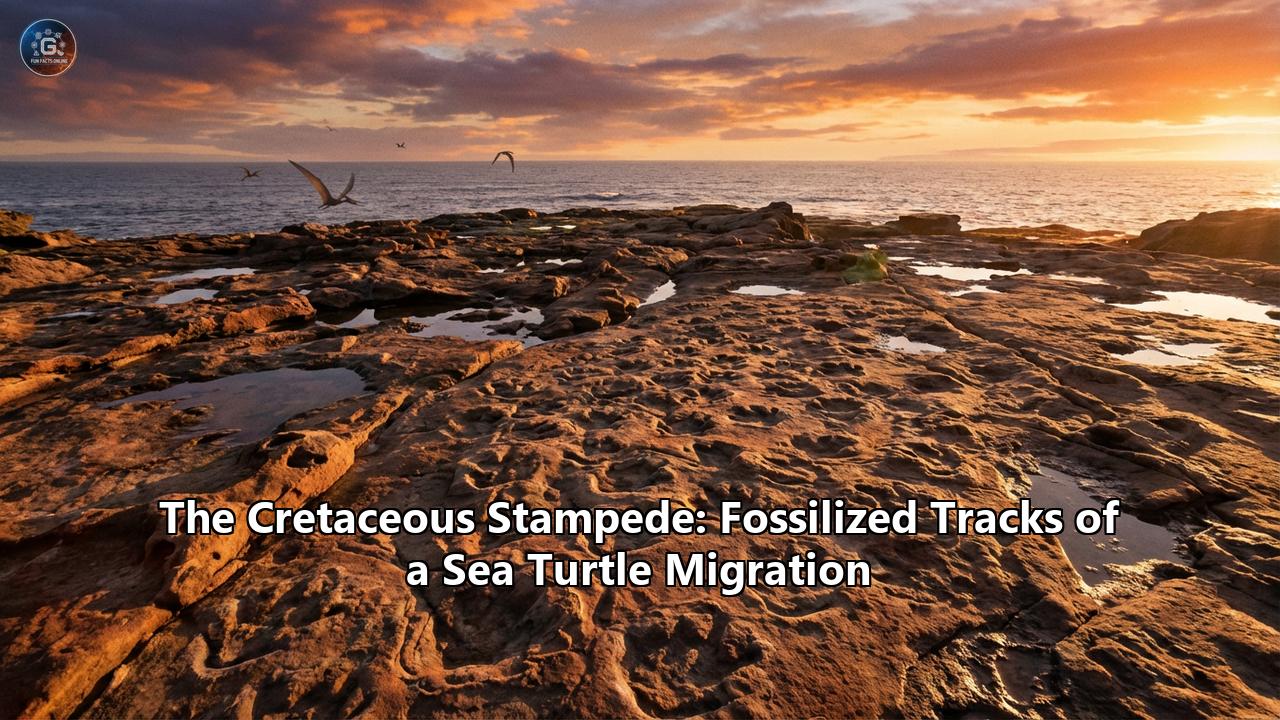
On a spring morning in 2019, amidst the salt-spray and sunlight of Italy’s Adriatic coast, a group of rock climbers scaled the limestone cliffs of Monte Cònero. They were looking for handholds, for friction, for the next move on a vertical face that plunged into the azure sea below. What they found instead was a moment of panic frozen in stone for eighty million years.
Etched into the white face of the "La Vela" slab were thousands of chaotic grooves and crescent-shaped depressions. To the untrained eye, they might have been tricks of erosion or the strange borings of ancient clams. But to the geologists who later examined them, they told a violent and spectacular story. These were not random marks. They were the frantic, thrashing footprints of a mass exodus—a "stampede" of Cretaceous sea turtles fleeing a cataclysmic earthquake that shook the floor of the ancient Tethys Ocean.
This discovery has since rippled through the paleontological community, offering a rare and vibrant window into the behavior of ancient marine reptiles. It is a story that connects the quiet, deep-sea deposition of the Scaglia Rossa limestone with the violent tectonics of the late Mesozoic, and the silent, stony records of the past with the living, breathing biology of the sea turtles we know today.
Part I: The White Cliffs of Time
To understand the stampede, one must first understand the stage upon which it played out. Monte Cònero is a geological anomaly. Rising abruptly from the Adriatic coastline south of Ancona, it is the only major limestone relief on the Italian east coast between Trieste and the Gargano. It is a mountain born of the sea, a massive upthrust of the Apennine orogeny that has exposed millions of years of Earth's history to the open air.
The rock that forms these cliffs is the Scaglia Rossa. For geologists, the Scaglia Rossa is legendary. It is the same formation that, in the nearby town of Gubbio, provided the first chemical evidence of the asteroid impact that killed the dinosaurs (the famous iridium anomaly discovered by Walter Alvarez). It is a pelagic limestone, formed from the slow, incessant rain of microscopic plankton shells—foraminifera and coccolithophores—drifting down to the dark, quiet bottom of a deep ocean basin.
Eighty million years ago, during the Campanian stage of the Late Cretaceous, this rock was soft mud. It lay hundreds of meters below the surface of the Tethys Ocean, a vast, tropical seaway that separated the supercontinents of Laurasia and Gondwana. The Adria microplate, which would later become the backbone of Italy, was a submerged promontory, a quiet realm far from the crashing waves of the shore.
In this silent, blue twilight, sediment accumulated at a rate of millimeters per millennium. It was an environment of stillness. Or so we thought.
The discovery at the La Vela outcrop shattered this image of tranquility. The slab in question, tilted nearly vertical by millions of years of tectonic pressure, revealed a surface that had been churned, scratched, and disturbed on a massive scale. The "trace fossils"—records of biological activity rather than biological remains—covered an area of hundreds of square meters. They were not the wandering, singular trails of a lonely scavenger. They were the chaotic overlapping marks of a crowd.
Part II: The Day the Sea Floor Shook
Reconstructing the event requires a blend of forensic geology and biological imagination. Based on the study led by geologist Alessandro Montanari and his colleagues, the timeline of the "Cretaceous Stampede" can be pieced together with chilling precision.
It is a day like any other in the Late Campanian. The water is warm, rich in nutrients upwelling from the deep. A massive aggregation of sea turtles is loitering near the seabed. Why they are here is a matter of debate—perhaps they are resting on the soft mud, perhaps they are feeding on a bloom of jellyfish or benthic crustaceans, or perhaps they are gathering for a migration, similar to the "arribada" (arrival) of modern Olive Ridley turtles.
Suddenly, the silence is broken. A deep, low-frequency rumble vibrates through the water column. The seabed shudders. It is a high-magnitude earthquake, a common occurrence in the tectonically active Tethys region where the African and Eurasian plates are grinding against each other.
For a sea turtle, water is an excellent conductor of sound and pressure. The shockwave would have hit them like a physical blow. Instinct took over. In a unified spasm of panic, the herd bolted.
The tracks on the La Vela slab show the mechanics of this flight. The marks are deep, rhythmic scratches made by the tips of long, powerful flippers. They are "swimming tracks"—not the footprints of an animal walking on land, but the scars left by animals swimming just centimeters above the bottom, their flippers digging into the mud to generate maximum thrust. The chaotic orientation of the tracks suggests confusion, a scrambling mass of bodies colliding and turning, desperate to escape the shuddering seafloor.
But the earthquake did more than just scare the turtles. It destabilized the underwater slopes above them. Moments after the stampede began, a massive volume of sediment collapsed, triggering a turbidite—an underwater avalanche.
This is the key to the preservation of the tracks. Normally, footprints in soft ocean mud are transient things. Currents wash them away; burrowing worms churning the sediment erase them within days. But the turbidite acted as a sealant. A thick slurry of mud and sand roared down the slope, burying the freshly made tracks under meters of sediment in an instant. The disaster that terrified the turtles was the very agent that preserved their memory.
The mud hardened into rock. The epochs passed. The Adria microplate was squeezed and lifted. The ocean floor became a mountain. And finally, the wind and rain of the Holocene eroded the overlying layers to reveal the snapshot of that terrible afternoon to the eyes of 21st-century climbers.
Part III: The Identity of the Ghosts
Who were these turtles?
No shells were found on the La Vela slab, only the scratches of flippers. In the world of paleontology, assigning a specific species to a footprint is notoriously difficult. However, the size and shape of the tracks allow scientists to narrow down the suspects.
The tracks suggest animals with a carapace length of 1 to 2 meters (3 to 6 feet). This rules out the smaller, coastal turtles of the time. We are dealing with true pelagic giants.
In the Late Cretaceous, the European seas were home to a diverse array of marine reptiles. The most famous giants, like Archelon ischyros, patrolled the Western Interior Seaway of North America. Archelon was a leviathan, measuring up to 4.6 meters (15 feet) long, with a leathery shell and a hooked beak capable of crushing ammonites.
Europe had its own titans. The recently discovered Leviathanochelys aenigmatica in the Spanish Pyrenees proves that giant sea turtles evolved independently on both sides of the Atlantic. Leviathanochelys was nearly as large as Archelon, with a strange, unique pelvic structure that suggests it had a different swimming style or respiratory system.
The Monte Cònero turtles were likely smaller than a full-grown Archelon or Leviathanochelys, but they were substantial animals. They may have been early members of the Chelonioidea, the superfamily that includes all modern sea turtles, or perhaps members of the Protostegidae, the extinct lineage of giant, leathery-shelled turtles.
The shape of the tracks—crescent-like scoops—matches the biomechanics of a "power stroke" used by modern sea turtles. Unlike plesiosaurs, which used four flippers in a complex "underwater flight" (often compared to a penguin’s flapping), or mosasaurs, which used their powerful tails for propulsion, sea turtles rely almost entirely on their front flippers for thrust. The tracks at La Vela show exactly this: deep, parallel gouges from the front limbs, with little to no trace of the hind limbs, which would have been used for steering.
The sheer number of tracks is the most telling clue. Mosasaurs were apex predators, likely solitary hunters. Plesiosaurs, too, are rarely found in mass aggregations. Sea turtles, however, are social animals during specific phases of their lives. The "stampede" hypothesis is bolstered by this behavioral consistency: only turtles would be found in such a density, all reacting to the same stimulus at the same time.
Part IV: A Tale of Two Ichnofossils
The discovery at La Vela is not the only reptilian secret Monte Cònero holds, and distinguishing between them is crucial for understanding the region's paleontological richness.
Years before the "turtle stampede" made headlines, another set of tracks was described from the same mountain, but from a different rock formation. In the Maiolica Formation—an older, white limestone dating to the Late Jurassic or Early Cretaceous—geologists found a mysterious trackway named "Coneroichnus marinus."
Coneroichnus is a very different beast. It consists of a sequence of eleven distinct imprints that suggest a large marine reptile "punting" along the seafloor—using its limbs to push off the bottom in a half-swimming, half-walking gait. The creators of Coneroichnus were likely pliosaurids, short-necked cousins of the plesiosaurs, with massive jaws and powerful flippers.The contrast between Coneroichnus and the La Vela turtle tracks highlights the changing nature of the Tethys Ocean. The Coneroichnus tracks are a solitary record—a single, lonely hunter patrolling a Jurassic seabed. The La Vela tracks, formed millions of years later in the Cretaceous, are a record of a mass event, a glimpse into the social dynamics of a different ecosystem.
Together, they make Monte Cònero a "Rosetta Stone" for marine reptile behavior. Trace fossils in deep-sea environments are vanishingly rare. Most vertebrate tracks are found on beaches or shallow mudflats (like the famous dinosaur tracks of the Paluxy River or the coastline of ancient Portugal). To find tracks made at depth, on the floor of the open ocean, requires a miraculous alignment of conditions: the animals had to be interacting with the bottom (which they rarely do in deep water), and the sediment had to be preserved immediately.
Part V: The Ethology of the Deep
Why were so many turtles on the seafloor?
Modern sea turtles spend most of their lives in the open ocean, often riding currents near the surface. However, they do dive to great depths to forage or rest. Loggerhead turtles (Caretta caretta) have been recorded sleeping on the seabed, tucking themselves under ledges to avoid predators and conserve oxygen. They can slow their heart rates dramatically, staying submerged for hours.
The "resting hypothesis" is a strong contender for the La Vela site. Imagine a "dormitory" of hundreds of sea turtles, scattered across the soft mud of the Tethys floor, resting between bouts of feeding. The depth of the Scaglia Rossa deposition suggests this was not a beach, but a bathyal environment—too deep for photosynthesis, but perhaps not too deep for diving reptiles.
Alternatively, they could have been foraging. The Cretaceous Tethys was a "greenhouse ocean," warm and teeming with life. The seabed would have been rich in sponges, crustaceans, and other invertebrates. If a bloom of prey had settled on the bottom, the turtles would have followed.
The "stampede" behavior also hints at the sensory capabilities of these ancient animals. Modern turtles are highly sensitive to vibration. The lateral line system of fish detects pressure waves, but turtles rely on their inner ear and touch receptors. An earthquake generates P-waves (compressional) and S-waves (shear). In water, the acoustic shock of a P-wave can be deafening. The fact that the entire herd reacted—and reacted before the sediment avalanche buried them—suggests a highly attuned sensitivity to their environment. They didn't wait to see the mudslide; they felt the earth move and ran.
Part VI: The Scaglia Rossa as a Time Capsule
The rock itself deserves a protagonist's share of the credit. The Scaglia Rossa is one of the most beautiful and informative rock formations in the world. Its name ("Red Scale" or "Red Flake") comes from its tendency to fracture into sharp, scaly chips and its characteristic pinkish-red color, derived from iron oxides.
This formation is a continuous record of the Late Cretaceous world. It captured everything. It captured the magnetic reversals of the Earth's poles (which allowed the Gubbio team to date the rock so precisely). It captured the dust from the asteroid impact at the K-Pg boundary. And, we now know, it captured the fleeting moments of animal behavior.
The preservation of the turtle tracks is a phenomenon known as "event stratigraphy." Usually, geology records processes that take millions of years—the slow rise of mountains, the drift of continents. But occasionally, it captures a moment. A raindrop hitting volcanic ash. A dinosaur slipping in the mud. A herd of turtles fleeing a quake.
These moments are precious because they bridge the gap between "deep time" and "lived time." We look at the Scaglia Rossa and usually see millions of years compressed into a meter of rock. But at La Vela, we are looking at five minutes of the Cretaceous. We can see the direction the turtles turned. We can see the width of their strokes. We can almost hear the muffled boom of the quake and the swish of turbulent water.
Part VII: The World They Fled
What lay beyond the panic of that day? If a turtle escaped the stampede and the avalanche, what kind of world did it surface into?
The Late Cretaceous Mediterranean was a tropical paradise, but a dangerous one. The Tethys Ocean was a corridor connecting the Atlantic to the Indian Ocean. It was a highway for marine life.
Surfacing for a breath, a survivor would have seen a sky patrolled by pterosaurs like Quetzalcoatlus or local variants, their massive shadows gliding over the waves. The water itself was dangerous. While the turtles were large, they were not the apex predators. That title belonged to the Mosasaurs.
Mosasaurs were the dragons of the Cretaceous seas. Growing up to 17 meters (56 feet) in length, animals like Mosasaurus hoffmannii or Prognathodon were specialized turtle-eaters. Their jaws were hinged to open wide, and their teeth were adapted for crushing shells. A panicked herd of turtles, displaced by an earthquake, would have been a ringing dinner bell for any mosasaur in the vicinity.
Yet, sea turtles were survivors. They had armor, they had speed, and they had numbers. The fact that we find their tracks in such density suggests that, like modern sea turtles, their survival strategy relied heavily on swarming—overwhelming predators with sheer abundance.
Part VIII: From the Cretaceous to the Anthropocene
The discovery of the Cretaceous Stampede offers a poignant mirror to the present. Today, the sea turtles that swim the same Adriatic waters—the descendants of those ancient refugees—face a different kind of stampede.
The Adriatic is currently one of the most impacted seas in the world. Bottom trawling, plastic pollution, and boat traffic create a chaotic environment for modern Loggerheads. The "earthquakes" they flee today are the thrum of ship engines and the explosions of seismic airguns used for oil exploration.
The Scaglia Rossa tracks remind us of the resilience of this lineage. Sea turtles have survived the asteroid that wiped out the dinosaurs. They survived the cooling of the Eocene, the drying of the Mediterranean during the Messinian Salinity Crisis, and the ice ages of the Pleistocene. They are survivors of the highest order.
The climbers who found the tracks—Paolo Sandroni and his team—represent a new era of paleontology, one where citizen science plays a crucial role. The cliffs of Monte Cònero are steep and dangerous; professional geologists cannot scour every square meter. It often takes the vertical skills of a climber, combined with a curious eye, to spot the anomalies that rewrite textbooks.
Part IX: The Science of Interpretation
Validating the "stampede" hypothesis was not a simple task. In the field of Ichnology (the study of trace fossils), skepticism is a necessary tool.
The first question Montanari’s team had to answer was: "Are these biological?"
Nature is a trickster. Fluid dynamics can create scour marks that look like footprints. Tool marks—scratches made by debris dragged by a current—can mimic claw marks.
The team ruled out abiotic causes by analyzing the regularity and symmetry of the tracks. Scour marks from currents are usually unidirectional and uniform. The La Vela tracks showed the complex, bilateral symmetry of a swimming animal. They showed the "entry" and "exit" angles of flippers. They showed the variability of living things—some tracks were deep and panicked, others shallow.
The second question: "Why turtles?"
Fish fins don't leave deep gouges. Crustaceans leave different, multi-legged patterns. The only vertebrates in the Cretaceous Tethys with the right limb structure (paddles) and the right size were marine reptiles. Plesiosaurs had four paddles, but their motion was different. Mosasaurs used their tails. Turtles, with their massive pectoral muscles and front-drive propulsion, were the perfect mechanical match for the crescent-shaped gouges.
The third question: "Why a stampede?"
The orientation of the tracks provided the answer. Random foraging tracks meander. These tracks showed a dominant directionality, a collective movement. And the association with the turbidite layer—the sedimentary signature of a landslide—provided the "smoking gun" for the cause. The earthquake triggered the slide, and the slide buried the panic.
Part X: Echoes in the Stone
The "Cretaceous Stampede" of Monte Cònero is more than just a scientific curiosity. It is a narrative masterpiece of the fossil record. It gives us a plot—a quiet day, a sudden disaster, a desperate flight. It gives us characters—the ancient turtles, ancestors of the gentle giants we love today. And it gives us a setting—the lost world of the Tethys Ocean, preserved in the pink stone of the Italian mountains.
As we look at those frantic scratches on the La Vela slab, we are witnessing a moment of pure, primal instinct that occurred 80 million years ago. We are seeing the will to survive, etched in stone. It is a testament to the dynamic, violent, and vibrant history of our planet, a history where the ground can shake, the mountains can rise from the sea, and a fleeing herd of turtles can leave a mark that outlasts the stars.
The cliffs of Monte Cònero stand silent now, watching over the Adriatic. The turtles are still there, swimming in the blue waters below, unaware that their ancestors’ panic has been immortalized in the rock above their heads. But for us, the tracks are a bridge. They allow us to reach back through the eons and feel, for just a moment, the pulse of the Cretaceous ocean.
Reference:
- https://indiandefencereview.com/mysterious-footprints-found-in-italy/
- https://allthatsinteresting.com/italy-prehistoric-sea-turtle-tracks
- https://www.researchgate.net/publication/374924767_Coneroichnus_marinus_ichnogenus_et_ichnospecies_nov_a_fossil_trackway_of_marine_reptile_in_the_Maiolica_Formation_Upper_Jurassic-Lower_Cretaceous_from_Monte_Conero_Marche_Italy
- https://www.researchgate.net/publication/233353788_Trace_fossils_from_a_Carboniferous_turbiditic_lake_Implications_for_the_recognition_of_additional_nonmarine_ichnofacies