
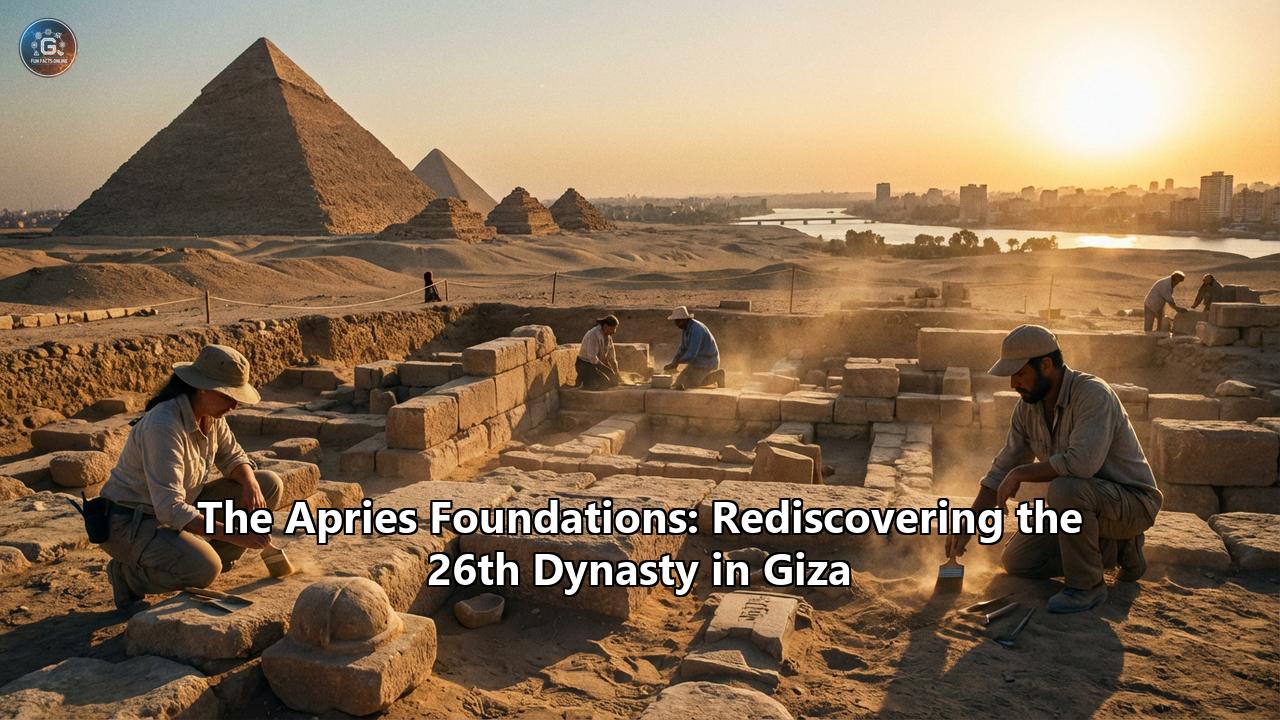
In February 2026, a tremor of excitement rippled through the global archaeological community, emanating from a dusty, often-overlooked mound in Mit Rahina, the site of ancient Memphis. A joint Egyptian-Chinese mission had struck stone—not just any stone, but the limestone foundations of a temple complex belonging to Wahibre Haaibre, known to history as Pharaoh Apries. While the media flashed headlines about "New Temple Discoveries," for scholars and historians, the find resonated on a deeper frequency. It was a key to unlocking one of the most enigmatic chapters in Egyptian history: the Saite Renaissance of the 26th Dynasty, a time when the pharaohs looked north from their capital in Memphis to the ancient Giza Plateau and attempted to rebuild the glory of the Old Kingdom.
These newly exposed stones are but the latest piece of a colossal puzzle known as the "Apries Foundations." For centuries, visitors to the region have been captivated by the Pyramids of Giza, often ignoring the massive mudbrick ruins that loom to the south. Yet, it is here, in the interplay between the administrative heart of Memphis and the spiritual necropolis of Giza, that Apries left his mark. His reign (589–570 BCE) was a pivotal moment—a desperate, glorious attempt to fuse the ancient past with a modern, multicultural future.
To understand the Apries Foundations is to rediscover Giza not just as a monument of the 4th Dynasty, but as a living landscape of the 26th—a place of restoration, pilgrimage, and political theater where a besieged pharaoh tried to shore up his rule with the weight of history.
Part I: The Saite Renaissance and the Giza Revival
The Archaising SpiritBy the time Apries ascended the throne in 589 BCE, the Great Pyramid of Khufu had already been standing for nearly two millennia. To the people of the 26th Dynasty, the Giza Plateau was as ancient and mysterious as the Roman Colosseum is to us today. The Saites, hailing originally from Sais in the Delta, had reunited Egypt after centuries of chaos and foreign domination by Assyrians and Nubians. Their legitimacy rested on a single, powerful idea: Archaism.
They believed that to make Egypt strong again, they had to return to the source. Art, language, and religion were deliberately styled to mimic the Old Kingdom. Artists were sent to the Giza mastabas to copy scenes of daily life; scribes revived long-dead hieroglyphic forms; and pharaohs began to view the Giza necropolis not just as a cemetery, but as a national heritage site in need of preservation.
The Inventory Stela: A Saite Fiction?One of the most controversial artifacts linking Apries’ era to Giza is the so-called Inventory Stela. Discovered in 1858 by Auguste Mariette in a small temple of Isis near the Great Pyramid, this limestone tablet recounts how Khufu "found" the Temple of Isis and the Sphinx already existing and merely repaired them.
For decades, this stela baffled Egyptologists because it seemingly rewrote history, claiming the Sphinx predated Khufu. However, modern analysis reveals the text is likely a "pious forgery" or a historical novel created during the Saite Period—possibly during the reign of Apries himself. The Saites were obsessed with the cult of Isis, "Mistress of the Pyramid." By creating this stela, the priesthood of the 26th Dynasty was projecting their own contemporary worship of Isis back into the golden age of Khufu. It was a way of saying, "Our gods were here from the beginning."
This artifact is a window into the Saite mind. It shows us that under Apries and his predecessors, Giza was bustling with activity. They weren’t just tourists; they were active curators, clearing sand from the Sphinx, repairing the casing stones of the pyramids, and building new temples on the sacred plateau.
Part II: The Palace in the Clouds
While Giza was the soul of the Saite revival, Memphis was its muscle. And nowhere was this muscle more visible than in the Palace of Apries.
The Fortress Above the CityThe recent 2026 excavations have focused attention back on the "Palace of Apries" (often called Qasr Apries), a structure that Flinders Petrie first explored in the early 20th century. Unlike the ground-level palaces of earlier eras, Apries built his residence on a gargantuan artificial platform—a "foundation" in the literal sense—rising over 13 meters (40 feet) above the city of Memphis.
Imagine standing on the ramparts of this palace in 575 BCE. To the north, the Pyramids of Giza would be clearly visible on the horizon, gleaming in their white limestone casing (which was still largely intact). To the south, the Step Pyramid of Djoser at Saqqara. Apries literally elevated himself to the level of the ancestors.
The palace was a fortress-city. Its walls were 15 feet thick, designed to withstand siege. The architecture was a blend of Egyptian grandeur and foreign innovation. The columns in the great reception hall rose 40 feet high, topped with palm-leaf capitals that echoed the ancient groves of the Nile. The 2026 mission has uncovered limestone blocks from a previously unknown temple within this complex, suggesting that the palace was not just a home for the king, but a cosmic engine where the living pharaoh communed with Ptah, the creator god of Memphis.
The View from the VerandaFrom his elevated throne room, Apries would have looked out over a cosmopolitan metropolis. Memphis in the 26th Dynasty was the New York City of the ancient world. It was a melting pot of languages and cultures, driven by the dynasty's reliance on foreign trade and military might. The "Foundations" of Apries were not just stone; they were economic and demographic.
Part III: The "Camp of the Memphis" and the Foreign Quarters
The most striking feature of Apries' reign—and the one that would eventually lead to his downfall—was his reliance on foreign mercenaries. The 26th Dynasty is often called the "Philhellenic" (Greek-loving) dynasty, but it wasn't just Greeks. Carians, Ionians, Phoenicians, and Jews flocked to Memphis and Giza.
The HellenomemphitesHerodotus, the Greek historian who visited Egypt a century later, described the "Camps" established by the Saite kings. These were not temporary bivouacs but permanent settlements. The Camp of the Tyrians (Phoenicians) was located south of the Temple of Ptah, while the Greek and Carian mercenaries were stationed in the "Stratopeda" near the Pelusiac branch of the Nile, before being moved to Memphis proper by Amasis.
Recent archaeological work in the Memphite necropolis has uncovered the tombs of these foreigners. They were buried in Egyptian style but with tell-tale foreign grave goods—Carian scripts, Greek pottery, and weapons that look distinctively Aegean.
For the conservative Egyptian priesthood and the native warrior caste (the Machimoi), the sight of Apries surrounded by these "unclean" foreigners in his towering palace was a source of deep resentment. The "Apries Foundations" were built on the backs of foreign shields, a fact that alienated him from his own people.
Part IV: The Giza Renovations
While Apries sat in Memphis, his work on the Giza Plateau was hands-on. The 26th Dynasty saw a surge in tomb construction at Giza, specifically in the area near the Sphinx and the Causeway of Khafre.
The Saite Tombs of GizaIf you walk around the Sphinx today, you will notice deep shafts cut into the bedrock. many of these are "Saite Shaft Tombs." Unlike the mastabas of the Old Kingdom, which were houses for the dead built up, the Saites dug down. They created complex subterranean palaces to protect their mummies from the rampant tomb robbing of the time.
The tomb of Thary, a high official of the 26th Dynasty, is a prime example. Located near the eastern cemetery of Giza, it demonstrates the archaising style perfectly. The reliefs on his tomb walls copy scenes from the adjacent 4th Dynasty tombs so perfectly that early Egyptologists sometimes had trouble telling them apart.
The Temple of IsisThe "Temple of Isis, Mistress of the Pyramid" (where the Inventory Stela was found) was the spiritual anchor of the Saite presence at Giza. Apries and his predecessors expanded this small shrine, converting it into a popular pilgrimage site. It was here that the Saites bridged the gap between the colossal, distant figures of Khufu and Khafre and the personal piety of the Late Period. They transformed the Great Pyramid from a sealed tomb of a god-king into a reliquary for Isis, the grieving mother and magical protector.
Part V: The Fall of the House of Apries
The end of Apries’ reign was as dramatic as a Greek tragedy, playing out in the shadow of the very monuments he sought to emulate.
The Libyan DisasterIn 570 BCE, Apries sent an army of native Egyptian troops to help the Libyans against the Greek colony of Cyrene. The expedition was a catastrophe. The Egyptians were slaughtered, and the survivors returned home convinced that Apries had sent them to their deaths on purpose, to weaken the native military and rely solely on his Greek mercenaries.
Civil WarThe army revolted and declared Amasis (Ahmose II), a general of common birth, as pharaoh. Apries, confident in his foreign guard and his fortress-palace in Memphis, refused to step down. The civil war that followed was brutal.
Apries led his army of Carians and Ionians against Amasis at the Battle of Momemphis. Despite their heavy armor and superior training, the mercenaries were overwhelmed by the sheer numbers of the Egyptian national army supporting Amasis. Apries was captured.
The Honorable BurialHere, the story takes a uniquely Egyptian turn. Amasis did not execute Apries immediately. He brought the fallen king back to the Palace of Apries in Memphis—the very palace Apries had built—and kept him as a "guest" (or prisoner) for some time. However, the populace demanded blood. Eventually, Apries was handed over to the mob and strangled.
Yet, Amasis, ever the astute politician, knew he could not simply discard a pharaoh. He gave Apries a full royal burial in the Saite Royal Necropolis (located in Sais, though his presence is felt in Giza/Memphis). By burying Apries with honor, Amasis absorbed the legitimacy of the 26th Dynasty's foundations while pivoting the country toward a new, prosperous era.
Part VI: The Rediscovery (2026)
The February 2026 discovery at Tel Aziz (the site of the Memphis palace) brings this entire narrative into sharp relief. The "clues" found by the Egyptian-Chinese mission—limestone blocks inscribed with Apries’ cartouche, potential fragments of the temple gate, and evidence of the burning that likely occurred during the civil war or the later Persian invasion—validate the descriptions of classical historians like Herodotus.
We are now finding that the "Apries Foundations" were more extensive than previously thought. The platform was not just a palace but a raised citadel that integrated religious, military, and administrative functions. It was a prototype for the fortified royal districts that would characterize later eras.
Why It Matters TodayRediscovering the 26th Dynasty in Giza and Memphis challenges the popular narrative that Ancient Egypt "ended" or "declined" after the New Kingdom. The Apries era shows a civilization that was vibrant, self-reflective, and incredibly resilient. They didn't just live in the shadow of the pyramids; they actively engaged with them, restoring them, and using them to define their identity in a changing world.
The "Apries Foundations" are a testament to the enduring power of Giza. Even 2,000 years after Khufu, the pharaohs of the 26th Dynasty understood that to rule Egypt, one had to stand on the bedrock of the plateau, linking the future to the eternal past. As the sands shift in 2026 to reveal more of Apries’ lost city, we are reminded that Giza is never truly finished; it is constantly being rediscovered, rebuilt, and reimagined.
Reference:
- https://www.ancientpages.com/2017/07/15/inventory-stela-and-its-message-controversy-about-this-artifact-still-remains/
- https://en.wikipedia.org/wiki/Inventory_Stela
- https://egyptunitedtours.com/apries/
- https://www.liverpoolmuseums.org.uk/artifact/palace-of-apries-gateway
- http://mc.dlib.nyu.edu/files/books/ifa_egypt000239/ifa_egypt000239_lo.pdf
- https://www.nationalgeographic.com/history/article/giza-pyramids