
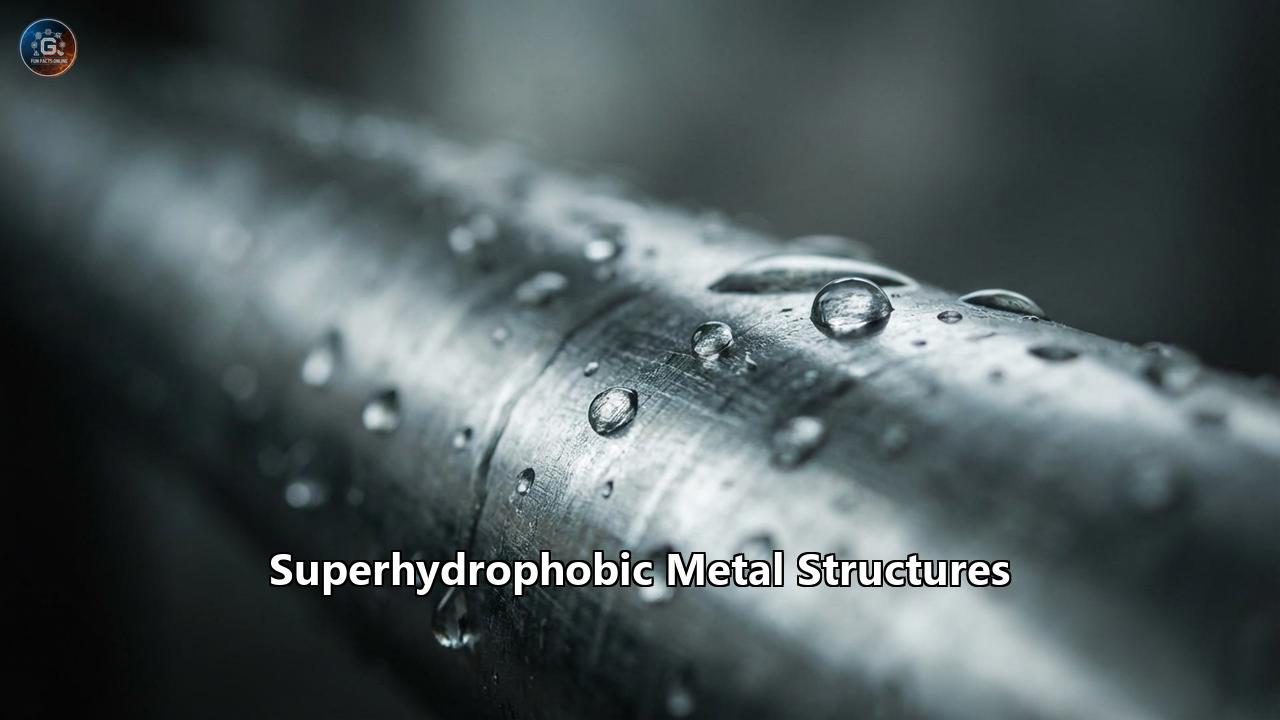
The quest to master surface interactions has led materials science to one of its most compelling frontiers: superhydrophobic metal structures. Inspired by the biological elegance of the lotus leaf and the Namib desert beetle, engineers are now sculpting metal surfaces at the micro- and nanoscale to repel water with unprecedented efficiency. This comprehensive exploration delves into the physics, fabrication, applications, and future of superhydrophobic metals. From the thermodynamic battles played out on the tip of a water droplet to the industrial-scale deployment of anti-icing aircraft wings and self-cleaning marine vessels, this article provides a definitive look at how roughened metal surfaces are redefining durability, efficiency, and performance in the modern world.
1. Introduction: The Lotus and the Laser
For centuries, the lotus leaf (Nelumbo nucifera) has been revered for its purity. Emerging from muddy waters, its leaves remain pristine, repelling dirt and water with an almost magical efficiency. This phenomenon, known as the "Lotus Effect," is not magic but physics—a result of hierarchical surface structures that minimize the contact area between water and the leaf. Today, this biological blueprint is being mapped onto the backbone of modern infrastructure: metal.
Superhydrophobic metal structures represent a paradigm shift in materials engineering. Traditionally, making a metal water-repellent involved applying a chemical coating—a paint or polymer that would eventually peel, crack, or degrade. The new approach is structural. By carving intricate textures directly into the metal's surface, scientists can alter its fundamental wetting properties. A piece of aluminum or titanium, once easily wetted, can be transformed into a surface where water droplets bounce like rubber balls, carrying away contaminants and refusing to freeze even at sub-zero temperatures.
The implications are vast. Corrosion, the silent killer of infrastructure that costs the global economy over $2.5 trillion annually, requires water to progress. Remove the water, and you stop the rot. Ice accumulation on power lines and aircraft wings creates drag and mechanical failure; a superhydrophobic surface sheds water before it can freeze. In the medical field, surgical tools that repel blood can prevent infection.
This article explores the journey from the theoretical underpinnings of wettability to the cutting-edge laser laboratories where metals are transformed. It examines the economic and environmental realities of these technologies and looks ahead to a future of self-healing, "immortal" metal surfaces.
2. The Physics of Wetting: Dancing on Air
To understand superhydrophobic metals, one must first understand the drama of forces occurring at the triple-phase contact line—where solid, liquid, and gas meet.
2.1. The Contact Angle and Wettability
The primary metric for wettability is the static water contact angle (WCA).
- Hydrophilic (<90°): Water spreads out, maximizing contact. Most smooth, clean metals are naturally hydrophilic due to their high surface energy.
- Hydrophobic (90°–150°): Water beads up but may still stick.
- Superhydrophobic (>150°): Water forms nearly perfect spheres. Crucially, a true superhydrophobic surface also has a sliding angle (or roll-off angle) of less than 10°. This low adhesion is what distinguishes a "sticky" rose petal surface from a "slippery" lotus leaf surface.
2.2. Thermodynamics: Wenzel vs. Cassie-Baxter
The behavior of a droplet on a rough metal surface is governed by two competing thermodynamic states.
- The Wenzel State: Imagine a droplet sitting on a grooved surface where the water penetrates every nook and cranny. The liquid "wets" the roughness completely. While this increases the surface area and can actually enhance hydrophobicity if the surface is chemically hydrophobic, it creates high adhesion. The droplet is "pinned" to the surface.
Equation: $\cos(\theta^) = r \cdot \cos(\theta)$
Where $\theta^$ is the apparent contact angle, $\theta$ is the intrinsic contact angle, and $r$ is the roughness factor (ratio of actual to projected area).
- The Cassie-Baxter State: This is the holy grail of superhydrophobicity. The water droplet sits atop the peaks of the surface asperities, trapping pockets of air in the valleys below. The water is effectively resting on a composite surface made mostly of air. Since air is perfectly hydrophobic (contact angle of 180°), the droplet beads up dramatically and rolls off with the slightest tilt.
Equation: $\cos(\theta^) = f_{s}(\cos(\theta) + 1) - 1$
Where $f_s$ is the fraction of solid surface in contact with the liquid. Lowering $f_s$ (i.e., making the surface mostly air) drives the contact angle toward 180°.
2.3. The Transition and Hysteresis
The stability of the Cassie-Baxter state is precarious. External pressure (like the impact of a raindrop) can force the liquid into the grooves, causing an irreversible transition to the "sticky" Wenzel state. This failure mode is a primary challenge in designing robust metal structures.
Contact Angle Hysteresis (CAH) is the difference between the advancing angle (as a droplet grows) and the receding angle (as it shrinks). For self-cleaning, CAH must be minimal. On a superhydrophobic metal, the receding angle is nearly as high as the advancing angle, meaning the droplet leaves nothing behind as it moves.2.4. Anisotropic Wetting
Recent advancements have moved beyond simple roughness to "directional" wetting. By creating parallel micro-grooves (like the scales of a shark or the ridges of a rice leaf) on stainless steel or copper, engineers can make water roll easily in one direction while pinning it in the perpendicular direction. This allows for passive water transport, moving fluid from point A to point B without pumps—vital for microfluidic cooling systems in electronics.
3. Materials and Fabrication: Sculpting at the Nanoscale
Creating a superhydrophobic metal requires a two-step process: creating a hierarchical roughness (micro-scale bumps with nano-scale hairs) and lowering the surface energy.
3.1. The Substrates
- Aluminum: The workhorse of the industry. Lightweight and prone to icing, it is a prime candidate for anti-icing modifications. Its relatively soft nature makes it easy to etch.
- Copper: Valued for thermal conductivity. Superhydrophobic copper condensers can increase heat transfer efficiency by promoting "jumping droplet" condensation, where droplets spontaneously leap off the surface upon coalescing, carrying away latent heat.
- Titanium: Used in aerospace and biomedical implants. Titanium’s hardness makes texturing difficult, but its biocompatibility makes superhydrophobic (and blood-repellent) titanium highly desirable.
- Stainless Steel: The backbone of construction and marine applications. Corrosion resistance is the main driver here.
3.2. Fabrication Techniques
A. Laser Texturing (The Gold Standard)Ultrafast lasers (femtosecond and picosecond pulses) ablate metal with extreme precision. They carve micro-patterns (pillars, grids) and induce nano-structures (ripples) simultaneously.
- Advantage: Extremely durable, precise control, no chemicals involved in the texturing phase.
- Mechanism: A femtosecond laser pulse creates a plasma that vaporizes metal before heat can diffuse, preventing melting and ensuring crisp structures. Interestingly, fresh laser-etched metals are often superhydrophilic initially. They become superhydrophobic over time as they adsorb airborne hydrocarbons (or are treated), a phenomenon known as "aging."
Acid baths (e.g., HCl, FeCl3) preferentially eat away at grain boundaries or dislocations in the metal crystal lattice, leaving behind a rough, coral-like structure.
- Advantage: Scalable and cheap. You can dip an entire car door into a tank.
- Disadvantage: Less control over geometry; uses hazardous chemicals.
Using an electric current to grow metal crystals (like zinc or nickel) onto a substrate. By controlling the current density and electrolyte concentration, one can grow "dendritic" or fern-like fractal structures that are perfect for trapping air.
D. Spray Coating & Sol-GelSpraying a mixture of a binder and hydrophobic nanoparticles (like silica or TiO2) onto the metal.
- Advantage: Can be applied to existing structures (retrofitting).
- Disadvantage: Generally less durable than intrinsic structural modification; the coating can be scratched off.
The most robust surfaces often combine techniques. For example, a "Laser-Chemical" hybrid approach might use a laser to cut a protective micro-grid (armor) and chemical etching to create the delicate nano-texture inside the grid cells.
3.3. The Surface Energy Problem
Roughness alone isn't enough. A rough metal surface is high-energy and will suck water in (superhydrophilic). To achieve superhydrophobicity, the rough metal must be coated with a low-surface-energy molecule. Common agents include:
- Fluoroalkylsilanes (FAS): The industry standard for lowering surface energy.
- Stearic Acid: A cheaper, fatty-acid based alternative often used on copper and aluminum.
- Theta-Alumina: A groundbreaking discovery (2019) identified a specific crystalline phase of alumina that possesses a naturally negative surface energy, potentially eliminating the need for organic coatings entirely.
4. Key Properties and Functionalities
The convergence of structure and chemistry unlocks a suite of superpowers for metal surfaces.
4.1. Anti-Corrosion
Corrosion is an electrochemical process requiring an electrolyte (water + salts). The air layer in the Cassie-Baxter state acts as a dielectric barrier, physically separating the corrosive liquid from the metal substrate. Electrochemical impedance spectroscopy (EIS) tests show that superhydrophobic coatings can increase the impedance of a metal surface by 7–8 orders of magnitude, effectively shutting down corrosion cells.
4.2. Anti-Icing
Ice adhesion is a major safety hazard. Superhydrophobic metals tackle this in two ways:
- Delaying Freezing: The air pockets act as insulators, slowing the heat transfer from the droplet to the cold metal.
- Icephobicity: If ice does form, the low contact area means it adheres weakly. The "adhesion strength" can drop from ~1600 kPa (on bare aluminum) to <20 kPa, allowing ice to be shed by wind or simple vibrations.
4.3. Self-Cleaning
On a superhydrophobic surface, dirt particles adhere more strongly to water droplets than to the metal. As a droplet rolls off, it acts like a vacuum cleaner, picking up dust, soot, and biological contaminants. This is vital for maintaining the efficiency of solar panel frames or optical sensors on autonomous vehicles.
4.4. Drag Reduction
In marine environments, the "air plastron" (the trapped air layer) acts as a lubricant. Water slips over the air layer with far less friction than it would over solid metal. Tests on model ships have shown drag reductions of 10-20%, which translates to massive fuel savings for cargo vessels.
5. Applications and Case Studies
5.1. Aerospace: Wings That Never Freeze
- Problem: Aircraft currently use "bleed air" (hot air from engines) or rubber boots to de-ice wings, which consumes energy and adds weight.
- Solution: Laser-patterned titanium or aluminum leading edges.
- Case Study: Researchers have demonstrated that superhydrophobic micro-patterns on airfoils can prevent the accretion of supercooled water droplets (freezing rain). While not yet a standalone replacement for active de-icing, it reduces the energy load significantly.
5.2. Marine: The Green Ship Hull
- Problem: Biofouling (barnacles, algae) increases drag and fuel consumption. Anti-fouling paints often contain toxic biocides (like copper or TBT) that leech into the ocean.
- Solution: A superhydrophobic hull keeps the surface dry underwater (via the air layer) preventing marine larvae from finding a foothold.
- Commercial Example: Companies like Aculon and Vetro Power (VP Nano-Dynamis) offer marine-grade nanocoatings that protect stainless steel railings and sensors from salt spray and fouling without toxic chemicals.
5.3. Automotive: The Self-Cleaning Sensor
- Problem: Autonomous vehicles rely on LiDAR and cameras. A single mud splash can blind the car.
- Solution: Superhydrophobic metal housings and lens coatings.
- Innovation: Nissan has tested "Ultra-Ever Dry" paint on vehicle bodies, creating a car that essentially never needs washing. While full-body coating is cost-prohibitive, the technology is finding a home in sensor protection and side mirrors.
5.4. Medical: Blood-Repellent Tools
- Problem: Surgical tools contaminated with blood are hard to clean and can spread infection.
- Solution: Superhydrophobic (and superhemophobic) stainless steel.
- Research: Studies have shown that laser-textured steel scalpels can repel blood completely, preventing clotting on the blade and reducing the risk of bacterial biofilm formation.
5.5. Heat Transfer: Jumping Droplets
- Application: Power plants and HVAC systems use metal condensers.
- Innovation: On a superhydrophobic copper condenser, droplets don't slide off; they jump off due to the release of excess surface energy during coalescence. This removes the insulating liquid layer faster, improving heat transfer rates by up to 30%.
6. The Durability Challenge: The Achilles' Heel
Despite the promise, you don't see superhydrophobic cars on every driveway. The reason is durability.
6.1. The Fragility of Roughness
The very micro-pillars that support the water droplet are mechanically weak. A thumbprint, a sandstorm, or a high-pressure wash can crush these structures. Once the roughness is flattened, the superhydrophobicity is lost forever.
6.2. Chemical Degradation
The low-surface-energy coatings (silanes/fatty acids) are sensitive to UV light and oxidation. Over time, sunlight breaks the chemical bonds, and the metal reverts to being hydrophilic.
6.3. Solutions and Breakthroughs (2024-2025)
- Armor-Like Structures: Researchers are now designing "armored" superhydrophobic surfaces. They build a honeycomb of hard, interconnected ceramic or metal ridges (the armor) that stick up slightly higher than the delicate hydrophobic nanostructures inside. If a finger wipes the surface, it touches only the armor, leaving the functional nanostructures beneath untouched.
- Self-Healing Coatings: New polymer-metal composites contain microcapsules of hydrophobic agents. If the surface is scratched, the capsules rupture, releasing fresh hydrophobic fluid to heal the "wound."
- Self-Healing Metals (Substrate): A 2024 breakthrough published in Nature observed platinum "healing" its own fatigue cracks at the nanoscale through cold welding. While currently microscopic, this suggests a future where the metal substrate itself could repair structural damage that would otherwise ruin the superhydrophobic texture.
7. Economic and Environmental Impact
7.1. Life Cycle Assessment (LCA)
Are these high-tech surfaces green?
- Fabrication: Laser texturing is energy-intensive but chemically clean. Chemical etching produces toxic waste (acids/metal ions) that must be managed.
- Operation: The operational benefits often outweigh production costs. An LCA of Polyurethane Elastomer (PUE) superhydrophobic coatings on aircraft showed a significant reduction in total environmental impact compared to bare aluminum, primarily due to fuel savings from reduced drag and reduced use of glycol-based de-icing fluids (which are toxic to waterways).
7.2. Cost-Benefit Analysis
- Initial Cost: High. Laser texturing is slow.
- ROI: High in specific sectors. For a container ship, a 1% drag reduction saves millions of dollars in fuel over a year. For a wind turbine, preventing icing prevents weeks of downtime in winter.
- Market: The global market for superhydrophobic coatings is projected to grow at a CAGR of over 20%, driven largely by electronics and anti-corrosion needs.
8. Future Horizons
The future of superhydrophobic metals lies in intelligence and scalability.
- Smart Surfaces: Imagine a metal surface that changes its wettability on demand. By using shape-memory alloys (like Nitinol) or voltage-responsive coatings, engineers are creating surfaces that can switch from superhydrophobic (slippery) to superhydrophilic (sticky) with the flip of a switch. This could allow a lab-on-a-chip to hold a droplet for analysis and then release it.
- Scalable Laser Processing: New high-speed polygon scanners and multi-beam interference patterning are increasing laser texturing speeds from millimeters per minute to square meters per minute, making it feasible to texture entire airplane wings.
- Bio-Inspiration 2.0: We are moving beyond the lotus. New designs mimic the Nepenthes* pitcher plant (using liquid-infused surfaces for self-healing lubricity) and the springtail (an insect that repels oil as well as water).
9. Conclusion
Superhydrophobic metal structures represent a triumph of biomimicry and precision engineering. By mastering the topography of metal at the scale of a water molecule, we are creating materials that defy the natural tendency to corrode, freeze, and foul. While challenges in mechanical durability remain the final barrier to ubiquitous adoption, the solutions—armored textures and self-healing chemistries—are already in the lab.
We are standing on the precipice of a new Iron Age, one where our metals are not just strong, but smart; not just passive structures, but active participants in their environment. From the wings of tomorrow’s aircraft to the hulls of global shipping fleets, superhydrophobic metals promise a future that is cleaner, faster, and more resilient.
Glossary of Key Terms
- Contact Angle (θ): The angle where a liquid interface meets a solid surface.
- Hysteresis: The difference between the angle at which a droplet advances and recedes; a measure of "stickiness."
- Hierarchical Structure: A surface texture containing features at multiple scales (e.g., micro-bumps covered in nano-hairs).
- Air Plastron: The layer of air trapped between a submerged superhydrophobic surface and the water.
- Femtosecond Laser: A laser that emits pulses lasting one quadrillionth of a second, allowing for "cold" ablation of materials.
- Oleophobic: Resistant to oil. A surface can be hydrophobic but oleophilic (oil-loving); true "superamphiphobic" surfaces repel both.
Reference:
- https://www.researchgate.net/publication/260044785_Superhydrophobicity_Is_it_really_better_than_hydrophobicity_on_anti-corrosion
- https://en.clickpetroleoegas.com.br/They-have-just-discovered-a-self-healing-metal-the-new-era-of-immortal-metal-that-will-revolutionize-the-future/
- https://www.neverwet.com/
- https://www.researchgate.net/publication/380920668_Factors_Affecting_the_Efficiency_of_Hydrophobic_Coatings-Experience_from_Application_on_Sandstone
- https://pmc.ncbi.nlm.nih.gov/articles/PMC10972411/
- https://www.advent-rm.com/en-GB/Articles/2024/09/How-Self-Healing-Metals-Are-Set-to-Transform-Advan
- https://www.researchgate.net/publication/384895642_Environmental_Impact_and_Life_Cycle_Cost_Analysis_of_Superhydrophobic_Coatings_for_Anti-Icing_Applications
- https://www.mdpi.com/2079-6412/14/10/1305
- https://www.aculon.com/hydrophobic-metal/
- https://www.speccoats.co.za/top-coat-automotive.php
- https://orbit.dtu.dk/en/publications/life-cycle-assessment-of-metal-additive-manufacturing-a-systemati/
- https://www.marketresearchfuture.com/reports/superhydrophobic-coating-market/companies
- https://www.mordorintelligence.com/industry-reports/superhydrophobic-coatings-market/companies