
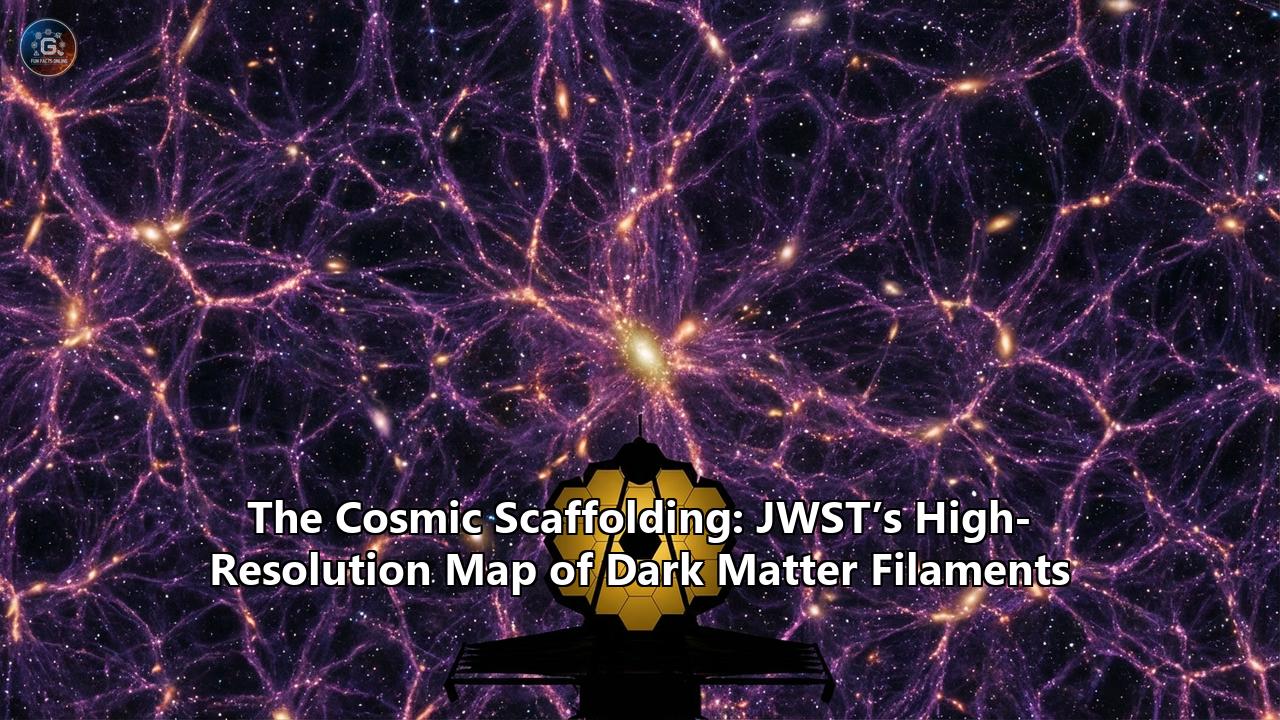
The universe is not a scattered archipelago of lonely galaxies floating in a void; it is a tapestry. For decades, astronomers have theorized that a vast, invisible network threads through the cosmos, a "cosmic web" composed of dark matter that acts as the scaffolding for all visible existence. It is the skeleton of the universe, the unseen architecture that dictated where stars could ignite and where galaxies could congregate. Yet, for all its fundamental importance, this web has remained largely in the realm of simulation and low-resolution inference. We could see the cities of light—the galaxies—but not the highways that connected them.
That has changed. In a landmark achievement that will define the next era of cosmology, the James Webb Space Telescope (JWST) has delivered the highest-resolution map of dark matter filaments ever constructed. Focused on the COSMOS-Web field and reaching back to the very epoch of reionization, this new map renders the invisible "scaffolding" of the cosmos with terrifying clarity. It reveals not just the massive nodes where galaxy clusters congregate, but the delicate, tenuous tendrils of dark matter that bridge the great voids, confirming the Lambda-CDM model of cosmology while simultaneously offering tantalizing hints of the physics governing the early universe.
This is the story of that map—how it was made, what it reveals, and why it changes our understanding of the universe’s history.
Part I: The Ghost in the Machine
To understand the magnitude of JWST’s achievement, one must first appreciate the elusive nature of the quarry. Dark matter is the ghost in the cosmic machine. It emits no light, reflects no radiation, and casts no shadow. It interacts with the rest of the universe primarily through gravity. We know it is there because the universe makes no sense without it.
In the 1930s, Fritz Zwicky noticed that galaxies in the Coma Cluster were moving too fast to be held together by the visible mass of their stars. Decades later, Vera Rubin confirmed this anomaly in the rotation curves of individual galaxies. There was "missing mass"—vast amounts of it. Modern estimates suggest that dark matter makes up roughly 27% of the universe, while the "normal" matter (baryons) that makes up stars, gas, and us accounts for less than 5%. The rest is the even more mysterious dark energy.
Computer simulations, such as the famous Millennium Simulation, predicted that this dark matter should not be evenly distributed. Instead, under the influence of gravity, it should collapse into a complex network. Thick "halos" of dark matter would form the gravitational wells where gas would settle and galaxies would be born. Connecting these halos would be long, thread-like filaments of dark matter, stretching across millions of light-years. Between the filaments would be vast, empty voids.
This structure is the "Cosmic Web." For years, we have seen the lights (galaxies) outlining the web, like cities seen from an airplane at night outlining the geography of a continent. But we had never clearly seen the land itself—the dark matter filaments—until now.
Part II: The Golden Eye Opens
The James Webb Space Telescope was not explicitly designed solely as a dark matter detector, but its unique capabilities make it the ultimate tool for mapping the invisible. While dark matter itself is invisible, its mass warps the fabric of space-time. This effect, predicted by Einstein’s General Relativity, is known as gravitational lensing.
When light from a distant background galaxy passes near a massive concentration of foreground matter (like a dark matter filament), the light’s path is bent. This distorts the shape of the background galaxy as seen from Earth. Strong lensing creates dramatic arcs and rings, but weak lensing—the tool used for this new map—creates subtle, statistical distortions. It slightly elongates the background galaxies, aligning them tangentially to the mass concentration.
To map the cosmic web using weak lensing, you need three things:
- Depth: You need to see millions of tiny, distant background galaxies to act as your "wallpaper."
- Resolution: You need to measure the shapes of these tiny blobs of light with extreme precision to detect the subtle warping.
- Infrared Sensitivity: Since the universe is expanding, light from the distant background galaxies is redshifted into the infrared, a spectrum visible only to telescopes like JWST.
Hubble attempted this, most notably in the COSMOS survey (Cosmic Evolution Survey). It was a heroic effort that provided our first blurry glimpse of the dark matter skeleton. But Hubble is an optical telescope with a smaller mirror. JWST, with its 6.5-meter gold-coated primary mirror and the exquisitely sensitive Near-Infrared Camera (NIRCam), is a different beast entirely. It can see fainter, more distant galaxies, and it can resolve their shapes with a sharpness Hubble could only dream of.
Part III: The COSMOS-Web Survey
The data for this groundbreaking map comes largely from the COSMOS-Web survey, the largest program in JWST’s first cycle of operations. Led by a consortium of astronomers including principal investigators mainly from U.S. and European institutions, the survey aimed to map a continuous patch of the sky—0.6 square degrees, roughly the size of three full moons—in the constellation Sextans.
While 0.6 square degrees sounds small, in the context of deep-space astronomy, it is a sprawling continent. Most JWST deep fields are the size of a grain of sand held at arm's length. COSMOS-Web is a panoramic sweep.
Over the course of 255 observing hours, JWST stared into this patch of sky. The resulting mosaic is a masterpiece of data. It contains approximately one million galaxies. But more importantly, it captured the light of galaxies from the "Epoch of Reionization"—the cosmic dawn, less than a billion years after the Big Bang—all the way to the present day.
The sheer density of galaxies is what enabled the high-resolution dark matter map. Hubble could resolve about 70 galaxies per square arcminute in this region. JWST resolved over 130. This doubling of the "background wallpaper" density reduced the noise in the weak lensing signal, bringing the blurry dark matter picture into sharp focus.
Part IV: The Map Revealed
The map released in early 2026 is a revelation. Where previous maps showed blobs and amorphous clouds of dark matter, the JWST map shows structure.
1. The Filaments:The most striking feature of the new map is the definition of the filaments. These are not vague bridges; they are sharp, well-defined ridges of mass connecting massive galaxy clusters. The map reveals that these filaments are narrower and denser than previously thought. They act as cosmic rivers, channeling gas from the voids into the galaxy clusters, fueling star formation. The precision of the map allows astronomers to measure the "thickness" of these filaments, a critical parameter that helps constrain the temperature of dark matter (a topic we will explore later).
2. The Voids:Just as important as the matter is the absence of it. The JWST map delineates the edges of cosmic voids with unprecedented sharpness. These vast, empty regions repel matter as the filaments attract it. The "cliffs" at the edge of these voids, where the density drops precipitously, are sharper in the JWST data than in simulations, posing a new challenge to theorists.
3. The Nodes:At the intersections of the filaments lie the nodes—the massive galaxy clusters. The map shows these halos in exquisite detail. We can see the "sub-structure" within the halos, the smaller clumps of dark matter merging into the larger whole. This confirms the hierarchical model of structure formation: big things are built from smaller things smashing together.
4. The Invisible Overlap:One of the most visually compelling aspects of the study was the overlay of visible light and dark matter. The researchers placed the map of visible galaxies (the light) over the map of dark matter (the gravity). The correlation is nearly perfect but with fascinating deviations. In the dense clusters, the light and mass trace each other exactly. But in the filaments, JWST found "dark" bridges—regions with strong gravitational mass but very few galaxies. These are "starless filaments," pristine rivers of dark matter and gas that have not yet ignited with star formation.
Part V: The ASPIRE Connection – Filaments at the Dawn of Time
While the COSMOS-Web map provides a panoramic view of the "adult" universe (redshift z=0 to z=2), another JWST program, ASPIRE (A Spectroscopic Survey of Biased Halos in the Reionization Era), has provided a crucial snapshot of the "infant" cosmic web.
In findings that complement the COSMOS-Web map, the ASPIRE team targeted 25 quasars in the very early universe (redshift z > 6.5), less than a billion years after the Big Bang. Quasars are the ultra-bright maws of supermassive black holes. The theory was that these monsters must inhabit the densest regions of the early cosmic web.
JWST proved this theory spectacularly. It discovered a filament of 10 galaxies stretching over 3 million light-years, anchored by a luminous quasar (J0305-3150). This is the earliest distinct filament ever seen.
The significance of this cannot be overstated. In the standard model, structure forms from the bottom up. Small clumps form first, then merge into filaments and clusters. To see such a long, well-defined filament so early in the universe’s history suggests that the "scaffolding" assembled incredibly quickly. The dark matter had to collapse into these strands almost immediately after the Big Bang to trap the gas necessary to form ten distinct galaxies and a supermassive black hole by z=6.6.
This "ASPIRE filament" serves as a chaotic, early ancestor to the ordered, majestic structures seen in the COSMOS-Web map. It shows us the cosmic web under construction.
Part VI: Confronting the Simulation
For twenty years, the Millennium Simulation (and its successors like IllustrisTNG) has been the gold standard for visualizing the cosmic web. These supercomputer models start with the physics of the Big Bang and let gravity run its course. They produce a specific "look" to the web—a fractal-like network of knots and threads.
The JWST data is the first real stress test for these simulations on fine scales.
- The Success: broadly speaking, JWST confirms the Lambda-CDM model. The statistical distribution of the filaments matches the simulations. Dark matter is "Cold" (meaning it moves slowly compared to the speed of light), allowing it to clump into these fine structures. If dark matter were "Warm" or "Hot," the filaments would be smeared out, washed away by the thermal velocity of the particles. The sharpness of the JWST map puts strict upper limits on the temperature of dark matter.
- The Tension: However, there are intriguing discrepancies. The JWST map shows more small-scale structure than some simulations predict. The voids are emptier, and the filaments are "stringier." This has led to whispers in the community about "Self-Interacting Dark Matter" (SIDM)—the idea that dark matter particles might interact with each other via some unknown force, not just gravity. While the current data doesn't prove SIDM, the high resolution of the map provides the first real battleground where these theories can be tested against observation.
Part VII: The "Warped Windowpane"
To understand how the map was made, Diana Scognamiglio of NASA’s Jet Propulsion Laboratory uses the analogy of a "warped windowpane."
Imagine looking at a patterned wallpaper through a pane of glass that has been melted and distorted. The pattern on the wall is the field of background galaxies. The glass is the dark matter in the foreground. By carefully analyzing the distortion of the wallpaper—how circles are stretched into ovals, how lines are bent—you can reconstruct the shape of the imperfections in the glass.
The challenge is that galaxies aren't perfect circles to begin with. They are ellipses, spirals, and cigars. If you see an oval galaxy, is it oval because it's a tilted spiral, or because dark matter stretched it?
This is where the "Big Data" aspect of JWST shines. You cannot tell for a single galaxy. But if you look at ten thousand galaxies in a small patch of sky, their random orientations should cancel out. If they all tend to align in a specific direction, that is not random—that is the signature of dark matter lensing.
JWST’s incredible resolution allows it to measure the "ellipticity" of galaxies with extreme precision. It can distinguish between a galaxy that is naturally cigar-shaped and one that has been subtly sheared by gravity. This "shear signal" is the ink with which the dark matter map is drawn.
Part VIII: Feeding the Galaxies
The map answers a longstanding question in galaxy formation: How do galaxies get their gas?
Galaxies are engines that turn gas into stars. But they are inefficient; they blow gas out with supernovas and black hole winds. To keep forming stars for billions of years, they need a fresh supply. Simulations suggested that "Cold Accretion Flows"—streams of cool gas running along the dark matter filaments—feed the galaxies like pipelines.
The JWST map provides observational support for this. By correlating the dark matter filaments with the properties of the galaxies residing in them, astronomers found that galaxies inside the filaments have higher star formation rates and more distinct chemical signatures than those in the voids or the field. The filaments are indeed the pipelines of the universe, funneling pristine gas directly into the hearts of galaxies to fuel the next generation of stars.
Part IX: Implications for the Standard Model
The "Standard Model of Cosmology" (Lambda-CDM) posits a universe dominated by Dark Energy (Lambda) and Cold Dark Matter (CDM). It is a robust theory, but it has cracks (e.g., the Hubble Tension).
The JWST Dark Matter Map acts as a reinforcement for the "CDM" part of the equation. The clumping factor of the dark matter—how "lumpy" the universe is—is measured by a parameter called S8. Some previous weak lensing surveys (like the KiDS survey) suggested the universe was smoother than Planck satellite data predicted (the "S8 Tension").
Preliminary analysis of the JWST COSMOS-Web map suggests an S8 value that aligns more closely with the Planck data, potentially relieving some of this tension. It suggests that the "smoothness" seen in ground-based surveys might have been a result of atmospheric blurring or insufficient depth. JWST, with its crystal-clear view, shows a universe that is exactly as lumpy as the Big Bang afterglow predicts it should be.
Part X: The Future of the Invisible
The COSMOS-Web map is just the beginning. It covers 0.6 square degrees. The sky is 41,000 square degrees. JWST is a sniper rifle; it cannot map the whole sky.
That task falls to the upcoming Nancy Grace Roman Space Telescope (scheduled for launch in 2027) and the European Space Agency's Euclid mission. These are "survey telescopes," designed with wide fields of view to map huge swathes of the sky.
However, JWST’s map serves as the "calibration key" for these missions. Because JWST goes so deep and sees so sharply, it provides the "ground truth" for what dark matter structures look like. Astronomers will use the JWST COSMOS-Web data to train the algorithms that will process the Roman and Euclid data.
Furthermore, JWST will continue to drill down. Future observations will likely target the "nodes" of the cosmic web with spectroscopy, measuring the 3D motion of the galaxies within the filaments to create a dynamic, moving map of the dark matter flow—a "weather map" of the universe.
Conclusion: The Scaffolding of Existence
When we look up at the night sky, we see the stars. But the JWST Dark Matter Map reminds us that what we see is merely the decoration on the structure. The true universe is the dark, silent scaffolding that holds it all together.
For the first time in history, we have a high-definition map of this invisible country. We can trace the ridges of the filaments where galaxies are born, and stare into the abyssal voids where nothing exists. The James Webb Space Telescope, built to see the "First Light," has ended up revealing the "First Dark."
This map is more than data; it is a vindication of a century of theoretical physics. It confirms that the ghost is real, that the web exists, and that we, in our glowing spiral galaxy, are merely dew drops clinging to a strand of a spider’s web, suspended in the infinite dark. The scaffolding is no longer a theory; it is a landscape, and we have finally begun to explore it.
Reference:
- https://www.nationalgeographic.com/science/article/dark-matter-map-james-webb-space-telescope
- https://www.youtube.com/watch?v=F-tNyaHbf-0
- https://communities.springernature.com/posts/mapping-the-dark-universe-at-unprecedented-resolution-with-jwst
- https://www.astronomy.com/science/new-dark-matter-map-shows-the-universe-in-detail/
- https://www.techexplorist.com/nasa-finds-new-evidence-dark-matter-steers-cosmos/101904/
- https://www.skyatnightmagazine.com/news/james-webb-space-telescope-dark-matter-map
- https://esawebb.org/images/aspire1/
- https://www.friendsofnasa.org/2023/06/earliest-strands-of-cosmic-web-aspire.html
- https://www.reddit.com/r/spaceporn/comments/1qplmyr/mapping_the_invisible_dark_matter_mapping_using/
- https://orbitaltoday.com/2026/01/28/james-webb-telescope-creates-most-detailed-map-yet-of-dark-matter/
- https://www.nasa.gov/missions/webb/nasa-reveals-new-details-about-dark-matters-influence-on-universe/
- https://science.nasa.gov/asset/webb/aspire-cosmic-filament-nircam-image/
- https://www.youtube.com/watch?v=DfU3NWXcSU8