
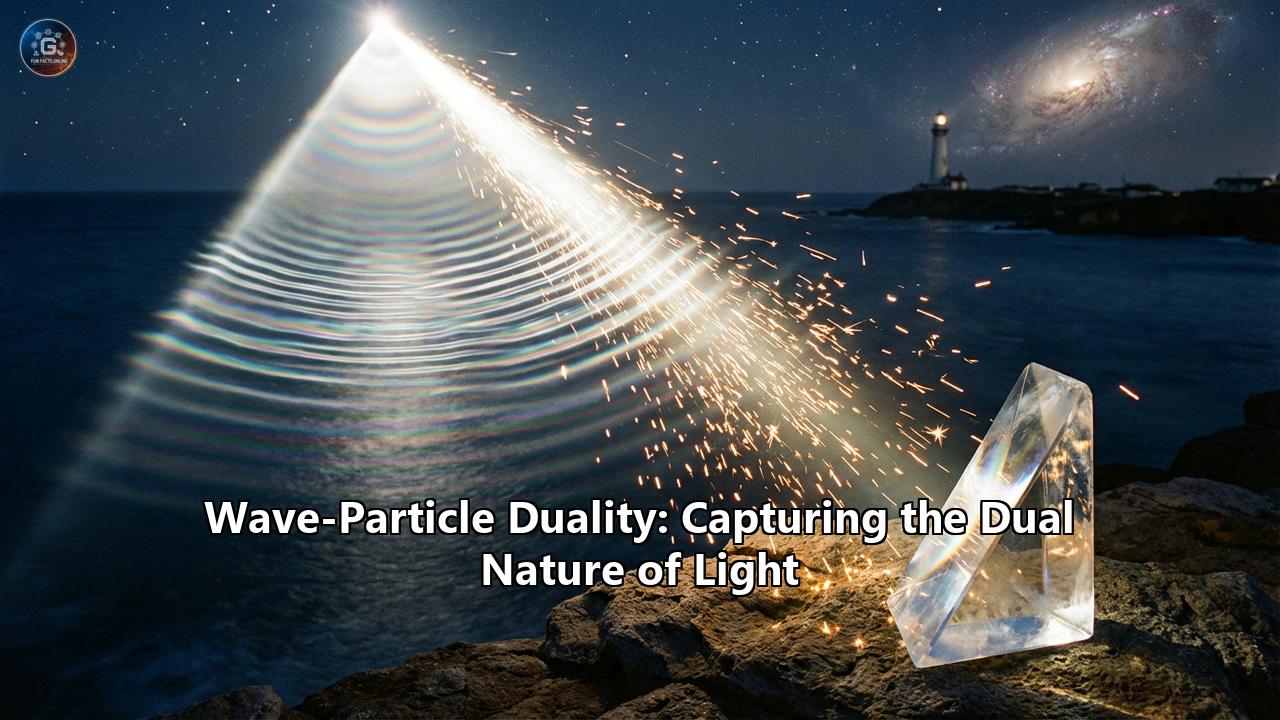
Light is the most familiar yet the most mysterious entity in the universe. It is the messenger of the stars, the carrier of our Wi-Fi signals, and the very reason we can perceive the world around us. Yet, ask a physicist what light is, and the answer becomes a journey into the deepest rabbit hole of modern science. Is it a stream of tiny bullets, ricocheting off mirrors and striking our retinas? Or is it a rippling ocean, flowing around obstacles and spreading out in concentric circles?
The answer, as discovered through centuries of fierce debate, accidental discoveries, and mind-bending experiments, is "yes."
This phenomenon is known as wave-particle duality, a fundamental principle of quantum mechanics that asserts that every particle or quantum entity may be described as either a particle or a wave. It is not merely a quirk of light but a fundamental property of the universe, extending to electrons, atoms, and perhaps reality itself. To understand it is to peel back the curtain of the macroscopic world and peer into the bizarre, probabilistic machinery that operates beneath.
This article explores the epic saga of wave-particle duality, from the candlelit desks of Isaac Newton and Christiaan Huygens to the high-tech laser labs of MIT in 2025. We will witness the clash of titans at the Solvay Conferences, the mathematical duel between matrix and wave mechanics, and the cutting-edge experiments that are finally settling debates that have raged for a century.
Part I: The Great Schism (17th – 19th Century)
The Corpuscular Authority
In the late 17th century, the nature of light was a battleground. On one side stood Sir Isaac Newton, the colossus of physics who had just tamed gravity and motion. In his 1704 treatise Opticks, Newton argued passionately that light was composed of "corpuscles"—tiny, discrete particles emitted from a source.
Newton’s logic was grounded in observation. Light travels in straight lines; it casts sharp shadows. If light were a wave, he reasoned, it should bend around corners like sound (a phenomenon known as diffraction). Since he didn't observe light bending around a doorframe, he concluded it must be a stream of particles. Because of Newton’s immense prestige, the "corpuscular theory" became the dogma of the scientific world for over a century.
The Wave Rebellion
Opposing him was the Dutch physicist Christiaan Huygens. He proposed that light was not a particle but a wave propagating through a medium called the "luminiferous aether." Huygens’ principle could explain reflection and refraction just as well as Newton’s, but without the "authority" of a figure like Newton, his theory languished in obscurity.
The Day the Particles Died: Young and Fresnel
The tides turned in 1801 with the English polymath Thomas Young. In an experiment that would become the most famous in physics history, Young passed sunlight through two narrow slits cut into a card.
If Newton were right, the light particles should have passed through the slits and created two bright strips on the screen behind them, like spray paint through a stencil. Instead, Young saw a series of alternating bright and dark bands—an interference pattern.
This pattern could only be explained if light was a wave. Just as two ripples on a pond can overlap to create a larger wave (constructive interference) or cancel each other out (destructive interference), the light waves from the two slits were interacting. Where crest met crest, there was light; where crest met trough, there was darkness.
The "Poisson Spot": A Theoretical Backfire
The final nail in the coffin of the particle theory came in 1818, in a moment of scientific drama that is now legendary. The French Academy of Sciences held a competition to explain the properties of light. Civil engineer Augustin-Jean Fresnel submitted a precise mathematical wave theory.
One of the judges was Siméon Denis Poisson, a staunch Newtonian who believed in particles. Poisson studied Fresnel’s math and found what he thought was a fatal flaw. He pointed out that if Fresnel’s wave theory were true, light shining on a small circular disk should diffract around the edges and interfere constructively in the exact center of the shadow, creating a bright spot where there should be total darkness. Poisson declared this result "absurd" and assumed he had disproven the wave theory.
However, the head of the committee, Dominique Arago, decided to actually perform the experiment. He mounted a small disk, shone a light, and looked at the shadow. There, shining defiantly in the center of the darkness, was the "absurd" bright spot.
It was named Poisson’s Spot (ironically immortalizing the man who said it couldn't exist), but the victory belonged to Fresnel. For the next hundred years, light was indisputably a wave.
Part II: The Quantum Revolt (Early 20th Century)
By the late 19th century, physics seemed complete. Maxwell’s equations had united electricity, magnetism, and light into a beautiful wave theory. But two dark clouds hung on the horizon: the Ultraviolet Catastrophe and the Photoelectric Effect.
Planck and the Desperate Guess
The "Ultraviolet Catastrophe" was a failure of classical physics to explain how hot objects emit heat (blackbody radiation). The equations predicted that a toaster should emit infinite energy at high frequencies (UV and beyond). In 1900, German physicist Max Planck solved this by making a "desperate assumption": he treated energy not as a continuous flow, but as discrete packets, or "quanta." He didn't think these packets were real; it was just a mathematical trick to make the equations work.
Einstein’s "Annus Mirabilis"
In 1905, a patent clerk named Albert Einstein took Planck’s "trick" seriously. He turned his attention to the photoelectric effect, a phenomenon where shining light on a metal surface knocks electrons off it.
Classical wave theory failed to explain this. It predicted that brighter light (more intense waves) should knock off electrons with more energy. But experiments showed that the color (frequency) of the light mattered, not the brightness. A dim blue light could eject electrons, while a blindingly bright red light did nothing.
Einstein realized that light itself was quantized. It wasn't just a wave; it was a stream of energy packets (later named photons). Blue photons had enough energy to knock an electron loose; red photons did not, no matter how many of them you fired. Einstein re-introduced the particle, but with a twist: these "particles" had frequency. Light was a paradox.
Part III: Matter Enters the Dance
If light (a wave) could act like a particle, could matter (particles) act like a wave?
In 1924, a French prince and PhD student named Louis de Broglie asked this radical question. He proposed that all matter—electrons, atoms, baseballs—has a wavelength associated with its momentum. The formula was elegantly simple: λ = h / p (Wavelength = Planck's constant / Momentum).
Three years later, Clinton Davisson and Lester Germer at Bell Labs accidentally confirmed this. They fired electrons at a nickel crystal and observed—shockingly—a diffraction pattern. The electrons were "rippling" through the crystal lattice just like X-rays. Matter was waving.
This discovery shattered the classical view of the universe. The hard, billiard-ball electrons of the Victorian era were actually fuzzy, wavelike entities.
Part IV: The Architects of the New Reality
By the mid-1920s, two opposing mathematical frameworks emerged to describe this new dual reality, led by two men who famously disliked each other’s methods.
Heisenberg’s Matrix Mechanics
Werner Heisenberg, a young German genius, hated the idea of unobservable "orbits" or "waves." He built a theory based purely on what could be measured (spectral lines, energy transitions). His "Matrix Mechanics" was algebraic, abstract, and incredibly difficult, treating physical quantities as spreadsheets of numbers that didn't commute (A times B did not equal B times A).Schrödinger’s Wave Mechanics
Erwin Schrödinger, an Austrian physicist, found Heisenberg’s math "repulsive." He wanted a visualizable physics. Inspired by de Broglie, he formulated the Schrödinger Equation, which described how the "wave function" (Ψ) of a system evolves over time. It felt like classical wave physics, and physicists loved it because it was familiar.For a brief period, the two camps warred. Heisenberg called Schrödinger’s waves "crap," and Schrödinger called Heisenberg’s matrices "monstrous." Eventually, Paul Dirac and John von Neumann proved that the two theories were mathematically equivalent. They were two languages describing the same strange reality.
Part V: The Clash of Titans (Solvay 1927)
The philosophical battle over what this duality meant came to a head at the Fifth Solvay Conference in Brussels in 1927. This was the "Super Bowl" of physics, attended by Einstein, Bohr, Curie, Planck, Heisenberg, and Schrödinger.
The debate centered on the Copenhagen Interpretation, championed by Niels Bohr. Bohr argued for Complementarity: an object can be a wave or a particle, but never both at the same time. The experimental setup determines which face nature reveals. Furthermore, the wave function wasn't a physical wave; it was a "probability wave" that collapsed upon measurement.
Einstein hated this. "God does not play dice," he famously insisted. He believed there was an objective reality independent of observation.The "Photon in a Box"
At the 1930 conference, Einstein proposed a thought experiment to break Bohr’s Uncertainty Principle. Imagine a box full of photons with a shutter that opens for a tiny split second to let one photon escape. By weighing the box before and after, we could know the photon’s energy (E=mc²) and the exact time it left, violating uncertainty.
Bohr spent a sleepless night pacing. The next morning, he triumphed. He pointed out that Einstein had forgotten his own Theory of General Relativity. As the box becomes lighter, it rises slightly in the gravitational field. According to General Relativity, time moves faster at a higher altitude. The uncertainty in the box’s vertical position creates an uncertainty in time, exactly satisfying the uncertainty principle. Einstein had been defeated by his own greatest theory.
Part VI: Modern Frontiers (2024 – 2025)
For decades, Solvay was the final word. But in the last few years, technology has finally caught up to these thought experiments, allowing us to test the boundaries of duality with unprecedented precision.
MIT’s "Atomic Slits" Experiment (2025)
In a groundbreaking study published in 2025, physicists at MIT led by Wolfgang Ketterle revisited the double-slit experiment, but with a twist that would have made Einstein dizzy. Instead of cutting slits in a physical screen, they used ultracold rubidium atoms trapped in an optical lattice as the "slits."
They scattered single photons off these atoms. The setup allowed them to tune the "fuzziness" of the atoms' positions. When the atoms were tightly confined (acting like hard particles), the photon scattered like a particle, and no interference pattern appeared. When the atoms were allowed to be "fuzzy" (more wavelike), the photon scattered as a wave, creating interference.
Crucially, this experiment tested Einstein’s recoil argument—that one could detect the path of the particle by the "kick" it gave the slit. The MIT team found that even when they tried to minimize the disturbance, the mere acquisition of "which-path" information destroyed the wave pattern. It was a high-fidelity confirmation of Bohr’s complementarity: nature fundamentally forbids you from seeing the wave and the particle simultaneously.
Linköping University & Information Theory (2024)
Meanwhile, researchers at Linköping University in Sweden took a different approach. They linked wave-particle duality to Information Theory. Using an interferometer where a beam splitter could be "partially" inserted, they measured photons that were in a superposition of being a wave and a particle.
Their results, published in Science Advances, demonstrated that duality is mathematically equivalent to entropic uncertainty. Essentially, the "missing information" about the path (particle nature) is exactly equal to the "visibility" of the interference (wave nature). This suggests that wave-particle duality isn't just a physical quirk, but a fundamental limit on how much information the universe can hold.
Part VII: Technological Applications
Wave-particle duality is not just a philosophical puzzle; it is the engine of the modern world.
- Electron Microscopy: Because electrons act as waves, their wavelength depends on their speed. By accelerating electrons to high speeds, we create "matter waves" with wavelengths thousands of times smaller than visible light. This allows electron microscopes to see individual atoms, a feat impossible with light waves.
- Solar Panels (Photovoltaics): Solar cells rely entirely on the particle nature of light. A photon hits a semiconductor, transferring its discrete packet of energy to an electron, knocking it loose to create current. If light were only a wave, solar panels wouldn't work the way they do.
- Quantum Cryptography (QKD): Systems like Quantum Key Distribution rely on duality. If an eavesdropper tries to intercept a photon (measure its particle path), the wave function collapses. This disturbance is instantly detectable by the legitimate receiver. The laws of physics guarantee the security of the line.
- Quantum Computing: Quantum bits (qubits) exist in a superposition of states (0 and 1), effectively acting as waves of probability. Algorithms manipulate these waves to perform constructive interference on the "correct" answer and destructive interference on the "wrong" answers, solving problems millions of times faster than classical computers.
Conclusion: The Universe is Not What It Seems
Wave-particle duality teaches us a humbling lesson: our human intuition, evolved to dodge predators and throw spears, is ill-equipped to understand the fabric of reality. We want things to be "this" or "that"—a rock or a ripple, a particle or a wave. But the universe refuses to be categorized.
Light is neither a wave nor a particle. It is something else—something more complex and beautiful—that reveals different faces depending on how we ask the question. As we push into the future with quantum computers and new theoretical frameworks, we are essentially learning to speak the native language of that "something else."
The ghost in the machine is real. It is a wave when it flies, a particle when it lands, and a mystery that keeps the universe running.
Reference:
- https://www.eurekalert.org/news-releases/1090864
- https://en.wikipedia.org/wiki/Wave%E2%80%93particle_duality
- https://photonterrace.net/en/photon/duality/
- https://en.wikipedia.org/wiki/Arago_spot
- https://atoptics.co.uk/blog/aragos-spot-or-fresnels-or-poissons-opod/
- https://physicscapsule.com/revisiting-bohr-and-einstein-100-years-on
- https://medium.com/@babunow99/stop-telling-god-what-to-do-69b9155782f7
- https://en.wikipedia.org/wiki/Matrix_mechanics
- https://galileo-unbound.blog/2020/06/15/the-solvay-debates-einstein-versus-bohr/
- https://english.cas.cn/newsroom/cas_media/202512/t20251208_1135579.shtml
- https://scienceblog.com/einstein-was-wrong-mits-laser-cooled-atoms-settle-the-light-debate/
- https://watchers.news/epicenter/mit-physicists-cleanest-double-slit-test-single-atoms/
- https://news.mit.edu/2025/famous-double-slit-experiment-holds-when-stripped-to-quantum-essentials-0728
- https://www.iflscience.com/double-slit-experiment-performed-with-single-atoms-shows-einstein-was-wrong-80203
- https://hayadan.com/mit-double-slit-quantum-experiment-2025