
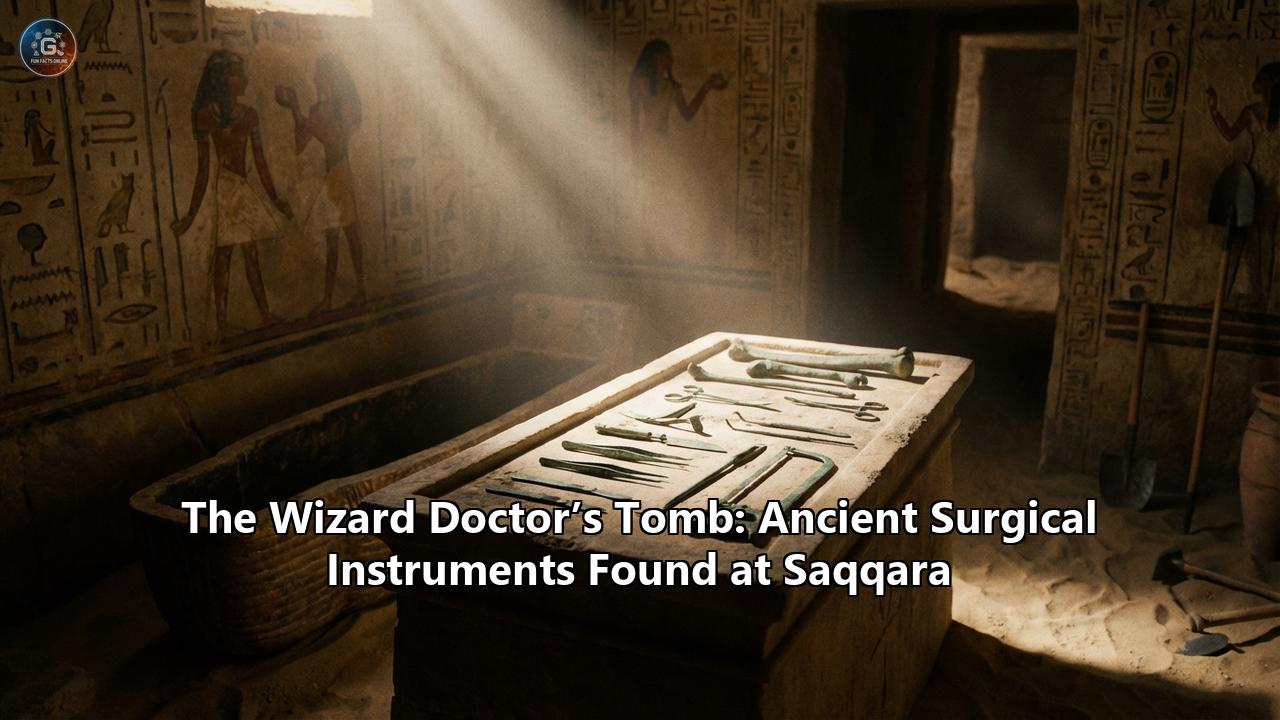
The sands of Saqqara are not merely dust; they are a archive of silence, keeping secrets that have waited four millennia to be whispered. Among the countless mastabas and crumbling pyramids of this vast necropolis, a discovery was made that shattered our understanding of the ancient world’s medical sophistication. It was not a trove of gold, nor a mask of lapis lazuli, that brought the world to a standstill, but a collection of corroded bronze implements—cold, sharp, and undeniably precise.
This is the story of the Tomb of the Physician, often whispered of as the "Wizard Doctor" due to the dual nature of his craft—a man who walked the razor's edge between the empirical science of surgery and the mystical arts of spell-casting. In the shadow of the Step Pyramid, archaeologists unearthed the resting place of Qar (sometimes spelled Kar), the "Chief Physician of the Palace," and with him, the oldest collection of surgical instruments ever found in the history of humanity.
What follows is a journey into the life, the tomb, and the tools of a man who lived and healed during the Sixth Dynasty of the Old Kingdom (c. 2350–2180 BCE). It is a deep dive into a world where a scalpel cut the flesh while a spell soothed the soul, where the hospital was a temple, and where the doctor was, in every sense, a wizard.
Part I: The Necropolis of Secrets
To understand the magnitude of the discovery, one must first understand the stage upon which it was set. Saqqara is not simply a cemetery; it is the oldest stone metropolis of the dead in existence. Located approximately 30 kilometers south of modern-day Cairo, it served as the primary burial ground for the ancient capital of Memphis.
For over 3,000 years, Egyptians buried their kings, nobles, and gods here. It is dominated by the Step Pyramid of Djoser, the first great stone structure of humanity, designed by the architect-physician Imhotep. It is fitting that the "Wizard Doctor’s" tomb was found here, in the shadow of Imhotep, the man who would eventually be deified as the god of medicine.
The desert winds here are harsh, shifting the dunes constantly, revealing and concealing history in a rhythmic dance. In December 2001, a team of Egyptian archaeologists led by the indomitable Dr. Zahi Hawass was excavating a site north of the pyramid of Sekhemkhet. They were looking for the lost tombs of the Old Kingdom, hoping to fill the blank pages of the Sixth Dynasty.
They found a mastaba—a flat-roofed, rectangular tomb with sloping sides, constructed of mudbrick and limestone. It had been ravaged by time and the inevitable tomb robbers of antiquity, but the core remained. As the sand was brushed away, hieroglyphs emerged from the gloom. They spelled out a name: Qar.
And then, they read his titles.
- Chief Physician of the Palace.
- Dean of the Physicians.
- Overseer of the Priests of the Pyramid.
This was not merely a noble; this was the man responsible for the health of the God-King himself. But the true treasure lay deeper. Beside the doctor’s limestone sarcophagus, obscured by centuries of debris, lay a collection of copper and bronze objects. They were small, distinct, and unmistakably shaped for a purpose other than warfare or carpentry.
They were the tools of a surgeon.
Part II: The Wizard Doctor – A Dual Identity
In the modern world, we draw a sharp, impenetrable line between science and magic. A surgeon does not chant while making an incision; a pharmacist does not invoke a goddess while compounding a pill. But in the Old Kingdom of Egypt, no such line existed. The "Wizard Doctor" is not a fanciful nickname; it is an accurate description of the Egyptian physician.
The ancient Egyptians had three distinct types of healers, often embodied in the same person:
- The Swnw (Sunu): The physician. This was the man of science, the one who set bones, stitched wounds, and prescribed herbal remedies. Qar was a high-ranking Swnw.
- The Sau: The magician or "protector." This healer used amulets and spells to ward off the evil spirits or angry gods believed to cause disease.
- The Priest of Sekhmet: Sekhmet was the lioness-headed goddess of plague and healing. Her priests were the "surgeons" of the day, often dealing with the most dangerous ailments.
Qar was likely a master of all three disciplines. To the Ancient Egyptian mind, a broken leg was a physical reality, but the cause of the accident might be a curse or a disruption in Ma’at (cosmic order). Therefore, the treatment required a splint for the bone (science) and a spell to drive away the malevolent spirit (magic).
The "Wizard Doctor" would have stood over his patient, a bronze scalpel in one hand and a papyrus scroll of incantations in the other. He was a conduit for divine power and a practitioner of advanced biology. The discovery of his tomb provided the physical evidence of this duality. While the walls bore the religious texts to guide his soul to the afterlife, the sarcophagus held the physical tools of his earthly trade.
Part III: The Instruments of Life and Death
The collection found in Qar’s tomb is the "smoking gun" of ancient surgery. Before this find, our knowledge of Egyptian surgery came primarily from artistic depictions—such as the famous relief at the Temple of Kom Ombo (which is from the much later Ptolemaic period) or the Edwin Smith Papyrus (a medical text). We knew they did surgery, but we had rarely held the tools they used.
The cache in Qar’s tomb included several distinct bronze implements. While some scholars initially debated whether these were "model" tools meant for the afterlife or actual working instruments, the wear patterns and the precision of their manufacture suggest they were the toolkit of a master.
1. The Scalpels
The centerpiece of the collection is the scalpel. Unlike the disposable steel blades of today, these were crafted from bronze. Bronze, an alloy of copper and tin, was the "high-tech" metal of the Old Kingdom. It could hold an edge capable of slicing through skin and muscle.
The scalpels found were small, with leaf-shaped blades. They were designed for precision. An Egyptian surgeon used two types of incisions: the "drawing" cut and the "puncturing" cut. These blades were capable of both. They would have been used to lance boils, remove cysts, and perhaps perform more complex procedures like circumcisions or the removal of tumors.
2. The Probes
Long, slender bronze rods were found, some with bulbous ends. These are unmistakable medical probes. In a world without X-rays, a probe was the surgeon's eyes. They were used to explore the depth of a wound, to detect foreign bodies (like arrowheads or splinters) inside the flesh, and to apply medication deep into a sinus track.
The existence of probes tells us that Egyptian doctors understood the concept of "exploratory surgery." They did not just treat the surface; they investigated the pathology beneath.
3. The Needles
Copper needles found in the cache suggest the practice of suturing. The Egyptians were known to use linen thread, and occasionally ant mandibles (in a pinch), to close wounds. The needles found with Qar were fine enough to stitch skin. The Edwin Smith Papyrus describes "drawing together the lips of the wound" with stitching—a technique that would not be improved upon until the invention of modern antiseptics.
4. The Spoons and Scoops
Small, spoon-like instruments were likely used for curettage—the scraping of tissue. This could be used to clean an infected wound, remove necrotic (dead) flesh, or mix and apply pharmaceutical ointments. The Egyptians had a vast pharmacopeia including honey (a natural antibiotic), acacia, frankincense, and malachite. These spoons were the delivery system for these medicines.
5. The Hooks
Hooks found in the collection serve a grim but necessary purpose: retraction. In surgery, one must pull back the skin or muscle to see the area of interest. These hooks allowed the "Wizard Doctor" to expose the site of operation. In more delicate procedures, such as the extraction of the brain during mummification (though usually done by embalmers, not necessarily physicians like Qar), hooks were essential.
Part IV: The Operating Theater of the Old Kingdom
How were these tools used? The discovery of Qar’s instruments forces us to reconstruct the "operating theater" of 2300 BCE.
It would not have been a sterile white room. It was likely a sunlit courtyard in the "House of Life" (Per Ankh) or a clean room in the palace. Cleanliness was a religious mandate for priests, which inadvertently created a semi-sterile environment. The doctors washed their hands, shaved their bodies, and wore clean linen.
Pain Management:Without anesthesia, speed was the surgeon’s greatest asset. However, the "Wizard Doctor" had his methods.
- Opiates: Poppy juice was known to the Egyptians.
- Alcohol: Beer and wine were used to dull the senses.
- The Stone of Memphis: A legendary substance (possibly a type of marble and vinegar mixture) mentioned in later texts that supposedly numbed the area.
- Hypnosis/Mesmerism: The "Wizard" aspect played a huge role here. The rhythmic chanting of spells, the scent of burning incense, and the authoritative presence of the doctor induced a trance-like state in the patient, reducing the perception of pain.
With Qar’s tools, the following procedures were possible:
- Trauma Care: The Old Kingdom was a time of massive construction (the Pyramids). Accidents were frequent. Setting compound fractures, stitching gashes from falling stone, and treating crushing injuries were daily tasks.
- Dentistry: While specialized "tooth doctors" existed, a Chief Physician like Qar would handle abscesses. The tools found could lance a gum boil to relieve pressure.
- Tumor Removal: The Ebers Papyrus speaks of "swellings." If a swelling was movable, the knife was used. If it was "angry" (malignant), they knew not to touch it—a wisdom that rivals modern oncology.
- Circumcision: A ritual and hygienic procedure performed on adolescents. The relief in the Tomb of Ankhmahor (also in Saqqara) details this procedure explicitly, showing a surgeon using a tool very similar to the ones found in Qar’s tomb.
Part V: The Tomb Architecture – A House for Eternity
The tomb of Qar itself is a masterpiece of Old Kingdom architecture, designed not just to house a body, but to facilitate the eternal work of the doctor.
The Location:The mastaba is located in the "medical quarter" of the Saqqara necropolis. It seems doctors preferred to be buried near one another, perhaps to continue their consultations in the Field of Reeds. It lies north of the Unfinished Pyramid of Sekhemkhet, cut partly into the bedrock and partly constructed of fine Tura limestone.
The False Door:The focal point of the tomb is the "False Door." In Egyptian belief, this was the portal between the world of the living and the dead. Qar’s spirit (his Ka) would pass through this solid stone door to receive offerings.
The inscriptions on the door are pristine. They list his titles and invoke the king’s bounty.
"An offering which the King gives, and Anubis, who is upon his hill... for the Ka of the Chief Physician, Qar."
The door depicts Qar seated at an offering table, smelling a lotus flower—a symbol of rebirth.
The Inscriptions:The walls of the tomb are not merely decorative; they are a biography. They show Qar in various stages of life. We see him overseeing scribes, receiving gifts from the Pharaoh, and, crucially, we see the tools of his trade.
One vivid scene depicts the funerary procession, with offering bearers carrying chests. It is inside one of these chests—conceptually—that the surgical tools were stored. The walls also feature "medical texts" disguised as religious spells, ensuring that Qar would retain his healing knowledge in the afterlife.
The Serdab:The tomb contained a Serdab, a hidden chamber. Inside, archaeologists found statues of the doctor. In one, he stands striding forward, a symbol of an active, vigorous life. In another, he is seated, a scribe’s scroll on his lap, emphasizing his intellect. The realism is striking—Qar is not depicted as an idealized god, but as a man of middle age, with the slight paunch of prosperity and the focused gaze of a diagnostician.
Part VI: The Man Behind the Mask
Who was Qar? Based on the skeletal remains and the tomb inscriptions, we can construct a profile of this ancient genius.
He died at approximately 50 years of age—a venerable lifespan in ancient Egypt, where the average was closer to 35. His bone structure reveals a man who was well-nourished, likely consuming a diet rich in meat, bread, and beer, consistent with his high status.
Interestingly, analysis of the mummies found in this sector of Saqqara often reveals signs of the very diseases they treated. We find evidence of arthritis, dental decay, and healed fractures. Qar himself likely suffered from the aches and pains of a life spent leaning over patients and reading scrolls.
As "Chief Physician of the Palace," Qar had the ear of the Pharaoh. He was part of the royal inner circle. He would have been responsible for the daily health rituals of the king—checking the royal stool, examining the royal eyes, and preparing the royal unguents. This was a position of immense political power. A doctor could poison a king as easily as cure him; thus, Qar’s loyalty was as prized as his skill.
He lived during the Sixth Dynasty, a time when the Old Kingdom was beginning to show cracks. The absolute power of the Pharaohs was waning, and the priesthoods and local officials were gaining strength. Qar, holding titles in both the medical and religious spheres ("Overseer of the Priests"), was a man of this new order—a powerful technocrat who commanded respect through his ability to control life and death.
Part VII: The Medical Papyri Connection
To fully appreciate the tools found in Qar’s tomb, we must read them in conjunction with the "textbooks" of the time. The Edwin Smith Papyrus (dated to roughly 1600 BCE but believed to be a copy of an Old Kingdom text, possibly written by Imhotep) is the world’s oldest surgical treatise.
It reads like a modern trauma manual. It categorizes injuries into three verdicts:
- "An ailment which I will treat." (Favorable prognosis)
- "An ailment with which I will contend." (Uncertain prognosis)
- "An ailment not to be treated." (Terminal)
Qar would have memorized these cases.
- Case 10: A gash above the eyebrow. The treatment involves stitching the wound (using the needles found in the tomb) and binding it with fresh meat (to stop bleeding and prevent swelling).
- Case 25: A dislocated jaw. The instruction is to place the thumbs inside the mouth and the fingers under the chin to snap it back into place—a maneuver still used in emergency rooms today (the Hippocratic maneuver).
The "Wizard" aspect appears in the "ailments not to be treated." When a skull was smashed or a tumor was inoperable, the physician switched to the magician. He would recite spells to ease the passing of the patient, ensuring their Ba (soul) could exit the broken body safely. The tools found in Saqqara were the physical extensions of this intellectual tradition.
Part VIII: Why Saqqara?
Why was this specific tomb found here? Saqqara is the "City of the Dead" for Memphis, the capital. But it was also a center of pilgrimage. The cult of Imhotep was centered here.
Imhotep, the vizier of King Djoser (3rd Dynasty), was the architect of the Step Pyramid and a physician of such renown that he was later deified. Sick pilgrims would come to Saqqara, sleeping in the temple precincts in hopes of receiving a "healing dream" from the god.
Qar, living a few centuries after Imhotep, would have revered him. By placing his tomb near the Step Pyramid, Qar was associating himself with the Great Master. He was planting his flag in the soil of the medical elite. The discovery of the surgical tools here confirms that Saqqara was not just a cemetery, but a campus of medical knowledge—a place where the best doctors lived, practiced, and were buried.
Part IX: The Significance of the Find
The discovery of the "Wizard Doctor’s" surgical instruments in 2001 changed the narrative of medical history.
1. Pushing Back the Timeline:Before this, many historians believed that complex surgery was a Greek or Roman invention (Hippocrates/Galen). Qar’s scalpels prove that sophisticated metallurgy and surgical intervention existed in Egypt 2,000 years before the birth of Hippocrates.
2. The Secular/Religious Blend:The find validates the theory that Egyptian medicine was a holistic practice. The proximity of the tools to religious amulets in the tomb shows that for Qar, the scalpel and the charm were two sides of the same coin.
3. The Sophistication of Toolmaking:The bronze used in these tools was not ordinary. Analysis suggests a specific alloy composition designed for hardness and durability. The Egyptians were not just hammering copper; they were engineering materials for specific medical applications.
4. A Window into the "House of Life":The Per Ankh or House of Life was the ancient library/university. Qar’s tomb gives us a physical inventory of a graduate of this system. It humanizes the ancient texts. We no longer just read about "cutting the flesh"; we see the blade that did it.
Part X: Conclusion – The Eternal Physician
As we gaze upon the corroded green bronze of the instruments today, housed in the Imhotep Museum at Saqqara, we are looking across a chasm of 4,000 years. Yet, the distance feels small.
The "Wizard Doctor" Qar faced the same enemies modern doctors face: infection, trauma, cancer, and death. He fought them with the best technology of his time—bronze blades—and the most powerful psychological tools at his disposal—magic.
The Tomb of the Wizard Doctor is more than an archaeological site; it is a monument to the human refusal to accept death without a fight. In the silence of the Saqqara desert, the spirit of Qar still seems to stand watch, his scalpel in hand, ready to heal the broken and guide the departed, forever blurring the line between the science of the body and the magic of the soul.
For the modern visitor, standing before his tomb is a humbling experience. It is a reminder that while our tools have changed from bronze to laser, and our spells have turned into pharmaceuticals, the core mission remains unchanged: to preserve the breath of life against the encroaching dark. The Wizard Doctor of Saqqara may have been buried four millennia ago, but through his tools, his hands are still at work, teaching us that the roots of our healing arts run deeper than we ever dared to imagine.
Reference:
- https://greekreporter.com/2025/01/07/tomb-ancient-egyptian-royal-doctor-saqqara/
- https://culturalpropertynews.org/healer-to-pharaohs-royal-physicians-tomb-discovered-in-saqqara/
- https://grokipedia.com/page/qar_doctor
- https://en.wikipedia.org/wiki/Qar_(doctor))
- https://www.smithsonianmag.com/smart-news/archaeologists-discover-intricately-decorated-tomb-belonging-to-a-doctor-who-treated-egyptian-pharaohs-4100-years-ago-180985788/
- https://en.wikipedia.org/wiki/Qar_(Ancient_Egyptian_official))
- https://www.youtube.com/watch?v=3gsimvNTdXM
- https://www.livescience.com/archaeology/ancient-egyptians/4-100-year-old-tomb-of-doctor-who-treated-pharaohs-discovered-at-saqqara
- https://www.heritagedaily.com/2025/04/princes-royal-tomb-discovered-in-saqqara/155019
- https://www.digital-epigraphy.com/publications/the-mastabas-of-qar-and-idu-g-7101-and-7102-digitally-revised-and-enhanced-edition
- https://en.ammonnews.net/article/65562
- https://www.meisterdrucke.ie/fine-art-prints/Kenneth-Garrett/1489361/Egypt;-Archaeology;-Old-Kingdom;-Saqqara,-Tomb-of-Qar,-Qar,-Physician,-copper,-tools.html
- https://archaeologicalpaths.com/news/dr-zahi-hawass-discovers-the-oldest-mummy-ever-found