
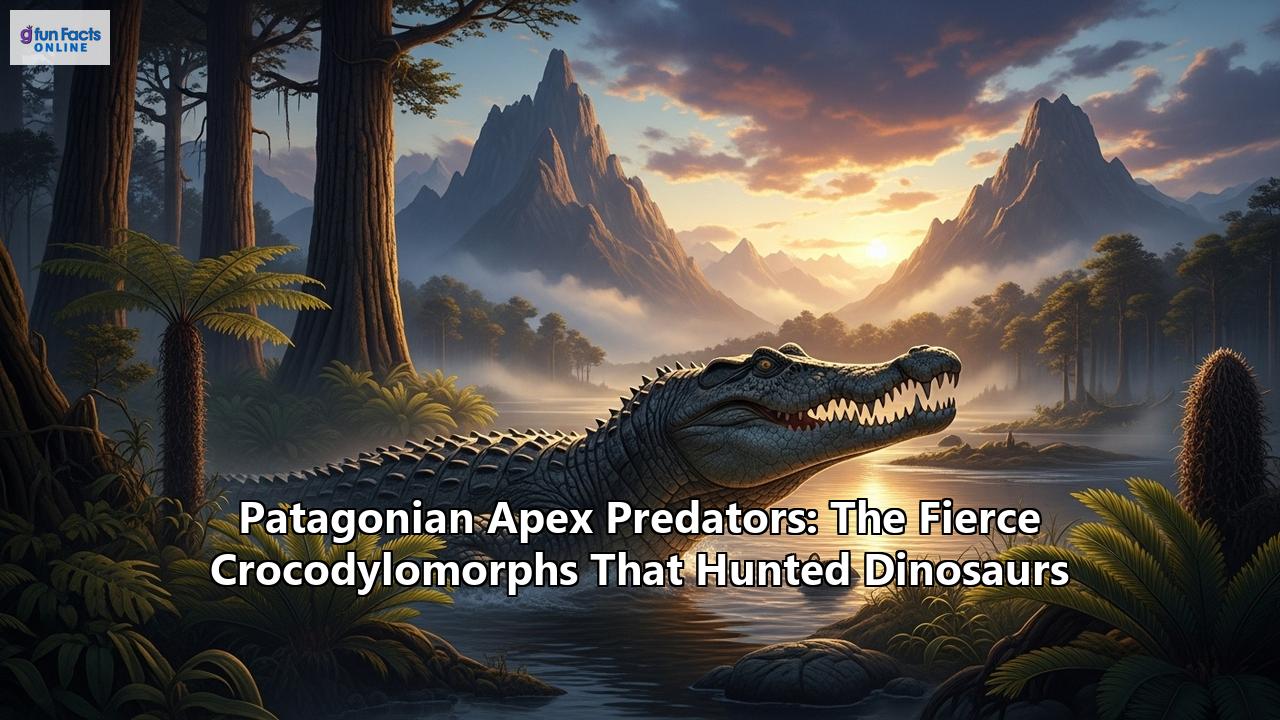
A Land Before Time: The Lost World of Cretaceous Patagonia
Imagine a world where the earth trembles beneath the feet of colossal beings, a realm of lush floodplains, dense conifer forests, and winding rivers stretching across a vast, ancient landscape. This was Patagonia during the Cretaceous Period, a time when this southern tip of South America was a vibrant, dynamic theater of life and death. The stars of this prehistoric drama were, of course, the dinosaurs. Giants like the 70-ton Patagotitan mayorum, one of the largest land animals to have ever lived, browsed through the treetops, their immense size a testament to the richness of their environment. Herds of herbivorous ornithopods grazed in the open, while armored ankylosaurs, bristling with defenses, navigated the undergrowth. This was a world ruled by titans.
But the kings of this lost world were not all dinosaurs. Stalking these giants and their smaller contemporaries was another, altogether more surprising dynasty of apex predators. These were not the familiar, water-bound ambush hunters we know today, but a formidable group of terrestrial crocodylomorphs, ancient cousins of modern crocodiles, who had evolved to conquer the land. With long legs, deep skulls, and teeth like serrated daggers, these creatures were built for a life of active predation on solid ground, challenging the very notion that dinosaurs were the undisputed rulers of the Cretaceous.
For decades, the fossil-rich badlands of Patagonia have been a treasure trove for paleontologists, revealing the secrets of this ancient ecosystem. Discoveries in geological formations like the Neuquén Basin and the Chorrillo Formation have unearthed a spectacular diversity of life, painting a picture of a complex food web where competition was fierce and survival was a daily battle. This article delves into the story of these forgotten Patagonian apex predators, the fierce crocodylomorphs that hunted dinosaurs, revealing a world far more complex and terrifying than previously imagined.
The Unlikely Contenders: A New Breed of Crocodile
When we think of crocodiles, we envision semi-aquatic lurkers, masters of the patient, explosive ambush from the water's edge. This has been their successful blueprint for millions of years. But the broader family to which they belong, the Crocodylomorpha, has a far more diverse and astonishing evolutionary history. This group of archosaurs, which first appeared in the Triassic period, experimented with a vast array of body plans and lifestyles. Some were tiny and agile, others were herbivorous, and some even took to the open ocean. But perhaps the most remarkable of these evolutionary experiments was the Notosuchia, a clade of primarily terrestrial crocodylomorphs that flourished on the supercontinent of Gondwana during the Cretaceous.
Notosuchians were a breed apart. Unlike their sprawling, semi-aquatic cousins, many notosuchians evolved an erect, or semi-erect, posture with their legs positioned directly beneath their bodies. This fundamental shift in locomotion, supported by long, slender limbs, untethered them from the water's edge and allowed them to become efficient and often swift movers on land. Their skulls were also highly specialized and diverse, moving away from the flattened profile of modern crocodiles to taller, shorter, and more robust shapes. This was coupled with a remarkable diversification of teeth. Instead of the uniform, conical teeth of their aquatic relatives, notosuchians developed complex, heterodont dentition, with different teeth in their jaws adapted for different functions, including large, canine-like teeth for gripping and tearing, and even multi-cusped, molar-like teeth in some for processing a variety of foods. This dental toolkit allowed them to exploit a wide range of ecological niches, from omnivory and herbivory to, most fearsomely, terrestrial hypercarnivory.
It was in South America, and particularly in Patagonia, that these terrestrial crocodylomorphs reached their zenith as apex predators. Two families, in particular, rose to prominence, becoming the stuff of dinosaur nightmares: the Baurusuchidae and the Peirosauridae. These were not just opportunistic scavengers; they were large, powerful hunters who actively competed with, and preyed upon, the dinosaurs that shared their world.
The Dinosaur-Mimics: Baurusuchidae, the Four-Legged Land Sharks
Among the most formidable of the notosuchians were the Baurusuchidae, a family of hypercarnivorous predators whose fossils are found in Late Cretaceous deposits across South America. So well-adapted were they to a terrestrial, predatory lifestyle that they have been dubbed "dinosaur-mimics." They represent a remarkable case of convergent evolution, developing many of the same deadly tools as the theropod dinosaurs they lived alongside and competed with.
The skull of a baurusuchid was a fearsome weapon. Tall, deep, and laterally compressed, it bore a striking resemblance to the skulls of carnivorous dinosaurs. Their teeth were ziphodont, meaning they were flattened from side to side, curved, and serrated like steak knives – perfect for slicing through flesh and bone. This differed significantly from the conical, piercing teeth of modern crocodiles, which are designed for gripping and drowning prey. The powerful jaw muscles of baurusuchids, inferred from the structure of their skulls, suggest they could deliver swift, powerful bites, likely ambushing their prey, sinking in their blade-like teeth, and using powerful neck muscles to subdue their victims, much like a Komodo dragon.
Their bodies were also built for life on the move. An erect stance and powerful limb muscles, evidenced by the attachment points on their fossilized bones, would have made them far more mobile on land than any modern crocodilian. While they were not likely marathon runners, they were certainly capable of surprising bursts of speed to chase down prey. Some evidence even suggests that baurusuchids, like Baurusuchus, may have been capable of digging burrows, perhaps to find water during dry seasons or to regulate their body temperature in the hot and arid climates they sometimes inhabited. This would have made them even less dependent on permanent bodies of water, truly cementing their status as terrestrial specialists.
Several remarkable baurusuchids roamed ancient Patagonia and its neighboring regions:
- ---Baurusuchus---: The namesake of the family, Baurusuchus itself is primarily known from the Adamantina Formation in Brazil, which shared a similar environment with parts of Cretaceous Patagonia. This predator, estimated to weigh up to 250 pounds, was a key player in its ecosystem, likely competing directly with abelisaurid theropods for food. Its well-studied anatomy provides a crucial blueprint for understanding how this family of land-crocs operated.
- ---Stratiotosuchus---: Another giant from Brazil's Adamantina Formation, Stratiotosuchus was a true hyperpredator. Its name, meaning "soldier crocodile," is a nod to its formidable nature. It may have filled the niche of top predator in its environment, especially in areas where large theropod dinosaurs were rare. With its robust build and powerful jaws, it would have been more than capable of tackling large prey, including the herbivorous titanosaurs that were common in the region.
- ---Wargosuchus australis---: Discovered in the Bajo de la Carpa Formation of Argentina's Neuquén Province, Wargosuchus is a confirmed Patagonian baurusuchid. Although known from fragmentary remains, including a piece of the snout and cranial roof, its features clearly align it with this formidable family. Its discovery reinforces the idea of a shared fauna between Brazil and Argentina during the Late Cretaceous and highlights the diversity of these predators in Patagonia itself.
- ---Cynodontosuchus rothi---: Another of the Argentinian baurusuchids, Cynodontosuchus was smaller and had weaker dentition than its more robust relatives. Some scientists have suggested that the known material may represent a juvenile of another species, but it nevertheless adds to the picture of a diverse baurusuchid presence in the region.
The Broad-Snouted Brutes: The Peirosauridae
While the baurusuchids were masters of the deep-skulled, blade-toothed style of predation, another family of notosuchians, the Peirosauridae, carved out their own niche as powerful terrestrial carnivores. Also widespread across Gondwana, peirosaurids are well-represented in the fossil record of Patagonia. They generally possessed a more "dog-like" or broad snout compared to the baurusuchids, and their dentition, while still formidable, showed a different kind of specialization. Their skulls often featured a mix of conical, caniniform teeth at the front and more robust, spatulate, or even globular teeth further back, suggesting a powerful, crushing bite in addition to slicing capabilities.
Recent discoveries in Patagonia have dramatically increased our understanding of these impressive predators, revealing them to be just as capable of taking on dinosaurs as their baurusuchid cousins.
- ---Kostensuchus atrox---: The discovery of Kostensuchus atrox in the Chorrillo Formation of southern Patagonia, announced in 2025, has been a game-changer for understanding peirosaurids. The beautifully preserved fossil, including a nearly complete skull and parts of the skeleton, belongs to an animal that lived around 70 million years ago, at the very end of the Cretaceous. Kostensuchus, whose name translates to "fierce wind crocodile," was a true apex predator. It measured approximately 11.5 feet (3.5 meters) in length and weighed an estimated 550 pounds (250 kg). Its broad, powerful snout was packed with large, robust ziphodont teeth, and its skull housed large chambers for jaw-closing muscles, indicating a devastatingly strong bite. The robust nature of its forelimbs further suggests it was capable of grappling with and subduing large prey, very likely including the medium-sized dinosaurs that were abundant in its ecosystem. Kostensuchus was the second-largest predator known from the Chorrillo Formation, sharing the top of the food chain with the giant megaraptorid theropod, Maip macrothorax.
- ---Gasparinisuchus peirosauroides---: Hailing from the older Late Cretaceous deposits (Santonian to early Campanian) of the Neuquén and Mendoza Provinces, Gasparinisuchus is another key Patagonian peirosaurid. Originally referred to another genus, Peirosaurus, it was later recognized as a distinct animal with a broad, rounded snout. Its discovery helped to show that the peirosaurid faunas of Argentina were distinct from those found in Brazil, highlighting the regional diversity of these crocodylomorphs. As a member of the Peirosauridae, it was undoubtedly a formidable terrestrial carnivore, patrolling the ancient floodplains in search of its next meal.
The Hunting Grounds: A Portrait of Cretaceous Patagonia
To truly understand these dinosaur-hunting crocodiles, we must first reconstruct the world they inhabited. Cretaceous Patagonia was a land of dramatic landscapes and dynamic climates, a far cry from the arid steppes of today. Its geological history, preserved in layers of sediment in places like the Neuquén Basin and the Chorrillo Formation, tells a story of changing environments that both nurtured and challenged the life within them.
During much of the Late Cretaceous, Patagonia experienced a warm and seasonally humid climate. Vast freshwater floodplains stretched across the landscape, crisscrossed by meandering rivers and dotted with lakes and lagoons. This aquatic network was the lifeblood of the region, supporting a rich and diverse flora. The fossil record reveals a world shaded by forests of conifers, similar to modern Araucaria (monkey puzzle trees), and podocarps. Ferns and cycads would have formed a lush understory. In the wetlands and along the waterways, aquatic ferns like the water lily family, including the lotus genus Nelumbo, flourished. The appearance and diversification of flowering plants, including relatives of modern palms and the southern beeches (Nothofagus), added new layers to these ecosystems.
This vibrant plant life supported an incredible array of herbivorous dinosaurs, which in turn provided a feast for a guild of predators. The river systems teemed with fish, frogs, turtles, and even plesiosaurs in the more coastal areas, while a variety of early mammals and other reptiles scurried in the shadows. The end of the Cretaceous saw a major marine transgression, with the Atlantic Ocean pushing inland, creating a complex archipelago of islands and reducing the available landmass, which would have further concentrated these diverse faunas.
It was on these floodplains and within these forests that the great predator-prey dramas of the Cretaceous played out. The ecosystems were robust enough to support not just one, but multiple types of large predators, leading to a fascinating interplay of competition and coexistence.
On the Menu: The Dinosaurs of Patagonia
The crocodylomorphs of Patagonia had a smorgasbord of potential prey. The sheer diversity of herbivorous dinosaurs in the region meant that there was a meal to be had for predators of all sizes and specializations.
At the top of the menu in terms of sheer biomass were the titanosaurian sauropods. Patagonia was the land of giants, and fossils of colossal long-necked herbivores like Patagotitan mayorum and Argentinosaurus are a testament to the productivity of the ancient environment. An adult Patagotitan would have been an unassailable fortress of flesh and bone for any predator. However, the young, the old, or the sick would have been vulnerable. It's highly probable that a pack of baurusuchids or a large peirosaurid would not have passed up the opportunity to bring down a juvenile titanosaur, or to scavenge from a massive carcass. The discovery of multiple Patagotitan individuals in a single location suggests that these giants may have succumbed to natural catastrophes like droughts or floods, which would have provided a bonanza for the region's carnivores.
More realistically, the day-to-day prey for these crocodylomorphs would have been the abundant medium-sized herbivorous dinosaurs. These included various ornithopods and other "bird-hipped" dinosaurs. The powerful jaws of a predator like Kostensuchus would have been well-suited for crushing the bones and tearing the flesh of these animals. The fossil record from formations across Patagonia is filled with the remains of these herbivores, indicating a steady and reliable food source.
Even the armored dinosaurs, the ankylosaurs, were not entirely safe. While their bony plates and tail clubs offered formidable protection, a determined and powerful predator could have potentially flipped a smaller individual or targeted its unarmored underbelly. The presence of ankylosaurs like Stegouros in the same ecosystems as these crocodylomorphs means that such encounters were certainly possible.
However, the crocodylomorphs were not the only large predators on the landscape. They shared their habitat with fearsome theropod dinosaurs. These included the truly gigantic carcharodontosaurids like Giganotosaurus, which rivaled Tyrannosaurus rex in size, and the slightly smaller but equally deadly megaraptorids like Maip macrothorax. These theropods were the traditional apex predators, and their co-existence with a guild of large predatory crocodylomorphs raises fascinating questions about niche partitioning. It seems that in Cretaceous Patagonia, the role of top terrestrial predator was not held by a single king, but was divided amongst a diverse court of killers. The theropods, with their bipedal stance and different hunting styles, may have focused on different prey or utilized different hunting grounds than the quadrupedal crocodylomorphs. For instance, in the southern ecosystems of the Chorrillo Formation, the predatory landscape was ruled jointly by the megaraptorid Maip and the peirosaurid Kostensuchus, a partnership that differed from the abelisaurid-dominated predator guilds further north. This suggests a complex and regionally varied ecological balance, where crocodiles and dinosaurs shared, and competed for, the throne.
The Killer's Craft: Hunting Strategies and Hard Evidence
The anatomy of these Patagonian crocodylomorphs speaks volumes about their predatory prowess. Their terrestrial adaptations fundamentally changed the way they would have hunted compared to their aquatic relatives. The Baurusuchidae, in particular, with their erect posture and deep, blade-like snouts, were likely active pursuit predators over short distances. They may have used their keen sense of smell to track prey, closing the distance with a burst of speed before delivering a devastating, slashing bite with their ziphodont teeth. The biomechanics of their skulls suggest that while their bite might not have had the bone-crushing force of a T-rex, it was incredibly fast and designed for defleshing a carcass with brutal efficiency.
The Peirosauridae, like Kostensuchus, with their broader snouts and more varied dentition, might have employed a slightly different strategy. Their powerful jaws suggest a crushing bite was a key part of their arsenal, allowing them to tackle more robust prey and break through bone. While still highly terrestrial, some studies suggest that creatures like Kostensuchus may have had a more sprawling posture than baurusuchids, perhaps making them comfortable both on floodplains and at the water's edge, true masters of the transitional zone between land and water.
Direct evidence of crocodylomorphs preying on dinosaurs is rare in the fossil record, but it does exist. One of the most spectacular examples comes not from Patagonia, but from Australia, which was part of the same Gondwanan supercontinent. A 95-million-year-old fossil of a crocodyliform named Confractosuchus was discovered with the partial skeleton of a young ornithopod dinosaur preserved in its stomach. This incredible fossil provides undeniable proof that these ancient crocodiles ate dinosaurs.
Closer to home, paleontologists find other tantalizing clues. Bite marks on dinosaur bones that match the size and shape of notosuchian teeth have been found, offering indirect but compelling evidence of these predator-prey interactions. The constant replacement of their serrated teeth meant that these predators were always well-armed for the hunt.
Imagine the scene: a young titanosaur, separated from the herd, wanders too close to a dense thicket of ferns. Hidden within, a Baurusuchus lies in wait. With an explosive burst of speed, the land-croc lunges, its serrated teeth sinking into the dinosaur's leg. The battle would be short and brutal, the crocodylomorph's powerful neck and body shaking its victim into submission. Or perhaps a Kostensuchus, patrolling the edge of a floodplain, spots a lone ornithopod. Using the cover of the vegetation, it closes the distance before launching its attack, its broad jaws clamping down with crushing force. These are the scenes, backed by fossil evidence, that played out across the plains of Cretaceous Patagonia, a world where dinosaurs had every reason to fear the "crocodiles."
End of a Dynasty
For millions of years, the terrestrial crocodylomorphs of Patagonia thrived, a fearsome and successful group of predators that shared the top of the food chain with their dinosaur rivals. But their reign, like that of the non-avian dinosaurs, was destined to come to an end. The cataclysmic event that marked the end of the Cretaceous Period, 66 million years ago – the impact of a massive asteroid – plunged the world into a new, dark age.
The subsequent mass extinction wiped out an estimated 75% of life on Earth, including the non-avian dinosaurs. The hypercarnivorous notosuchians of Patagonia, including the mighty baurusuchids and peirosaurids, also appear to have vanished. Their specialization as predators of large terrestrial vertebrates tied their fate directly to that of the giant herbivorous dinosaurs they hunted. When the ecosystems collapsed and their primary food sources disappeared, these magnificent predators followed them into extinction.
However, not all notosuchians died out. In a remarkable story of survival, at least one group, the sebecids, managed to cross the Cretaceous-Paleogene boundary. These terrestrial predators, some of which were also large-bodied, survived the extinction event and continued to roam South America into the Cenozoic Era, long after the last of the giant dinosaurs had gone. Their survival is a testament to the resilience and adaptability of the crocodylomorph lineage.
The discovery of Patagonia's dinosaur-hunting crocodiles has rewritten our understanding of Cretaceous ecosystems. They reveal a world where the lines between predator and prey were complex and ever-shifting, and where the title of "apex predator" was fiercely contested. These fossils, unearthed from the windswept plains of southern Argentina, are more than just ancient bones; they are the remnants of a lost dynasty, a time when crocodiles walked tall and hunted giants, proving that the age of dinosaurs was also, unequivocally, an age of crocodiles.
Reference:
- https://thedinosaurs.org/dinosaurs/patagotitan
- https://www.amnh.org/exhibitions/permanent/orientation-center/the-titanosaur
- https://www.discovermagazine.com/at-around-12-feet-and-550-pounds-this-crocodile-relative-ate-dinosaurs-about-70-million-years-ago-47975
- https://www.jpost.com/archaeology/article-865627
- https://cosmosmagazine.com/history/patagonia-dinosaur-diversity/
- https://www.researchgate.net/publication/286615428_The_Cretaceous_flora_of_the_Neuquen_Basin_its_paleoenvironmental_and_paleoclimatic_significance
- https://www.researchgate.net/publication/360868899_Insights_into_paleoecology_of_the_Bajo_Barreal_Formation_Upper_Cretaceous_Patagonia_Argentina
- https://www.vliz.be/imisdocs/publications/342490.pdf
- http://bhort.bh.cornell.edu/histology/patpaleo.html
- https://www.researchgate.net/figure/Late-Cretaceous-to-Palaeocene-palaeogeographical-reconstruction-of-southern-Patagonia-and_fig5_227698040
- https://api.naturalis.fcnym.unlp.edu.ar/server/api/core/bitstreams/9e21a0d4-fd3e-4918-b7b1-8f72e58cabfa/content
- https://ca.news.yahoo.com/paleontologists-discover-dinosaur-era-crocodile-191234196.html
- https://www.discoverwildlife.com/dinosaurs/patagotitan-mayorum-facts
- https://www.sciencedaily.com/releases/2025/08/250828002409.htm
- https://www.sci.news/paleontology/kostensuchus-atrox-14175.html
- https://www.earth.com/news/ancient-crocodile-relative-kostensuchus-atrox-was-fierce-predator-alongside-dinosaurs/
- https://www.amnh.org/explore/news-blogs/patagotitan-mayorum-giant-dinosaur
- https://www.sci.news/paleontology/patagonykine-body-plan-13634.html