
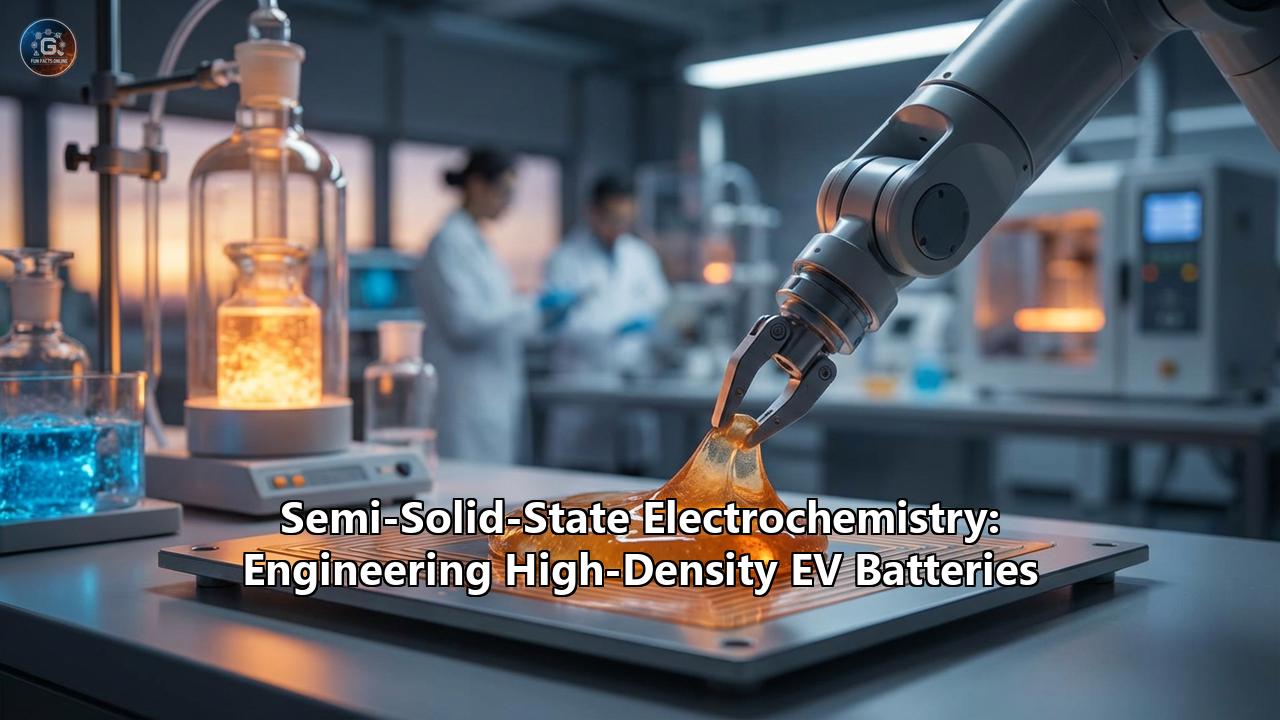
The electric vehicle (EV) revolution has reached a critical juncture. For the past decade, the automotive industry has ridden the wave of traditional liquid lithium-ion batteries, scaling up production to unprecedented levels while driving down costs. However, as consumers demand faster charging, longer ranges, and absolute safety, the foundational chemistry of traditional lithium-ion cells is approaching its theoretical limits. The much-anticipated "holy grail" of the industry—the all-solid-state battery (ASSB)—promises to solve these issues, yet it remains entangled in a web of manufacturing complexities, high costs, and interface scaling challenges.
Enter the pragmatic, highly engineered, and commercially viable hero of the current decade: semi-solid-state electrochemistry. Positioned elegantly between the liquid-drenched batteries of today and the purely solid ceramics of tomorrow, semi-solid-state batteries (SSSBs) are quietly rewriting the rules of energy density, manufacturing scalability, and vehicular safety.
The Electrochemical Anatomy of Semi-Solid-State Batteries
To appreciate the sheer engineering brilliance of semi-solid-state batteries, we must first look at the electrochemical heart of energy storage: the electrolyte. In a conventional lithium-ion battery, a highly volatile, flammable liquid organic electrolyte shuttles lithium ions between the cathode and the anode. While excellent at maintaining ionic conductivity, this liquid acts as a highly reactive fuel in the event of a short circuit, leading to the dreaded "thermal runaway."
All-solid-state batteries replace this liquid entirely with a solid matrix—often a sulfide, oxide, or polymer. While supremely safe, solid electrolytes suffer from poor interfacial contact. Imagine trying to perfectly press two hard rocks together; microscopic gaps will always exist. In a battery, these gaps create massive electrical resistance, crippling the cell’s ability to charge and discharge efficiently, especially at lower temperatures.
Semi-solid-state electrochemistry solves the "hard rock" problem by introducing a hybrid approach. Often described as having the consistency of clay, gel, or honey, the semi-solid electrolyte blends the mechanical stability of solid-state materials with the superior interface-wetting properties of a liquid. Depending on the specific architectural design, semi-solid batteries can be categorized into a few distinct types:
1. Solid-Liquid Hybrid Systems: These architectures utilize different electrolytes for the cathode and anode. For instance, an engineer might deploy a dense solid electrolyte on the anode side to suppress lithium dendrites, while using a minimal amount of liquid electrolyte on the cathode side to maintain rapid ion transport. 2. Gel-Polymer and Clay Types: In these systems, the traditional liquid electrolytes are gelled, or the electrolytes are mixed directly into the active electrode materials to form a viscous, clay-like slurry.By retaining just enough liquid to lubricate the ion pathways—typically constituting less than 10% of the battery's total weight—semi-solid cells ensure flawless interfacial contact while drastically reducing the volume of flammable material.
Breaking the Energy Density Ceiling
In the realm of electric vehicles, energy density dictates everything from the physical footprint of the vehicle to its maximum driving range. Traditional liquid lithium-ion batteries generally max out around an energy density of 250 to 260 Watt-hours per kilogram (Wh/kg). Pushing beyond this limit with standard liquid electrolytes drastically increases the risk of instability.
Semi-solid-state engineering shatters this ceiling by enabling the use of high-capacity active materials that would otherwise degrade or become dangerous in a liquid system. Because the semi-solid matrix exerts physical pressure and utilizes solid-state ion conductors, it stabilizes aggressive, high-energy anodes like silicon-rich composites and pure lithium metal.
The real-world results of this chemical engineering are staggering. In 2023, Chinese battery manufacturer WeLion delivered a commercial batch of semi-solid-state cells to the EV maker Nio, boasting a remarkable cell-level energy density of 360 Wh/kg. When assembled into Nio's flagship 150 kWh battery pack, the entire system weighs only 575 kilograms. To put this into perspective, this massive leap in capacity is only 3.6% heavier than Nio's older 100 kWh liquid battery pack, which weighed 555 kilograms.
Furthermore, the academic and research sectors are pushing these numbers into the stratosphere. Researchers at Nankai University in China recently developed a semi-solid-state battery pack delivering an isolated cell energy density of 500 Wh/kg, and an impressive 288 Wh/kg at the fully integrated system level. The team is already iterating on designs expected to push system-level densities beyond 340 Wh/kg, which could theoretically enable EV ranges of over 1,600 kilometers (nearly 1,000 miles) on a single charge.
Even more astonishing are the laboratory results emerging from WeLion. In late 2025, WeLion's Chairman, Yu Huigen, announced that the company had achieved an industry-leading energy density of 824 Wh/kg in lab tests using advanced solid-state and semi-solid formulations, with long-term sights set on breaking the 1,000 Wh/kg barrier.
The Manufacturing Edge: A "Drop-In" Revolution
Perhaps the most potent advantage of semi-solid-state batteries is not their performance, but their manufacturability. The transition to all-solid-state batteries requires tearing down billion-dollar Gigafactories and inventing entirely new manufacturing paradigms. Solid-state cells often require extreme pressure environments, specialized sintering processes, and ultra-dry rooms that are prohibitively expensive to build at scale.
Conversely, semi-solid-state batteries offer a "drop-in" replacement for existing lithium-ion infrastructure. Because they still utilize a degree of flowable or malleable material during the assembly phase, semi-solid cells can be manufactured on the exact same roll-to-roll coating machines and winding lines that currently produce standard EV batteries. This allows automotive giants to pivot to high-density semi-solid technology without stranding billions of dollars in existing capital assets.
A prime example of manufacturing innovation in this space comes from the US-based startup 24M Technologies. Founded by researchers from MIT, 24M has completely reimagined battery architecture with its "SemiSolid" thick-film technology. Traditional battery manufacturing requires mixing active materials with toxic solvents and inactive binders, coating them onto thin metallic foils, and then undergoing a costly, energy-intensive drying process.
24M’s approach mixes the electrolyte directly with the active materials to form a binderless, clay-like slurry that is extruded directly into the cell. By eliminating binders and significantly reducing the volume of inactive components like current collectors and separators, 24M dramatically increases the volumetric energy density (Wh/L) of the cell while simultaneously slashing the manufacturing footprint and raw material costs. Their technology is so promising that giants like Kyocera, Fujifilm, and Volkswagen have poured millions into the company to secure licensing and production rights.
Taming the Thermal Runaway: A Paradigm Shift in Safety
Range anxiety is rapidly being cured by larger batteries, but battery safety remains a vital hurdle in the public adoption of EVs. In traditional batteries, microscopic needle-like structures called "dendrites" can grow from the anode during rapid charging. If a dendrite pierces the porous plastic separator between the anode and cathode, it creates a dead short, instantly dumping the cell's energy as heat. This ignites the liquid electrolyte, leading to fires that burn at thousands of degrees and are notoriously difficult to extinguish.
Semi-solid electrochemistry heavily mitigates this risk. First, the reduction of volatile liquid organic compounds—often replaced or heavily diluted by flame-retardant polymers, ceramics, and gelled matrices—starves the battery of highly flammable fuel. Second, the mechanical rigidity of the semi-solid electrolyte acts as a physical barricade against dendrite formation. Even if small lithium structures begin to form, the dense, clay-like or polymer-ceramic hybrid matrix suppresses their growth, preventing them from bridging the gap to the cathode.
The result is a battery that can withstand physical puncturing, overcharging, and extreme temperatures with a fraction of the thermal runaway risk associated with standard lithium-ion cells. This allows EV manufacturers to reduce the heavy, expensive cooling and armor systems traditionally required for battery packs, further improving the overall efficiency and weight of the vehicle.
Trailblazers of the Semi-Solid Revolution
The commercialization of semi-solid-state batteries has accelerated dramatically, moving from university laboratories to highway-ready vehicles. Several key players have catalyzed this transition:
Nio and WeLion: The 1,000-Kilometer Milestone
The most highly publicized triumph of semi-solid-state technology belongs to the partnership between the Chinese EV automaker Nio and battery developer WeLion. In 2021, Nio promised the world a 150 kWh battery pack capable of a 1,000 km range. After years of rigorous development and iterative delays, the promise became a reality. WeLion's semi-solid cells—featuring a 360 Wh/kg energy density—were successfully integrated into Nio's architecture.
To prove the technology's viability, Nio’s CEO, William Li, embarked on a live-streamed journey in a Nio ET7 sedan. Powered entirely by the 150 kWh semi-solid-state battery, the vehicle traveled 1,044 kilometers (approximately 650 miles) on a single charge over a 14-hour trip. At the end of the journey, the battery still retained 3% of its charge. While the battery pack remains highly expensive—costing roughly as much as an entire standard vehicle, limiting its initial mass-market adoption—it stands as a monumental proof-of-concept for the future of long-haul electric transport.
24M Technologies and the ESS Crossover
While automotive applications grab the headlines, semi-solid-state technology is also transforming the Energy Storage System (ESS) market. 24M Technologies, utilizing its proprietary binderless clay-like manufacturing, has successfully commercialized its batteries in the Japanese residential energy storage market in partnership with Kyocera. These home energy storage products, ranging from 5 kWh to 15 kWh, benefit deeply from the low fire risk and high cycle life of the semi-solid architecture. 24M’s cells boast production energy densities of 280 to 400 Wh/kg, rivaling the most advanced standard lithium-ion cells on the market today.
Defining the Standard
As semi-solid technology boomed, the terminology became a marketing buzzword, with some manufacturers slapping the "semi-solid" label on standard batteries with minor chemical tweaks. To combat this and protect consumer trust, regulatory bodies, particularly in China, have begun enforcing strict, quantifiable measures to define battery classifications. New standards have been introduced that categorize batteries based on liquid mass loss rates. Under these new guardrails, a "hybrid solid-liquid battery" (the technical term for a semi-solid-state battery) must feature a distinct blend of solid electrolyte matrices and a strictly limited percentage of liquid, ensuring that future EVs are built upon genuine technological breakthroughs rather than clever marketing.
The Road Ahead: Challenges and Horizons
Despite the incredible momentum, semi-solid-state electrochemistry is not without its bottlenecks. The primary challenge remains economic. The advanced materials required to build solid electrolyte matrices—particularly sulfide-based electrolytes and high-purity lithium metals—are currently far more expensive than standard liquid battery materials. As WeLion's Chairman noted, initial deployments of these ultra-high-density batteries will likely be restricted to "price-insensitive applications" such as aerospace, military drones, humanoid robots, and ultra-luxury EVs where safety and weight take precedence over cost.
Furthermore, engineers must continue to refine the low-temperature performance of semi-solid cells. As the liquid content is reduced, the viscosity of the electrolyte increases, which can sometimes lead to sluggish ion transport in sub-zero climates if not perfectly optimized with polymer additives.
However, the trajectory is clear. Semi-solid-state electrochemistry has successfully bridged the chasm between the flammable, liquid-heavy past of lithium-ion technology and the purely solid-state future. By offering drop-in manufacturing compatibility, drastically reducing thermal runaway risks, and reliably pushing energy densities well beyond 300 Wh/kg, semi-solid batteries have secured their place as the critical stepping stone of the 2020s.
As supply chains mature, gigafactories adapt their production lines, and economies of scale drive down the costs of advanced polymers and ceramics, the semi-solid-state battery is poised to transition from a luxury niche to the global standard. The race to electrify the planet without compromising on range or safety has found its catalyst, and the automotive industry will never be the same.
Reference:
- https://www.mitsui.com/mgssi/en/report/detail/__icsFiles/afieldfile/2025/03/27/2501btf_zhao_ishiguro_e.pdf
- https://www.evlithium.com/Blog/semi-solid-state-battery.html
- https://www.sinexcel-re.com/blog/what-the-new-solid-state-battery-standard-means-for-ev-industry-competition/
- https://cnevpost.com/2025/12/11/welion-begins-pre-ipo-tutoring-onshore-listing/
- https://www.saurenergy.com/solar-energy-news/nio-partners-welion-to-integrate-semi-solid-state-batteries-in-150-kwh-battery-pack
- https://www.techradar.com/vehicle-tech/hybrid-electric-vehicles/chinese-researchers-develop-the-first-semi-solid-state-ev-battery-with-a-massive-620-mile-range-but-questions-remain
- https://carnewschina.com/2025/12/16/china-battery-company-welion-achieves-824-wh-kg-energy-density-in-lab-targets-1000-wh-kg/
- https://www.snec-h2.com/article/fujifilm-adds-$20-million-to-obtain-manufacturing-and-marketing-license-of-semi-solid-state-batteries-from-24m-technologies
- https://www.techinsights.com/blog/welions-semi-solid-state-batteries-transforming-evs-and-small-power-products
- https://www.electrive.com/2025/11/17/nio-drops-150-kwh-battery-with-semi-solid-electrolyte-again/
- https://www.energy-storage.news/quantumscape-and-24m-claim-solid-semi-solid-state-breakthroughs-but-ess-adoption-further-away/
- https://www.reddit.com/r/electricvehicles/comments/1mpflpq/the_first_ev_powered_by_a_semisolidstate_battery/