
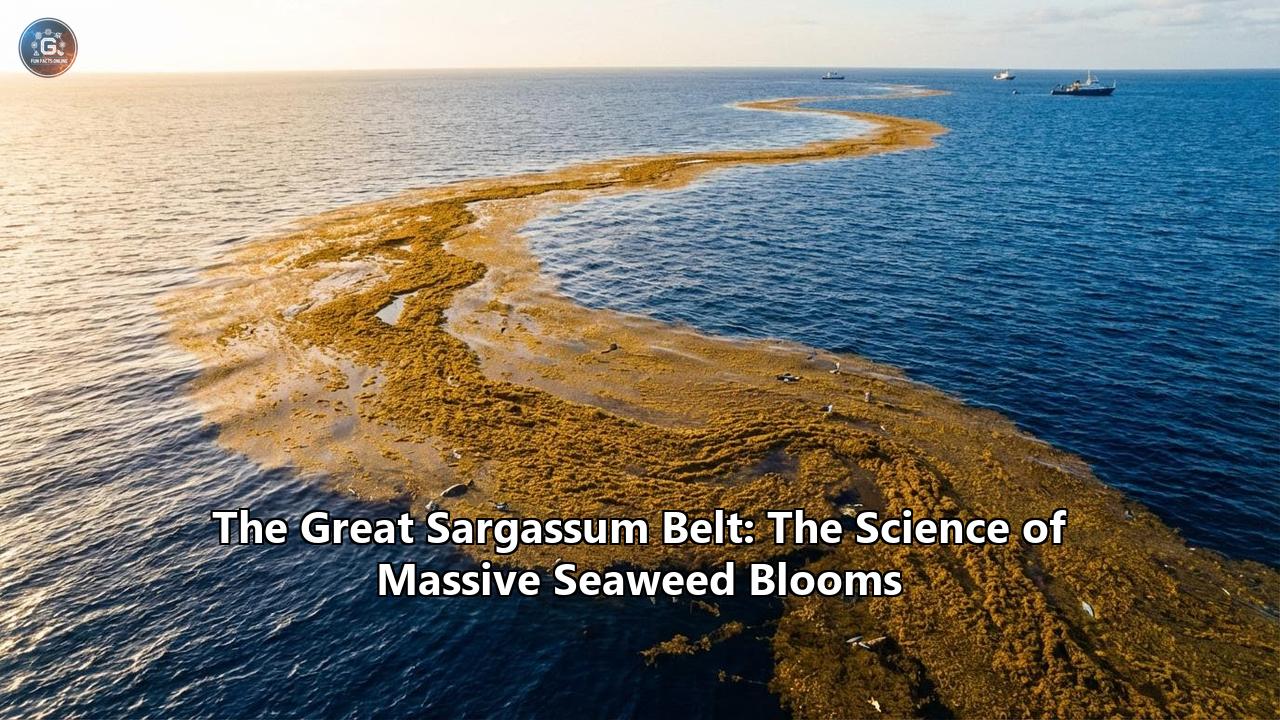
Imagine standing on a pristine, white-sand beach in the Caribbean or along the Florida coast. The water is historically crystal clear, turquoise, and inviting. Now, imagine that same shoreline buried under a three-foot-thick carpet of decaying, dark brown vegetation. The air is thick with a nauseating stench reminiscent of rotten eggs, and the once-vibrant waters are stained the color of steeped tea. This is not a localized anomaly; it is the modern reality for thousands of miles of coastline, born from an oceanic phenomenon that stretches from the western shores of Africa, across the tropical Atlantic, and into the Gulf of Mexico. This sprawling ecosystem is known as the Great Atlantic Sargassum Belt (GASB), and it represents the largest macroalgal bloom on the planet.
What was once a localized wonder in the North Atlantic has aggressively expanded, mutating into a dual-natured entity: a floating oasis of life in the open ocean, and a devastating ecological and economic menace when it crashes ashore. To understand this monumental shift in the ocean’s behavior requires unraveling a complex web of marine biology, global climate cycles, deep-sea nutrient upwelling, and advanced satellite oceanography.
The Biology of a Floating Forest
The protagonists of this global phenomenon are seemingly unassuming. Sargassum is a genus of large brown macroalgae within the class Phaeophyceae. While most seaweeds, like kelp, must anchor themselves to the ocean floor to grow, the specific species that make up the Great Atlantic Sargassum Belt are holopelagic. This means they spend their entire life cycle suspended in the open water, never attaching to the seabed.
The belt is primarily composed of two species: Sargassum fluitans and Sargassum natans. These organisms have evolved remarkable adaptations to survive and thrive in the harsh, sun-drenched environment of the ocean's surface. They are characterized by highly branched, golden-brown thalli (the algal equivalent of stems and leaves) and are kept afloat by thousands of small, gas-filled bladders known as pneumatocysts. These tiny biological buoys allow the seaweed to remain in the photic zone, where it can absorb maximum sunlight for photosynthesis.
Reproduction in these holopelagic species is exclusively vegetative. They do not produce spores or seeds; instead, they grow through continuous fragmentation. When wave action, storms, or passing ships break a mat of Sargassum apart, each floating fragment possesses the ability to continue growing independently, effectively cloning itself. This biological mechanism is crucial to understanding the sheer scale of the blooms. Given the right combination of sunlight, warm water, and nutrients, a small patch of Sargassum can rapidly double in size in less than three weeks.
Scientific surveys of the modern belt have identified distinct morphotypes—sub-varieties with slightly different physical and chemical properties. For instance, studies tracking massive influxes into coastal areas have found that Sargassum fluitans III often dominates during the peak summer season, while Sargassum natans I and Sargassum natans VIII fluctuate in abundance depending on the time of year and the ocean currents delivering them. These subtle morphological differences play a surprisingly large role in how the algae absorb nutrients, how they harbor toxic elements, and how they decompose upon reaching the shore.
The Historic Sargasso Sea vs. The Modern Juggernaut
To grasp the magnitude of the Great Atlantic Sargassum Belt, one must first distinguish it from its historical predecessor: the Sargasso Sea. When Christopher Columbus sailed across the Atlantic in 1492, his expedition encountered vast, floating mats of seaweed in the North Atlantic. His sailors were terrified, fearing the thick vegetation would trap their vessels forever or that it indicated hidden, hull-shattering shoals. This region, bounded by the clockwise rotation of the North Atlantic Gyre, became known as the Sargasso Sea. For centuries, it was the only known home of holopelagic Sargassum.
The Sargasso Sea is a contained, stable ecosystem. The seaweed there is corralled by four major ocean currents—the Gulf Stream to the west, the North Atlantic Current to the north, the Canary Current to the east, and the North Atlantic Equatorial Current to the south. In this relatively nutrient-poor region of the ocean, the Sargassum grows slowly, providing a vital, permanent habitat for specialized marine life, including the endemic Sargassum fish, and serving as the primary nursery for endangered Atlantic eels.
However, in 2011, everything changed. Without warning, massive quantities of Sargassum began washing up on the beaches of West Africa, the Caribbean, and South America—areas far south of the traditional Sargasso Sea. This was not a mere leakage from the northern gyre; it was the birth of an entirely new, self-sustaining oceanic biome. By 2018, the belt contained an estimated 20 million metric tons of seaweed, wreaking havoc on shorelines. In 2025, the belt broke historical records, with nearly 38 million metric tons observed across the Atlantic basin.
The Great Atlantic Sargassum Belt is fundamentally different from the Sargasso Sea. It occupies the tropical Atlantic, stretching thousands of miles across the equator. Here, the algae are subjected to different ocean currents, distinct nutrient sources, and higher water temperatures, leading to explosive, aggressive growth that far outpaces the historical populations of the north.
Unraveling the Mystery: The Paradigm Shift in Ocean Science
For a decade, the sudden appearance and explosive growth of the Great Atlantic Sargassum Belt baffled oceanographers. How did a seaweed population historically confined to the North Atlantic suddenly establish a massive, parallel empire in the tropics?
Early theories heavily blamed anthropogenic (human-driven) nutrient pollution. The prevailing logic suggested that deforestation and massive agricultural expansion in the Amazon basin were causing immense quantities of fertilizer—rich in nitrogen and phosphorus—to wash down the Amazon and Orinoco rivers. When this nutrient-laden freshwater discharged into the Atlantic Ocean, it supposedly provided a feast for the Sargassum, triggering the mega-blooms. Another supporting theory posited that iron-rich dust blowing off the Sahara Desert was settling into the ocean, fertilizing the algae from above.
However, science is an iterative process, and groundbreaking research published between 2024 and 2026 has fundamentally rewritten this narrative, shifting the blame away from coastal river pollution and toward profound, deep-ocean climate mechanics.
First, the origin story was clarified. A 2025 study published in Nature Communications by an international team of researchers, including experts from the University of South Florida (USF), successfully mapped the exact tipping point that initiated the crisis. Using advanced computer modeling and historical climate data, they discovered that the crisis was triggered in the winter of 2009-2010 by a severe, consecutive negative phase of the North Atlantic Oscillation (NAO). The NAO is a massive shift in atmospheric pressure over the Atlantic that dictates wind and weather patterns. During this unusual phase, exceptionally strong westerly winds literally blew a massive "seed population" of Sargassum out of its historical home in the Sargasso Sea and pushed it southward into the tropical Atlantic.
Once this seed population arrived in the tropics, it found itself in an entirely new world: warm waters and intense, year-round sunlight. But sunlight and water alone do not create 38 million tons of biomass; the algae needed massive amounts of nutrients.
This is where the second major paradigm shift occurred. A landmark 2025 study in Nature Geoscience comprehensively debunked the theory that Amazon River pollution was the primary driver. By analyzing years of river discharge data against Sargassum bloom sizes, researchers found absolutely no significant interannual relationship between the two. Instead, the real fuel for the Great Atlantic Sargassum Belt comes from the deep ocean.
The models revealed that the nutrients feeding the belt are supplied by a powerful natural engine: equatorial upwelling and vertical mixing. Shifting wind patterns along the equator cause surface waters to part, which draws deep, freezing, nutrient-dense water up from the ocean floor to the sunlit surface. Specifically, this upwelling brings massive amounts of phosphorus to the surface. Once in this phosphorus-rich fertile zone, the Sargassum—aided by nitrogen-fixing microbes that live symbiotically on its fronds—went into overdrive. The seaweed population exploded, permanently establishing the Great Atlantic Sargassum Belt not as a symptom of coastal river pollution, but as an entirely new oceanic regime driven by deep-sea upwelling and shifting global climate cycles.
The Ocean's Conveyor Belt: Transport and Eddies
Understanding how the Sargassum grows is only half the battle; understanding how it moves is what allows scientists to predict the devastation of coastal communities. The belt is not a static carpet; it is a dynamic, highly mobile entity driven by complex hydrodynamics.
As the algae proliferate in the central Atlantic, they are caught in the North Equatorial Current, which acts as a massive oceanic conveyor belt pushing the biomass westward toward the Caribbean Sea. Once it enters the Caribbean basin, it is swept up by the Caribbean Current, flowing past the Antilles, funneled through the Yucatan Channel into the Gulf of Mexico, and eventually caught by the Loop Current and the Florida Current, which drags it up the eastern seaboard of the United States.
A fascinating layer of this transport mechanism lies in oceanic eddies—massive, swirling whirlpools of water that can span dozens of miles across. Oceanographers utilizing satellite observations from 2011 to 2023 discovered that Sargassum distribution is deeply influenced by these mesoscale features. Specifically, research has shown that Sargassum is up to 47% more likely to be concentrated in cyclonic eddies than in the surrounding ocean water.
Cyclonic eddies rotate counter-clockwise (in the Northern Hemisphere) and create a physical depression—the sea surface inside the eddy is actually lower than the water surrounding it. This physical trough naturally draws floating materials, including Sargassum, into its center. But cyclonic eddies are more than just physical traps; they are biological incubators. The same physics that pull water into the center of the eddy also cause localized upwelling, pulling nutrient-rich water up from the deep. Therefore, an eddy not only gathers the seaweed but actively fertilizes it, allowing the algae to multiply rapidly as it travels toward the coast.
Ecological Duality: A Blessing in the Blue, A Curse on the Coast
The Great Atlantic Sargassum Belt represents one of the most stark ecological paradoxes in the natural world. Its impact is entirely dependent on its location.
In the vast, nutrient-depleted expanse of the open ocean, the Sargassum belt is an ecological miracle. It serves as a floating reef, providing critical shelter, structure, and food in an environment that is otherwise a featureless expanse of blue. Hundreds of species rely on these floating canopies. It is an essential nursery for pelagic fish like mahi-mahi, jacks, and amberjacks. Endangered sea turtles, particularly loggerheads and green turtles, spend their "lost years" living inside the Sargassum mats, using the algae for both camouflage from predatory seabirds and as a buffet of small crustaceans. In a world where oceanic habitats are under constant threat, the open-ocean Sargassum belt is a vital engine of biodiversity.
However, when this floating ecosystem is pushed out of the open ocean and into shallow coastal waters, it morphs into a devastating ecological catastrophe.
When millions of tons of Sargassum are blown ashore by the trade winds, they form impenetrable barriers along the coastline. The immediate physical impact is the smothering of nearshore ecosystems. Coral reefs, which rely on clear water for the symbiotic algae living within their tissues to photosynthesize, are plunged into darkness as the massive brown mats block out the sun. Seagrass beds, the primary food source for manatees and green sea turtles, suffer the same fate, dying off rapidly in the artificially induced shade.
The horror truly begins when the algae die and begin to decompose. The decomposition of such astronomical amounts of biomass rapidly consumes the dissolved oxygen in the water. This creates acute, localized hypoxic zones, commonly known as "dead zones." Fish, crustaceans, and other marine organisms trapped in the shallow waters suffocate. Furthermore, the physical mass of the Sargassum prevents adult sea turtles from reaching the beaches to lay their eggs, and prevents newly hatched turtles from making their perilous journey from the sand to the sea.
The Socioeconomic and Human Health Catastrophe
The ecological destruction is paralleled only by the devastating socioeconomic impact on human communities. The regions most heavily impacted by the Sargassum inundation events—the Caribbean islands, Mexico’s Quintana Roo (Cancun, Tulum, Playa del Carmen), and the coastal United States (Florida, Puerto Rico, the U.S. Virgin Islands)—are fundamentally reliant on coastal tourism.
The aesthetic degradation of the beaches is immediate. The legendary white sands and blue waters are replaced by a brown, rotting sludge that drastically reduces the visual appeal of the coast. But the true repellant is the smell. As the Sargassum undergoes anaerobic decomposition on the beach, it releases massive quantities of hydrogen sulfide gas. This gas produces an overpowering, nauseating odor identical to rotten eggs.
Hydrogen sulfide is not just a nuisance; it is a genuine public health hazard. Prolonged exposure to the gas causes respiratory irritation, headaches, nausea, and can exacerbate conditions like asthma in coastal residents and tourists. This combination of ruined beaches and toxic air has led to catastrophic economic losses. A 2026 study published by the Woods Hole Oceanographic Institution (WHOI) and the University of Rhode Island (URI) determined that annual economic losses are already reaching multi-million-dollar levels in Puerto Rico and the USVI, and threaten to unleash billion-dollar impacts along Florida's Atlantic coast. Studies in the Caribbean have noted that decaying Sargassum biomass can reduce localized tourism activity by up to 35% during severe inundation events.
Beyond tourism, the traditional fishing industry is being crippled. Small-scale, artisanal fishermen find it impossible to navigate their small vessels through the dense mats, which easily clog water intake pipes, foul propellers, and destroy fishing nets. The dead zones created by the decaying algae also drive commercial fish populations away from traditional nearshore fishing grounds, severely impacting the livelihoods of coastal communities.
The Heavy Metal Dilemma: Arsenic and the "Toxic Sponge"
One of the most insidious and scientifically complex problems associated with the Great Atlantic Sargassum Belt is the algae's relationship with heavy metals. Like many brown algae, Sargassum possesses a unique cellular structure—specifically a high concentration of alginates and sulfated polysaccharides in its cell walls. These biological compounds act as incredibly efficient ion-exchangers, allowing the seaweed to act like a giant, floating sponge that absorbs and bioaccumulates trace elements and heavy metals from the surrounding ocean water.
While floating in the open ocean, the Sargassum silently absorbs whatever is present in the water column. Unfortunately, extensive chemical profiling of the seaweed making landfall in the Americas has revealed alarmingly high concentrations of toxic pollutants, primarily arsenic.
A comprehensive 2024 study analyzing the biomass landing in South Florida detected 16 different heavy metals in the Sargassum tissue. While elements like manganese, zinc, and copper were present, arsenic was consistently the most prevalent heavy metal across all morphotypes of the algae. Astonishingly, the study found that 70% of the Sargassum samples tested contained arsenic levels that far exceeded the European maximum allowable limits for seaweed used in animal fodder or agricultural soil. Furthermore, research has indicated that the presence of epibionts—tiny organisms that live attached to the surface of the seaweed—can increase the overall arsenic concentration of the uncleaned biomass.
The algae rapidly releases this arsenic when it washes into coastal habitats. As the Sargassum rots on the shoreline, these accumulated heavy metals leach out, creating highly toxic runoff. This leachate seeps directly into the coastal waters, poisoning near-shore marine life, and percolates down through the sand, threatening to contaminate fragile coastal groundwater aquifers. The deposition of thousands of tons of heavy-metal-laden biomass on the same beaches year after year represents a slow-motion environmental poisoning that scientists are only just beginning to quantify.
Tracking the Golden Tide: The View from Space
Managing a coastline-destroying event that spans an entire ocean requires a god's-eye view. Over the past decade, satellite oceanography has revolutionized our ability to monitor, track, and predict Sargassum inundations.
Leading the charge in this technological frontier is the Optical Oceanography Laboratory at the University of South Florida (USF), in collaboration with NASA and NOAA. Together, they have developed the Sargassum Watch System (SaWS), a satellite-based tracking tool that provides near real-time monitoring of the Great Atlantic Sargassum Belt.
The system relies on satellite sensors, such as MODIS (Moderate Resolution Imaging Spectroradiometer) and VIIRS (Visible Infrared Imaging Radiometer Suite), which scan the ocean surface. Because Sargassum contains chlorophyll and other distinct pigments, it reflects light differently than the surrounding ocean water. Specifically, the algae exhibit a strong "red-edge" reflectance in the near-infrared spectrum. By calibrating satellite sensors to detect this specific optical signature, scientists can pinpoint the location and density of floating Sargassum mats across millions of square miles of ocean.
However, detecting the algae in the open ocean is only the first step. The critical question for coastal managers is: How much of it is actually going to hit the beach?
Historically, this was incredibly difficult to predict. The distribution of the biomass offshore is not always a strong predictor of coastal landings, as complex local currents, wind shifts, and tidal patterns can push a massive mat out to sea just as easily as they can push it onto a beach. To solve this, researchers have recently developed advanced methodologies that merge satellite imagery with sophisticated ocean transport models.
By converting the two-dimensional area of Sargassum detected by satellites into an estimate of three-dimensional "wet biomass," scientists can now predict the sheer tonnage of seaweed poised to strike a specific region. For example, these advanced models revealed that in 2018 alone, a staggering 10 million tons of Sargassum physically inundated the coastlines of the Caribbean. As these forecasting tools become increasingly refined, they are providing local governments and the tourism industry with crucial lead time to deploy protective booms, prepare heavy earth-moving equipment, and mobilize cleanup crews before the golden tide makes landfall.
From Menace to Miracle? The Science of Valorization
Faced with an unrelenting deluge of seaweed, human ingenuity has turned toward a singular question: Instead of treating Sargassum as toxic waste, can we harvest it and turn it into a valuable resource? This concept, known as "valorization," is currently the subject of intense global research.
Harvesting the algae is the first major hurdle. Removing it once it hits the beach is expensive, ecologically damaging to the sand and nesting turtles, and the resulting biomass is already decomposing and mixed with silica and plastic debris. Harvesting it in the shallow coastal water using specialized conveyor-belt boats is cleaner, but logistically complex and highly dependent on weather conditions.
Once harvested, the potential applications for the biomass are vast, yet heavily constrained by the algae's unique biology.
Bioplastics and Alginates: Sargassum cell walls contain high amounts of alginates and fucoidans (accounting for roughly 40% of its dry weight). Alginates are highly sought after in the food, pharmaceutical, and textile industries for their thickening and gelling properties. Researchers are successfully extracting these compounds to create biodegradable bioplastics, offering a potential localized solution to single-use plastic pollution. However, pelagic Sargassum species typically yield poorer quality alginates compared to commercially farmed kelps, making economic scalability a challenge. Biofuels and Energy: Converting the massive biomass into biofuel (such as biogas through anaerobic digestion or bioethanol) is highly attractive. However, Sargassum possesses very high water and ash content, which acts as a major constraint for traditional biofuel processing techniques. It requires significant energy to dry the seaweed before it can be processed, which often negates the energy yield. Agricultural Fertilizer and Compost: Using the seaweed as a nutrient-rich fertilizer for agriculture is a historical practice. Sargassum is rich in potassium, nitrogen, and essential micronutrients. However, the heavy metal dilemma creates a massive roadblock. Because 70% of the Sargassum contains arsenic levels above agricultural safety thresholds, spreading it on food-producing crops poses a severe risk of bioaccumulating heavy metals in the human food chain. Strict regulations and the need for complex, expensive chemical washing processes to strip the arsenic currently hinder its widespread agricultural use. A Biosorbent for Water Treatment: Paradoxically, the very chemical properties that make Sargassum a dangerous toxic sponge in the ocean make it an incredibly promising tool for industrial water treatment. A recent breakthrough study demonstrated that untreated Sargassum biomass can be utilized as a highly effective, low-cost biosorbent to clean wastewater contaminated with dangerous heavy metals like lead (Pb) and cadmium (Cd). The alginates and functional groups within the algae's cell walls rapidly bind to the lead and cadmium ions in aqueous solutions, pulling the toxins out of the water. Because the Caribbean region produces thousands of tons of this biomass annually, utilizing it to remediate industrial wastewater offers a revolutionary, circular-economy solution to two environmental crises at once.The Future Outlook
As we look toward the latter half of the 2020s and beyond, the Great Atlantic Sargassum Belt shows no signs of disappearing. The 2025 discovery that the belt is driven by deep-ocean equatorial upwelling and major atmospheric pressure cycles (like the North Atlantic Oscillation) suggests that we are dealing with a deeply entrenched oceanic regime.
Furthermore, climate change continues to act as an unpredictable amplifier. While Sargassum actually grows faster in normal or slightly cooler sea surface temperatures, the warming of the global ocean alters the strength and position of the wind patterns and ocean currents that drive the upwelling of nutrients. As our planet changes, scientists warn that the natural cycles driving the equatorial nutrient engine could intensify, cementing the seasonal seaweed inundation not as an anomaly, but as a permanent, permanent fixture of the Atlantic coastline.
The scientific consensus is clear: coastal communities must pivot from a posture of reactive shock to one of proactive adaptation. Forecasting models are becoming more accurate, enabling better pre-event planning and mitigation. Investments are pouring into advanced coastal defense mechanisms, such as offshore deflection booms, and deep-water sinking operations designed to plunge the algae to the abyssal plain before it reaches the reef, simultaneously sequestering its carbon permanently.
The Great Atlantic Sargassum Belt is a stark reminder of the ocean's profound interconnectivity. A shift in atmospheric pressure over the North Atlantic in 2009 cascaded into a biological explosion in the deep tropics, which now dictates the economic survival of coastal communities from Barbados to Miami. It is a striking testament to how rapidly planetary systems can shift, transforming a natural oceanic refuge into an unstoppable golden tide. As science races to decode the complexities of its biology, its movements, and its potential utility, humanity is forced to adapt to the new, brown reality of the Atlantic Ocean.
Reference:
- https://www.seafoodsource.com/news/environment-sustainability/research-study-addresses-economic-impact-of-sargassum-inundation-on-us-coastal-economies
- https://science.nasa.gov/earth/earth-observatory/a-massive-seaweed-bloom-in-the-atlantic-151188/
- https://www.frontiersin.org/journals/marine-science/articles/10.3389/fmars.2021.699664/full
- https://www.mdpi.com/2673-9410/4/2/13
- https://ocean2climate.org/2025/12/08/solving-the-mystery-of-the-great-atlantic-sargassum-belt-5-surprising-truths/
- https://www.eurekalert.org/news-releases/1076785
- https://www.usf.edu/marine-science/news/2025/usf-experts-lead-on-sargassum-research-monitoring-and-prediction.aspx
- https://pmc.ncbi.nlm.nih.gov/articles/PMC7049257/
- https://www.mdpi.com/1660-4601/20/3/2559
- https://www.researchgate.net/publication/222513240_Sargassum_Seaweed_as_Biosorbent_for_Heavy_Metals