
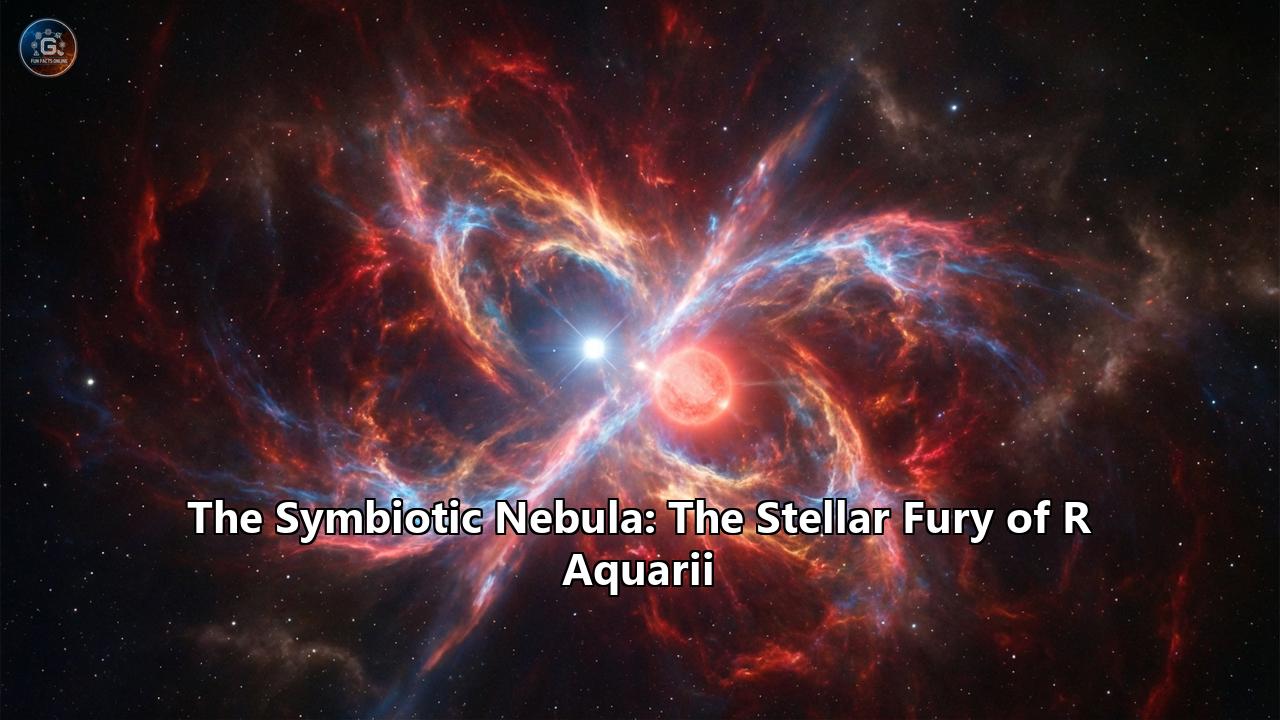
In the vast, silent theater of the cosmos, roughly 700 light-years from Earth, a dramatic performance is unfolding. To the unaided eye, or even through the lens of a modest amateur telescope, the star R Aquarii appears as a single, somewhat variable point of light in the constellation Aquarius. It twinkles innocently against the velvet backdrop of the night, a faint ember in the celestial water-bearer's jar. But this tranquility is a lie.
Zoom in with the piercing gaze of the Hubble Space Telescope or the X-ray vision of the Chandra Observatory, and the "star" reveals its true nature: a chaotic, violent binary system locked in a destructive embrace. This is not a single star, but a symbiotic pair—a dying red giant and a voracious white dwarf—engaged in a relationship so volatile it tears the very fabric of their local space apart. Surrounding them is not a peaceful halo, but a twisted, knotted nebula known as Cederblad 211, a structure resembling a cosmic sprinkler spraying jets of superheated plasma into the void.
This object, R Aquarii, represents one of the nearest and most spectacular examples of a "stellar fury." It is a laboratory of high-energy physics where magnetic fields twist gas into pretzels, where nuclear explosions on the surface of a dead star rival the output of nations, and where the death throes of one star fuel the resurrection of another. This article delves deep into the heart of this symbiotic nebula, exploring the physics of its fury, the history of its observation, and the secrets it holds for the future of our own understanding of the universe.
Part I: The Cosmic Odd Couple
To understand the fury of R Aquarii, one must first meet the actors in this binary tragedy. The system is a "symbiotic star," a term coined by astronomer Paul Merrill in the 20th century to describe systems where two stars with wildly different temperatures and evolutionary stages coexist and interact.
The Dying Giant: A Mira VariableThe primary component of the R Aquarii system is a Red Giant, specifically a Mira-type variable. This star is in the twilight of its life. Once a star similar to our Sun, it has exhausted the hydrogen fuel in its core and swollen to monstrous proportions. If placed in our solar system, this giant would engulf the orbit of Mars, swallowing the Earth whole.
But this giant is not static. It is a pulsating beast. Every 390 days, it expands and contracts, changing its brightness by a factor of 750. At its peak, it is thousands of times more luminous than our Sun; at its dimmest, it fades into obscurity. This pulsation drives a "stellar wind"—a gentle but massive outflow of gas from the star’s outer layers. The giant is literally evaporating, shedding its mass into space at a rate that creates a dense, dusty envelope around the system. It is a star coughing out its lungs, enriching its surroundings with carbon, nitrogen, and oxygen.
The Vampire: The White DwarfLurking in the shadows of the giant’s brilliance is the secondary star: a White Dwarf. This is the corpse of a star that died eons ago. It has collapsed down to the size of Earth but retains the mass of the Sun. This extreme density gives it a gravitational pull that is terrifying in its intensity.
The white dwarf orbits the red giant with a period of approximately 44 years. The orbit is highly eccentric, meaning it is not a perfect circle but an elongated oval. This eccentricity is the metronome of the system’s fury. When the white dwarf swings close to the red giant (periastron), it passes through the dense wind the giant has exhaled. Like a cosmic vacuum cleaner, the white dwarf’s gravity captures this gas.
This captured material—mostly hydrogen—does not fall directly onto the white dwarf. Instead, it spirals inward, forming an accretion disk. This disk is a swirling maelstrom of gas, heated by friction to millions of degrees, glowing fiercely in ultraviolet and X-ray light. It is here, in this stolen halo of gas, that the seeds of the stellar fury are sown.
Part II: Anatomy of an Outburst
The interaction between the red giant and the white dwarf is not a smooth, continuous process. It is punctuated by violent episodes that astronomers call "outbursts." These are the moments when the symbiotic relationship turns explosive.
The Thermonuclear TriggerAs hydrogen gas accumulates on the surface of the white dwarf, the pressure and temperature at the base of the accretion layer rise dramatically. The white dwarf is a sleeping dragon; the hydrogen is the fuel being heaped upon its scales. Eventually, a critical threshold is reached. The hydrogen layer becomes hot and dense enough to ignite nuclear fusion.
Unlike the controlled fusion in the core of a normal star, this fusion happens on the surface of a degenerate object. The reaction runs away instantly. In a matter of seconds, the accumulated layer of hydrogen undergoes a thermonuclear runaway—essentially a massive hydrogen bomb explosion that covers the entire surface of the star.
This event is known as a nova (or in R Aquarii's case, a "symbiotic nova"). The energy released blasts the outer layers of the accumulated gas into space at speeds exceeding a million miles per hour. This is the source of the "fury." The white dwarf brightens dramatically, temporarily outshining its giant companion, and a shockwave travels outward, plowing into the surrounding nebula.
The Magnetic CannonIf the explosion were spherical, R Aquarii would be a simple expanding bubble. But R Aquarii is anything but simple. The white dwarf spins rapidly, and the accretion disk generates powerful magnetic fields. These fields act like a cage or a gun barrel.
As the plasma tries to escape the surface explosion, it is trapped by these magnetic field lines. The field lines are twisted into a helix by the rotation of the star and the disk. The plasma is forced to follow these twisted paths, channeled into two narrow beams—jets—that shoot out from the north and south poles of the star.
This process transforms the messy explosion into a directed weapon. The jets of R Aquarii are collimated streams of superheated matter that pierce the surrounding nebula like a needle. As the binary stars orbit each other, the "gun" rotates, causing the jets to wobble or "precess." Over decades, this wobbling motion paints an "S" shape onto the sky, writing the history of the system’s orbital dance in glowing gas.
Part III: The Twisted Nebula (Cederblad 211)
The aftermath of these violent outbursts is the nebula known as Cederblad 211. It is the physical scar tissue of the system’s history.
The Hourglass and the S-CurveVisually, the nebula is stunning. Deep exposure images reveal a large, hourglass-shaped outer structure. This is the "fossil" record of an older explosion, perhaps one that occurred 600 to 1,000 years ago. It represents material that has expanded far from the central binary, cooling and slowing down as it plows into the interstellar medium.
Inside this hourglass lies the inner nebula, which is much more dynamic. Here, we see the famous "S" shape. This structure is composed of knots and filaments of gas that are glowing brightly in the light of ionized oxygen ([O III]) and nitrogen ([N II]). The green glow of oxygen tells astronomers that the gas is extremely hot and tenuous, shocked by the high-speed jets.
The filaments appear twisted, like a wrung-out towel. This is a direct visualization of the magnetic forces at work. The magnetic fields are not just invisible lines on a diagram; in R Aquarii, they are strong enough to physically mold the nebula, forcing the gas into rope-like structures that loop back on themselves.
A "Cosmic Lawn Sprinkler"Because the white dwarf orbits the red giant every 44 years, the source of the jets is moving. Imagine a garden sprinkler spinning while shooting out water. The water forms a spiral pattern in the air. Similarly, as the white dwarf moves along its orbit, the jets are sprayed out in a changing direction.
Observations from the Hubble Space Telescope over the last few decades have allowed astronomers to create a time-lapse of this motion. We can literally watch the plasma move. In the span of just a few years, knots of gas travel billions of kilometers. This makes R Aquarii one of the few objects in the sky where we can see "weather" changing on human timescales. It is not a static painting; it is a movie.
Part IV: A History Written in Light
While modern technology has revealed the details of R Aquarii, the system has likely been watched for a millennium.
The Mystery of 930 ADAncient astronomical records from Japan mention a "guest star" (a temporary star or nova) that appeared in the year 930 AD. For years, astronomers speculated that this might have been a major outburst of R Aquarii—perhaps the event that created the outer hourglass nebula.
However, modern analysis of the position and movement described in the ancient texts suggests this might have been a comet rather than a nova. A more likely candidate for a historical sighting is a record from 1073 AD found in Korean chronicles. This "guest star" appeared in the constellation Aquarius and remained visible for some time. The timing of this event aligns remarkably well with the expansion rate of the outer nebula. If we trace the gas back to its origin point, much of it seems to have been ejected around the 11th century.
The Discovery of VariabilityThe scientific history of R Aquarii began in 1810, when German astronomer Karl Ludwig Harding discovered it. He didn't see a nebula; he saw a star that wouldn't stay still. He noted that its brightness fluctuated wildly. It was cataloged as a variable star, designated "R" in the sequence of variables for the constellation Aquarius.
It wasn't until the 1920s that the true weirdness of the system became apparent. Spectroscopic observations—breaking the light of the star into a rainbow—revealed an impossible combination. The spectrum showed the molecular bands of a cool, red star (titanium oxide) and the high-energy emission lines of a hot, blue nebula (ionized helium and oxygen). It was a "Jekyll and Hyde" star. This led to its classification as a symbiotic star: two distinct objects living in close proximity, each influencing the other.
Part V: The Great Dimming (2018–2026)
One of the most exciting recent developments in the study of R Aquarii is the "eclipse" event that began around 2018 and is predicted to last until roughly 2026.
This is not a simple eclipse like the moon passing in front of the sun. In R Aquarii, the red giant is believed to be passing behind the massive cloud of dust and gas surrounding the white dwarf and its accretion disk. Because the orbital period is ~44 years, this alignment is a rare event for astronomers.
The "Dust Puff" TheoryWhen the eclipse began, the system’s brightness plummeted. However, it wasn't just a simple blockage of light. The "eclipse" is likely caused by a specific stream of dust that the white dwarf siphoned off the red giant decades ago. We are seeing the shadow of the white dwarf's "feeding habits."
Astronomers using the Very Large Telescope (VLT) and other observatories have been monitoring this event closely. They have observed that while the red giant's visible light is dimmed, the high-energy radiation from the white dwarf's accretion disk is still punching through, illuminating the nebula in new and changing ways. This period of dimming offers a unique opportunity to "dissect" the structure of the accretion disk and the dusty envelope, using the red giant as a backlight.
Part VI: Modern Eyes on the Fury
The 21st century has brought a revolution in our view of R Aquarii, thanks to adaptive optics and space telescopes.
Hubble's "Moving Picture"In 2024, NASA and ESA released a stunning time-lapse video of R Aquarii, comprised of images taken between 2014 and 2023. The video shows the star breathing. The diffraction spikes (artifacts of the telescope optics) wax and wane as the red giant pulses. More dramatically, the nebula expands visibly.
The time-lapse reveals the "lawn sprinkler" effect in high definition. We can see knots of plasma being ejected and twisting as they move away. The sheer scale of these movements is mind-boggling—the material travels hundreds of millions of kilometers in just a few years. This visual data has confirmed that the magnetic fields in the jets are indeed helical, twisting the plasma like a corkscrew.
X-Ray Vision: A Mini-GalaxyWhen viewed in X-rays by the Chandra X-ray Observatory, R Aquarii looks less like a star and more like a miniature Active Galactic Nucleus (AGN). AGNs are the supermassive black holes at the centers of galaxies that shoot out massive jets of energy.
R Aquarii is a scaled-down model of these galactic monsters. The physics is remarkably similar: a central compact object (white dwarf vs. black hole), an accretion disk, and magnetic jets. By studying R Aquarii, which is right in our backyard, astronomers can learn about the physics that drives quasars and radio galaxies billions of light-years away. The "knots" of X-ray emission in R Aquarii's jets are shock fronts where the supersonic jet slams into slower-moving gas, heating it to millions of degrees.
Resolving the BinaryFor a long time, the two stars were just a single point of light. But using the SPHERE instrument on the Very Large Telescope (VLT) in Chile, astronomers have achieved the impossible: they have optically resolved the two components.
We can now distinguish the red giant from the white dwarf. The images show the red giant not as a sphere, but as a teardrop shape, distorted by the gravity of the white dwarf. This tidal distortion is physical proof of the vampire-like siphon process. We can literally see the red giant being pulled apart.
Part VII: The Physics of Symbiosis
The fury of R Aquarii is driven by a delicate balance of forces.
- Gravity vs. Fusion: Gravity pulls the hydrogen onto the white dwarf. Fusion blows it off. This cycle of accumulation and explosion acts like a cosmic pressure valve. If the white dwarf kept all the mass it stole, it would eventually reach the Chandrasekhar limit (1.4 times the mass of the Sun) and detonate as a Type Ia Supernova. However, the recurring novae eject much of this mass, delaying that ultimate fate.
- Magnetic Collimation: The reason R Aquarii has jets and not just a spherical wind is magnetism. The accretion disk is conductive plasma. As it spins, it generates a magnetic field (the dynamo effect). These field lines get "wound up" perpendicular to the disk. Charged particles (plasma) cannot cross magnetic field lines; they must slide along them. This forces the escaping gas into the narrow, polar channels we see as jets.
- Shock Physics: The nebula glows because it is being shocked. The jet material is moving at supersonic speeds (600–1,000 km/s). The surrounding medium (the old wind from the red giant) is moving much slower. When the jet hits the wind, it creates a shock wave, similar to a sonic boom. This shock creates extreme heat, stripping electrons from atoms (ionization) and causing them to emit the characteristic green ([O III]) and red (H-alpha) light.
Part VIII: Why R Aquarii Matters
Why do astronomers spend so much time looking at this one object?
1. The Origin of ElementsThe red giant in R Aquarii is an AGB (Asymptotic Giant Branch) star. These stars are the factories of the universe. In their deep interiors, they synthesize carbon, nitrogen, and other heavy elements. The stellar wind and the symbiotic outbursts dredge these elements up and spray them into the galaxy. The carbon in your DNA and the nitrogen in the air you breathe were likely forged in a star like R Aquarii. This system shows us exactly how those elements are distributed into the interstellar medium to form new stars and planets.
2. A Laboratory for Jet PhysicsJets are ubiquitous in the universe. Young stars have them, black holes have them, neutron stars have them. But most of those objects are either too far away (black holes) or obscured by dust (young stars). R Aquarii is close, bright, and clear. If we can understand the magnetic collimation here, we can apply that knowledge to the jets of supermassive black holes that shape the evolution of entire galaxies.
3. The Supernova Precursor?There is a lingering question: Will R Aquarii explode? Despite the nova outbursts ejecting mass, it is possible that the white dwarf is still slowly gaining weight. If it ever crosses the Chandrasekhar limit, it will trigger a Type Ia supernova. This would be a cataclysmic event, visible in the daytime sky from Earth. While likely thousands of years away (if it happens at all), studying the mass transfer rates in R Aquarii helps us calibrate our models of these "standard candle" explosions used to measure the size of the universe.
Part IX: Comparison with Other Symbiotic Stars
R Aquarii is the jewel of symbiotic stars, but it is not alone.
- Z Andromedae: The prototype of the class. It shows similar outbursts but lacks the resolved, spectacular nebula of R Aquarii.
- RS Ophiuchi: A "recurrent nova" that explodes every 15-20 years. Its outbursts are more violent and frequent than R Aquarii’s, but it lacks the beautiful, persistent jet structure.
- T Coronae Borealis: The "Blaze Star," which is expected to have a major nova eruption in 2024-2025. While T CrB creates a bright flash, R Aquarii provides the sustained, photogenic "fury" of the jets.
R Aquarii stands out because of its proximity (closest symbiotic star to Earth) and the favorable orientation of its orbit, which allows us to see the "S" jet so clearly.
Conclusion: The Future of the Fury
As we look toward the future, R Aquarii promises to remain a source of fascination. The current eclipse event (ending around 2026) will provide a treasure trove of data on the density and composition of the accretion disk.
The nebula will continues to expand. The "new" jet material ejected in the 1970s and 80s will travel further out, interacting with the older 11th-century shell. New outbursts are inevitable. Whether in 10 years or 100, the white dwarf will once again ignite, sending a fresh pulse of light and matter screaming into the void.
R Aquarii is a reminder that the night sky is not a static tapestry. It is a roiling, boiling, exploding cauldron of physics. In the twisted filaments of Cederblad 211, we see the universe in action—recycling the old to build the new, driven by the inexorable forces of gravity and magnetism. It is a stellar fury, beautiful and terrifying, burning bright in the darkness of Aquarius.
Reference:
- https://www.zmescience.com/science/news-science/hubble-captures-dramatic-outburst-of-space-volcano/
- https://www.eso.org/public/germany/blog/monitoring-the-changing-r-aquarii/
- https://skyandtelescope.org/sky-and-telescope-magazine/the-drama-ridden-couple-of-r-aquarii/
- https://www.aanda.org/articles/aa/pdf/2005/19/aa2455.pdf
- https://www.nao.ac.jp/contents/about/reports/annual-report-en/annual2022-e.pdf