
Prologue: The Eye in the Sky
In the quiet vacuum of space, roughly one hundred miles above the Earth, a metallic cylinder tumbled silently through the void. It was September 1967. The world below was fractured by ideological iron curtains, proxy wars, and the existential dread of nuclear annihilation. This cylinder, a KH-4B CORONA satellite launched by the United States intelligence community, was not looking for ancient history. It was hunting for Soviet missile silos, troop movements, and the industrial pulse of America’s Cold War adversaries.
As it swept over the arid steppes of Syria and northern Iraq, its panoramic cameras—technological marvels of their time—snapped distinct, high-resolution strips of the landscape below. These cameras did not transmit data instantly in a stream of zeros and ones. Instead, they exposed physical film, miles of it, which was then wound into recovery capsules. These capsules were jettisoned from the satellite, streaking through the atmosphere like man-made meteors to be snatched mid-air by C-119 Flying Boxcars over the Pacific Ocean.
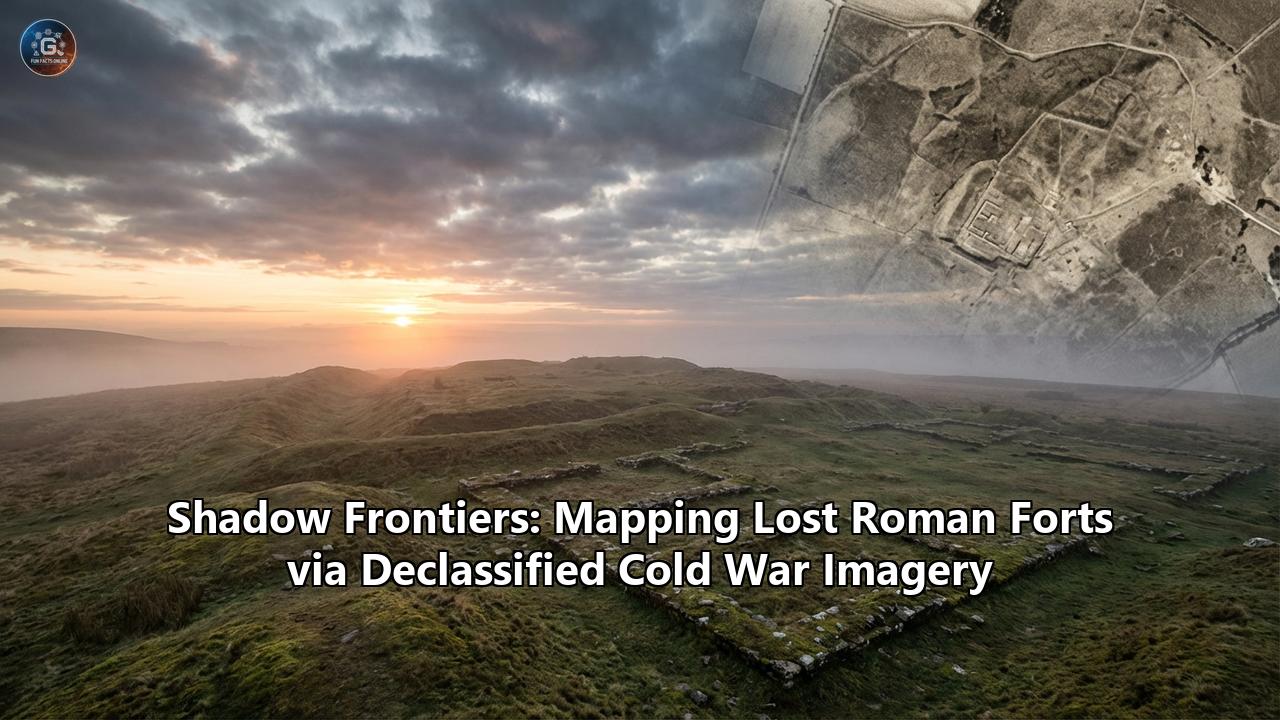
For decades, these images sat in the dark, classified top-secret, their contents known only to analysts with the highest security clearances. They were tools of modern warfare, instruments of the "Shadow Frontier" between East and West. But roughly half a century later, when the seals of secrecy were broken and the images declassified, they revealed a different kind of frontier altogether.
Buried within the grainy, black-and-white textures of the Syrian steppe were the ghostly footprints of an empire that had vanished long before the Soviet Union or the United States existed. There, etched into the earth, were the outlines of hundreds of lost Roman forts.
This is the story of how the Cold War’s deepest secrets illuminated the ancient world’s greatest mysteries. It is a narrative that spans two millennia, linking the legionaries of Rome to the spycraft of the 20th century, and overturning our understanding of how the greatest empire of antiquity managed its easternmost limits.
Part I: The Myth of the Line
The Priest and the Biplane
To understand the magnitude of the recent discoveries, one must first look back to the man who originally drew the map of Rome’s eastern frontier: Father Antoine Poidebard.
In the 1920s, the concept of aerial archaeology was in its infancy. World War I had demonstrated that the view from above could reveal trench lines and earthworks invisible from the ground. Poidebard, a French Jesuit missionary, explorer, and pilot, was stationed in Syria—then a French mandate—and became obsessed with the traces of Rome in the desert.
Between 1925 and 1932, Poidebard flew a rickety Tiger Moth biplane over the Syrian desert. With the wind whipping through the open cockpit and a handheld camera, he documented the landscape at the "magic hour," when the low angle of the sun cast long shadows, revealing the slight undulations of buried walls and ditches.
Poidebard’s work was monumental. He identified 116 Roman forts, seemingly arranged in a linear fashion running north to south. To the eyes of a man who had just lived through the Great War, with its static trench lines and the defensive mindset of the Maginot Line, these forts appeared to be a singular, cohesive defensive barrier. He called it the Limes, a fortified border designed to hold back the "barbarian" hordes of the Persian Empire and nomadic Arab tribes.
For nearly a century, Poidebard’s map defined the history books. Scholars accepted his conclusion: Rome’s eastern frontier was a wall of stone and iron, a line in the sand meant to say, "This is Rome; beyond is the unknown." It fit the narrative of an empire under siege, constantly fending off the aggressive Parthian and Sassanian dynasties.
But Poidebard’s view was limited by his technology and his fuel tank. He flew where he expected to find forts, largely along the Strata Diocletiana, a famous military road. He saw a line because he flew a line. He didn't know that just beyond the horizon, the desert was hiding a much more complex reality.
The Problem with the Wall
As archaeological theory evolved in the later 20th century, cracks began to appear in the "defensive wall" theory. Historians like Benjamin Isaac argued that the Roman Limes was not a blockade like the Berlin Wall or the modern border fences. The word limes itself originally meant a path or a road, not a boundary.
Furthermore, a static line of forts in the middle of a desert makes little tactical sense. The Syrian steppe is a vast, open expanse. An invading Persian army could simply ride around a fort. If these structures were purely defensive, they were poorly placed.
But without new data, these arguments remained academic theories. The region was difficult to survey. Political instability, wars in Iraq and Syria, and the sheer vastness of the terrain made a comprehensive ground survey impossible. The truth remained buried, waiting for a perspective that was higher, wider, and older than anything modern archaeologists could achieve.
Part II: The Declassified Time Machine
CORONA and HEXAGON
The breakthrough came from an unlikely source: the CIA.
In 1995, President Bill Clinton signed an executive order declassifying the imagery from the CORONA satellite program. Later, in 2011, the imagery from the subsequent HEXAGON program was also released. Suddenly, the scientific community had access to nearly a million images of the Earth’s surface as it appeared in the 1960s and 70s.
For archaeologists, this was akin to being handed a time machine. The Middle East of the 1960s was a vastly different place than it is today. The massive urban expansion of cities like Aleppo and Mosul had not yet swallowed the countryside. Industrial agriculture had not yet deep-plowed every inch of the steppe. The giant reservoirs created by dams on the Tigris and Euphrates had not yet flooded vast river valleys.
The spy satellites had captured a "fossilized" landscape. They preserved the surface of the earth before the Anthropocene—the age of human impact—erased the delicate scars of antiquity.
The Dartmouth Study
Enter Professor Jesse Casana and his team from Dartmouth College. A specialist in the archaeology of the Middle East, Casana realized that the "Shadow Frontiers" of the Cold War held the key to the Roman frontier.
The team didn't just look at a few pictures. They undertook a massive, systematic analysis of the declassified imagery covering approximately 300,000 square kilometers of the northern Fertile Crescent. This was "landscape archaeology" on a steroid-fueled scale.
Using stereoscopic viewing techniques—similar to how intelligence analysts looked for Soviet missile silos—the team scanned the grainy grayscale images for the tell-tale signatures of Roman military architecture. Roman forts are distinctive. They are playing-card shaped or square, with standardized dimensions (typically 50 to 80 meters per side), often with visible corner towers and internal barracks.
The results were shocking.
The 396
Poidebard had found 116 forts. Casana’s team found those... and then they found 396 more.
These weren't just a few missed outposts. It was an entire missing network. Even more startling than the number was the distribution. The new forts did not form a north-south line. Instead, they were scattered across the steppe in a massive east-west axis, stretching from the Tigris River in modern Iraq all the way to the lush plains of western Syria.
They didn't look like a wall. They looked like a web.
Part III: Trade, Travel, and Terror
Reimagining the Frontier
The discovery of 396 new forts fundamentally shattered the "Maginot Line" theory of the Roman East. If the forts didn't form a barrier, what were they doing?
The answer lies in what flows through the desert: not just armies, but money.
The east-west distribution aligns perfectly with the movement of trade. This was the era of the Silk Road’s western terminus. Caravans laden with Chinese silk, Indian spices, Arabian incense, and precious stones were moving constantly between the Persian territories and the Roman Mediterranean ports like Antioch.
The Dartmouth team’s findings suggest that these forts were not designed to stop people from moving; they were designed to help them move safely.
The Facilitation of Flow
Imagine a caravan in the 2nd century AD. A train of 500 camels, carrying wealth equivalent to the GDP of a small city, is trekking across the dusty, water-scarce steppe. The greatest threat to this caravan is not a full-scale invasion by the Persian army, but the opportunistic banditry of nomadic tribes or thirst.
The network of forts discovered by Casana’s team functioned as a militarized highway system.
- Water Security: Many of these forts were built near wadis (seasonal riverbeds) or engineered wells. They controlled the most precious resource in the desert. By securing the water, Rome secured the route.
- Safe Harbors: The forts acted as "truck stops" of antiquity. They provided a walled compound where merchants could sleep without fear of having their throats slit in the night.
- Taxation and Control: Rome was not providing this security out of charity. These forts were likely customs posts. They allowed the Roman state to monitor the flow of goods and, crucially, to tax them. The forts were as much about the Imperial Treasury as they were about the Imperial Legions.
A Permeable Border
This creates a picture of a "permeable" frontier. Rome and Parthia (and later Sassanid Persia) were great rivals, yes. They fought brutal wars. But between the wars, life went on. Commerce continued. The "Iron Curtain" analogy of the Cold War was wrong for the ancient world.
The frontier was a zone of interaction, a "middle ground" where Roman soldiers, local Arabs, Syrian merchants, and Persian envoys mixed. The forts were the nodes of this interaction. They projected Roman power not by blocking the horizon, but by managing the chaotic flow of the steppe.
Part IV: The Anatomy of a Ghost Fort
What did these lost places look like? Thanks to the high resolution of the KH-9 HEXAGON satellites (which could resolve objects smaller than 2 feet wide), and comparative data from the few surviving sites, we can reconstruct them.
The Architecture of VigilanceMost of the newly identified sites follow a standard plan. A square curtain wall, built of local limestone or basalt, roughly 50 to 80 meters on each side. At the corners, projecting square towers allowed archers to enfilade anyone attacking the walls.
Inside, the layout was often rigid. Barracks blocks for the infantry or cavalry (many were likely auxiliary cavalry units, alae, suited for desert patrol). A central headquarters building (principia), a granary (horreum) to store food for long sieges or drought, and a bathhouse. Even in the desert, Romans insisted on their baths.
The GarrisonWho manned these lonely outposts? It was rarely the legions of Italian-born citizens. The garrisons were "Auxiliaries"—local Syrians, Arabs, Palmyrenes, or soldiers drawn from other fringes of the empire like Thrace or Gaul. They were Roman soldiers, but they spoke Aramaic or Greek as often as Latin. They ate local food, worshipped local gods alongside the Imperial Cult, and likely had families living in the vicus (civilian settlement) that often sprang up outside the fort walls.
A Day in the LifeLife in these shadow forts would have been a mix of boredom and terror. Days spent patrolling the blindingly bright steppe, checking passing caravans for contraband, maintaining weapons, and clearing sand from the walls. Nights spent listening to the wind howl, wondering if the dust cloud on the horizon was a trade caravan or a Persian raiding party.
The satellite images reveal that many of these forts had complex water management systems—cisterns and channels—indicating that survival was a daily battle against the environment itself.
Part V: The Grand Strategy Debate
The "Shadow Frontiers" project has landed a heavy blow in one of the longest-running academic brawls in history: The debate over the "Grand Strategy of the Roman Empire."
Luttwak’s Defense-in-DepthIn 1976, Edward Luttwak published a seminal book arguing that Rome had a coherent, evolving strategy. He argued that in the early empire, Rome used "Forward Defense" (stopping the enemy at the border), which later evolved into "Defense-in-Depth" (allowing enemies to penetrate and then destroying them with mobile armies). Poidebard’s "wall" of forts was a key piece of evidence for the static, barrier-based defense.
The Isaac RebuttalHistorian Benjamin Isaac later countered that Rome had no such grand, modern-style strategy. He argued the empire was more reactive, and that the frontier infrastructure was largely about internal security—policing the locals and handling banditry—rather than fighting foreign empires.
The Satellite VerdictThe Casana study supports a synthesis that leans toward Isaac but adds a commercial dimension. The east-west distribution proves that the frontier wasn't a static line meant to hold ground. It was a dynamic network meant to hold connections.
Rome’s strategy in the East was not about drawing a line in the sand; it was about netting the steppe. It was a strategy of hegemony through presence. By scattering forts across the entire region, Rome ensured that no large force could move undetected, and no major trade route could operate without Roman sanction. It was a surveillance state, 2nd-century style.
Part VI: The Tragedy of the Vanishing Earth
There is a melancholic undercurrent to the Shadow Frontiers project. The declassified images are not just a map of the past; they are an obituary for the landscape.
When Casana’s team tried to cross-reference the 396 newly discovered forts with modern satellite imagery (like Google Earth), they found a scene of devastation.
The Great ErasureIn the decades since the CORONA and HEXAGON satellites snapped their photos, the Middle East has undergone rapid modernization and brutal conflict.
- Urban Sprawl: Towns have expanded into cities, paving over ancient ruins.
- Agriculture: Industrial farming has employed deep-plowing machinery that churns the earth meters deep, obliterating the stone foundations of forts that had survived for 1,800 years.
- The Mosul Dam: The construction of massive dams has flooded entire valleys, drowning uncounted archaeological sites under millions of gallons of water.
- Looting and War: The chaos of the Syrian Civil War and the rise of ISIS led to industrial-scale looting of archaeological sites. Forts that were visible in 1960 are now cratered moonscapes, pockmarked by looters' pits.
The Dartmouth study revealed that a significant percentage of the sites visible in the Cold War imagery are now completely gone. If we had relied only on modern technology, we never would have known they existed. The "Shadow Frontier" is literally a shadow—a memory preserved on film of a world that has been erased from the physical plane.
This highlights the urgent importance of "Space Archaeology." We are in a race against time. The physical record of human history is being destroyed faster than we can dig it up. The archives of the Cold War spy programs are essentially a backup drive for the planet’s history.
Part VII: The Future of the Past
The "Shadow Frontiers" project is just the beginning. The CIA declassified over 800,000 images from the CORONA, ARGON, and LANYARD missions. The HEXAGON release added thousands more, with even higher resolution.
Algorithms and AI are now joining the hunt. While Casana’s team relied on manual stereoscopic analysis (human eyes looking through special lenses), new projects are training Artificial Intelligence to scan these millions of images. They are teaching computers to recognize the spectral signature of a buried wall or the geometric shadow of a leveled tell.
We are entering a golden age of remote sensing. We can now map the Silk Road, the Roman frontiers in North Africa, the lost cities of the Amazon, and the ancient irrigation systems of Mesopotamia, all without sticking a shovel in the ground.
But the lesson of the Roman forts in Syria is a human one. It teaches us that our simplistic narratives of "walls" and "borders" are often modern projections on the past. The Romans, practical and ruthless, understood that a wall in the desert is useless. True power lay in control of the flow—of water, of silver, of silk, and of people.
The 396 ghost forts, silent and scattered across the Syrian steppe, are a testament to a complex, interconnected world that mirrors our own. They remind us that globalization is not new. Two thousand years ago, a soldier from Gaul might have sat on the wall of a fort in Iraq, wearing silk from China, paid in silver mined in Spain, watching a caravan bound for Antioch.
Through the lens of a Cold War spy satellite, we have finally seen them. And in seeing them, we have mapped not just a lost empire, but the enduring human drive to connect the ends of the earth, regardless of the frontiers in between.
Epilogue: How to Explore the Shadow Frontier
For those inspired by this intersection of spycraft and antiquity, the journey doesn't have to end here. The CORONA Atlas Project, maintained by the Center for Advanced Spatial Technologies at the University of Arkansas, has made much of this imagery available to the public. You can log on, scroll across the globe, and look through the eyes of a 1960s spy satellite.
You might not find a Roman fort. But you will see the world as it was, suspended in the amber of silver-halide film, waiting for its secrets to be told.
The Shadow Frontier is open. The map is being redrawn. And the ghosts of Rome are finally coming into the light.