
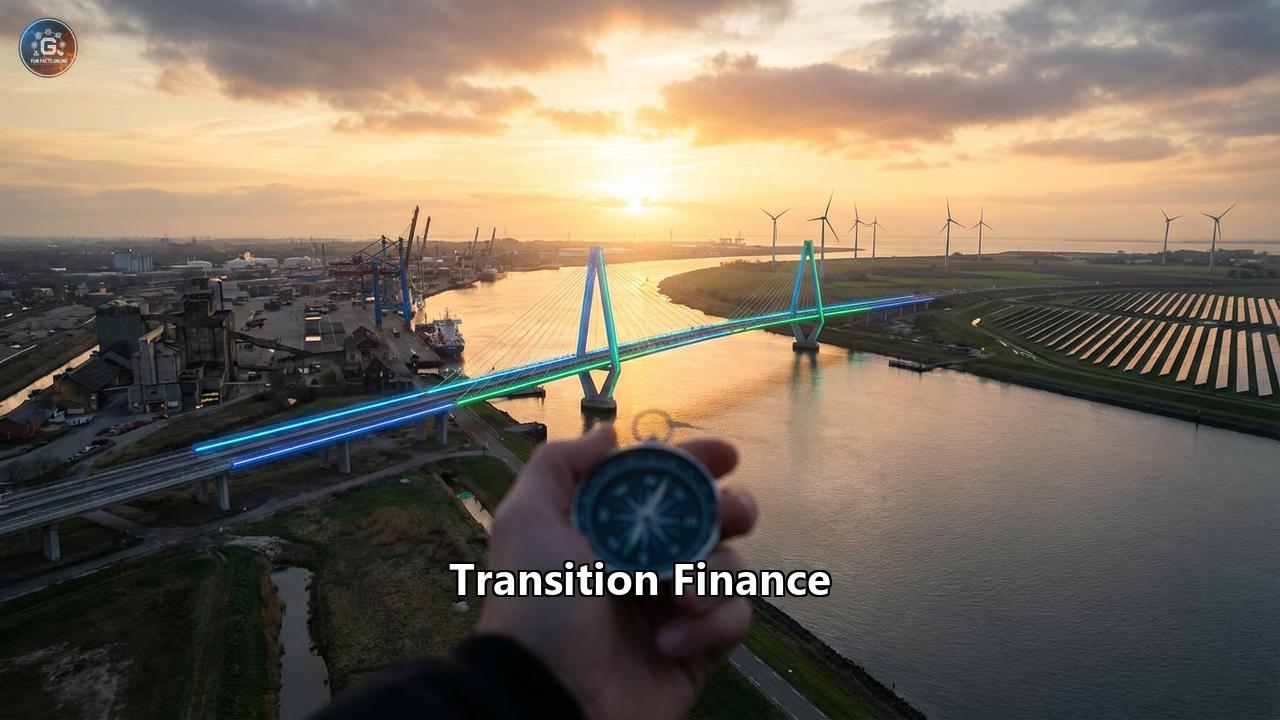
The "Missing Middle" of climate action—Transition Finance—has emerged as the single most critical, yet contentious, pillar of the global net-zero economy for the mid-2020s. While "Green Finance" (funding pure renewables like wind and solar) has enjoyed a decade of rapid growth and clear definitions, Transition Finance addresses the uncomfortable reality: the world cannot switch off the old economy overnight.
This article provides a comprehensive, deep-dive exploration of Transition Finance as of early 2026. It covers the definitions, the instruments, the geopolitical divergent approaches, the sectoral pathways, and the integrity challenges that define this evolving market.
Part 1: The Great Re-Pricing of the "Brown" Economy
The Context: Why Transition Finance Now?
For years, the sustainable finance market was binary. Assets were either "Green" (good) or "Brown" (bad). Investors flocked to pure-play renewable energy companies, electric vehicle (EV) manufacturers, and battery tech firms. This created a massive capital surplus for technologies that were already commercially viable, leading to "green bubbles" in certain equity markets.
However, the "Brown" economy—steel, cement, aviation, shipping, heavy chemicals, and fossil fuel power generation—accounts for over 75% of global greenhouse gas emissions. Starving these sectors of capital does not reduce emissions; it simply forces them to rely on opaque private equity, state subsidies, or cash reserves, often delaying necessary upgrades.
By 2025, the realization hit global policymakers and asset managers: We cannot divest our way to net zero. We must finance the transformation of high-emitters. This is the realm of Transition Finance.
Defining the Indefinable
Transition Finance is capital provided to high-emitting entities to help them decarbonize over time. Unlike Green Finance, which funds activities that are already low-carbon, Transition Finance funds entities that are currently high-carbon but have a credible plan to become low-carbon.
The central challenge has been the lack of a universal definition.
- The "Green" Zone: Solar parks, wind farms, afforestation. (Easy to finance, low reputational risk).
- The "Red" Zone: New coal mines, new oil exploration. (increasingly uninvestable for public markets).
- The "Amber" Zone: A gas power plant replacing coal; a steel mill switching from blast furnace to electric arc; a shipping company retrofitting vessels for methanol.
This "Amber" zone is where Transition Finance operates. In 2026, the market has moved beyond vague promises to rigorous frameworks anchored by the "Credible Transition Plan."
Part 2: The Instrument Toolkit – From Bonds to Blended Structures
The financial machinery of transition is complex. It requires instruments that hold borrowers accountable for their future performance.
1. Sustainability-Linked Bonds (SLBs)
SLBs were hailed as the "killer app" for transition finance. Unlike "Use of Proceeds" bonds (where money must be spent on specific projects), SLB proceeds can be used for general corporate purposes. However, the bond’s structural characteristics (usually the coupon/interest rate) are tied to the achievement of pre-defined Key Performance Indicators (KPIs) and Sustainability Performance Targets (SPTs).
- The Mechanism: A cement company issues a 10-year bond. It promises to reduce its carbon intensity per ton of clinker by 20% by year 5. If it fails, the interest rate on the bond steps up by 25 basis points (0.25%) for the remaining life of the bond.
- The 2024-2025 Crisis: By late 2024, the SLB market faced a credibility crisis. Investors realized that many "step-up" penalties were too small to motivate management. A 25bps penalty on a multi-billion dollar balance sheet was seen as the "cost of doing business" rather than a true deterrent. Furthermore, issuers were accused of setting "sleeping targets"—goals they were going to achieve anyway.
- The 2026 Evolution: The market is now demanding "Materiality and Ambition." New SLB structures involve "step-down" incentives (lower interest rates for success) combined with significant "step-up" penalties (50-75bps) and mandatory Scope 3 emission inclusion.
2. Transition Bonds
Transition Bonds are "Use of Proceeds" instruments specifically earmarked for climate transition activities. Historically, these struggled to gain traction because issuers feared being labeled "not green enough," and investors feared accusations of greenwashing.
- Japan’s Leadership: Japan reinvigorated this market with its GX (Green Transformation) Economy Transition Bonds. In February 2024, the Japanese government issued the world’s first sovereign transition bond, creating a 20 trillion yen ($140 billion) roadmap. This sovereign stamp of approval gave the instrument legitimacy, proving that transition bonds could fund gas-firing blending (ammonia/hydrogen) and heavy industry R&D.
3. Transition Loans
For many corporates, the public bond market is too transparent and volatile for the messy reality of transition. The loan market—bilateral or syndicated deals with banks—has become the engine room of transition finance. Banks, under pressure to decarbonize their loan books (financed emissions), are incentivizing clients to upgrade assets.
- The "Margin Ratchet": Similar to SLBs, these loans offer lower interest margins if ESG targets are met.
- Private Data Sharing: Banks can demand granular data (e.g., asset-level emissions of a specific chemical plant) that a company might be hesitant to publish in a public bond prospectus.
4. Managed Phase-Out (MPO) Mechanisms
This is the most radical and necessary instrument. MPO deals finance the early retirement of fossil fuel assets.
- The Coal Paradox: A coal plant in Indonesia might have a technical life of 40 years. Closing it at year 15 requires paying off the debt holders and compensating equity owners for lost future revenue. MPO structures use blended finance (public money taking the first loss, private money taking the senior tranche) to buy the plant, shorten its life, and replace its output with renewables.
- The CCT (Climate Capital Stack): These deals require a complex "layer cake" of capital: Philanthropic grants (to pay for feasibility studies), Concessional debt (cheap loans from development banks), and Commercial equity.
Part 3: The Framework Landscape – A Tale of Fragmented Standards
As of 2026, there is no single global rulebook, but three distinct "gravitational centers" have emerged.
1. The European Union: The Regulatory Superpower
Europe views transition finance through the lens of strict regulation and taxonomy.
- SFDR (Sustainable Finance Disclosure Regulation): By 2026, the EU moved to amend SFDR to explicitly include a "Transition" category. This allows funds to market themselves as "Transition Funds" if they invest in high-emitters with credible capex plans aligned to the EU Taxonomy.
- The Taxonomy "Capex" Clause: A crucial feature of the EU Taxonomy is that a company can be considered "taxonomy-aligned" not just if its revenue is green, but if its Capital Expenditure (CapEx) is directed toward greening its operations. This was a game-changer for heavy industry.
2. Asia: The Pragmatic Realists
Asia, led by Japan, Singapore, and China, advocates for an "inclusive" transition.
- The "Amber" Category: The ASEAN Taxonomy for Sustainable Finance introduced a tiered system. "Green" is global standard; "Amber" is for activities that reduce emissions but aren't net-zero yet (e.g., a coal plant retiring early, or a gas plant replacing coal).
- Japan’s Sector Roadmaps: The Japanese Ministry of Economy, Trade and Industry (METI) published detailed technology roadmaps for hard-to-abate sectors (steel, chemicals, cement). If a company’s transition plan aligns with the METI roadmap, it qualifies for transition finance. This top-down guidance provides immense certainty to lenders.
3. The UK and GFANZ: The Principles-Based Approach
The UK, home to the Transition Finance Council (TFC), and the Glasgow Financial Alliance for Net Zero (GFANZ), focus on the "Credible Transition Plan."
- The "Gold Standard" Plan: In 2025/2026, the UK TFC released final guidelines. A credible plan must include:
1. Interim Targets: Not just 2050, but 2030 and 2035 targets.
2. Absolute vs. Intensity: A commitment to reduce absolute emissions, not just intensity.
3. Governance: Executive remuneration tied to climate targets.
4. Financial Planning: Explicit disclosure of where the money (Capex) will come from.
Part 4: Sectoral Deep Dives – Where the Money Meets the Smokestacks
Transition finance is not abstract; it is about physical assets. Here is how it applies to the "Hard-to-Abate" sectors.
1. Steel: The Hydrogen Gamble
Steel production is responsible for ~8% of global CO2.
- The Challenge: Traditional Blast Furnaces (BF-BOF) use coal (coke) as a chemical reductant. They cannot be easily decarbonized.
- The Solution: Direct Reduced Iron (DRI) using Green Hydrogen.
- The Finance Gap: A hydrogen-DRI plant costs billions. The "Green Premium" (the extra cost of green steel) is 20-30%.
- Transition Deal: A steel major issues a transition bond to fund the pilot DRI plant, while simultaneously securing a long-term "Green Steel" offtake agreement with an automaker (e.g., Volvo or Mercedes). The offtake agreement serves as collateral to de-risk the bond.
2. Cement: The Process Emission Nightmare
Cement is unique because CO2 is released not just from burning fuel, but from the chemical reaction of limestone calcination (Process Emissions).
- The Solution: Carbon Capture, Utilization, and Storage (CCUS).
- The Finance Gap: CCUS increases the cost of cement by 50-100%. It generates no revenue (unless there is a high carbon price).
- Transition Deal: Blended finance is essential here. Governments (via mechanisms like the EU Innovation Fund or US Inflation Reduction Act tax credits) cover the CAPEX of the capture unit. Private transition loans fund the pipeline infrastructure.
3. Shipping: The Fuel Dual-ity
- The Challenge: Ships built today last 25 years. We don't know which fuel will win: Methanol, Ammonia, or Hydrogen.
- The Solution: Dual-Fuel vessels.
- Transition Deal: Banks provide "Sustainability-Linked Loans" to shipping fleets. The KPI is not just "emissions per container-mile" but the "percentage of fleet capable of running on zero-carbon fuels." This incentivizes the capability to switch as soon as fuel becomes available.
Part 5: The Integrity Crisis – Greenwashing vs. Transition-Washing
The biggest risk to transition finance is "Transition-Washing." This occurs when a company secures "transition" capital but continues business as usual, or makes only marginal improvements (e.g., a coal plant improving efficiency by 2% to extend its life by 10 years).
The "Lock-In" Risk
Financing a gas power plant today reduces emissions compared to coal, but it "locks in" carbon emissions for the next 20 years.
- The Safeguard: The "sunset clause." Credible transition financing for gas requires a technological guarantee that the plant is "Hydrogen-Ready"—meaning it can switch to burning 100% hydrogen with minimal retrofitting by a specific date (e.g., 2035).
The Data Void
Scope 3 emissions (supply chain) are the elephant in the room. An automaker might claim to be transitioning, but if its steel suppliers are coal-based, its footprint remains massive.
- Digital Enablers: By 2026, blockchain and IoT sensors are playing a role. "Smart Contracts" on SLBs can automatically trigger interest rate penalties if satellite data detects methane leaks or if real-time sensor data from smokestacks exceeds limits.
Part 6: The Geopolitics of Transition – North vs. South
Transition finance is a flashpoint in global diplomacy.
The Global South's Argument
Developing nations (India, Indonesia, South Africa, Vietnam) argue that they cannot transition at the same speed as the West. They need "Just Energy Transition Partnerships" (JETPs) that provide grants, not just loans.
- Debt Traps: If transition finance is provided in hard currency (USD/EUR) to countries with depreciating currencies, it creates a debt crisis.
- The 2025/2026 Shift: We are seeing a move toward "Local Currency Transition Bonds." Multilateral Development Banks (MDBs) like the Asian Development Bank offer guarantees to allow an Indonesian utility to issue bonds in Rupiah, protecting them from currency fluctuations.
The US vs. EU Divide
- US Approach: "Carrots." The Inflation Reduction Act (IRA) offers tax credits. It’s technology-neutral. If you capture carbon, you get paid. The transition is driven by profit motives and tax efficiency.
- EU Approach: "Sticks." The Carbon Border Adjustment Mechanism (CBAM) taxes high-carbon imports. The transition is driven by compliance and market access.
Part 7: The Role of Technology in Financing
Finance does not exist in a vacuum. It follows technology.
- CCUS (Carbon Capture): In 2026, CCUS is finally moving from "pilot" to "industrial." Financing these projects resembles infrastructure project finance—long tenures, high upfront costs, stable long-term returns.
- Green Hydrogen: The "Hydrogen Hype" of 2022 cooled by 2025 due to cost realities. Now, finance is focused on "Blue Hydrogen" (Gas + CCS) as a transitional step. This is controversial but increasingly accepted in Transition Finance frameworks as a necessary bridge.
- Grid Modernization: The unsung hero. You cannot transition to renewables without a grid. Transition finance is pouring into transmission lines. "Grid Bonds" are becoming a popular subset of the market.
Part 8: The Future Outlook (2026-2030)
As we look toward 2030, several trends are solidifying:
- The Death of "Voluntary": The era of voluntary commitments is ending. Transition Plans are becoming mandatory for listed companies in major jurisdictions (UK, EU, eventually parts of Asia).
- Litigation Risk: Companies that issue transition instruments and fail to deliver are facing lawsuits not just from environmental groups, but from investors suing for "misrepresentation of risk."
- The Rise of "Scope 4" (Avoided Emissions): There is a push to standardize the calculation of "avoided emissions." A company making insulation foam or efficient wind turbine blades wants credit for the emissions they help others avoid.
- Private Equity's Big Play: Public markets are squeamish about "brown" assets. Private Equity (PE) firms are raising massive "Transition Funds" to buy dirty assets cheap, clean them up (using aggressive capex), and sell them at a "Green Premium." This "Brown-to-Green" arbitrage is the hottest trade of the late 2020s.
Conclusion
Transition Finance is the messy, complex, necessary work of saving the planet. It lacks the moral purity of Green Finance. It involves compromises, bridge fuels, and difficult conversations about the lifespan of coal plants. But it is the only mechanism capable of moving the 75% of the economy that isn't yet green.
For the global financial system, the question is no longer "Should we fund high emitters?" but "How do we structure the deal to ensure they stop being high emitters?" The answer lies in rigorous data, credible plans, and financial instruments that align the profit motive with planetary survival.
Extended Analysis: The Mechanics of a "Credible" Transition Plan
To truly understand Transition Finance, one must dissect its atomic unit: The Transition Plan. In 2026, a PDF with photos of wind turbines is no longer a transition plan. Institutional investors (BlackRock, Vanguard, Amundi) and regulators utilize the GFANZ Net-zero Transition Plan (NZTP) framework.
The Five Pillars of Credibility:
- Foundations (Objectives & Priorities):
Does the plan cover all greenhouse gases (not just CO2, but Methane, N2O)?
Does it align with a specific scientific pathway (e.g., IEA NZE 2050)? A plan based on a "2.0°C scenario" is increasingly viewed as junk-grade; "1.5°C with no overshoot" is the gold standard.
- Implementation Strategy (Business Model Changes):
This is the hardest part. It asks: How will you change what you sell?
Example: An Oil & Gas major cannot just say "we will lower operational emissions." They must show a decline in fossil fuel production and a rise in electron/biofuel sales. The "Green Capex Ratio"—the percentage of total investment going to new technologies—is the key metric. If a company claims to be transitioning but spends 95% of Capex on oil exploration, the plan is rejected.
- Engagement Strategy (Value Chain & Policy):
Lobbying Alignment: A company cannot have a transition plan while funding trade associations that lobby against climate policy. Investors now audit "Political Footprint."
Supply Chain: Major retailers (e.g., Walmart, Tesco) are using "Supply Chain Finance" programs. Suppliers who submit credible transition plans get access to cheaper working capital.
- Metrics & Targets:
The 2030 Test: 2050 is free; 2030 is expensive. The credibility of a plan rests almost entirely on its near-term targets.
Carbon Intensity vs. Absolute: Intensity targets (CO2 per $ revenue) allow emissions to rise if the company grows. Absolute targets (Total Tons CO2) are the only ones that matter to the atmosphere.
- Governance:
Board Competence: Does the Board of Directors have climate expertise?
Remuneration: Is the CEO's bonus tied to the stock price or the carbon reduction target? 2026 best practice suggests 15-20% of Long-Term Incentive Plans (LTIPs) should be weighted on climate KPIs.
The Regional Taxonomy War: Green vs. Amber
The friction between Western and Asian taxonomies is a defining feature of the current market.
The European "Green or Bust" Model:The EU Taxonomy is a binary dictionary. It was designed to prevent greenwashing. However, it inadvertently created a "Transition Trap." High-emitting companies found themselves ineligible for "Green" funds, cutting them off from the cheapest capital. This forced the EU to reconsider and introduce the concept of "CapEx alignment"—allowing companies to be "green" if they are spending to become green.
The Asian "Traffic Light" Model:Asia recognizes that its grid is young and coal-heavy. The ASEAN Taxonomy Version 3 is a landmark document. It explicitly formalizes the "Amber" (Transition) category.
- Scenario: An Indonesian utility builds a Combined Cycle Gas Turbine (CCGT).
EU View: Not Green (it burns fossil fuel).
ASEAN View: Amber (if it replaces a coal plant, reduces emissions by >50%, and has a phase-out plan).
This pragmatism allows Asian banks to fund gas as a "bridge fuel," arguing that energy security cannot be sacrificed for climate purity.
The China Factor:China’s "Green Bond Endorsed Projects Catalogue" historically included "Clean Coal" (efficient coal burning). Under international pressure, this was removed. However, China’s domestic "Transition Finance Guidelines" are robust. The People's Bank of China (PBOC) provides cheap liquidity to banks specifically for lending to carbon-reduction projects in steel and cement. This state-directed transition finance is massive in scale, dwarfing Western voluntary markets, though often opaque in data.
The "Managed Phase-Out" (MPO) of Coal: The Ultimate Test
The MPO is the "moonshot" of transition finance. It is financially counter-intuitive: you are buying a profitable asset to shut it down.
The Financial Structure of an MPO Deal:Let's construct a hypothetical deal for the "Equator Coal Plant" (1GW capacity, 10 years old, 30 years remaining life).
- Valuation Gap: The current owner values the future cash flows at $1 Billion. To shut it down in 10 years (instead of 30), the value drops to $400 Million. Who pays the $600 Million gap?
- The Carbon Credit Kicker: The early closure generates millions of tons of "avoided emissions." These can be monetized as high-integrity "Transition Carbon Credits" (TCCs). If the carbon price is high enough, this covers part of the gap.
- Concessional Capital: The World Bank or a JETP (Just Energy Transition Partnership) provides a loan at 1% interest (vs market rate of 8%). This cheap debt increases the equity return, making the shorter life acceptable to private investors.
- Just Transition Grant: A grant is needed to retrain the 500 workers at the plant. This usually comes from philanthropic foundations (e.g., Rockefeller, Bezos Earth Fund).
If the plant closes, does the grid have enough power? MPO deals must be paired with simultaneous investment in renewables + battery storage to replace the baseload power. This makes the transaction size enormous and complex.
Conclusion: The Industrial Revolution 2.0
Transition Finance is not merely a niche banking product; it is the funding mechanism for the Second Industrial Revolution. The first revolution was built on digging carbon up and burning it. This one is built on keeping it in the ground or capturing it.
For the CEO, Transition Finance offers a lifeline: a way to fund the survival of their business in a net-zero world.
For the Investor, it offers alpha: the chance to spot the winners in the great industrial re-ordering.
For the Policymaker, it is the lever: the only way to move from "pledges" to "plumbing."
As we move through 2026, the "Missing Middle" is filling up. The frameworks are settling, the instruments are sharpening, and the capital is—finally—starting to flow to where it is needed most: not just to the green, but to the brown, to turn it green.
Reference:
- https://g20sfwg.org/wp-content/uploads/progress-updates/gfanz-9548.pdf
- https://www.hoganlovells.com/en/publications/climate-transition-focus-second-edition-2025-update-on-transition-planning-and-transition-finance
- https://www.icmagroup.org/assets/Transition-Finance-in-the-Debt-Capital-Market-paper-ICMA-14022024.pdf
- https://www.accountingforsustainability.org/en/knowledge-hub/blogs/transition-plans-gfanz-joy-williams.html
- https://www.weforum.org/stories/2024/06/net-zero-climate-finance-transition-challenges/
- https://www.msci-institute.com/wp-content/uploads/2023/12/MS194-Phaseout-of-Coal-Fired-Power-Plants-Report-201123_4.pdf
- https://www.stibbe.com/publications-and-insights/eu-esg-wrap-up-concluding-2025-and-stepping-into-2026
- https://assets.bbhub.io/professional/sites/24/951623_BNEF-Energy-Transition-Trends-2025-Abridged.pdf
- https://climateinstitute.edhec.edu/charting-pathway-transition-finance-challenges-and-opportunities-eu-framework
- https://www.tdsecurities.com/ca/en/sustainable-finance-outlook-2025
- https://ideas.repec.org/a/ers/journl/vxxviiiy2025i3p646-658.html
- https://www.aoshearman.com/en/insights/transition-finance-update-creating-a-global-framework-for-entity-level-transition-finance
- https://ersj.eu/journal/4066/download/Green+Finance+vs+Greenwashing+Challenges+to+the+Ecological+Transformation.pdf
- https://www.marketsmedia.com/sustainable-bond-market-reaches-new-highs/
- https://ieefa.org/resources/mapping-coal-phaseouts-key-asian-markets