
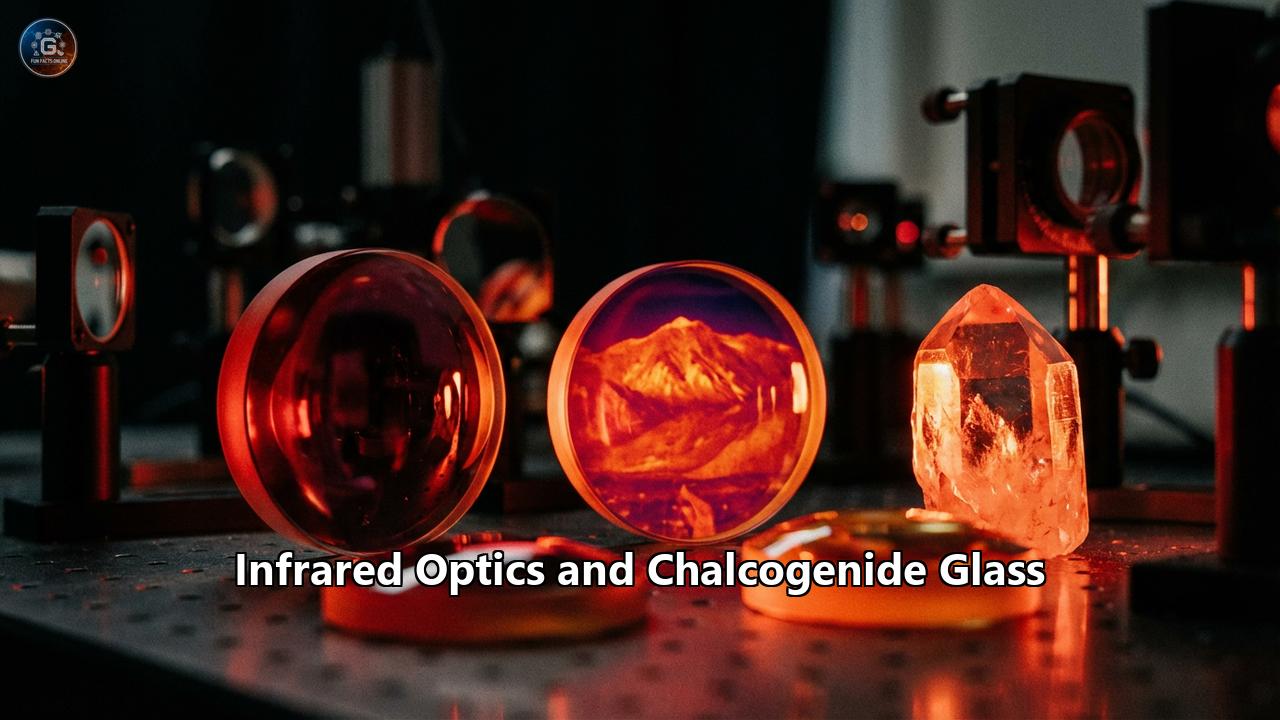
We live in a world bathed in light, yet our eyes perceive only a tiny fraction of it. Beyond the red edge of the rainbow lies the infrared (IR) spectrum, a vast domain of electromagnetic radiation that carries the thermal signatures of the universe. From the heat of a distant star to the fever of a child, from the invisible gases leaking in a factory to the enemy hiding in pitch darkness, the infrared spectrum holds the keys to seeing the unseen.
For decades, accessing this invisible world was the privilege of elite military units and well-funded research laboratories. The primary barrier was not just the sensors, but the optics. Standard glass, the silicate material that forms our windows and spectacles, is opaque to thermal energy. To focus heat, one needed exotic crystals—germaniun, silicon, zinc selenide—materials that were heavy, brittle, difficult to shape, and prohibitively expensive.
Today, we stand on the precipice of a revolution in infrared technology, driven by a material that challenges the traditional definition of "glass." Chalcogenide glass, a unique class of amorphous material, has emerged as the game-changer that is democratizing thermal imaging. It is enabling cars to see at night, drones to inspect power lines autonomously, and doctors to diagnose diseases without contact. This is the story of how a peculiar dark glass is reshaping the future of optics.
II. The Physics of the Invisible: Understanding the Infrared SpectrumTo appreciate the role of chalcogenide glass, one must first understand the terrain it conquers. The infrared spectrum is not a monolith; it is divided into distinct bands, each with its own physical characteristics and applications.
- Near-Infrared (NIR: 0.75 – 1.4 µm): This band behaves much like visible light. It is reflected by objects and can pass through standard silica glass. It is the domain of fiber optic telecommunications, TV remotes, and night-vision goggles that rely on image intensification (amplifying moonlight).
- Short-Wave Infrared (SWIR: 1.4 – 3 µm): SWIR offers a unique "x-ray like" capability for industrial inspection. It can penetrate silicon (making it vital for semiconductor inspection) and differentiate between materials that look identical to the naked eye, such as bruised fruit vs. healthy fruit, or plastic vs. natural fibers.
- Mid-Wave Infrared (MWIR: 3 – 5 µm): This is the "thermal contrast" sweet spot. At these wavelengths, hot objects emit intense radiation. MWIR is favored for high-performance military systems and long-range surveillance because it penetrates humidity and haze better than other bands.
- Long-Wave Infrared (LWIR: 8 – 14 µm): This is the true "thermal imaging" band. Terrestrial objects—humans, cars, trees, buildings—emit the majority of their thermal energy in this range. LWIR sensors do not need external light; they see the heat generated by the object itself. This is the primary domain where chalcogenide glass is displacing traditional materials.
For fifty years, the undisputed king of infrared optics was Germanium (Ge).
Germanium is a chemical element (atomic number 32) that is naturally transparent to infrared light. It has an incredibly high refractive index (~4.0), which means it can bend light sharply, allowing for powerful lenses. However, Germanium has severe limitations that have stifled the mass adoption of thermal imaging:
- Scarcity and Cost: Germanium is a rare by-product of zinc mining. It is subject to extreme price volatility and geopolitical supply chain risks. As of 2024-2026, export restrictions and mining bottlenecks have sent Germanium prices soaring.
- The "Thermal Runaway" Problem: Germanium has a fatal flaw. As it gets hot, it becomes opaque. At temperatures above 100°C, a Germanium lens effectively turns into a blindfold. Even at 60°C, its performance degrades significantly. This makes it risky for use in high-speed missiles, industrial furnaces, or desert environments.
- Manufacturing Bottlenecks: Germanium is a crystal, not a glass. It cannot be molded. Every Germanium lens must be individually cut, ground, and polished using Single Point Diamond Turning (SPDT). This process is slow, expensive, and difficult to scale. You cannot stamp out Germanium lenses like plastic caps; you must craft them one by one.
The industry needed a material that offered the optical performance of Germanium but with the manufacturability of plastic. It needed Chalcogenide Glass.
IV. Chalcogenide Glass: The Chemistry of the DarkChalcogenide glass (often shortened to ChG) is not "glass" in the window-pane sense. It is a non-oxide amorphous solid. While standard glass is based on Silicon Dioxide (sand), Chalcogenide glass is based on the chalcogens—elements in Group 16 of the periodic table, specifically Sulfur (S), Selenium (Se), and Tellurium (Te).
These elements are mixed with "network formers" like Arsenic (As), Germanium (Ge), or Antimony (Sb) to create stable glass structures. Common compositions include As₂S₃ (Arsenic Trisulfide) and Ge-As-Se variations.
Key Properties that Define Chalcogenide Glass:- Broadband Transparency: Unlike silica, which goes black beyond 2 µm, chalcogenide glasses transmit light effortlessly from 1 µm out to 12-16 µm. They cover the SWIR, MWIR, and LWIR bands simultaneously.
- High Refractive Index: With indices typically between 2.4 and 2.8, these glasses are powerful enough to create thin, lightweight lenses, though not as extreme as pure Germanium.
- Athermalization (The "Secret Weapon"): The refractive index of chalcogenide glass changes very little with temperature (low dn/dT). This allows optical engineers to design "passive athermal" systems—lenses that stay in focus from -40°C to +80°C without requiring heavy mechanical motors to adjust them. This is crucial for automotive and drone applications.
- Amorphous Structure: Because it is a true glass (disordered atomic structure), it softens when heated. This simple physical fact is the key to its commercial success.
The single greatest advantage of chalcogenide glass is that it can be molded.
In the traditional diamond-turning process used for Germanium, a technician creates one lens at a time. It can take 20-60 minutes to machine a single aspheric lens.
With Precision Glass Molding (PGM), the process looks different:
- A "gob" or perform of chalcogenide glass is placed into a high-precision mold made of tungsten carbide or silicon carbide.
- The assembly is heated to the glass transition temperature (Tg), typically between 200°C and 400°C.
- The glass softens, and the mold halves are pressed together.
- The glass replicates the mold's shape perfectly, including complex aspheric curves and diffractive patterns (kinoforms) that correct color aberration.
- The lens is cooled and released.
The shift from crystalline Germanium to molded Chalcogenide is fueling the explosion of infrared applications across three major sectors.
1. Defense and SecurityHistorically the driver of IR tech, defense is moving toward "swappable" sensors. Soldiers need lightweight thermal sights for rifles and helmets. Chalcogenide lenses are 30-40% lighter than Germanium equivalents.
- Thermal Weapon Sights: High-volume production allows every soldier, not just special forces, to have thermal capability.
- Micro-UAVs (Drones): The Black Hornet and similar micro-drones rely on gram-weight thermal cameras. Chalcogenide's low density makes these flight times possible.
This is the "killer app" for chalcogenide. As cars become autonomous (Level 3 and 4 ADAS), they need to see in total darkness and through fog—conditions where LIDAR and cameras fail.
- Pedestrian Detection: A thermal camera can spot a pedestrian's body heat at 200 meters in pitch blackness.
- Cost Sensitivity: The auto industry operates on razor-thin margins. They could never afford Germanium lenses. Molded chalcogenide brings the price of thermal cores down to levels acceptable for luxury and eventually mid-range vehicles.
- Firefighting: Handheld thermal cameras help firefighters see through smoke (which blocks visible light but passes LWIR) to find victims or the seat of a fire.
- Smartphone Attachments: Devices like FLIR One and Seek Thermal use molded chalcogenide optics to bring thermal imaging to consumers for checking home insulation or water leaks.
- Medical Diagnostics: Non-contact thermography is being used to screen for fevers in airports and to detect inflammation or circulatory issues (like diabetic foot ulcers) early.
While lenses are the current commercial standard, the future of chalcogenide glass lies in Integrated Photonics.
1. Photonic Integrated Circuits (PICs)Just as silicon chips process electricity, photonic chips process light. Researchers are now depositing thin films of chalcogenide glass onto silicon wafers.
- Why? Silicon is good for NIR but absorbs MWIR and LWIR. Chalcogenide waveguides act as "super-highways" for mid-infrared light on a chip.
- Application: A "lab-on-a-chip" sensor that can sniff out specific gas molecules (like methane or CO2) by analyzing their infrared absorption fingerprints. Imagine a smartphone sensor that can warn you of a gas leak or check air quality with laboratory precision.
Chalcogenide glass has a "non-linear" optical response up to 1,000 times stronger than silica. When you pump intense laser light into a chalcogenide fiber, the glass "explodes" the light into a massive rainbow of colors spanning the entire infrared spectrum.
- Supercontinuum Lasers: These "white light" IR lasers are used for hyperspectral imaging, allowing satellites to determine the chemical composition of plastics in the ocean or minerals on the ground from space.
A specific subset of chalcogenides (like GST - Germanium-Antimony-Tellurium) can switch between a crystalline and amorphous state when zapped with electricity or light. This is the basis of Phase Change Memory (PCM).
- Neuromorphic Chips: These materials mimic the human brain's synapses. They don't just store 1s and 0s; they change their resistance gradually, allowing them to "learn" and perform AI calculations directly in the hardware, vastly faster and more efficiently than standard CPUs.
For all its wonders, chalcogenide glass requires careful engineering.
- Mechanical Softness: It is softer than Germanium. It can be scratched easily. Therefore, nearly all chalcogenide lenses are coated with a Diamond-Like Carbon (DLC) or Hard Carbon coating. This thin armor makes the lens tough enough to survive windshield wipers or sandstorms.
- The "Toxic" Myth: Chalcogenide glasses often contain Arsenic or Selenium. This raises alarm bells. However, in the glass form, these elements are chemically bound and stable. They are non-toxic to the user. You can hold a chalcogenide lens without risk. The danger exists only during the manufacturing phase (grinding or melting), where dust or vapors must be managed with strict ventilation and filtration systems. Once the lens is finished, it is inert.
As we move toward 2030, the trajectory of Chalcogenide Glass is exponential.
- Self-Healing Materials: In 2024, researchers discovered that certain chalcogenide structures can self-heal from gamma radiation damage, making them ideal for deep-space satellites and nuclear reactor inspection.
- Ubiquity: We are moving toward a world where "Heat" is just another channel of information, as common as "Color" is today. Chalcogenide glass is the lens through which this future will be viewed.
Infrared optics has transitioned from a niche military technology to a cornerstone of modern sensing. At the heart of this transition is Chalcogenide Glass. By breaking the shackles of cost and manufacturability that held back Germanium, this material has opened the floodgates for innovation. From the autonomous car protecting pedestrians in the dark to the AI chip mimicking the human brain, the "dark glass" is illuminating our future.
Reference:
- https://www.fisba.com/sites/default/files/2021-02/Alternative_to_Germanium_Gaining_Momentum_for_IR_Optics_%28en%29.pdf
- https://digital.bnpengage.com/emagazine-acers-bulletin-may-2024/cover-story-chalcogenide-glasses/
- https://opg.optica.org/abstract.cfm?uri=nlo-2011-ntue1
- https://www.lasercomponents.com/fileadmin/user_upload/home/Datasheets/workshops/ir-abstracts-2021-2/2_3-Tatsuya-Suetsugu.pdf
- https://ece.engin.umich.edu/event/reconfigurable-optical-devices-utilizing-chalcogenide-phase-change-materials
- https://irflex.com/products/safety/
- https://media.schott.com/api/public/content/a9dc0a8ee0fb4572bf01c3e0851e30ca?v=70fd717a
- https://ieeexplore.ieee.org/iel5/6306339/6325355/06325463.pdf
- https://validate.perfdrive.com/?ssa=32eacc8b-1253-a2d0-b557-52622d6b5861&ssb=72165281645&ssc=https%3A%2F%2Fopg.optica.org&ssi=e985209e-d3hy-3c89-8fb9-43a89fcbf63a&ssk=botmanager_support@radware.com&ssm=23687546851313063104585307157241&ssn=bc56ecb5b4b172a51d41e903061685a5cfd87a969bb5-3786-ba32-c9885c&sso=64a7b32-c735-ce632c8b7cd18cec29870746d49c04c95b70b973f73acbf6&ssp=29317022541771503797177157533385026&ssq=90802034853113414831548531572641174559778&ssr=MTgwLjE4OC4xNzQuMjg=&sst=python-requests%2F2.32.3&ssv=&ssw=
- https://sydor.com/blog/chalcogenide-materials-as-an-alternative-option/
- https://avantierinc.com/resources/knowledge-center/chalcogenide-as-an-alternative-to-germanium-for-ir-optics/
- https://andovercorp.com/germanium-alternatives/
- https://www.light-am.com/en/article/doi/10.37188/lam.2023.024
- https://pubs.aip.org/aip/jap/article/129/15/151103/1056474/Chalcogenide-phase-change-devices-for-neuromorphic
- https://spie.org/news/photonics-focus/julyaug-2022/seeing-the-future-of-photonics-with-chalcogenides
- https://pmc.ncbi.nlm.nih.gov/articles/PMC8695193/
- https://www.sciencealert.com/breakthrough-new-glass-self-heals-from-gamma-radiation