
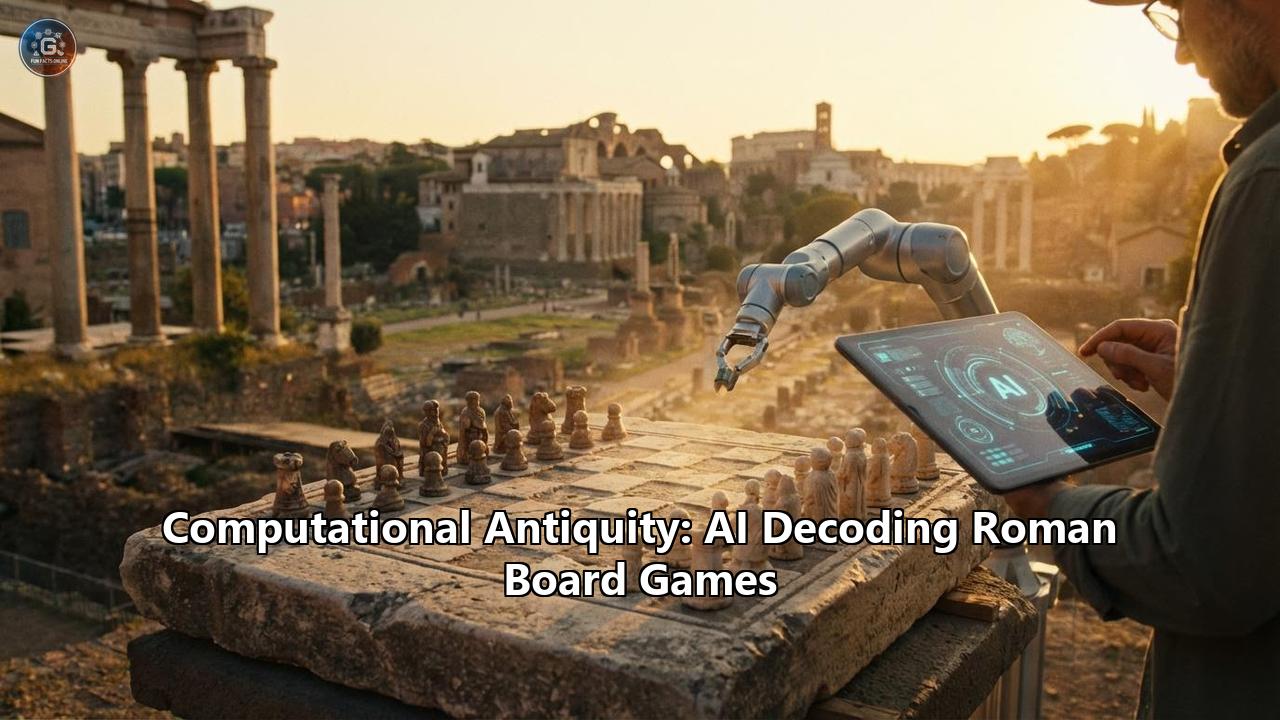
For over a century, a seemingly unassuming piece of smooth, white limestone sat in the collection of a local museum in the Netherlands. Discovered in the late nineteenth or early twentieth century amid the ruins of Coriovallum—a Roman-era frontier town that is today the modern Dutch city of Heerlen—the artifact measured a mere 20 centimeters across. On its flattened upper face, someone had purposefully carved a geometric pattern: a rectangle bisected by four diagonal lines and one straight line. To the untrained eye, it might have looked like a builder’s tally mark or an abstract doodle. But to archaeologists, the markings whispered of something profoundly human, yet entirely lost to time: it was an ancient board game.
There was only one problem. The rules of this game had been dead for nearly two millennia.
Because most everyday Roman games were casually scratched into tavern tables, drawn in the dust, or carved into perishable wood, they rarely survived the collapse of the Empire. When the oral traditions of the common people faded, so did the instructions. The Coriovallum stone was a rare, durable survivor of ancient leisure. Yet, without a surviving rulebook, the stone was nothing more than a locked door. For decades, archaeologists could only guess at how the game was played, viewing it as an unsolvable enigma of antiquity.
That is, until the intersection of silicon and stone changed the field of archaeology forever. In a groundbreaking achievement published in the journal Antiquity in early 2026, an international team of researchers utilized artificial intelligence to successfully reverse-engineer the rules of this 2,000-year-old game. It marked the birth of a new era in "Computational Antiquity," proving that modern machine learning can do much more than generate text or analyze financial data—it can reach across thousands of years to resurrect the lost joys of our ancestors.
The Tragedy of Lost Play
To understand the magnitude of this breakthrough, one must understand how games survive the ravages of time. Board games are among the oldest documented forms of human leisure, dating back at least to the Bronze Age. The grand, royal games of history are well understood because they were immortalized by the elite. The ancient Egyptian game of Senet survived because extravagant sets were buried with pharaohs like Tutankhamun to ensure their passage into the afterlife. In ancient Sumer, the rules of the Royal Game of Ur were deemed important enough to be meticulously etched into cuneiform clay tablets.
But the games of the commoners—the soldiers stationed on the cold frontiers of the Roman Empire, the merchants resting at a waystation, the children playing in the dirt streets of Coriovallum—were rarely recorded. Their rules were passed down through the generations by word of mouth. When the culture shifted or populations were displaced, the rules vanished. Geometric patterns etched into stones across Europe and the Mediterranean have long mocked historians; they are the ghost towns of ancient play, containing the architecture of a game but devoid of the people and logic that brought them to life.
Dr. Walter Crist, an archaeologist at Leiden University specializing in ancient games, recognized the Coriovallum stone as a playing board not just because of its deliberate geometry, but because of a much subtler clue: the physical scars of play. The limestone bore visible, uneven damage along the carved grooves. This wear-and-tear was highly consistent with the repeated abrasion caused by players sliding glass, bone, or earthenware gaming pieces across the soft stone surface.
To get a closer look at this ancient friction, Luk van Goor from the restoration studio Restaura produced incredibly detailed 3D scans of the stone. These high-resolution models revealed that some of the carved lines were a fraction of a millimeter deeper than others, indicating that certain pathways on the board were used far more intensively during gameplay. The pieces weren't simply picked up and placed down; they were slid, leaving microscopic trails of strategy. The disproportionate wear pattern was essentially the fingerprint of the game's mechanics. However, matching that fingerprint to a set of rules required processing power far beyond human intuition.
Enter the Machine: Digital Archaeoludology
Faced with a mathematical and historical puzzle of astronomical proportions, the researchers turned to a pioneering discipline: Digital Archaeoludology. This nascent field blends archaeology, computer science, and cultural history to analyze and reconstruct traditional games using modern computational techniques.
The research was conducted under the umbrella of the Digital Ludeme Project, an ambitious initiative led by computer scientist Cameron Browne at Maastricht University and funded by the European Research Council. The project operates on a fascinating premise: just as biological organisms are made of genes, games are made of "ludemes". A ludeme is a fundamental, indivisible unit of play—a conceptual "game meme". For example, "moving one space forward," "capturing an opponent by jumping over them," or "winning by reaching the edge of the board" are all distinct ludemes. By breaking down the world's traditional strategy games into their basic ludemes, researchers can create a digital, playable database of human gaming heritage.
To decode the Coriovallum stone, the team—which included Dennis Soemers from Maastricht University and Dr. Matthew Stephenson from Flinders University—employed a specialized AI system named Ludii. Ludii is a game description language and general game-playing artificial intelligence designed not just to master games (like the AI that famously beat human champions at Go), but to understand, design, and evaluate them.
The Gladiatorial Arena of Algorithms
The methodology the team devised was a brilliant fusion of historical constraints and raw computational power. They knew that if they simply asked the AI to invent a game that fit the board, it would generate countless mathematically sound but historically nonsensical rulesets. "If you present Ludii with a line pattern like the one on the stone, it will always find game rules," Dennis Soemers cautioned.
To prevent the AI from hallucinating a modern game, the researchers anchored the machine in history. They trained Ludii with the rules and ludemes of more than 100 documented historical board games spanning antiquity and the Middle Ages, particularly focusing on games from the same European and Mediterranean cultural spheres, such as the Scandinavian game Haretavl and the Italian Gioco dell'orso.
Then, the digital games began. The researchers essentially built a virtual arena inside the computer, a digital twin of the Coriovallum stone. They programmed two AI agents to play against each other tens of thousands of times using the stone's exact geometric layout. The AI was instructed to test a dizzying array of piece configurations and ludeme combinations. They experimented with different starting setups: three pieces versus two, four versus two, and two against two. For every simulated match, the AI tested countless strategic moves, relentlessly exploring the mathematical boundaries of the game.
As the AI agents dueled, the system generated a digital "heat map" of movement, tracking exactly which lines the virtual pieces traveled across most frequently. The researchers then engaged in a high-tech game of matching: they compared the movement frequencies predicted by the AI's simulated play with the physical, uneven wear patterns captured by the 3D scans of the 2,000-year-old limestone.
The goal was to find the precise ruleset that would naturally compel players to slide their pieces exactly where the real-life Romans had worn down the stone.
Decoding Ludus Coriovalli
After exhaustively running through thousands of simulated games, the AI system successfully identified a set of game mechanics that perfectly replicated the historical wear-and-tear. The mystery that had baffled historians for a century was finally cracked. The team named the reconstructed game Ludus Coriovalli, or "The Coriovallum Game".
The AI revealed that Ludus Coriovalli was a deceptively simple but thrillingly deep strategy game. Specifically, it was an asymmetric "blocking game" of the "hounds and hares" variety.
Unlike games such as Chess or Checkers, where the primary objective is to capture and remove the opponent's pieces from the board, the goal of a blocking game is entirely spatial. Players win by maneuvering their pieces to trap their opponent, restricting their movement until they can no longer make a legal move.
The simulations determined that the most likely and historically sound version of the game was highly asymmetrical, pitting four pieces of one color (acting as the "hounds") against two pieces of another color (the "hares"). The player controlling the hares attempts to evade capture and survive for as long as possible, while the hounds must coordinate their movements along the board's diagonals and straight lines to corner the hares. It was a game of intense tactical positioning, where a single misstep could result in a claustrophobic defeat. The researchers noted that players likely swapped roles after each round to determine who was the superior strategist.
Rewriting the History of Play
The discovery of Ludus Coriovalli is much more than a neat technological parlor trick; it fundamentally rewrites our understanding of ancient European gaming culture.
Prior to this AI-driven breakthrough, historians and archaeologists believed that blocking games were a relatively late invention. Documented evidence of blocking games in Europe only extended back to the Middle Ages, heavily associated with later Scandinavian and medieval cultures. Finding a fully realized blocking game on a 2,000-year-old Roman frontier stone pushes the history of this game genre back by an astonishing 1,500 to 1,700 years.
It proves that the Roman legions and provincial citizens were engaged in deep, asymmetric blockade strategies centuries earlier than the historical record previously indicated. Furthermore, the AI simulations revealed that the game was robust enough to support multiple variations. The AI identified nine plausible board layouts and rule variants that remained highly enjoyable for human players. This suggests a vibrant, adaptive gaming culture where inventive Romans developed local "house rules," much like how families today argue over the specific rules of Monopoly or Uno.
By pushing the boundaries of spatial strategy, the Romans on the edge of the Empire were engaging in complex cognitive exercises that mirrored military flanking and entrapment maneuvers—a fitting pastime for a heavily militarized frontier.
The Broader Horizon of Computational Antiquity
The resurrection of Ludus Coriovalli serves as a watershed moment for the archaeological community. "This is the first time that AI-driven simulated play has been used in concert with archaeological methods to identify a board game," Dr. Crist stated.
For decades, the standard method for identifying an ancient game relied strictly on connecting geometric patterns to known text references or artistic depictions. If a game wasn't painted on a vase or written in a scroll, it was considered lost forever. But the success of the Ludii AI system changes the paradigm entirely. Dr. Matthew Stephenson noted that this computational approach bridges the gap between the material sciences and historical studies, providing archaeologists with a vital new tool.
The implications are vast. Deep within the archives of museums worldwide sit thousands of "mysterious artifacts"—incised stones, etched clay tablets, and carved wooden boards—that have been vaguely classified as "ritual objects" or "unknown geometric tools". With the methodology proven by the Coriovallum stone, AI simulations can now be tailored to investigate these artifacts. By feeding 3D scan data of physical wear patterns into reinforcement learning algorithms, AI acts as an impartial, tireless experimentalist capable of testing millions of hypotheses that human researchers could never feasibly explore.
This represents a larger shift in how we study the past. Artificial intelligence is rapidly becoming the ultimate translator of antiquity. Just as machine learning models are currently being used to digitally unwrap and read the charred papyri of Herculaneum, or to decipher fragmented cuneiform tablets, AI is now deciphering the behavioral and social pastimes of ancient humanity. It is peeling back the silence of the archaeological record to reveal the laughter, the frustration, and the competitive spirit of people who lived thousands of years ago.
Your Move
Board games are inherently social artifacts. They are not merely objects; they are engines of human interaction. They reflect our innate desire for creative problem-solving, our competitive instincts, and our need for shared enjoyment across the social spectrum. When the ancient citizens of Coriovallum sat down around a piece of French limestone to slide glass pieces across carved grooves, they were partaking in a universal human experience.
Through the rigorous application of modern machine learning, 3D imaging, and cultural history, that experience has been saved from the abyss of forgotten time. The dusty carved lines have been transformed into a bridge linking the digital age to Roman antiquity.
Today, the work of the Digital Ludeme Project has democratized this discovery. Ludus Coriovalli is no longer trapped in the 1st century, nor is it locked inside a supercomputer. The researchers have made the reconstructed game available online, entirely free of charge. Anyone with an internet connection can load up the board, choose to play as the hounds or the hares, and test their wits against the computer.
When you make your first move, sliding a digital piece down a diagonal line to block your opponent, you are executing a strategy that was last pondered by a Roman citizen two millennia ago. In decoding the geometry of play, artificial intelligence has done more than solve a historical puzzle. It has allowed us to pull up a chair, sit across from our ancient ancestors, and finally take our turn.
Reference:
- https://www.sciencenews.org/article/ai-roman-board-game-limestone
- https://www.cbsnews.com/news/mysterious-ancient-board-game-rules-decoded-ai-scientists/
- https://archaeology.org/news/2026/02/16/archaeologists-use-ai-to-decipher-how-romans-played-board-game/
- https://nunc.ch/en/ai-reconstructs-the-rules-of-a-forgotten-roman-game/
- https://www.eurekalert.org/news-releases/1120532
- https://www.atlasobscura.com/articles/ancient-games-artificial-intelligence
- https://ucstrategies.com/news/ai-just-solved-a-2000-year-old-roman-mystery-no-one-could-explain/
- https://gizmodo.com/dueling-ais-reconstruct-rules-of-mysterious-roman-era-board-game-2000719655
- https://www.maastrichtuniversity.nl/news/thanks-ai-we-can-play-roman-game-again
- https://antiquity.ac.uk/news/2026/ai-simulation-helps-calculate-rules-unknown-roman-board-game
- https://pmc.ncbi.nlm.nih.gov/articles/PMC7194251/
- https://bioengineer.org/ai-uncovers-secrets-behind-ancient-gaming-enigma/