
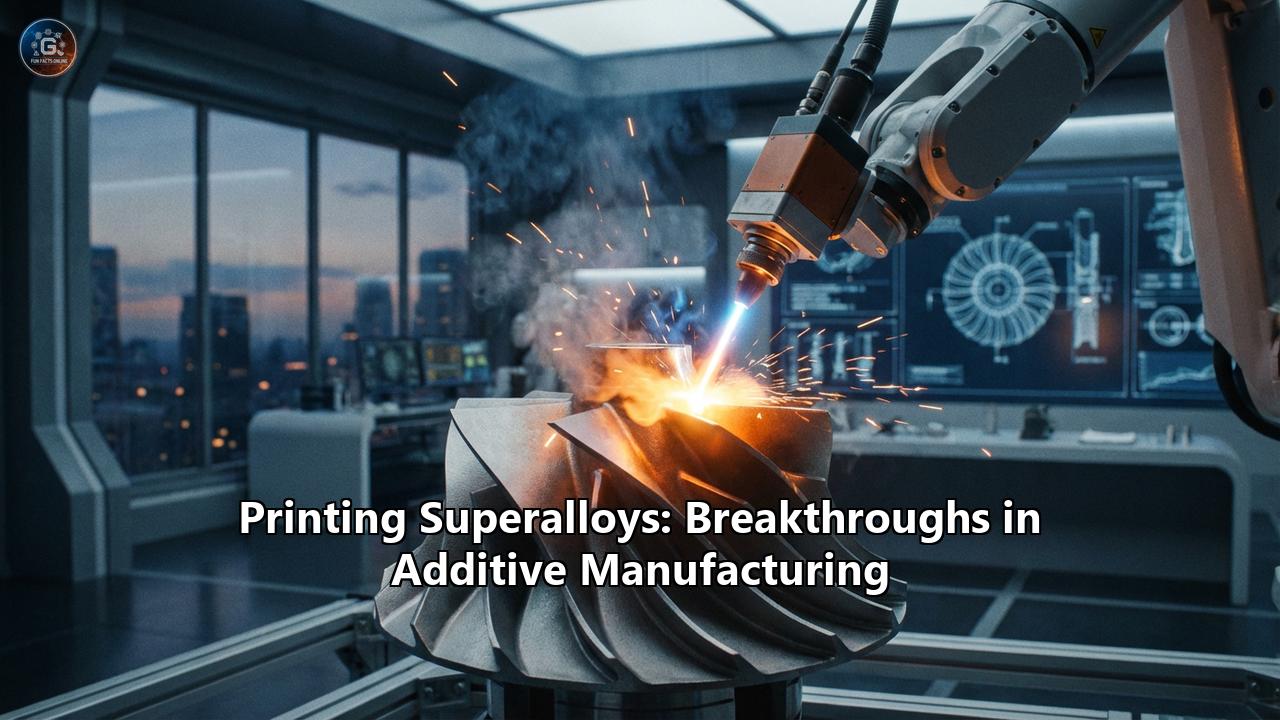
Executive Summary: The Renaissance of High-Temperature Metallurgy
The intersection of Additive Manufacturing (AM) and superalloy metallurgy has precipitated one of the most significant shifts in industrial engineering of the 21st century. For decades, the design of jet engines, gas turbines, and rocket propulsion systems was constrained not by imagination, but by the limitations of casting and forging. Superalloys—the high-performance nickel, cobalt, and iron-based metals capable of withstanding the hellish temperatures of combustion—were notoriously difficult to process. They were hard to machine, prone to cracking during welding, and limited to geometries that could be poured into a mold.
In 2024 and 2025, however, the narrative changed. We moved past the era of merely "adapting" old casting alloys for 3D printers. We have entered the age of "printable superalloys"—materials designed at the atomic level specifically for the rapid heating and cooling cycles of a laser beam. Breakthroughs like NASA’s GRX-810 and novel "directional recrystallization" heat treatments have shattered previous performance ceilings, offering components that are not only printable but are 1,000 times more durable than their traditionally manufactured counterparts.
This article provides a comprehensive examination of this technological revolution. We will explore the material science behind the new superalloys, the maturation of printing processes like Binder Jetting, the critical—and often overlooked—innovations in post-processing, and the real-world applications currently reshaping the aerospace and energy sectors.
Part I: The Material Revolution
From "Unweldable" to "Born to Print"
The single biggest hurdle in the early days of metal 3D printing was that traditional superalloys (like Inconel 738 or Mar-M247) were never designed to be welded. When subjected to the intense, localized heat of a laser in Laser Powder Bed Fusion (LPBF), these materials suffered from "hot cracking" or "strain-age cracking." The rapid solidification left behind microscopic fissures that spelled disaster for flight-critical parts. The industry’s solution for years was to use "weldable" but lower-performance alloys like Inconel 718. That compromise is no longer necessary.
1. The GRX-810 Breakthrough
The crown jewel of recent advancements is undoubtedly GRX-810, an Oxide Dispersion Strengthened (ODS) alloy developed by NASA. ODS alloys have long been the "holy grail" of high-temperature metallurgy because they contain tiny, nanoscale ceramic particles dispersed throughout the metal matrix. These particles pin the grain boundaries in place, preventing the metal from deforming (creeping) under heat and stress.
Historically, making ODS alloys required expensive, slow mechanical alloying processes (ball milling) that were impossible to scale for complex shapes. NASA’s breakthrough was to combine computational modeling with additive manufacturing.
- The Innovation: Researchers used thermodynamic modeling to determine the precise alloy composition that would allow nanoscale yttrium oxide particles to form in-situ during the printing process.
- The Result: A printable alloy that can withstand temperatures over 2,000°F (1,093°C). Compared to current state-of-the-art AM superalloys, GRX-810 is twice as strong, 1,000 times more durable in creep-rupture tests, and twice as resistant to oxidation.
- Commercialization: In 2024, NASA licensed this technology to four US companies (Carpenter Technology, Elementum 3D, Linde Advanced Material Technologies, and Powder Alloy Corp), moving it from the lab to the commercial supply chain. Elementum 3D has reportedly already shipped ton-scale quantities of the powder, signaling that this is no longer just a research curiosity.
2. High-Entropy Alloys (HEAs) and Multi-Principal Element Alloys
Beyond traditional nickel-based superalloys, 2025 has seen a surge in High-Entropy Alloys. Unlike standard alloys which have one base element (like nickel) with small additions of others, HEAs mix five or more elements (e.g., Al, Co, Cr, Fe, Ni) in roughly equal proportions.
- The "Cocktail Effect": This complex mixture creates a distorted crystal lattice that naturally impedes dislocation movement, leading to exceptional strength and fracture toughness, even at cryogenic temperatures.
- Printability: Surprisingly, many HEAs have shown excellent printability. The sluggish diffusion of atoms in these chaotic lattices suppresses the formation of brittle phases that typically cause cracking during printing.
3. Sandia’s "Super-Solar" Alloy
Researchers at Sandia National Laboratories and Ames National Laboratory developed a new superalloy (42% aluminum, 25% titanium, 13% niobium, 8% zirconium, 8% molybdenum, and 4% tantalum) specifically for power generation. This alloy is actually stronger at 800°C than it is at room temperature—a counter-intuitive property derived from its unique precipitation hardening behavior. This material is poised to revolutionize concentrated solar power plants and nuclear reactors, where thermal efficiency is directly tied to operating temperature.
Part II: The Process Paradigm Shift
Maturation of Printing Technologies
While Laser Powder Bed Fusion (LPBF) remains the gold standard for critical rotating parts, 2025 has been defined by the diversification of printing modalities.
1. Laser Powder Bed Fusion (LPBF) Refinement
LPBF has moved from a "black box" art to a precise science. The latest machines feature multi-laser systems (some with 12+ lasers) that can scan simultaneously, drastically reducing print times.
- Beam Shaping: New beam-shaping technology allows engineers to switch between a Gaussian spot (for fine detail) and a ring-mode beam (for faster bulk melting) on the fly. This reduces spatter and porosity, key defect sources in superalloys.
- In-Situ Monitoring: Artificial Intelligence is now standard in high-end printers. Cameras monitor the melt pool in real-time, detecting "keyhole" porosity or lack of fusion. In some systems, the AI can adjust laser power in the next layer to heal defects detected in the previous layer, creating a "self-healing" manufacturing process.
2. The Rise of Binder Jetting for Superalloys
For years, Binder Jetting (BJT)—where a print head deposits a glue-like binder onto powder—was considered unsuitable for superalloys due to the difficulty of achieving high density during the subsequent sintering step. That has changed.
- Why it Matters: BJT is roughly 100 times faster than laser printing and significantly cheaper. It opens the door to using superalloys in automotive turbochargers and industrial pumps, not just million-dollar rocket engines.
- The Breakthrough: Companies like Desktop Metal and HP, working with powder experts, have qualified superalloys like Mar-M247 and Inconel 718 for BJT. The key was developing "sinter-friendly" binder chemistries and mastering the shrinkage compensation factors. By essentially printing a part 20% larger than needed and predicting exactly how it will shrink in the furnace, manufacturers can now achieve aerospace-grade densities (over 99%) without the thermal stress issues of laser melting.
3. Electron Beam Melting (EBM)
EBM remains critical for materials prone to cracking. Because the process takes place in a vacuum and at high temperatures (often >800°C), the part is essentially heat-treated while it is being printed. This reduces residual stress, making EBM the preferred method for printing crack-sensitive titanium aluminides (TiAl) used in the low-pressure turbine blades of the GE9X engine.
Part III: Mastering Microstructure
The Science of "Digital Metallurgy"
One of the most profound realizations of the last two years is that printing is not just shaping; it is heat treating. The cooling rates in AM (up to 1,000,000°C per second) create unique microstructures that cannot be replicated by casting.
1. Controlling Grain Geometry
In a cast turbine blade, engineers spend millions to grow a "single crystal" (SX) structure to eliminate grain boundaries, which are the weak points where creep rupture begins. In AM, we are learning to "print" grain structures.
- Columnar vs. Equiaxed: By manipulating the laser scan strategy (speed, power, and pattern), engineers can force grains to grow in specific directions. For example, a rocket nozzle could be printed with columnar grains running vertically to resist thermal stress, transitioning to equiaxed (random) grains in the mounting flange for better isotropic strength.
- The Cornell/UNSW Approach: Research groups have successfully used "inoculants"—trace elements added to the powder—to nucleate grains on demand. This allows for the disruption of dangerous columnar grains that typically form in the center of welds, turning them into fine, strong equiaxed structures without changing the base alloy significantly.
2. Directional Recrystallization (The MIT Method)
A major limitation of printed superalloys has been their fine grain structure, which is good for strength but bad for high-temperature creep. MIT engineers developed a post-print heat treatment called directional recrystallization.
- How it works: A 3D printed rod is passed through an induction coil at a very precise speed and temperature (e.g., 1,235°C at 2.5mm/hour). This thermal gradient sweeps through the material, causing the chaotic "mangled spaghetti" of fine grains to snap into alignment, forming massive, single-crystal-like grains. This technique could allow 3D printed blades to finally match the creep performance of single-crystal castings.
Part IV: Beyond the Print – Post-Processing
The Hidden Half of the Equation
No superalloy part comes out of the printer ready for flight. Post-processing has evolved from a bottleneck into a sophisticated technology suite.
1. Hot Isostatic Pressing (HIP)
HIP is standard practice: putting the part in a high-pressure furnace to crush internal pores. However, new "High Pressure Heat Treatment" (HPHT) units combine HIP and rapid quenching in one cycle. This prevents the formation of deleterious phases that can occur if a part cools too slowly after HIPing, streamlining the supply chain significantly.
2. Finishing Internal Channels
The greatest advantage of printing superalloys is the ability to create complex internal cooling channels (like the capillaries in a lung) inside a turbine blade. But these channels often have rough surfaces that impede airflow.
- Abrasive Flow Machining (AFM): A putty-like polymer laden with diamond grit is forced through the internal channels, polishing them smooth.
- Chemical Polishing: New acid-based etching techniques can "wash" the interior of a printed heat exchanger, removing semi-sintered powder and reducing surface roughness by up to 80% without altering the external geometry.
3. Surface Modification
Techniques like Plasma Additive Layer Manufacture Smoothing (Palms) use plasma pulses to remelt just the outermost few microns of the surface, creating a mirror-like finish that improves fatigue life by eliminating surface crack initiation sites.
Part V: Real-World Applications & Case Studies
The Technology in Action
The "hype" phase is over. We are now in the deployment phase.
1. The "Hot Fire" Proof: NASA & Elementum 3D
In late 2024 and early 2025, NASA conducted hot-fire tests of rocket engine components made from GRX-810. These injectors and nozzles survived durations and temperatures that would have melted Inconel 718. The ability to print these parts monolithically (in one piece) eliminates the O-rings and bolted joints that are common failure points in rocket engines.
2. Energy Sector: Hydrogen-Ready Turbines
As the world shifts to green hydrogen, gas turbines must run hotter and handle the faster flame speeds of hydrogen combustion. Siemens Energy and GE Vernova are using printed superalloy fuel injectors with "micromixer" designs. These complex lattices mix hydrogen and air so rapidly that the flame cannot flash back, a design only possible with AM.
3. Formula 1 and Hypercars
While aerospace leads, automotive is following. Formula 1 teams are printing Inconel exhaust headers that are 20% lighter than bent steel tubes. The thin walls (0.5mm) achievable with modern LPBF allow for rapid heat dissipation, crucial for managing the thermals of high-performance hybrid power units.
Part VI: Certification & The Path to Flight
The Final Hurdle
You can print a miracle alloy, but if the FAA doesn't certify it, it won't fly.
1. The NCAMP Standard
The National Center for Advanced Materials Performance (NCAMP) has begun the arduous process of creating public databases for AM superalloys. By standardizing the "recipe" (powder spec + machine parameters + heat treatment), they create a shared dataset that smaller companies can use to certify their parts without spending millions on redundant testing.
2. The "Digital Twin" Qualification
The future of certification is data-driven. Instead of destructively testing every 10th part, manufacturers are moving toward "born qualified" parts. By recording terabytes of data during the print (melt pool temperature, laser power, oxygen levels), they can create a "Digital Twin" of the individual part. If the data shows that every voxel was melted within the allowable window, the part is deemed airworthy. This shift is critical for the economics of AM in mass production.
Part VII: Future Outlook (2025-2030)
The Industrial Metaverse and Future Foundries
Looking ahead, the convergence of superalloy AM with robotics and AI will create "Future Foundries."
- Autonomous Production: Concepts demonstrated at IMTS 2024 show robotic arms moving parts from printers to de-powdering stations, to heat treatment furnaces, and finally to CNC machining centers, with zero human intervention.
- Sustainability: Printing superalloys is inherently greener than casting. The "buy-to-fly" ratio (the ratio of raw material bought vs. material in the final part) drops from 10:1 (machining from billet) to near 1:1. Furthermore, the ability to repair turbine blades by printing new material directly onto worn surfaces extends the life of these energy-intensive components.
Conclusion
We are witnessing the end of the "design for manufacture" era and the beginning of the "manufacture for design" era. Superalloys, once the most stubborn and difficult materials in the engineer’s repository, have been tamed by the laser and the electron beam. With breakthroughs like GRX-810, microstructural control, and industrial-scale binder jetting, the next generation of jet engines will be lighter, rockets will be more reusable, and power plants will be more efficient. The age of printed superalloys has arrived, and it is built to withstand the heat.
Reference:
- https://raytech.be/en/finishing-internal-channels-3d-printing-metal/
- https://www.tandfonline.com/doi/full/10.1080/17452759.2021.2018938
- https://www.notebookcheck.net/NASA-develops-1-000x-more-durable-heat-resistant-3D-printable-superalloy.1089542.0.html
- https://spinoff.nasa.gov/3D-Printable-Alloy-Can-Take-the-Heat
- https://www.space.com/us-economy-nasa-3d-printed-superalloy
- https://www.nasa.gov/centers-and-facilities/glenn/nasa-licenses-3d-printable-superalloy-to-benefit-us-economy/
- https://aeroastro.mit.edu/news-impact/with-new-heat-treatment-3d-printed-metals-can-withstand-extreme-conditions/
- https://www.techbriefs.com/component/content/article/47533-new-heat-treatment-allows-3d-printed-metals-to-withstand-extreme-heat
- https://www.tctmagazine.com/mit-engineers-develop-heat-treatment-for-3d-printed-metals-transforms-microscopic-structure/