
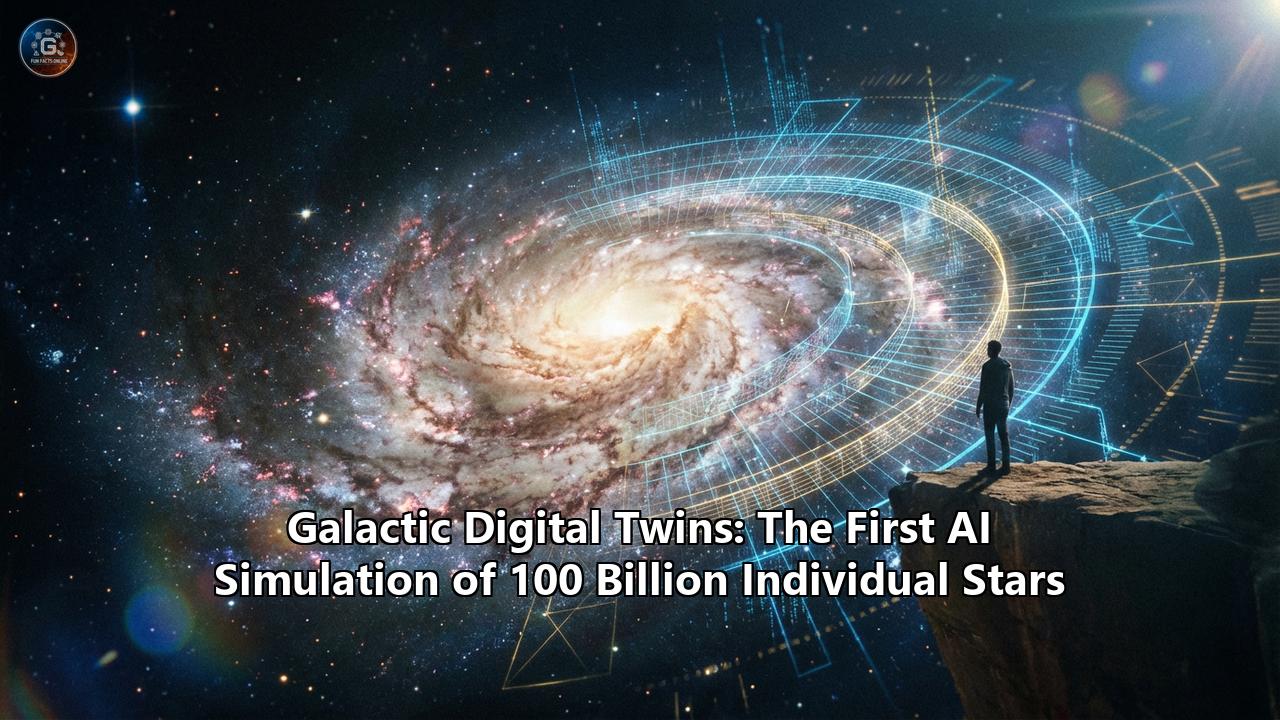
The Milky Way is not merely a splash of light across the night sky; it is a bustling, chaotic, and majestic metropolis of over 100 billion individual stars, each with its own history, trajectory, and destiny. For centuries, astronomers have looked up and mapped these points of light, building catalogs and theories to explain how such a colossal structure came to be. But for the last few decades, computational astrophysicists have harbored a dream that seemed technologically impossible: to not just map the galaxy, but to build one. They dreamed of creating a perfect digital replica—a "Digital Twin"—where every single star is accounted for, tracked, and simulated in real-time physics.
In late 2025, that dream became reality.
A team of researchers led by the RIKEN Center for Interdisciplinary Theoretical and Mathematical Sciences (iTHEMS) in Japan shattered the computational barrier that had held back the field for half a century. Utilizing a revolutionary hybrid of Artificial Intelligence and High-Performance Computing (HPC) on the world-leading supercomputer Fugaku, they successfully ran the first star-by-star simulation of a Milky Way-sized galaxy. This was not a simulation of "star particles" representing thousands of suns, as had been the standard for decades. This was a simulation of 100 billion individual stars.
This achievement marks a turning point not just in astrophysics, but in the history of science. It signals the dawn of the "Galactic Digital Twin" era—a time when we can fast-forward the life of our galaxy, rewind to its violent birth, and peer into the dynamics of stars that have not yet been born.
Part I: The Billion-Body Barrier
To understand the magnitude of this achievement, one must first appreciate the sheer cliff-face of difficulty that researchers have been staring up at for decades. The central problem of galactic simulation is one of scale—specifically, the uncomfortable coexistence of the microscopically fast and the cosmically slow.
The Tyranny of N-Body Physics
At its core, simulating a galaxy is an "N-body problem." You have $N$ objects (stars, gas clouds, dark matter particles), and every single one of them exerts a gravitational pull on every other one. In a pure, brute-force calculation, if you have 100 billion stars, calculating the forces for just a single moment in time requires a number of operations so vast it defies comprehension.
For decades, the solution was compromise. Astrophysicists developed brilliant shortcuts, such as the Barnes-Hut tree algorithm or Particle-Mesh methods, which grouped distant stars into "clumps" to approximate their gravity. This allowed simulations to run, but it came at a cost: resolution.
In the famous simulations of the 2010s, such as Illustris, EAGLE, and Fire, the "particles" on the screen were not stars. They were massive tracer particles, each representing a cluster of tens of thousands, or even millions, of solar masses. When you looked at a simulation of the Milky Way from 2020, you weren't seeing stars; you were seeing a low-resolution pointillist painting, where each dot was a city of stars blurred together.
The Supernova Bottleneck
But gravity wasn't even the biggest problem. The true enemy of the galactic simulation was the supernova.
A galaxy evolves over billions of years. To simulate it, you want to take large "time steps"—jumping forward 10,000 or 100,000 years at a time to see how spiral arms form or how galaxies merge. However, inside that galaxy, individual stars are living fast and dying young. A massive star might live for only a few million years and then explode in a supernova.
This explosion is a violent, intricate event that plays out over mere seconds, days, and centuries. The shockwave from a supernova heats the surrounding gas to millions of degrees, pushing it outward and changing the destiny of the neighborhood. To simulate this accurately, the computer needs to slow down. It cannot jump 100,000 years; it must calculate what happens every few years or even days to capture the explosion's physics.
This created a paradox: To simulate the whole galaxy, you need big time steps. To simulate the stars that drive the galaxy's evolution, you need tiny time steps. If you tried to simulate a whole galaxy with the tiny time steps needed for individual supernovae, the calculation would take longer than the age of the universe.
In a paper presented at the SC '25 (Supercomputing 2025) conference, the RIKEN team estimated that running a star-by-star simulation of the Milky Way using conventional methods would take 36 years of continuous run-time on the world's fastest supercomputers to simulate just 1 billion years of history.
The door to the Digital Twin was locked, and the key was missing.
Part II: The AI Surrogate Revolution
The breakthrough did not come from a faster chip or a bigger computer. It came from a fundamental rethinking of how we compute physics. The team, led by Keiya Hirashima, realized that they didn't need to simulate every single second of a supernova explosion every time it happened. They just needed to know the result of the explosion.
The Deep Learning Surrogate
This is where Artificial Intelligence stepped in, not as a generator of fake data, but as a master of physics compression.
The team built what is known as a "Deep Learning Surrogate Model." First, they ran traditional, extremely high-resolution simulations of just supernova explosions. They simulated thousands of these explosions in exquisite detail, consuming massive computing power to generate a library of "ground truth" data. They taught the computer exactly how gas expands, heats, and pushes outward in the 100,000 years following a blast.
Then, they trained a Neural Network on this data. The AI learned the complex physics of the explosion. It learned that if a star of Mass X explodes in Gas Density Y, the resulting bubble of hot gas will look like Z.
Once the AI was trained, they plugged it into the massive galactic simulation. Now, when a star in the digital Milky Way reached the end of its life, the supercomputer didn't grind to a halt to calculate the explosion equation by equation. Instead, it "asked" the AI: "A star just blew up here. What happens next?"
The AI, recalling its training, instantly predicted the expansion of the gas and the injection of energy into the surrounding medium.
The Speed of Thought
The result was a computational miracle. The "surrogate" model replaced the most computationally expensive part of the simulation with a near-instantaneous inference.
The numbers are staggering:
- Old Method: 315 hours to simulate 1 million years of galactic time.
- New AI Method: 2.78 hours to simulate 1 million years.
This was a speed-up of over 100 times. Suddenly, the 36-year runtime for a billion-year simulation shrank to just 115 days. The "impossible" simulation was now something that could be finished in a single academic semester.
Part III: Building the Digital Galaxy
With the software architecture in place, the team turned to the hardware. The simulation was deployed on Fugaku, the crown jewel of Japanese high-performance computing, alongside the Miyabi system at the University of Tokyo.
7 Million Cores
The scale of the deployment is difficult to visualize. The simulation utilized approximately 7 million CPU cores. To put that in perspective, a high-end consumer laptop has perhaps 8 to 14 cores. The simulation harnessed the power of a million laptops working in perfect synchronization.
Fugaku's architecture, based on the ARM A64FX processor, was uniquely suited for this. Its massive memory bandwidth allowed the system to shuffle the positions and velocities of 100 billion particles without choking. The code, a highly optimized N-body and Hydrodynamics solver, managed the gravitational dance of the stars while the AI handled the explosive feedback of the dying ones.
The Birth of 100 Billion Stars
When the simulation began, it didn't just spawn a static picture of the galaxy. It started with the raw ingredients—clouds of gas and dark matter—and let gravity take the wheel.
On the screens at RIKEN, researchers watched as the gas collapsed. But unlike previous simulations where gas turned into "star particles," here the gas fragmented into individual points of light. One, two, a thousand, a billion. The screen filled with the dust of creation.
The Digital Twin was born. It possessed spiral arms, a central bar, and a dense bulge. But if you zoomed in—past the arms, past the clusters—you would see individual stars. You could pick one out and track it. You could see it drift through a gas cloud, get kicked by the gravity of a passing neighbor, and eventually, perhaps, explode, triggering the AI surrogate to blow a bubble in the virtual gas.
Part IV: Scientific Implications
Why does this matter? Is simulating individual stars just a flex of computing power, or does it unlock new science? The answer lies in the details. The universe is a bottom-up system; small things determine the fate of big things.
1. The Chemical Fingerprint of the Cosmos
One of the holy grails of astronomy is "Chemical Tagging." Every star is a time capsule, preserving the chemical composition of the gas cloud from which it was born.
In the early universe, there were only hydrogen and helium. Heavier elements—carbon, oxygen, iron—were forged in the hearts of stars and sprayed out by supernovae. This means the chemical "flavor" of the galaxy has changed over time.
In the old, low-resolution simulations, this chemical mixing was averaged out. You knew that a region had "more iron," but you couldn't say which stars carried it. In the Galactic Digital Twin, researchers can track the chemical history of specific stars. They can see how a single supernova enriches a nearby cloud, which then collapses to form a second generation of stars with a specific ratio of oxygen to iron.
This allows scientists to compare the simulation directly with data from the Gaia Space Telescope, which is currently mapping the chemical composition of millions of real stars in the Milky Way. If the simulation matches the observation, it validates our theories of how the elements of life—carbon, oxygen—spread through the galaxy.
2. Unraveling the Dark Matter Mystery
Dark matter makes up 85% of the matter in the universe, but it is invisible. We only know it's there because of its gravity. Theories predict that dark matter isn't smooth; it should be clumpy, forming thousands of tiny "sub-halos" swarming around the Milky Way.
However, we don't see thousands of dwarf galaxies. We see only a few dozen. This is the "Missing Satellites Problem."
A star-by-star simulation offers a new way to find these invisible clumps. As a dark matter sub-halo passes through a stream of stars, its gravity should disturb their orbits, creating a "wake" or a gap in the stream. These disturbances are tiny—too small to be seen in a low-resolution simulation. But in a simulation with 100 billion stars, these delicate streams are visible.
Researchers can now use the Digital Twin to predict exactly what these scars look like. They can tell observers: "Look at this specific stream of stars. If you see a gap of this size, it's proof of a dark matter sub-halo of this mass." This turns the Digital Twin into a treasure map for hunting dark matter.
3. The Formation of Globular Clusters
Globular clusters are ancient, dense balls of huge numbers of stars that orbit the galactic center. They are some of the oldest objects in the universe, yet their formation is a mystery. Do they form inside their own dark matter halos? Or are they debris from galaxy collisions?
Previous simulations couldn't resolve the internal dynamics of these clusters. They were just single dots. The RIKEN simulation can resolve the internal structure of these clusters, showing how stars interact, share energy, and sometimes get ejected from the cluster entirely. This could finally settle the debate on where these ancient fossils of the universe came from.
Part V: The Era of Digital Twins
The term "Digital Twin" is borrowed from engineering. In industry, a digital twin is a virtual replica of a jet engine or a wind turbine. Engineers use it to test stress, predict failure, and optimize performance without risking the real hardware.
Applying this concept to a galaxy is a profound philosophical and practical shift.
From Simulation to Twin
A "simulation" is a generic model. It looks like a galaxy. A "Digital Twin" implies a specific fidelity to the observed reality.
With the capability to simulate 100 billion stars, we are moving toward a future where we can input the exact position and velocity of the real stars measured by the Gaia mission and run them forward. We can create a twin of our Milky Way, not just a Milky Way.
This allows for "predictive astrophysics." We can forecast the night sky of Earth 10 million years from now. We can rewind the clock to pinpoint the birth cluster of our own Sun, finding its long-lost siblings that drifted away billions of years ago.
Beyond Astronomy: Earth and Climate
The impact of this technology extends far beyond the stars. The technique pioneered by Hirashima's team—using AI surrogates to replace expensive small-scale physics in a massive system—is the "missing link" for many other fields.
Consider Climate Change modeling. A global climate model is like a galaxy simulation. You have a massive system (the Earth's atmosphere) driven by tiny events (cloud formation, turbulence, raindrop physics). Just as we couldn't simulate individual supernovae, climate scientists struggle to simulate individual clouds in a global model. They have to approximate.
The RIKEN team has explicitly stated that their "AI Surrogate" method is transferable. Climate scientists can train an AI on high-resolution simulations of cloud physics and plug it into a global climate model. This could lead to the first "Cloud-Resolving Digital Twin" of the Earth, vastly improving our ability to predict extreme weather, rainfall patterns, and the long-term effects of global warming.
In this sense, the Digital Twin of the Milky Way is a proving ground for the Digital Twin of Earth.
Part VI: The Future of Discovery
As we look forward, the implications of this breakthrough are dizzying.
The End of the Approximation Era
For as long as computers have existed, science has been the art of approximation. We approximated cows as spheres, galaxies as fluids, and atoms as averages. The "100 Billion Star" simulation signals the end of that era. We are entering the era of Brute Force Precision, enabled by AI.
We are no longer limited to modeling the "average" behavior of a system. We can model the outliers, the rogues, the individual anomalies. In a system of 100 billion, it is often the one-in-a-billion event that changes everything—the single star that wanders too close to a supermassive black hole, the single mutation that starts a pandemic, the single failure point in a global power grid. AI-accelerated simulation gives us the eyes to see these needles in the haystack.
The Ethical and Philosophical Angle
There is also a philosophical dimension. If we can simulate a galaxy with such fidelity that we can track individual stars, how far are we from simulating individual solar systems? And if we can simulate solar systems, what about the planets within them?
While we are light-years away from simulating life or civilizations (the complexity of biology dwarfs the complexity of gravity), this achievement nudges us one inch closer to the "Simulation Hypothesis"—the idea that our own universe might be a Digital Twin in someone else's supercomputer. If we can compress the physics of a supernova into a neural network, who is to say the laws of physics we experience aren't just the efficient inferences of a higher-dimensional AI?
Conclusion: The New Map
For now, the researchers at RIKEN, the University of Tokyo, and their collaborators are content with their virtual galaxy. They have handed humanity a new map. It is not a paper map of static lines, but a living, breathing, evolving model of our cosmic home.
The "Galactic Digital Twin" is a triumph of human ingenuity. It proves that when we hit the hard limits of hardware, we can invent our way around them with software and intelligence. We have built a mirror for the Milky Way, and for the first time, when we look into it, we can see every single star looking back.
Deep Dive: The Tech Behind the Twin
To fully appreciate this milestone, we must explore the "engine room" of the simulation. How exactly does one code a galaxy?
The Hybrid Architecture
The simulation runs on a code that is a hybrid of N-body gravitational solvers and Hydrodynamic Grid solvers.
- Gravity (The N-Body Part): This handles the stars and dark matter. The code uses a "Tree-Particle-Mesh" algorithm.
Long Range: For distant forces (e.g., the pull of the galactic core on a star in the outskirts), the simulation uses a Fourier Transform mesh. It treats the galaxy as a density field, allowing for rapid calculation of global forces.
Short Range: For nearby stars, it uses a "Tree" structure (like an Octree). It groups stars into boxes, then boxes into bigger boxes. If a box is far away, you treat it as one heavy dot. If it's close, you open the box and calculate the force from the stars inside. This reduces the complexity from $N^2$ to $N \log N$.
- Gas (The Hydrodynamics Part): This handles the interstellar medium—the gas clouds. The team uses "Smoothed Particle Hydrodynamics" (SPH) or a mesh-based equivalent. This treats gas as a fluid, calculating pressure, temperature, and density.
- The AI Bridge: This is the novelty. In a standard code, when the gas density gets high enough, the code says "Star Formed." When that star ages, the code says "Supernova."
Standard Way: The code pauses the global timestep. It zooms in on the explosion. It solves fluid equations for the shockwave moving through the gas. This requires timesteps of days. The rest of the galaxy (waiting for million-year updates) sits idle.
The RIKEN Way: The code says "Supernova." The AI activates. It looks at the density and temperature around the star. It infers the outcome after 100,000 years. It paints that outcome directly onto the gas grid. The simulation continues without pausing.
Supercomputer Fugaku
Fugaku is a beast of a machine. Located in Kobe, Japan, it held the title of the world's fastest supercomputer from June 2020 to May 2022. Even today, it remains a top-tier system, specifically famous for its efficiency in real-world scientific applications rather than just synthetic benchmarks.
- Processor: Fujitsu A64FX (48 cores + 4 assistant cores).
- Vector Extensions: It uses SVE (Scalable Vector Extension), allowing it to crunch massive arrays of numbers (like star coordinates) in single gulps.
- Interconnect: The "Tofu Interconnect D" connects thousands of nodes with extremely low latency. This is crucial for gravity. If Star A is on Node 1 and Star B is on Node 10,000, they still pull on each other. The computer needs to send that information instantly.
The Galactic Digital Twin used 148,900 nodes on Fugaku. This effectively turned the entire building-sized computer into a single, coherent brain focused entirely on the Milky Way.
Historical Context: A Timeline of Galactic Simulation
To see how far we've come, we must look back.
- 1941: Erik Holmberg performs the first "simulation" of interacting galaxies using light bulbs. He used the intensity of light to represent gravity (since both follow the inverse square law) and measured the brightness to calculate forces.
- 1970s: The first digital N-body simulations appear, tracking a few hundred stars. They reveal that galaxies are embedded in dark matter halos (the Ostriker-Peebles criterion).
- 1990s: The "Cosmological Constant" era. Simulations like the Virgo Consortium begin to model large chunks of the universe, but galaxies are just blobs.
- 2005: The Millennium Simulation. A landmark simulation of the structure of the universe. It tracked 10 billion particles of dark matter. However, it didn't include gas or stars—it was a "Dark Matter only" skeleton.
- 2014: Illustris. The first major simulation to include complex baryonic physics (gas, stars, black holes) on a large scale. It produced beautiful visual galaxies, but the resolution was still low (mass resolution ~1 million solar masses).
- 2018: IllustrisTNG and EAGLE. Massive improvements in physics and volume. They could simulate thousands of galaxies, but individual stars were still unresolved.
- 2025: RIKEN Star-by-Star Simulation. The Billion-Particle Barrier is broken. Individual stars are resolved in a Milky Way-mass galaxy.
The "Digital Twin" Future in Space Exploration
The timing of this breakthrough is not coincidental. It aligns with a shift in how space agencies like NASA and ESA view data. We are moving from an era of "Observation" to "Modeling."
ESA's Gaia Mission has provided the 3D positions and velocities of nearly 2 billion stars. This dataset serves as the "Initial Conditions" for the Digital Twin. By feeding Gaia data into the RIKEN simulation model, we can create a kinetic model of the actual Milky Way, not just a theoretical one.
This has practical applications for future deep-space travel.
- Navigation: A high-fidelity dynamic map of the galaxy allows for precise navigation of interstellar probes over thousands of years.
- Hazard Avoidance: Understanding the distribution of dust and debris (simulated via the gas hydrodynamics) helps in planning routes for future telescopes that need clear lines of sight.
- Exoplanet Habitability: The simulation tracks the "Galactic Habitable Zone." It can identify stars that have stayed in safe, quiet regions of the galaxy versus stars that have plunged through dangerous supernova-rich spiral arms. This helps us target the search for extraterrestrial life.
Closing Thoughts
The creation of the first 100-billion-star simulation is a technical marvel, but its true beauty is conceptual. It represents the moment when our digital capacity finally caught up with our cosmic ambition.
For thousands of years, humans have tried to hold the universe in their minds. We built stone circles, drew charts, and wrote equations. Now, we have built a mind—a silicon and code mind—large enough to hold the galaxy itself.
As the AI surrogate models improve and supercomputers grow even faster (marching toward the Zettascale era), this Digital Twin will only get sharper. We will soon see not just the stars, but the planets, the moons, and perhaps, eventually, the reflection of our own curiosity looking back at us from the digital void.
The Milky Way is no longer just out there. It is now in here, spinning on the hard drives of humanity, waiting to be explored.
Reference:
- https://www.riken.jp/en/news_pubs/research_news/pr/2025/20251117_2/index.html
- https://orbitaltoday.com/2025/11/20/researchers-create-first-100-billion-star-milky-way-simulation-using-ai/
- https://www.youtube.com/watch?v=koISwYTUXQY
- https://www.illustris-project.org/about/
- https://itaintmagic.riken.jp/hot-off-the-press/millions-of-years-of-galaxy-evolution-simulated-in-mere-months-with-the-help-of-ai/
- https://www.youtube.com/watch?v=70RxWJbes9E
- https://www.mdpi.com/2072-4292/16/16/3023
- https://academic.oup.com/mnras/article/503/3/3113/5919460
- https://universemagazine.com/en/large-scale-space-simulations-have-contributed-to-discovering-a-new-type-of-star-system/
- https://www.kratosspace.com/constellations/articles/how-digital-twins-are-modeling-the-future-of-space
- https://en.wikipedia.org/wiki/N-body_simulation
- https://www.okc.albanova.se/news/leveraging-ai-to-create-a-digital-twin-of-the-universe-1.843463
- https://www.realclearscience.com/2025/11/18/researchers_simulate_the_milky_way_with_a_supercomputer_1148038.html