
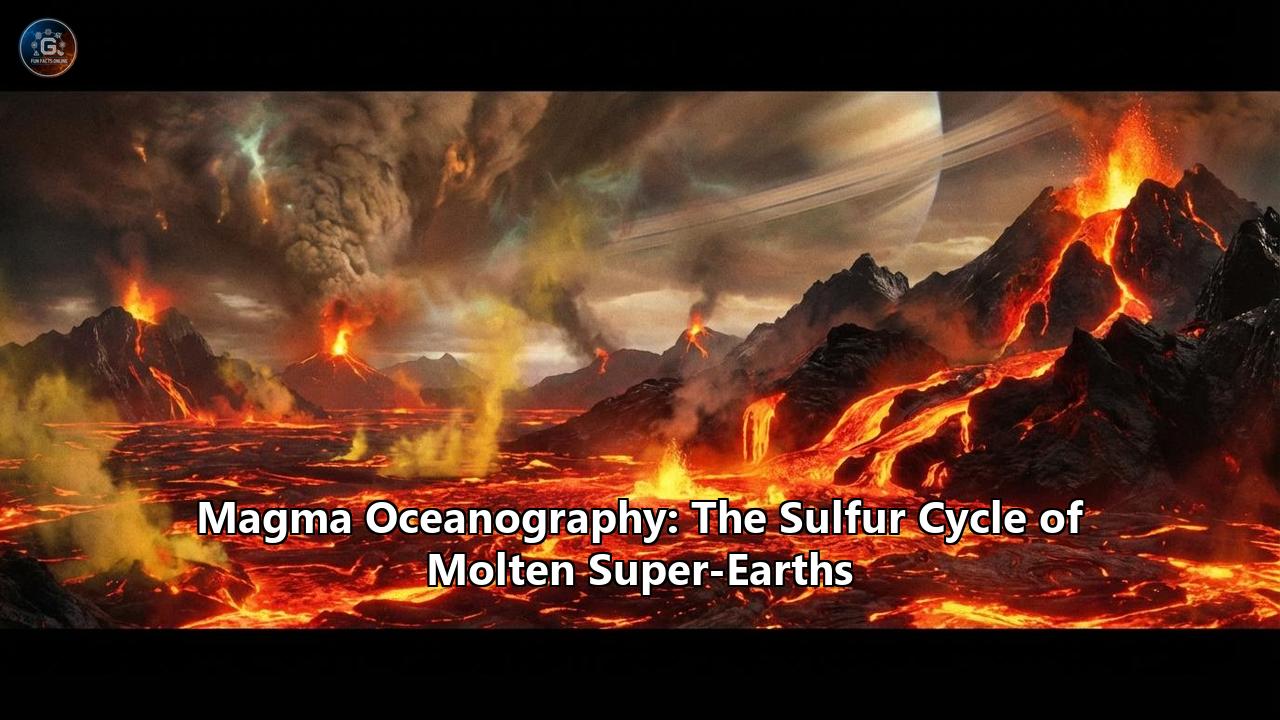
golden age of observational planetary astrophysics, providing the first direct evidence of these molten, sulfurous worlds.
Case Study 1: The Carbon-Smothered Lava of 55 Cancri e
Located approximately 41 light-years from Earth in the constellation Cancer, 55 Cancri e (officially named Janssen) is the archetype of a lava world. It boasts a radius 1.95 times that of Earth and a mass nearly 8.8 times greater, orbiting a Sun-like star at a distance of just 1.4 million miles—completing a year in less than 18 hours. The planet is so close to its star that the stellar disk would appear 70 times wider in its sky than the Sun does from Earth. The dayside temperature reaches a staggering 2,573 Kelvin (roughly 2,300 degrees Celsius).
For years, astronomers debated the nature of Janssen. Was it a bare, stripped rocky core? Did it possess a tenuous atmosphere made entirely of vaporized rock? In 2024, an international team utilizing JWST’s Near-Infrared Camera (NIRCam) and Mid-Infrared Instrument (MIRI) laid the debate to rest. By observing the planet as it slipped behind its star (a secondary eclipse) and measuring the thermal phase curve, the telescope detected the definitive spectral fingerprint of a thick atmosphere rich in carbon monoxide (CO) or carbon dioxide ($CO_2$).
Crucially, the data definitively ruled out the hypothesis of a thin, vaporized rock atmosphere. The measured thermal emission indicated that heat was being efficiently redistributed from the scorching dayside to the nightside—a feat that requires a substantial gaseous envelope. The researchers concluded that this carbon-rich atmosphere could not be a primordial remnant; it would have been blown away by stellar winds long ago. Instead, it is a secondary atmosphere, continuously bubbling out of a global magma ocean. Along with carbon compounds, the spectral data hinted at a complex, noxious mixture lacing the sky, potentially including water vapor, molecular nitrogen, and sulfur dioxide—the very chemical that gives volcanic emissions their characteristic rotten egg smell.
Case Study 2: L 98-59 d and the Stench of a Magma Ocean
If 55 Cancri e provided the first glimpse of a magma ocean's exhalations, the discovery surrounding the exoplanet L 98-59 d brought the sulfur cycle directly into the spotlight.
Orbiting a red dwarf star just 34.6 light-years away in the southern constellation Volans, L 98-59 d has a mass 1.52 times that of Earth and a radius 1.94 times larger. It completes an orbit every 7.5 days. Initially, calculating its density yielded a remarkably low value—between 3 and 3.4 grams per cubic centimeter. This low density led many planetary scientists to hypothesize that L 98-59 d was a "water world," possessing a deep, global ocean of liquid water and ice accounting for a massive portion of its bulk.
However, when an international team of researchers aimed JWST at L 98-59 d to perform transmission spectroscopy—analyzing the starlight filtering through the planet's atmosphere as it transits across its host star—the results were shocking. There was a complete absence of water vapor and carbon dioxide. Instead, the atmospheric spectrum was dominated by overwhelming signatures of sulfur dioxide ($SO_2$) and hydrogen sulfide ($H_2S$).
In a landmark 2026 study, researchers from the University of Oxford utilized intricate computer models—accounting for geochemistry, fluid dynamics, and atmospheric physics—to explain this bizarre composition. They concluded that the "water world" hypothesis was dead. L 98-59 d is, in fact, an intensely volcanic lava world harboring a deep ocean of hot magma.
The low density of the planet is not due to water, but rather an incredibly thick, inflated hydrogen-dominated atmosphere saturated with heavy sulfur compounds. The models deduced that L 98-59 d possesses an astonishing sulfur mass fraction of at least 1.8%—an enormous quantity compared to terrestrial planets in our Solar System.
This abundance of sulfur points to a highly active, planetary-scale sulfur cycle. The intense ultraviolet light from the host red dwarf drives continuous chemical reactions in the atmosphere, creating the observed $SO_2$ and $H_2S$. These gases are then trapped and buffered by the deep magma ocean below, establishing an equilibrium of continuous outgassing and re-absorption. Because the planet formed in a volatile-rich environment in the cooler, outer parts of its stellar system before migrating inward, it retained these heavy elements. Today, the extreme greenhouse effect of its massive, sulfurous gaseous envelope acts as a thermal blanket, trapping heat and ensuring the planet remains almost completely molten for billions of years. If verified by further observations, L 98-59 d represents the smallest known exoplanet with a detected atmosphere, and stands as the ultimate laboratory for studying the exoplanetary sulfur cycle.
The Fluid Dynamics of Magma and Atmospheric Coupling
To fully grasp the mechanics of worlds like 55 Cancri e and L 98-59 d, we must look at the physical behavior of the magma ocean itself. The branch of magma oceanography dealing with fluid dynamics reveals that magma oceans are not uniform pools, but complex systems of stratigraphy and circulation.
Because liquid silicates are highly compressible, the density of the magma increases dramatically with depth. As researchers have found, this compressibility allows a magma ocean to pack more mass into a smaller volume, slightly increasing the bulk density of bare lava worlds without atmospheres. However, on worlds with thick secondary atmospheres, this effect is overshadowed by the sheer volume of the gaseous envelope.
Convection within the magma ocean is driven by the stark temperature contrasts of the tidally locked environment. The hottest magma at the sub-stellar point upwells to the surface, bringing dissolved sulfur and carbon from the deep interior. As it reaches the surface, the pressure drops, and the volatiles fiercely exsolve into the atmosphere. The degassed, slightly cooler, and denser magma then flows horizontally across the surface toward the terminators, where it eventually downwells back into the deep mantle to be reheated and enriched with volatiles once more.
This magma circulation is intimately coupled with atmospheric circulation. The outgassed sulfur dioxide and hydrogen sulfide are quickly caught in equatorial atmospheric jet streams, whipping around the planet at supersonic speeds. The coupling between the atmospheric drag and the surface of the magma ocean can create significant friction, generating planetary-scale waves in the liquid rock. Furthermore, the thick, opaque sulfur hazes generated by UV photochemistry alter the amount of starlight reaching the surface, impacting the magma ocean's cooling rate.
Implications for Planetary Evolution and Habitability
The study of the sulfur cycle on molten super-Earths is not merely an exercise in cataloging extreme environments; it is a vital step in understanding the lifecycle of all rocky planets, including our own.
Every terrestrial planet in our Solar System—Earth, Mars, Venus, and the Moon—is believed to have passed through a magma ocean phase shortly after its formation, following the immense heat generated by planetary accretion and giant impacts. Earth's "Hadean" eon was a time when our world closely resembled L 98-59 d or 55 Cancri e: a molten surface shrouded in a thick, toxic atmosphere of outgassed volatiles.
By observing exoplanets currently in their magma ocean phase, we are witnessing the exact mechanisms that determined Earth's ultimate fate. The sulfur cycle plays a pivotal role in a planet's thermal evolution. High in the atmosphere, sulfate aerosols act as highly reflective mirrors. If an exoplanet outgasses enough sulfur, the resulting global haze layer can drastically increase the planet's albedo, reflecting stellar radiation back into space. This anti-greenhouse effect could theoretically trigger rapid cooling, allowing the magma ocean to crystallize, form a solid crust, and eventually allow water vapor to condense into oceans of liquid water.
Conversely, as seen on L 98-59 d, if the atmosphere is overwhelmingly thick and dominated by hydrogen and sulfur gases, the greenhouse effect traps the internal and external heat. The planet becomes locked in a permanent molten state, a sterile lava world completely hostile to life as we know it, buffering and recycling its volatiles for billions of years without ever cooling down.
The rate at which a magma ocean degasses its volatile inventory dictates the final atmospheric composition of the solidified planet. Recent thermodynamic simulations of magma oceans show that the solubility and degassing of elements like carbon, helium, and sulfur are highly dependent on the pressure and the presence of other gases. When multiple volatile species are present in the melt, they can facilitate each other's escape, leading to profound volatile loss from the magma ocean and the formation of a much thicker, hotter secondary atmosphere than previously thought.
Therefore, the sulfur cycle is not just a quirk of planetary chemistry; it is a determining factor in whether a planet eventually becomes a habitable, temperate world, or remains a permanently scarred, boiling hellscape.
The Future of Magma Oceanography
As we stand in the early years of the JWST era, magma oceanography is rapidly evolving from theoretical speculation into a rigorous, data-driven science. The detection of thick $CO/CO_2$ atmospheres on 55 Cancri e and the violent, sulfur-rich volcanic outgassing on L 98-59 d are just the opening chapters.
Looking ahead, next-generation observatories like the extremely large ground-based telescopes (ELTs) and proposed space missions such as the Large Interferometer For Exoplanets (LIFE) and the ARIEL mission will provide unprecedented resolution. Astronomers will move beyond simply identifying the presence of $SO_2$ and $H_2S$ to measuring the precise isotopic ratios of sulfur in exoplanet atmospheres. Because different atmospheric and geological processes favor different isotopes, mass-independent fractionation of sulfur isotopes will allow scientists to map the precise rates of photochemistry and magma circulation occurring light-years away.
Simultaneously, the discipline relies heavily on high-pressure experimental petrology. Down on Earth, scientists use diamond anvil cells and high-powered lasers to crush and melt microscopic samples of peridotite and basalt to pressures of millions of atmospheres, mimicking the conditions at the bottom of a super-Earth's magma ocean. By studying how sulfur, carbon, and water dissolve in these microscopic synthetic magma oceans, researchers refine the computer models that decode the JWST spectra.
The sulfur cycle of molten super-Earths forces us to expand our definition of planetary science. It demonstrates that the cosmos is fiercely creative, utilizing the same basic elements found in our own backyard to construct worlds of unimaginable violence and complexity. As magma oceanography continues to mature, it will undoubtedly reveal even more astonishing mechanisms by which planets live, breathe, and evolve in the fiery proximity of their stars.
Reference:
- https://pubs.geoscienceworld.org/msa/rimg/article/90/1/323/645015/A-Framework-for-the-Origin-and-Deep-Cycles-of
- https://science.nasa.gov/asset/webb/super-earth-exoplanet-55-cancri-e-artists-concept/
- https://research.open.ac.uk/news/distant-planet-seems-have-sulphur-rich-atmosphere-hinting-alien-volcanoes
- https://www.esa.int/Science_Exploration/Space_Science/Webb/Webb_hints_at_atmosphere_around_rocky_exoplanet
- https://www.sciencealert.com/substantial-atmosphere-detected-on-a-rocky-super-earth-world-for-the-first-time
- https://arxiv.org/html/2405.04057v1
- https://www.researchgate.net/publication/381639103_Degassing_of_CO2_triggers_large-scale_loss_of_helium_from_magma_oceans
- https://www.inverse.com/science/jwst-finds-a-lava-planet-with-a-carbon-dioxide-atmosphere
- https://www.sci.news/astronomy/lava-worlds-12300.html
- https://skyandtelescope.org/astronomy-news/molten-sulfurous-world-blurs-exoplanet-categories/
- https://www.semanticscholar.org/paper/9040b5af0d4f4e496771b08514f9cf59c56aea2b
- https://www.pnas.org/doi/10.1073/pnas.2416190122
- https://universemagazine.com/en/ocean-of-magma-sulfur-rich-atmosphere-hints-at-exoplanets-secrets/
- http://english.gyig.cas.cn/pu/cjog/202104/P020210416318816350573.pdf