
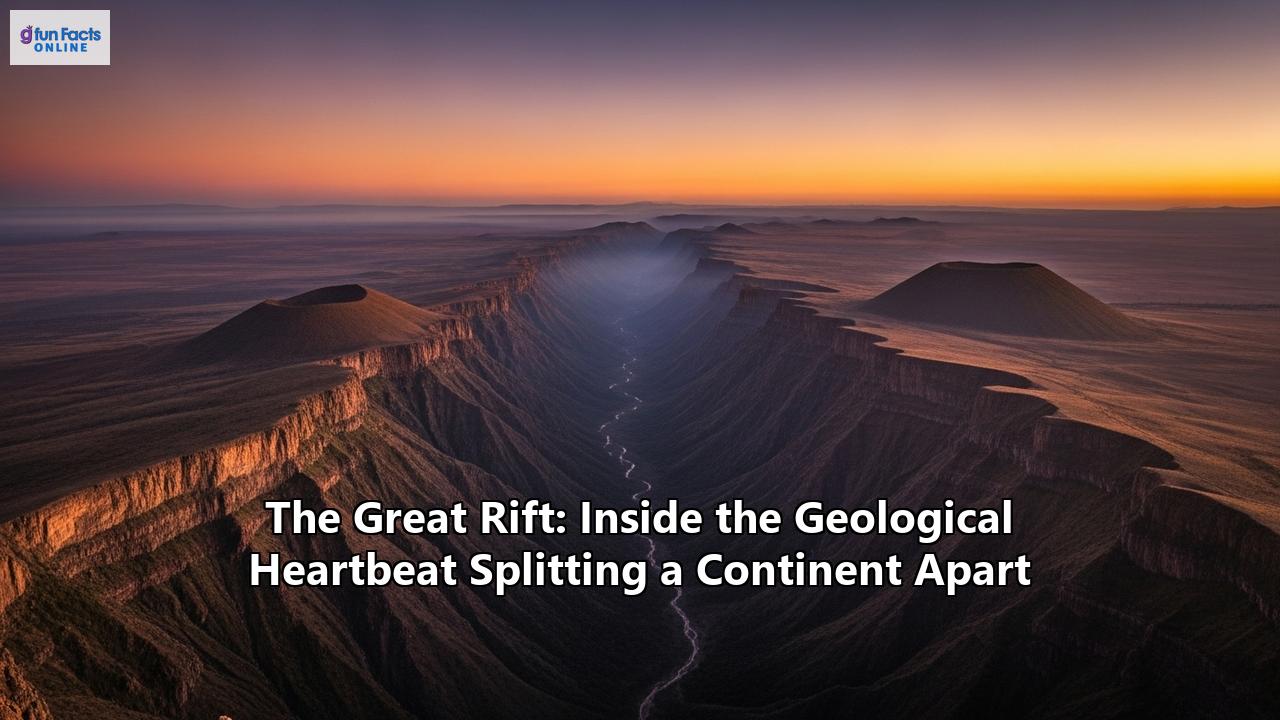
A continent is tearing itself apart. Deep within the Earth's crust, a colossal fracture is splitting Africa in two, a process that will one day birth a new ocean. This monumental geological drama is unfolding in the Great Rift Valley, a sprawling network of valleys, volcanoes, and lakes that stretches over thousands of kilometers, from the Middle East to Southern Africa. This is not a story of sudden cataclysm, but a slow, relentless geological heartbeat, a process that has been shaping the continent for millions of years and providing a unique window into the powerful forces that forge our planet. The East African Rift System (EARS) is more than just a geological curiosity; it is a cradle of humanity, a hotspot of biodiversity, and a dynamic engine of change that continues to shape the destiny of the land and its people.
The Great Unzipping: A Tectonic Tale
The story of the Great Rift Valley is a story of plate tectonics. The Earth's lithosphere, its rigid outer layer, is not a single, seamless shell, but is broken into several large plates that are in constant, slow-motion collision, separation, and friction with one another. The Great Rift is a classic example of a divergent plate boundary, where a continental plate is being stretched and thinned, destined to eventually rupture completely.
The protagonist in this continental split is the African Plate, which is in the process of breaking into two smaller plates: the larger Nubian Plate to the west and the smaller Somalian Plate to the east. These two plates are pulling away from each other at a seemingly leisurely pace of about 6 to 7 millimeters per year. This immense pulling apart of the Earth's crust is the driving force behind the formation of the Great Rift Valley.
The entire rift system forms a distinctive 'Y' shape. The stem of the 'Y' runs southwards through East Africa, while the two arms branch out to the north. One arm forms the Red Sea, and the other, the Gulf of Aden. These two northern arms are more mature stages of rifting, where the continental crust has already completely broken apart and new oceanic crust is forming. The meeting point of these three arms, in the Afar region of Ethiopia, is a geological triple junction, a place of intense volcanic and seismic activity.
The genesis of this great rift began around 22 to 25 million years ago, during the Miocene epoch. However, the forces that initiated this continental sundering are still a subject of scientific debate. The prevailing theory points to the influence of a massive mantle plume, an upwelling of abnormally hot rock from deep within the Earth's mantle. This superplume is thought to have pushed upwards against the African Plate, causing the crust to dome, stretch, and ultimately fracture. The immense heat from the plume also fueled the extensive volcanism that is a hallmark of the region.
The rift doesn't just slice through the African continent indiscriminately. It tends to follow ancient lines of weakness, prehistoric sutures where ancient continental masses collided and fused together billions of years ago. These old scars in the continental crust provide a pre-existing vulnerability, a path of least resistance for the immense tectonic forces to exploit.
A Tale of Two Branches: The Eastern and Western Rifts
As the Great Rift Valley extends southwards from the Afar triple junction, it splits into two main branches that arc around the vast Lake Victoria. This bifurcation is a testament to the complex geology of the region. The rift encountered the ancient and rigid Tanzania Craton, a piece of crust too strong to be torn through. Instead, the rift diverted around this obstacle, creating the distinct Eastern and Western branches.
The Eastern Rift, also known as the Gregory Rift, is the more famous of the two. It carves its way through Ethiopia and Kenya and is characterized by a higher degree of volcanic activity. The valley floor is dotted with a chain of volcanoes, some still active, and a series of shallow, alkaline lakes. The soils in this branch are often fertile Andisols, derived from recent volcanic activity.
The Western Rift, or Albertine Rift, presents a different character. It is less volcanically active but is marked by a series of deep basins that cradle some of the world's deepest lakes, such as Lake Tanganyika and Lake Malawi. The Western Rift is also more seismically active than its eastern counterpart, experiencing larger earthquakes. This branch is bordered by some of Africa's highest mountain ranges, including the Ruwenzori Mountains and the Virunga Mountains, which are themselves a product of the rifting process.
The two branches represent different stages in the evolution of a continental rift. The Eastern Rift, with its intense volcanism, is considered a more mature rift, closer to the point of complete continental breakup. The Western Rift, with its deep, sediment-filled basins, is thought to be in an earlier stage of development.
The Fiery Heart: Volcanoes of the Rift
The Great Rift Valley is a land of fire, a place where the Earth's molten heart breaks through to the surface. The thinning of the continental crust allows magma to rise, feeding a spectacular chain of volcanoes that stretches along the rift. These volcanoes are not just mountains; they are active geological engines that continue to shape the landscape and influence the lives of those who dwell in their shadow.
Among the most famous of the rift's volcanoes is Mount Kilimanjaro, Africa's highest peak. This dormant stratovolcano is actually composed of three distinct volcanic cones: Kibo, Mawenzi, and Shira. While Mawenzi and Shira are extinct, Kibo is merely dormant and could erupt again, though the last major eruption occurred around 360,000 years ago. Its iconic snow-capped peak, a stark contrast to the surrounding savanna, is a powerful symbol of the geological forces at play.
Further north, in Tanzania, lies a volcano of a truly unique nature: Ol Doinyo Lengai, which means "Mountain of God" in the Maasai language. It is the only active volcano on Earth that erupts natrocarbonatite lava, a bizarre, low-temperature magma that is rich in sodium and potassium carbonates. This lava erupts at a relatively cool 600 degrees Celsius and flows with the fluidity of water, appearing black in the daylight and only glowing with a dull reddish hue at night. Its eruptions, recorded since the 1880s, are a constant reminder of the unusual and diverse magmatic processes occurring deep beneath the rift.
In the Democratic Republic of Congo, within the Western Rift, looms the menacing figure of Mount Nyiragongo. This volcano is notorious for its persistent lava lake, a churning cauldron of molten rock in its summit crater. The lava produced by Nyiragongo is exceptionally fluid, and when the crater walls have fractured, as they did in 1977 and 2002, the lava has drained with catastrophic speed, devastating surrounding areas and the nearby city of Goma. The 2021 eruption once again highlighted the immense danger this volcano poses to the dense population living at its base.
The Afar region of Ethiopia is home to Erta Ale, another volcano with a long-lived lava lake that has been continuously active since at least 1967. And in 2008, the Dalaffilla volcano, also in Ethiopia, produced the largest eruption in the nation's recorded history. These are just a few of the many active and dormant volcanoes that line the Great Rift, each a testament to the fiery power simmering just beneath the surface.
A Land in Motion: Earthquakes and the Shaking Continent
Where continents are torn asunder, the ground inevitably shakes. The East African Rift is the most seismically active rift system on Earth today. The constant stretching and faulting of the crust generates a steady stream of earthquakes, ranging from small tremors to powerful, destructive events.
The seismic character of the rift mirrors the differences between its two main branches. The Eastern Rift is characterized by swarms of smaller earthquakes, often associated with the movement of magma in volcanic systems. In contrast, the Western Rift experiences larger and deeper earthquakes, a sign of the immense strain being accommodated by the less volcanically active crust.
History has recorded numerous damaging earthquakes along the rift. In 1910, a magnitude 7.4 earthquake struck the Rukwa region of Tanzania, causing widespread damage. More recently, a magnitude 6.8 earthquake in 2005 caused fatalities and damage in the Democratic Republic of Congo and Tanzania, while a magnitude 7.0 event shook Mozambique in 2006. In 2008, a magnitude 5.9 earthquake struck the Lake Kivu region, causing significant damage and loss of life in the DRC and Rwanda.
These seismic events are a stark reminder of the immense power of the forces at work. As the plates continue to pull apart, stress builds up along the numerous faults that define the rift, and this stress is periodically released in the form of earthquakes. For the millions of people living within the rift, this seismic hazard is a constant and unpredictable reality.
The Cradle of Humanity: Where Our Story Began
The Great Rift Valley is not just a geological marvel; it is the place where the human story began. It is within this dynamic and changing landscape that our earliest ancestors took their first bipedal steps, developed the first tools, and began the long evolutionary journey that led to modern humans.
The geological processes of the rift created a unique environment that was highly conducive to early human evolution. The formation of the rift mountains is thought to have created a rain shadow effect, leading to a drier climate in the east and the replacement of dense forests with open savannas. This environmental shift is believed to have been a key driver in the evolution of bipedalism, as our ancestors adapted to life on the open plains.
The volcanic activity of the rift, while hazardous, also played a crucial role. Volcanic ash, rich in minerals, created fertile soils that supported a diverse range of plants and animals, providing a rich food source for early hominids. The volcanic rocks themselves provided the raw materials for the first stone tools.
The sedimentary basins of the rift, formed by the sinking of the valley floor, provided the perfect conditions for the preservation of fossils. Over millions of years, the remains of our ancestors were buried by layers of sediment and volcanic ash, creating a priceless and unparalleled fossil record.
It is in the Great Rift Valley that some of the most important hominid fossils have been unearthed. In the Olduvai Gorge in Tanzania, Louis and Mary Leakey made a series of groundbreaking discoveries, including the 1.75-million-year-old skull of Paranthropus boisei (dubbed "Nutcracker Man") and the first fossils of Homo habilis, the "handyman," so-named because it was believed to be the maker of the early stone tools found at the site.
In Hadar, Ethiopia, the discovery of "Lucy," a remarkably complete 3.2-million-year-old skeleton of Australopithecus afarensis, provided a wealth of information about one of our earliest upright-walking ancestors. More recent discoveries, such as the 4.4-million-year-old "Ardi" skeleton, also from Ethiopia, continue to push back the timeline of human evolution and refine our understanding of our family tree. These fossil treasures have firmly established the Great Rift Valley as the ancestral homeland of all humanity.
A Tapestry of Life: The Unique Biodiversity of the Rift
The dramatic geology of the Great Rift Valley has given rise to a stunning diversity of ecosystems, making it one of the world's most important biodiversity hotspots. From the volcanic peaks and their montane forests to the vast savannas and the unique aquatic environments of the rift lakes, the region is teeming with life, much of it found nowhere else on Earth.
The lakes of the Great Rift are particularly noteworthy for their unique biodiversity. Many of these lakes are alkaline, with high concentrations of sodium carbonate, creating a harsh environment in which only specialized organisms can thrive. These alkaline waters support massive blooms of algae, which in turn provide food for vast flocks of flamingos, creating one of the most spectacular wildlife spectacles on the planet. The Kenya Lake System, a UNESCO World Heritage site comprising Lakes Bogoria, Nakuru, and Elementaita, is a critical foraging ground for millions of lesser flamingos.
The freshwater lakes of the Western Rift, such as Lake Tanganyika and Lake Malawi, are renowned for their incredible diversity of cichlid fish. These lakes have acted as evolutionary crucibles, with hundreds of species of cichlids evolving in isolation to fill a wide variety of ecological niches.
The terrestrial ecosystems of the rift are equally rich. The savannas are home to the classic African megafauna, including elephants, lions, giraffes, and rhinoceroses. The Ngorongoro Conservation Area in Tanzania, centered on a massive volcanic caldera, boasts one of the densest concentrations of wildlife in Africa. The mountain forests on the slopes of the rift's volcanoes harbor a wealth of endemic plants and animals. The region's conservation areas, such as the Serengeti National Park, are vital for the protection of this incredible biodiversity.
The Rift Today: Living with a Continent in Motion
The geological heartbeat of the Great Rift Valley continues to shape the lives of the millions of people who call this dynamic region home. Living in the rift presents a unique set of challenges and opportunities, a constant interplay between the risks and rewards of a geologically active landscape.
The most immediate risks are posed by volcanic eruptions and earthquakes. The eruption of Mount Nyiragongo in 2002 and again in 2021 demonstrated the devastating impact that these events can have on human settlements, destroying homes, infrastructure, and livelihoods. The ongoing seismic activity is a constant threat, and the high vulnerability of buildings and infrastructure in many parts of the region exacerbates the risk.
But the rift also provides significant benefits. The volcanic soils are highly fertile, supporting agriculture in many areas. The most significant modern benefit, however, lies in the potential for geothermal energy. The same heat from the Earth's mantle that drives the volcanism can be harnessed to generate clean, renewable electricity. Kenya is already a world leader in geothermal energy production, with numerous power plants located within the rift. Ethiopia is also developing its geothermal resources, and the potential for geothermal energy throughout the East African Rift System is estimated to be over 15,000 megawatts. Tapping into this vast resource could transform the energy landscape of the region, providing a stable and sustainable source of power.
The stunning landscapes and abundant wildlife of the Great Rift Valley also make it a major draw for tourism, providing a vital source of income for many communities. National parks and conservation areas attract visitors from around the world, eager to witness the unique geological features and incredible biodiversity of the region.
The Future of the Rift: A New Ocean in the Making
The splitting of the African continent is an ongoing process, and the Great Rift Valley offers a glimpse into the geological future. As the Nubian and Somalian plates continue to pull apart, the rift will continue to widen and deepen. The ultimate fate of the Great Rift Valley is to become a new ocean.
Geologists predict that in 5 to 10 million years, the land within the rift will sink below sea level, and the waters of the Red Sea and the Gulf of Aden will flood the valley, creating a new ocean basin. The eastern part of Africa, including the Horn of Africa, will become a new continent, a large island separated from the rest of Africa by this nascent ocean. Countries like Uganda and Zambia, currently landlocked, could one day find themselves with a new coastline.
This is a process that unfolds over geological timescales, far beyond the scope of human experience. But the evidence of this future is all around us in the Great Rift Valley: in the steaming vents of its volcanoes, the tremors of its earthquakes, and the inexorable, millimeter-by-millimeter widening of the continental fracture. The Great Rift is a living laboratory of plate tectonics, a place where we can witness the awesome power of the Earth's geological engine in action, a power that has not only shaped our planet's past but is actively forging its future. It is a powerful reminder that the ground beneath our feet is not static, but is part of a dynamic, ever-changing world.
Reference:
- https://www.thinkgeoenergy.com/realising-the-geothermal-potential-of-the-east-african-rift-new-report-by-irena/
- https://en.wikipedia.org/wiki/Ol_Doinyo_Lengai
- https://www.mountnyiragongo.com/how-many-times-has-mount-nyiragongo-erupted/
- https://www.mdpi.com/1996-1073/16/4/1656
- https://stellaeenergy.com/geothermal-energy-in-the-east-africa-rift-system
- https://earthobservatory.nasa.gov/images/9164/nyiragongo-volcano-erupts-in-the-congo
- https://www.geolsoc.org.uk/science-and-policy/plate-tectonic-stories/mount-kilimanjaro/
- https://en.wikipedia.org/wiki/2021_Mount_Nyiragongo_eruption
- https://www.bgr.bund.de/EN/Themen/Zusammenarbeit/TechnZusammenarb/Projekte/Abgeschlossen/Afrika/2029_2016-2066-5_RegionalOstafrika_Geothermie_en.html?nn=1548118
- https://www.climbing-kilimanjaro.com/kilimanjaro-geology/
- https://en.wikipedia.org/wiki/Mount_Nyiragongo
- https://www.kilimanjaroparktanzania.com/blog/is-mount-kilimanjaro-still-active/
- https://rafhladan.is/bitstream/handle/10802/5415/UNU-GTP-SC-17-1102.pdf
- https://earthjay.com/earthquakes/20160910_tanzania/Saemundsson_2010_east_africa_rift.pdf
- https://www.encounterstravel.com/blog/great-rift-valley
- https://en.wikipedia.org/wiki/Mount_Kilimanjaro
- https://www.britannica.com/place/Ol-Doinyo-Lengai
- https://www.volcanodiscovery.com/it/lengai.html
- https://roseannechambers.com/volcanoes-and-east-african-rift-roulette/
- https://ingv.it/en/ingv-newsletter-n-7-September-2021-year-xv/nyiragongo-the-eruption-of-one-of-the-most-dangerous-volcanoes-in-the-world
- https://en.wikipedia.org/wiki/East_African_Rift
- https://www.usgs.gov/observatories/yvo/news/lets-go-volcano-safari
- https://earthquake.usgs.gov/earthquakes/eventpage/iscgem908452/region-info
- https://www.researchgate.net/publication/238500985_Earthquakes_along_the_East_African_Rift_System_A_multiscale_system-wide_perspective
- http://www.seismo.org/Share/Projects/SSA-Hazard/Paper/Poggi_etal_BEE_20161219.pdf
- https://www.blackpast.org/global-african-history/rift-valley-east-africa-great-rift-valley/
- https://cosmosmagazine.com/history/archaeology/east-african-fossils-may-be-oldest-modern-human-remains/
- https://www.nhm.ac.uk/discover/homo-habilis-early-maker-stone-tools.html
- https://www.ebsco.com/research-starters/geology/great-rift-valley
- https://www.africanworldheritagesites.org/cultural-places/human-origins.html
- https://www.ultimatekilimanjaro.com/great-rift-valley-everything-you-need-to-know/
- https://library.fiveable.me/key-terms/introduction-world-geography/rift-valley-lakes
- https://museums.or.ke/kenya-lake-system-in-the-great-rift-valley/
- https://www.naturalworldheritagesites.org/sites/kenya-lake-system-in-the-great-rift-valley/
- https://www.wildvoyager.com/blog/the-history-of-great-rift-valley-kenya/