
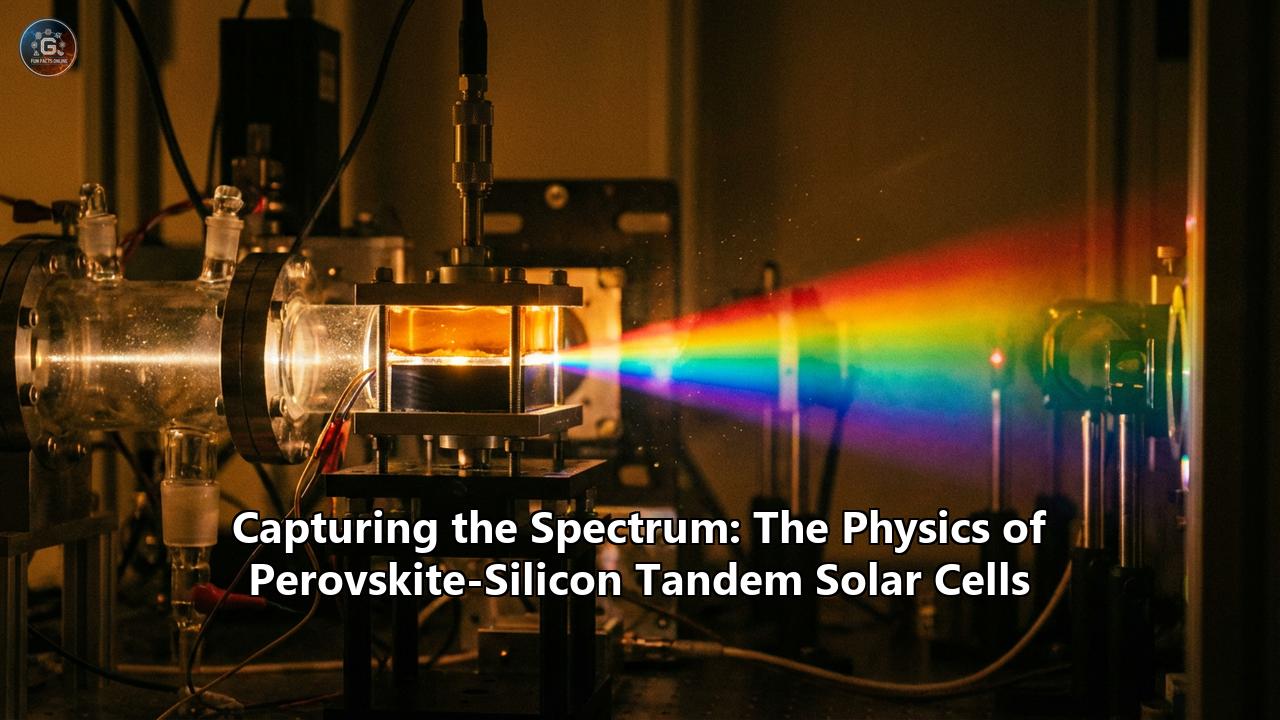
The quest to harvest solar energy has long been defined by a single, fundamental constraint: the Shockley-Queisser (S-Q) limit. For decades, silicon—the workhorse of the photovoltaic industry—has marched steadily toward its theoretical maximum efficiency of roughly 29.4%. Yet, thermodynamics dictates that a single-junction cell can only do so much; it must compromise between absorbing low-energy photons and extracting high-energy photocarriers without thermalization losses. Enter the perovskite-silicon tandem solar cell, a device that does not merely improve upon silicon but fundamentally alters the physics of capture. By stacking a tunable, wide-bandgap perovskite top cell atop a narrow-bandgap silicon bottom cell, scientists are rewriting the rules of solar conversion, pushing efficiencies past the 34% mark and aiming for thermodynamic ceilings previously thought unreachable for flat-plate collectors.
This article explores the intricate physics governing these tandem devices, from the quantum mechanics of tunneling recombination junctions to the thermodynamic subtleties of luminescent coupling and the atomic-scale battles against phase segregation.
I. The Thermodynamic Imperative: Transcending the Single-Junction Limit
To understand the tandem cell, one must first appreciate the "losses" it is designed to recover. In a standard silicon cell ($E_g \approx 1.12$ eV), two primary mechanisms throttle efficiency:
- Transmission Losses: Photons with energy $h\nu < E_g$ pass through the silicon crystal essentially unnoticed, their energy unharvested.
- Thermalization Losses: High-energy photons (e.g., blue or UV light) generate electron-hole pairs with significant kinetic energy. This "hot" excess energy is rapidly lost to the lattice as phonons (heat) within picoseconds, relaxing the carriers to the band edges before they can be extracted.
The tandem architecture addresses this by spectral splitting. A top cell with a wider bandgap (typically $1.68 - 1.75$ eV) intercepts the high-energy photons, extracting them at a higher voltage potential—effectively "saving" the energy that silicon would have wasted as heat. The silicon bottom cell then cleans up the remaining infrared spectrum, operating in its optimal regime.
Theoretical calculations suggest that a dual-junction tandem operating at the detailed balance limit could achieve efficiencies approaching 45%. In practice, recent breakthroughs in 2025 and early 2026, such as those by LONGi and other research consortia, have pushed certified efficiencies to 34.85%, decisively breaking the silicon ceiling.
II. The Heart of the Machine: Physics of the Interconnect
In a monolithic two-terminal (2T) tandem, the perovskite and silicon sub-cells are electrically connected in series. This interface, often less than 100 nm thick, is the most physically complex region of the device. It must act as a "recombination junction"—a paradoxical requirement where charge carriers (electrons from the top cell and holes from the bottom cell, or vice versa) must annihilate each other efficiently and losslessly to maintain current continuity.
1. The Tunnel Recombination Junction (TRJ)
The standard solution is a Tunnel Recombination Junction (TRJ). Physically, this junction relies on quantum mechanical tunneling. When a heavily doped n-type layer ($n^+$) is brought into contact with a heavily doped p-type layer ($p^+$), the depletion width becomes so narrow (often $<10$ nm) that electrons can tunnel directly from the conduction band of the n-side to the valence band of the p-side (or via trap states).
In perovskite-silicon tandems, this is often implemented using nanocrystalline silicon (nc-Si:H) or transparent conductive oxides (TCOs) like Indium Tin Oxide (ITO) or Indium Zinc Oxide (IZO).
- Trap-Assisted Tunneling: Unlike pure Esaki diodes, TRJs in solar cells often rely on defect states within the bandgap to facilitate tunneling. The physics here is a balancing act: you need enough defects to allow high current density without resistance, but not so many that the layer becomes optically opaque or chemically unstable.
- Band Alignment Engineering: The quasi-Fermi levels of the electron transport layer (ETL) of the perovskite and the emitter of the silicon cell must align perfectly. A misalignment of even a few hundred millielectron volts creates a transport barrier, manifesting as an "S-shape" kink in the current-voltage (J-V) curve, destroying the Fill Factor (FF).
2. Quantum Interference Effects
A breakthrough realization in late 2024 and 2025 has been the role of quantum interference in these ultrathin interconnect layers. Recent studies indicate that when the ITO recombination layer is thinned to the scale of the electron de Broglie wavelength, coherent electron transmission can occur. Constructive interference of the electron wavefunction across the junction can effectively lower the tunneling resistance beyond what classical drift-diffusion models predict. This "quantum boost" allows for thinner, more transparent interconnects that reduce parasitic optical absorption without sacrificing electrical connectivity.
III. Optical Physics: The Dance of Photons
In a 2T tandem, the sub-cells are current-matched: the current flowing through the top cell must equal the current flowing through the bottom cell ($J_{top} = J_{bottom}$). If one cell generates less current, it bottlenecks the entire device. This constraint makes the physics of light management critical.
1. Current Matching and Spectral Sensitivity
The solar spectrum changes throughout the day and year. Morning and evening light is "red-rich," favoring the silicon bottom cell. Midday light is "blue-rich," favoring the perovskite top cell.
- The "Blue-Rich" Dilemma: Under blue-rich conditions, the perovskite generates excess carriers. In a strictly series-connected device, these excess carriers cannot be extracted and must recombine. If they recombine non-radiatively (via defects), energy is lost.
- Physics of Textured Interfaces: To maximize absorption in the silicon (which has a lower absorption coefficient than perovskite), the silicon wafers are textured with random pyramids (typically 3-10 $\mu$m in size). This creates a physical challenge: depositing a liquid perovskite precursor solution over these "mountains" requires controlling crystallization kinetics on a microscopic scale. If the perovskite film is too thin at the pyramid tips, shunting occurs; if too thick in the valleys, carrier transport suffers. Recent advances in blade-coating and hybrid evaporation-solution methods have solved this by creating conformal films that maintain uniform thickness perpendicular to the pyramid facets.
2. Luminescent Coupling: The Photon Recycling Bonus
One of the most elegant physical phenomena in high-efficiency tandems is Luminescent Coupling (LC).
When the perovskite top cell is of high quality (low defect density), recombination is primarily radiative. An electron and hole recombine to emit a photon with energy $\approx E_{g,perovskite}$.
- The Mechanism: Instead of escaping the device, this photon travels downwards into the silicon bottom cell. Since silicon has a lower bandgap, it readily absorbs this photon.
- Relaxing Constraints: This acts as a self-regulating valve. If the top cell limits the current (generates more carriers than the bottom cell can match), the "excess" voltage builds up, increasing radiative recombination. These emitted photons boost the current of the bottom cell. Physics models show that strong luminescent coupling effectively softens the hard current-matching constraint, allowing the device to operate closer to its theoretical limit even under spectral mismatch. It effectively transfers the "excess" current from the top cell to the bottom cell via photons.
IV. Material Physics: The Stability Battleground
While the efficiency physics is sound, the material physics of perovskites (specifically organic-inorganic hybrids like $FAPbI_3$) presents a chaotic landscape of ions and lattice instabilities.
1. Ion Migration and Phase Segregation
Perovskites are mixed ionic-electronic conductors. Under the electric field of the p-n junction and illumination, halide ions (Iodine $I^-$ and Bromine $Br^-$) can physically migrate through the crystal lattice.
- The Hoke Effect: In mixed-halide perovskites (used to tune the bandgap to the ideal 1.7 eV), light soaking causes the halides to segregate into iodide-rich and bromide-rich domains.
- The Physics: Iodide-rich domains have a lower bandgap. These domains act as "energy funnels," trapping charge carriers. The voltage of the entire cell effectively collapses to the voltage of these low-bandgap domains, causing a massive loss in open-circuit voltage ($V_{OC}$).
- Solution: This is currently being battled with strain engineering and compositional locking. Adding large cations (like Cesium or Rubidium) or pseudo-halides (like Thiocyanate $SCN^-$) increases the activation energy for ion migration, effectively freezing the lattice in its mixed state.
2. The Atomic Mechanism of Moisture Degradation
Water molecules are the kryptonite of perovskites. Recent in-situ transmission electron microscopy (TEM) has revealed the atomic mechanism: water molecules penetrate the lattice and coordinate with the organic cation (e.g., Methylammonium or Formamidinium). This weakens the hydrogen bonding holding the octahedra cages together. The lattice collapses, reverting to a photo-inactive "yellow phase" (non-perovskite $\delta$-phase) and lead iodide ($PbI_2$).
- Passivation Physics: Modern record-breaking cells employ Self-Assembled Monolayers (SAMs) (e.g., carbazole-based molecules like 2PACz) at the interfaces. These molecules chemically anchor to the oxide surface and present a hydrophobic tail to the perovskite, physically blocking water ingress and chemically passivating surface defects that would otherwise catalyze degradation.
V. Manufacturing Physics: From Lab to Fab
Scaling these devices involves distinct physical challenges.
- Thermal Budget: The silicon bottom cell (often a Heterojunction or TOPCon cell) contains temperature-sensitive passivation layers (amorphous silicon). The perovskite fabrication process, particularly the annealing step, must stay below $\approx 200^{\circ}C$ to avoid damaging the bottom cell.
- Solvent Engineering: As perovskites are typically solution-processed, the solvent (e.g., DMF, DMSO) must be removed to crystallize the film. On a large, textured wafer, non-uniform evaporation leads to Marangoni flows, creating thickness variations. "Solvent quenching" or vacuum-flash techniques are used to freeze the liquid film into a solid state instantly, bypassing these fluid dynamic instabilities.
VI. Conclusion: The Path to 40%
The physics of perovskite-silicon tandem solar cells is a convergence of quantum mechanics, photonics, and solid-state chemistry. We are moving from the era of "discovering" these materials to "engineering" them at the atomic level.
- Future Frontiers: The next leap involves all-perovskite tandems (removing silicon entirely) or triple-junctions (Perovskite/Perovskite/Silicon) which could theoretically breach 50%.
- Energy Yield: Beyond STC (Standard Test Conditions), the physics of these cells favors real-world energy yield. Their superior temperature coefficient (they lose less efficiency as they get hot compared to silicon) and the benefits of luminescent coupling mean that for every rated Watt, a tandem module produces more kilowatt-hours over a year than a standard module.
As we stand in 2026, the question is no longer if the physics works, but how robustly we can package these delicate quantum processes into a module that survives 25 years on a rooftop. The spectrum has been captured; now it must be tamed.