
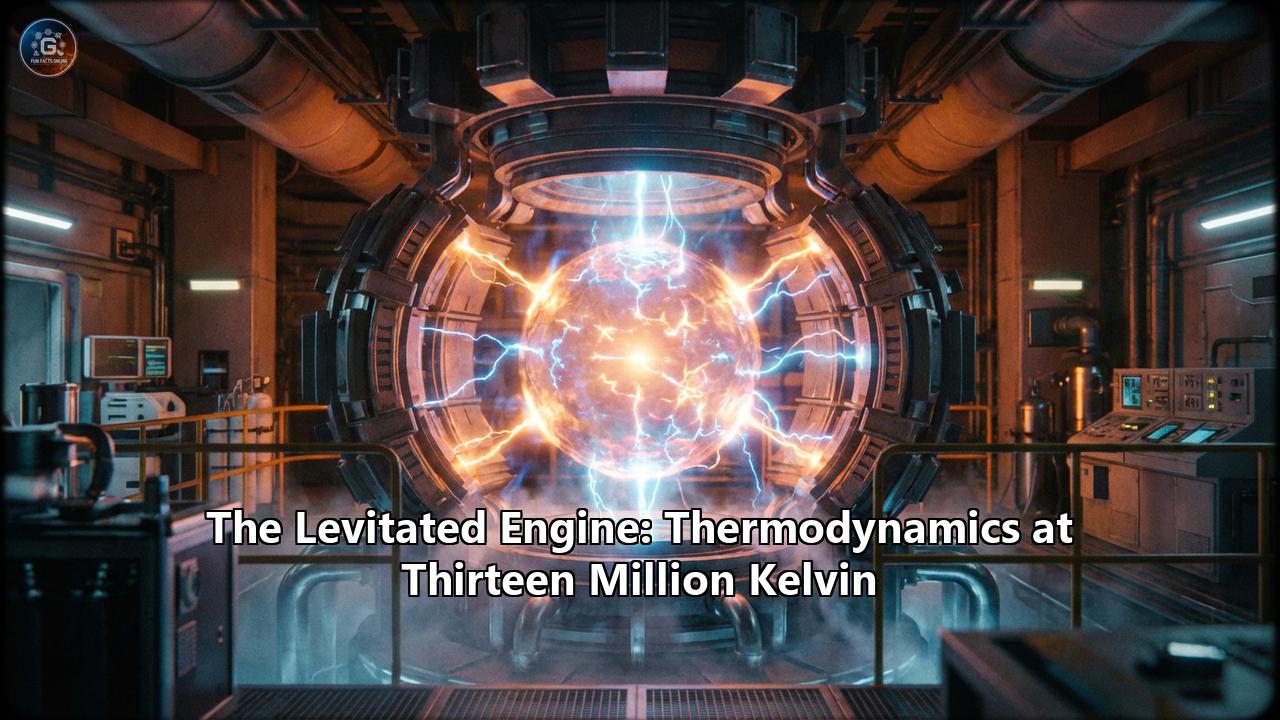
I. The Impossible Fire
In a quiet laboratory at King’s College London, inside a vacuum chamber roughly the size of a shoebox, a speck of glass is screaming.
To the naked eye—if you could see it—the five-micrometer silica sphere appears motionless, suspended in the nothingness of a high vacuum. It is a ghost, hovering without visible support, held in place not by threads or pillars, but by the invisible fingers of an oscillating electric field. It is a "levitated engine," a machine composed of a single particle.
But if you were to touch it, you would feel nothing but the cool indifference of room-temperature glass. Its internal lattice is calm; its atoms are vibrating at a leisurely 300 Kelvin. Yet, if you were to measure the motion of this sphere—the sheer violence with which it thrashes against its invisible cage—and translate that kinetic energy into thermal units, the thermometer would shatter.
Thirteen million Kelvin.
This is the temperature of the deep stellar core, the crucible where hydrogen fuses into helium to light the universe. It is a temperature that should vaporize glass, strip electrons from nuclei, and turn matter into plasma. Yet, here it is, contained within a microscopic bead that is arguably the coldest "sun" ever created.
This paradox is the heart of the Levitated Engine, a frontier of physics where the rigid laws of thermodynamics begin to blur, bend, and seemingly break. This is not a story about a new rocket thruster or a power plant, though the implications for both are profound. It is a story about the fundamental nature of heat, the definition of an "engine," and what happens when we isolate matter so perfectly that it forgets it is part of our universe.
II. The Architecture of Nothingness
To understand the Levitated Engine, one must first understand the art of holding onto nothing. For centuries, the study of thermodynamics was the study of contact. Steam engines worked because hot gas pushed against a piston. Car engines worked because explosions drove a crankshaft. Heat was transferred by conduction, convection, and radiation, always involving materials touching other materials.
But contact is a thief. It steals energy through friction; it leaks heat through conduction. To build the ultimate thermodynamic system, one must sever the connection to the physical world. One must levitate.
The device used to achieve the thirteen-million-degree state is known as a Paul Trap, named after Wolfgang Paul, who won the Nobel Prize for its invention in 1989. In its simplest form, it consists of four metal rods or a ring electrode geometry. By applying a rapidly oscillating voltage to these electrodes, a saddle-shaped electric field is created.
Imagine a saddle. If you place a ball in the middle, it will roll off to the sides. But if you spin the saddle fast enough, the ball gets trapped, unable to fall off because the "downhill" slope is constantly becoming an "uphill" slope before the ball can react. The Paul Trap does this with electric potential. It creates a dynamic stability, a sweet spot where a charged particle—or in this case, a charged glass bead—can float indefinitely.
In the experiment at King's College London, led by physicist Dr. James Millen, the glass nanosphere is loaded into this trap. The air is pumped out until the pressure drops to a billionth of an atmosphere. At this level of vacuum, the sphere is virtually alone in the universe. It collides with a stray air molecule perhaps once every few milliseconds. It is thermally isolated to a degree that is impossible in the macroscopic world.
This isolation is the key. In a car engine, the burning fuel heats the metal block, the coolant, and the air around it. The temperature of the "working fluid" (the gas) and the "body" (the engine block) tend to equilibrate. But in the Levitated Engine, the "body" is the internal crystal lattice of the silica, and the "working fluid" is the center-of-mass motion of the sphere itself. Because there is no air to transfer heat between the two, they can exist at wildly different temperatures.
The researchers injected chaos into this system. They added a noisy, random electrical signal to the trapping electrodes. This "active noise" acted like a heat bath, kicking the sphere randomly in all directions.
The sphere responded. It began to jitter. As the amplitude of the noise increased, the jitter became a frenzy. The sphere was effectively being bombarded by an electrical storm, mimicking the bombardment of gas molecules in a furnace. By carefully tuning the properties of this noise, the researchers drove the center-of-mass motion to a kinetic energy equivalent to 13 million Kelvin.
The bead was now a schizophrenic object: a solid, cool piece of glass possessing the movement of a fusion plasma.
III. The Thermodynamics of the Ghost
Why call this an "engine"?
In classical thermodynamics, a heat engine is a device that takes thermal energy from a hot reservoir, converts some of it into work, and dumps the rest into a cold reservoir. The efficiency of this process is governed by the Carnot limit, a harsh ceiling imposed by the Second Law of Thermodynamics.
The levitated sphere is a Stochastic Heat Engine. It is an engine made of probability.
In this microscopic realm, the "hot reservoir" is the electrical noise making the particle jitter. The "cold reservoir" is the damping force—the feedback cooling or the residual gas molecules that try to slow it down. The "work" is the energy the particle gives up to the system as it moves against the electric fields.
What makes this engine fascinating is that it operates on the scale of fluctuations. A V8 engine doesn't care if a single gasoline molecule hits the piston a little harder than another; it averages out over trillions of collisions. But for the levitated nanosphere, every "kick" matters.
At 13 million Kelvin, the sphere enters a regime of Active Matter. It behaves less like a passive rock and more like a living thing, or a "hot" swimmer. The researchers found that by modulating the trap—squeezing and relaxing the electric field—they could extract work from this chaotic motion, forming a thermodynamic cycle (compression, heating, expansion, cooling) just like a diesel engine.
However, because the "temperature" is artificial (synthesized by electrical noise), the engine exhibits behaviors that would be considered magic in the macro world.
1. Efficiency Violations (Transient):For brief moments, the Levitated Engine can appear to exceed the Carnot efficiency. This doesn't break the laws of physics; it exploits the statistical nature of the Second Law. The Second Law states that entropy statistically increases. For a steam engine, the odds of entropy decreasing are effectively zero. For a single nanoparticle, the odds are small but measurable. The levitated engine can occasionally "get lucky," borrowing energy from thermal fluctuations to perform more work than it "should," provided it pays the debt back later.
2. Negative Friction:In the active bath of the Paul trap, the particle can experience effective negative drag. Instead of the environment slowing it down, the environment (the noise) pumps energy into it, accelerating it further. This is the mechanism that allows the temperature to skyrocket to millions of degrees.
3. The decoupling of T_internal and T_center-of-mass:This is the most alien concept. If you heated a real car engine to 13 million degrees, it would be a cloud of plasma. The Levitated Engine survives because it stores its energy in a single degree of freedom: its position in space. The energy does not "leak" into the vibrational modes of the glass atoms (phonons) because the coupling is incredibly weak. It is a "holographic" heat—real in terms of dynamics, illusory in terms of material state.
IV. The Cousins of the Levitated Engine: Dipoles and Fusion
While the 5-micron bead is the current record holder for this specific type of "effective" temperature, the concept of the Levitated Engine has a massive, high-stakes cousin in the world of nuclear energy: The Levitated Dipole Experiment (LDX).
If the glass bead is a study in thermodynamic theory, the LDX is a study in survival.
Fusion energy—the dream of replicating the sun on Earth—usually involves the Tokamak, a donut-shaped reactor that uses magnetic fields to confine plasma at 100 million Kelvin. In a Tokamak, the magnets are wrapped around the outside of the donut.
But nature has a different way of holding high-temperature plasma. Look at Jupiter. Look at the Earth. These are "dipoles." They have a magnetic field that loops out from the center, like the lines of a bar magnet. High-energy particles in the Van Allen radiation belts are trapped by these fields, bouncing back and forth between the poles.
In the early 2000s, a joint team from MIT and Columbia University asked a radical question: What if we built a fusion reactor that looked like a planet?
They built the LDX. To recreate a planetary field, they needed a magnet inside the plasma. But you can't have supports holding the magnet up; the supports would melt instantly in the fusion fire, and they would conduct heat away, cooling the plasma (the "thief of contact" again).
The solution? Levitate the reactor core.
The LDX features a half-ton, donut-shaped superconducting magnet made of Niobium-Tin. Before the experiment begins, this magnet is cooled to cryogenic temperatures (4 Kelvin) using liquid helium. Then, it is energized with a massive electrical current.
Once the magnet is charged, the supports are withdrawn. A second, attractive magnet on top of the chamber catches the donut, lifting it into the air. The result is a half-ton superconductor floating freely inside a vacuum chamber.
Surrounding this floating ring, the researchers inject gas and heat it with microwaves. The gas turns into plasma and gets trapped by the magnetic field of the floating donut.
Here, the "Levitated Engine" concept scales up. The floating magnet is thermally isolated. It is a cold object (4 Kelvin) surrounded by a hellscape of hot plasma (millions of Kelvin). If it touches anything, the experiment ends.
The LDX demonstrated a phenomenon called "turbulent pinching." In most reactors, turbulence is bad; it causes plasma to leak out. In the Levitated Dipole, turbulence actually packs the plasma tighter, increasing the density and pressure near the core. It works like a thermodynamic pump, naturally organizing the chaos of the plasma into a dense, hot engine.
While the LDX was shut down due to funding shifts toward Tokamaks, it remains the ultimate macroscopic example of a Levitated Engine: a system where the working fluid (plasma) and the mechanical structure (the magnet) are physically decoupled, allowing for extreme thermodynamic separation.
V. The Active Matter Revolution
Returning to the microscopic scale, the 13-million-degree glass bead is part of a broader revolution known as Active Matter.
Passive matter is a rock rolling down a hill. It moves because gravity pulls it. Active matter is a bird flying, a bacteria swimming, or a nanobot crawling. It moves because it burns energy internally to generate force.
The Levitated Engine at King's College London is a simulator for active matter. By programming the electrical noise, researchers can make the glass bead behave like a frantic bacterium or a molecular motor.
This is crucial because biology is, in essence, a heat engine that ignores the rules we are used to.
Inside your cells, protein motors called kinesin walk along microtubule highways, hauling cargo. They operate in a "thermal storm." To a kinesin molecule, the water molecules surrounding it are bombarding it like cannonballs. It shouldn't be able to walk in a straight line; it should be buffeted randomly.
Yet, kinesin works. It is a "Brownian Ratchet." It uses the random thermal noise to its advantage, rectifying the chaos into directed motion.
The 13-million-degree experiment allows physicists to study this "rectification" at extreme limits. By creating a "noise bath" that is millions of times more energetic than room temperature, they can test the limits of how much work can be extracted from chaos.
Can we build a computer that runs on heat noise?
Conventional computers fight heat. Heat is the waste product, the enemy that melts processors. But in the realm of the Levitated Engine, heat is the fuel. The concept of Thermodynamic Computing suggests that we could build logic gates that use thermal fluctuations to flip bits, guiding the noise rather than fighting it. The levitated bead, which turns noise into directed vibration, is a primitive logic gate of this type.
VI. The Quantum Limit: Freezing the Fire
The most ironic twist in the story of the Levitated Engine is that to understand the heat, we must freeze it to zero.
The 13 million Kelvin figure is a measure of "center-of-mass" energy. But what happens if we do the opposite? What if we use the electric fields not to shake the particle, but to slow it down?
This is the field of Cavity Optomechanics. Instead of electric fields, researchers often use lasers. When a laser beam hits a glass bead, it exerts "radiation pressure." By carefully tuning the laser, you can create an "optical tweezer" that traps the bead.
If the bead tries to move left, the laser pushes it right. If you do this with a feedback loop—measuring the bead's position and adjusting the laser power in real-time—you can apply a "friction" that doesn't exist in nature. You can drain the kinetic energy out of the bead.
In recent years, teams in Vienna, Zurich, and London have managed to cool the motion of a levitated nanosphere down to the Quantum Ground State.
This is the opposite of the 13 million degree engine. This is a temperature of almost absolute zero (micro-Kelvin). At this state, the bead stops behaving like a classical object and starts behaving like a quantum wave. The "engine" stops running.
Why is this important? Because it creates a bridge between the two worlds.
We can take a particle, cool it to the quantum ground state (zero entropy), and then suddenly hit it with the "13 million degree" noise sequence. We can watch, in real-time, how a quantum system becomes a classical thermodynamic system. We can watch the "birth of heat."
This is one of the deepest questions in physics: How does the smooth, reversible world of quantum mechanics turn into the messy, irreversible world of thermodynamics? The Levitated Engine is the stage where this transition plays out.
VII. The Future: Engines of the Void
The technology of levitated thermodynamics is moving from curiosity to utility. The "13 Million Kelvin" experiment was a proof of concept, but the applications are dazzling.
1. The Dark Matter Detector:A particle levitated in a vacuum is the most sensitive sensor imaginable. Because it is touching nothing, it has almost zero friction. If a stray wave of Dark Matter—the invisible substance that makes up 85% of the universe's mass—were to nudge it, the sphere would recoil. Researchers are currently designing levitated sensor arrays to "listen" for the wind of Dark Matter passing through the Earth.
2. The Micro-Gyroscope:Navigation systems in deep space or underwater require precise gyroscopes. A levitated spinning nanosphere can rotate at millions of RPM with zero friction. It is a gyroscope that never drifts, potentially allowing for navigation without GPS.
3. The Heat-to-Electricity Converter:The principles of the stochastic heat engine could be applied to "energy harvesting." Imagine a device that floats inside a hot exhaust pipe, levitated by magnetic fields, converting the random thermal noise of the gas directly into electricity without any moving parts touching the walls. It would be an un-wearable engine.
4. Testing Gravity:We still don't know if gravity is a quantum force. To test this, we need to put a heavy object (like a glass bead) into a quantum superposition (being in two places at once) and see if its gravitational field is also in two places at once. This requires levitation. You cannot superpose a rock sitting on a table because the table "measures" the rock's position. A levitated rock, isolated in a dark vacuum, can dream of being in two places.
VIII. The Philosophy of the Levitated Engine
The Levitated Engine challenges our anthropocentric view of the universe. We are creatures of contact. We touch, we push, we burn. Our engines are brutalist machines of steel and fire.
But the universe, at its fundamental level, is a lonely place. Atoms are mostly empty space. Galaxies are separated by millions of light-years of void. The "natural" state of matter is isolation, not contact.
The experiment at King's College London, where a speck of dust roars with the energy of a star while remaining frozen to the touch, is a glimpse into this deeper reality. It teaches us that "temperature" is not a single number, but a story—a narrative about how energy is distributed across the modes of a system.
It teaches us that an engine need not be a heavy block of iron. It can be a probability distribution, a song of electrical noise played to a lonely sphere in the dark.
In the end, the Levitated Engine is a paradox wrapped in a vacuum:
It is the hottest object in the room, yet it cannot burn you.
It is an engine, yet it has no pistons.
It is a solid, yet it flows like a plasma.
It is stuck in a box, yet it is the freest object on Earth.
As we peer closer at that vibrating speck of glass, dancing its 13-million-degree ballet, we are looking at the future of machines—machines that are lighter than air, hotter than stars, and powered by the very noise of existence.
Reference:
- https://www.youtube.com/watch?v=yut6r-zD1h8
- https://www.scribd.com/document/942203116/Physics-Article
- https://www.scribd.com/document/490342939/DepEd-EASE-Modules-Physics-Combined-1
- https://www.sciencenews.org/article/hottest-engine-levitated-glass
- https://www.gadgets360.com/science/news/microscopic-heat-engine-reaches-13-million-c-without-burning-9497017
- https://www.nationalacademies.org/read/11211/chapter/4
- https://files01.core.ac.uk/download/37961369.pdf
- https://www.researchgate.net/publication/300342119_Experimental_opto-mechanics_with_levitated_nanoparticles_towards_quantum_control_and_thermodynamic_cycles_Presentation_Recording