
Part I: The Quantum Dead End and the Error Paradox
The Promise and the WallFor decades, the promise of quantum computing has hung over the technological world like a mirage. We have been told that these machines will solve the unsolvable, cracking encryption codes in seconds that would take classical supercomputers millennia, designing new life-saving drugs in days rather than decades, and unlocking the secrets of materials that could reverse climate change. The theory is sound. The mathematics is impeccable. But the reality has been a frustrating slog through a swamp of noise and errors.
This is the "Error Paradox" of quantum computing. To make a quantum computer useful, you need qubits (quantum bits) that can maintain their delicate quantum state—a property known as coherence—long enough to perform complex calculations. However, qubits are notoriously fragile. The slightest vibration, the faintest whisper of a magnetic field, or a stray photon can cause a qubit to "decohere," collapsing its quantum state and destroying the information it holds.
To combat this, physicists developed Quantum Error Correction (QEC). The idea is similar to how classical computers handle errors: redundancy. In your laptop, if a bit flips from a 0 to a 1 due to cosmic rays, the system has backup bits to check and correct it. In the quantum world, however, the laws of physics—specifically the "No-Cloning Theorem"—prevent us from simply copying a qubit. Instead, we have to entangle a single "logical" qubit across hundreds or even thousands of physical qubits to detect and correct errors without measuring the state directly (which would also destroy it).
Here lies the paradox: To build a useful quantum computer, you need millions of physical qubits to create just a few thousand logical, error-corrected qubits. But adding more physical qubits increases the noise and the control complexity, which in turn requires even more error correction. It is a vicious cycle. Current superconducting and trapped-ion qubits—the leading technologies from companies like Google and IBM—are trapped in this scaling nightmare. Building a machine with enough physical qubits to do useful work would require a device the size of a football field, consuming the energy of a small city, just to keep the error correction running.
Enter the MajoranaInto this impasse steps a ghost from the history of physics: the Majorana fermion. First theorized in 1937 by the brilliant and enigmatic Italian physicist Ettore Majorana, this particle is unique in the standard model of physics because it is its own antiparticle. For 80 years, it was a mathematical curiosity, a "what if" scribbled in notebooks.
But for Microsoft, it became the Holy Grail. While the rest of the industry rushed to build noisy, error-prone qubits using superconducting loops (transmons) or floating ions, Microsoft placed a lonely, high-stakes bet on a completely different approach: topological quantum computing.
The idea was seductive in its elegance. instead of fighting errors with massive redundancy, why not build a qubit that is immune to errors by its very nature? If you could split an electron into two separated Majorana zero modes (MZMs) and encode information non-locally between them, local noise—like a jittering atom or a magnetic fluctuation—could not corrupt the data. The information wouldn't be "here" or "there"; it would be shared topologically between the two ends of a nanowire. To destroy the information, the noise would have to affect both ends of the wire simultaneously, an event so unlikely it is practically impossible.
This is the "Majorana Chip." It promises to solve the Error Paradox not by correcting errors, but by preventing them. It is a technology that could compress the timeline of quantum utility from decades to years. But it is also a technology that has been plagued by controversy, "false dawns," and retracted scientific papers.
Now, with the unveiling of the "Majorana 1" chip, Microsoft claims to have finally done it. They claim to have engineered a new state of matter—a "topoconductor"—and trapped these elusive particles on a chip the size of a fingernail. If they are right, the quantum age truly begins now. If they are wrong, it is one of the most expensive scientific dead ends in history.
Part II: The Physics of the Impossible
The Enigma of Ettore MajoranaTo understand the chip, we must understand the particle. Ettore Majorana was a genius on par with Newton or Einstein. He barely published anything, preferring to write his discoveries on cigarette packs and then throw them away. In 1937, he proposed a solution to the Dirac equation that allowed for a fermion (a matter particle) to be its own antiparticle. Shortly after, he bought a boat ticket from Naples to Palermo, sent a cryptic note to his family, and vanished. He was never seen again.
His particle, however, refused to disappear. In the vacuum of space, we have yet to definitively find a fundamental Majorana particle (though neutrinos are strong candidates). But in the messy, complex world of condensed matter physics—the physics of solids, liquids, and crystals—strange things can happen. Under the right conditions, billions of electrons can dance together in a way that simulates a Majorana fermion. These are called "quasiparticles." They aren't fundamental particles like protons, but collective excitations that behave exactly like them.
Topological Protection: The Donut and the Coffee CupThe magic of the Majorana qubit lies in topology. Topology is the branch of mathematics that deals with properties that don't change when you stretch or twist an object. To a topologist, a donut and a coffee cup are the same thing because they both have one hole. You can squish a clay donut into the shape of a coffee cup without tearing it. But you can't turn a donut into a ball without closing the hole. The "hole" is a topological invariant.
In a Majorana nanowire, the quantum information is stored topologically. Imagine a piece of string. If you tie a knot in it, that knot is a robust feature. You can shake the string, twist it, or stretch it, and the knot remains. The only way to remove the knot is to cut the string or untie it from the ends. Local perturbations—shaking the middle of the string—do nothing to the knot.
In the Majorana 1 chip, the "knot" is formed by the arrangement of Majorana zero modes at the ends of a nanowire. The quantum state (the 0 or 1) is encoded in the parity of the electrons shared between these separated modes. Because the modes are far apart (in atomic terms), a local noise source affecting one end cannot "read" or "flip" the information because the information isn't there—it's delocalized. This is Topological Protection. It means you don't need thousands of physical qubits to error-correct one logical qubit. The physical qubit is the logical qubit (or very close to it).
Non-Abelian Statistics and the Dance of BraidingThe most mind-bending aspect of Majorana particles is how they process information. In our 3D world, all particles are either bosons (like photons) or fermions (like electrons). If you swap two identical bosons, nothing happens. If you swap two identical fermions, the quantum wavefunction picks up a minus sign, but the state remains essentially the same.
Majoranas are "non-Abelian anyons." This means they don't follow the commutative laws of mathematics (where A x B = B x A). If you swap two Majorana particles—a process called braiding—you don't just get the same state back. The act of swapping them fundamentally transforms the information they hold.
Imagine three particles in a line: A, B, and C. If you swap A and B, then B and C, you get a different result than if you swap B and C, then A and B. The order of the swaps matters. The history of their movement is recorded in the "knot" of their world-lines (their path through space and time).
To perform a calculation on a Majorana chip, you don't fire microwave pulses at the qubits like you do with transmon qubits. Instead, you "braid" them. You move the Majorana modes around each other on the chip, tying their world-lines into complex knots. The calculation is the knot. The answer is the final state of the knot.
This is a revolutionary concept because the calculation depends only on the topology of the braid—did particle A go around particle B? Yes or no. It doesn't matter if particle A wobbled a bit, or if it went fast or slow. As long as the braid is completed, the calculation is perfect. This is the "digital" nature of topological quantum computing, contrasting sharply with the "analog" nature of other quantum approaches where every slight fluctuation in voltage ruins the computation.
Part III: The Machine – Inside Majorana 1
The TopoconductorThe heart of Microsoft's breakthrough is a material stack they call a "topoconductor." It is not found in nature; it must be grown, atom by atom, in a vacuum.
The recipe sounds like alchemy. You take a nanowire made of a semiconductor, Indium Arsenide (InAs), which has strong "spin-orbit coupling" (an interaction between the electron's spin and its motion). You then coat it with a superconductor, Aluminum (Al). When you cool this hybrid wire to near absolute zero and apply a precise magnetic field along its length, a miracle occurs. The superconductivity from the aluminum "leaks" into the semiconductor (the proximity effect), and the interplay of the magnetic field and spin-orbit coupling forces the electrons into a topological phase.
At the very ends of this wire, the mathematics dictates that the electron wavefunctions must split, leaving a "half-electron"—a Majorana Zero Mode—isolated at each tip.
Hardware Architecture: The "Hashtag"The Majorana 1 chip doesn't look like a traditional processor. It consists of these nanowires arranged in geometric patterns, often resembling hashtags or ladders. This arrangement allows the Majorana modes to be moved. You can't physically drag a quasiparticle through the wire. Instead, you use a series of "piano key" gates—tiny electrodes underneath the wire.
By applying voltage to these gates, you can change the potential energy landscape of the wire. You can effectively "push" the Majorana mode along the wire, or even move it onto a perpendicular wire (a T-junction). This is how the "braiding" is physically realized. It’s like a sliding tile puzzle, where the tiles are the quantum bits.
Digital Control vs. Analog NightmareOne of the most significant claims Microsoft makes about Majorana 1 is the shift from analog to digital control.
- The Competitors (Analog): In a superconducting quantum computer (like IBM's), to perform a gate, you must send a microwave pulse of a very specific frequency, duration, and amplitude. If the pulse is 0.001% too strong, the gate is slightly wrong. These errors accumulate.
- Majorana 1 (Digital): In the topological approach, you simply apply a voltage to move the Majorana. The voltage doesn't need to be perfect; it just needs to be "on" enough to move the particle. It is effectively a digital switch. You are either braiding or you are not. This drastically simplifies the control electronics. Instead of racks of expensive microwave generators, you can use simple voltage sources. This is a massive advantage for scaling.
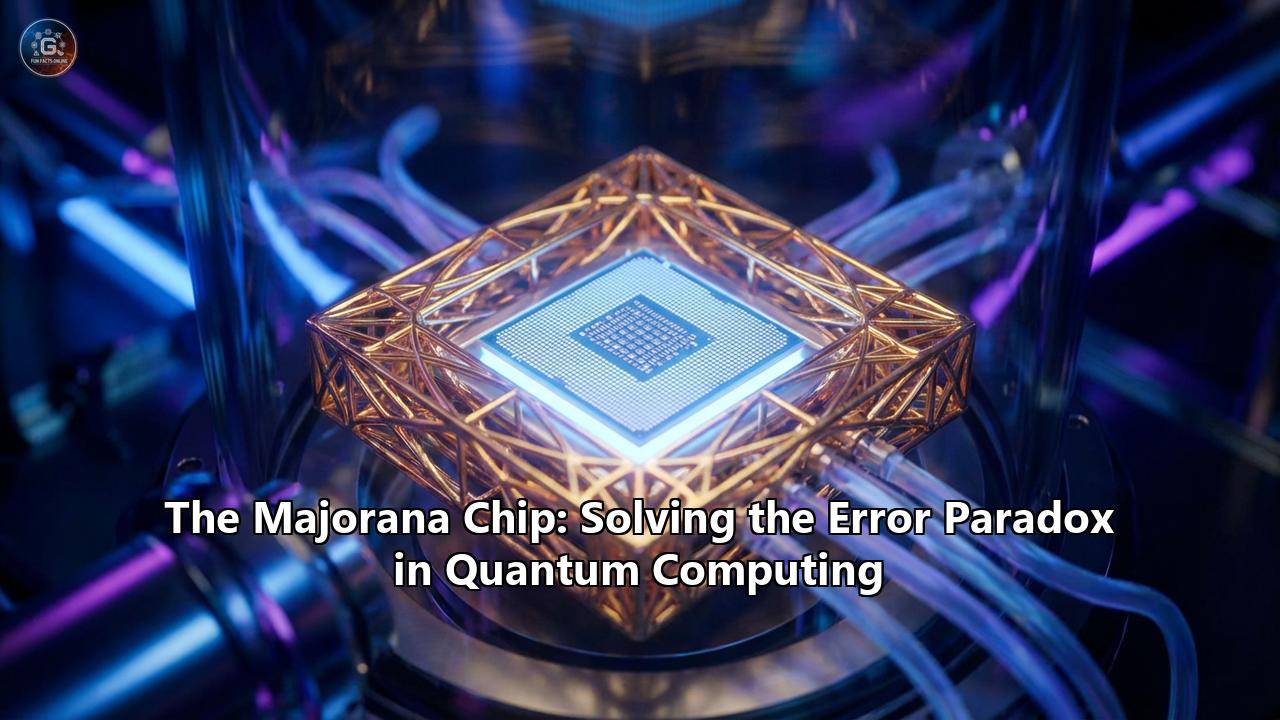
The chip sits at the bottom of a dilution refrigerator, a gold-plated chandelier of cooling loops that brings the temperature down to roughly 10 millikelvin (colder than deep space). Inside this fridge, the Majorana 1 chip is shielded from all external noise. But unlike other systems that need thousands of wires running out of the fridge to control the qubits (which leaks heat in), the digital nature of Majorana 1 allows for multiplexing and simpler control lines, keeping the "thermal budget" manageable even as the qubit count grows.
Part IV: The Controversy and the Skeptics
The Ghost of 2018You cannot tell the story of the Majorana chip without addressing the elephant in the room: the retractions.
In 2018, Microsoft researchers led by Leo Kouwenhoven published a blockbuster paper in the journal Nature. They claimed to have observed "quantized Majorana conductance"—the smoking gun signature of the elusive particle. The physics community celebrated. Microsoft's stock in the quantum race skyrocketed.
But soon, other physicists began to look closer at the data. Sergey Frolov from the University of Pittsburgh and Vincent Mourik from UNSW (both former colleagues of the Delft team) noticed inconsistencies. They found that the data in the paper had been "cherry-picked." Experimental runs that contradicted the conclusion had been excluded. Under immense pressure, the authors released the full raw data, and the conclusion collapsed. In 2021, the paper was officially retracted. It was a massive embarrassment for Microsoft and a blow to the credibility of the entire field.
The "Topological Gap Protocol" DebateFast forward to the present. Microsoft is no longer relying on simple conductance peaks. They have developed a rigorous checklist called the Topological Gap Protocol (TGP). This is a set of criteria that a device must pass to be certified as "topological." It involves measuring the energy gap (the protection barrier) and ensuring it is stable across a wide range of magnetic fields and voltages.
Microsoft claims their new InAs-Al hybrid devices have passed this protocol with flying colors. They argue that the TGP is the most stringent test ever applied to a quantum device.
However, the skepticism remains intense. Critics like Henry Legg and the vocal Sergey Frolov argue that the TGP itself is flawed. They suggest that "trivial" (non-topological) states—like Andreev bound states, which mimic Majoranas but offer no protection—can also trick the protocol. They argue that the protocol is too sensitive to the "tuning" of parameters; if you change the range of the magnetic field in the analysis, the "pass" can turn into a "fail."
The criticism is blunt: "Extraordinary claims require extraordinary evidence." After the 2018 debacle, the physics community is essentially saying, "Show us a qubit that works. Don't show us a conductance plot. Show us a braid. Show us an actual calculation."
Microsoft acknowledges this burden of proof. The Majorana 1 announcement is their answer. They are effectively saying, "We are done with just plotting graphs. We have built a chip. We are going to run a braid."
Part V: The Software Stack – Azure Quantum Elements
Hybrid High-Performance Computing (HPC)While the hardware battle rages, Microsoft has been quietly building a formidable software empire. They realized early on that a quantum computer will never work in isolation. It will always be a co-processor, working alongside massive classical supercomputers.
This is Azure Quantum Elements. It is a cloud platform that integrates:
- HPC: Massive classical computing power for simulation.
- AI: Models trained on physics data to approximate quantum calculations.
- Quantum: The actual quantum hardware (eventually Majorana 1, currently partner hardware like IonQ and Quantinuum).
A key part of this stack is the integration of Generative AI. Microsoft has trained "Copilot for Science" on millions of chemistry and physics papers. A researcher can ask, "Design a molecule that captures carbon but is stable at 50 degrees Celsius." The AI will propose candidates. Then, the system uses classical HPC to screen these candidates. Finally, for the few molecules where the classical simulation fails (because the electron interactions are too complex), the system will farm that specific calculation out to the quantum chip.
This "hybrid loop" is the future of scientific discovery. It doesn't wait for a perfect quantum computer; it uses whatever quantum capacity is available to augment classical methods.
The "1 Million Qubit" RoadmapMicrosoft's roadmap is aggressive.
- Level 1 (Foundational): Where we are now. Noisy intermediate-scale quantum (NISQ) systems.
- Level 2 (Resilient): Reliable logical qubits. This is what Majorana 1 targets.
- Level 3 (Scale): A quantum supercomputer.
They argue that because their topological qubits are smaller (microns vs millimeters for some other types) and require less error correction overhead (10-100 physical qubits per logical qubit vs 1,000-10,000 for transmons), they can fit one million qubits on a single wafer-sized chip.
If true, this is the "Moore's Law" moment for quantum. While competitors are struggling to wire up 1,000 qubits, Microsoft is designing lithography masks for a million.
Part VI: The Future – What Can a Majorana Chip Do?
If the Majorana 1 chip works as advertised, the implications are staggering. A fault-tolerant, million-qubit machine is not just a faster computer; it is a different kind of tool. It is a simulator of nature itself.
1. The Nitrogen Fixation Holy GrailSynthetic fertilizer production (the Haber-Bosch process) consumes about 2% of the world's energy supply. It requires high heat and pressure to break the triple bond of nitrogen. Yet, bacteria in the soil do this at room temperature using an enzyme called nitrogenase.
We cannot simulate nitrogenase on classical computers because the electron exchange in its active site is too complex. A Majorana quantum computer could map this process perfectly. If we can learn how to catalyze nitrogen fixation at room temperature, we could slash global carbon emissions and revolutionize agriculture.
2. Carbon Capture MaterialsWe need materials that can suck CO2 out of the air efficiently. Current amines are too expensive or energy-intensive to regenerate. A quantum computer could simulate millions of potential Metal-Organic Frameworks (MOFs) to find one with the perfect "binding energy"—strong enough to grab CO2, but weak enough to let it go when we want to store it.
3. The "Self-Healing" WorldMicrosoft executives often speak of "self-healing materials." Imagine concrete that patches its own cracks or polymers that regenerate after being cut. These properties depend on complex molecular chain reactions that are governed by quantum mechanics. Designing them is currently trial and error. With a topological computer, it becomes an engineering problem.
4. The End of RSA EncryptionIt must be mentioned: a stable million-qubit machine will break RSA encryption (Shor's Algorithm). This is the "Y2Q" (Year 2 Quantum) threat. However, the same machine can help design Post-Quantum Cryptography (PQC) standards. It is a race between the shield and the sword.
Conclusion: The Gamble of the Century
The story of the Majorana Chip is one of the most dramatic narratives in modern science. It has everything: a mysterious disappearing genius, a "miracle" particle, a trillion-dollar corporation, a scandal of retracted science, and a promise to save the world.
Microsoft is alone on this path. Google, IBM, Rigetti, and Amazon have all chosen different, "safer" routes. They are building the vacuum tubes of the quantum age—big, hot, and unreliable, but they work. Microsoft is trying to skip straight to the transistor.
If the Majorana 1 chip fails—if the "topological gap" turns out to be another mirage, or if the braiding operations are too difficult to control—Microsoft will have wasted billions of dollars and decades of research. They will be left behind as the rest of the world slowly perfects the brute-force method of error correction.
But if it works...
If it works, the Error Paradox dissolves. The resource overhead vanishes. We will go from struggling with 100 qubits to scaling to millions in a few years. The "Quantum Age" will arrive not with a whimper, but with a sudden, thunderous crack—the sound of a topological knot being tied, solving problems that have plagued humanity for centuries.
We are watching the turn of a card. The stakes are the future of computation. And for now, the Majorana is still Schrödinger’s cat: both a revolutionary breakthrough and a theoretical ghost, waiting for the box to be opened.
Reference:
- https://www.nokia.com/blog/topological-quantum-computing-the-quest-for-a-quality-qubit/
- https://azure.microsoft.com/en-us/blog/quantum/2025/02/19/microsoft-unveils-majorana-1-the-worlds-first-quantum-processor-powered-by-topological-qubits/
- https://quantum.microsoft.com/en-us/insights/education/concepts/topological-qubits
- https://insidehpc.com/2025/02/toward-a-million-qubits-microsoft-says-quantum-chip-based-onnew-state-of-matter/
- https://scitechdaily.com/a-million-qubits-within-reach-as-microsoft-redefines-quantum-computing/
- https://bernardmarr.com/microsofts-quantum-moonshot-just-became-reality-inside-the-revolutionary-majorana-1-chip/
- https://gilkalai.wordpress.com/2025/02/21/majorana-zero-modes-and-topological-qubits/
- https://en.wikipedia.org/wiki/Microsoft_Azure_Quantum
- https://www.microsoft.com/en-us/research/blog/microsoft-has-demonstrated-the-underlying-physics-required-to-create-a-new-kind-of-qubit/
- https://www.semanticscholar.org/paper/Braiding-Majorana-zero-modes-in-spin-space%3A-from-to-Luo-He/48ac89ac556e6b8a15cb49267e03ccddd3f01c7d
- https://www.youtube.com/watch?v=l4mZM0RUMdU
- https://topocondmat.org/w2_majorana/braiding.html
- https://medium.com/@sahin.samia/microsofts-majorana-1-a-new-era-in-quantum-computing-fc9fcee5d909
- https://www.youtube.com/watch?v=rOyfI1Fgb1g
- https://torontostarts.com/2025/04/19/microsoft-quantum-computer-criticism/
- https://retractionwatch.com/2021/03/08/authors-retract-nature-majorana-paper-apologize-for-insufficient-scientific-rigour/
- https://news.microsoft.com/source/features/innovation/microsofts-majorana-1-chip-carves-new-path-for-quantum-computing/
- https://redmondmag.com/articles/2023/06/22/azure-quantum-elements-private-preview.aspx
- https://www.forbes.com/sites/moorinsights/2024/10/02/microsoft-azure-quantum-accelerating-discovery-in-the-quantum-age/