
Introduction: The Crisis in Cosmology and the Need for a New Ruler
We live in an expanding universe. This fundamental truth, discovered nearly a century ago by Edwin Hubble, serves as the bedrock of modern cosmology. Yet, in the last decade, this bedrock has developed a fracture. It is a crack in our understanding that has grown from a minor statistical annoyance into a full-blown crisis known as the "Hubble Tension."
The problem is deceptively simple: the universe is expanding, but we cannot agree on how fast. When cosmologists look at the early universe—using the pristine light of the Cosmic Microwave Background (CMB) released just 380,000 years after the Big Bang—and project forward using our standard model of physics, they predict an expansion rate (the Hubble Constant, $H_0$) of approximately 67.4 kilometers per second per megaparsec (km/s/Mpc).
However, when astronomers measure the expansion rate of the local universe directly—by observing pulsating stars and exploding supernovae in nearby galaxies—they consistently find a faster rate, hovering around 73 km/s/Mpc.
These two numbers do not match. The difference is about 8%, and the statistical significance of this discrepancy has reached a level where it can no longer be dismissed as bad luck or measurement error. It suggests that either our measurements are flawed in subtle, undetected ways, or our fundamental model of the universe—encompassing dark matter, dark energy, and gravity itself—is missing a crucial piece.
Enter Time-Delay Cosmography.
This technique acts as a completely independent arbiter in this cosmic dispute. It does not rely on the "distance ladders" of local stars, nor does it depend on the assumptions of the early universe model. Instead, it turns the universe’s most massive structures into giant, intergalactic clocks. By watching how gravity bends and delays light from distant quasars and supernovae, astronomers can measure the scale of the universe directly.
This is the story of how a theoretical curiosity from 1964 became one of the most powerful tools in modern astrophysics, capable of measuring the heartbeat of the cosmos with unprecedented precision.
Part 1: The Cosmic Telescope
General Relativity and the Bending of Light
To understand time-delay cosmography, we must first look through the lens of Albert Einstein’s General Theory of Relativity. Published in 1915, this theory revolutionized our understanding of gravity, describing it not as a force, but as a curvature of spacetime caused by mass and energy.
One of the theory's first predictions was that light itself would follow these curves. When a photon passes near a massive object—like a star, a galaxy, or a cluster of galaxies—it does not travel in a straight line. Instead, it follows the curved path of spacetime, much like a marble rolling around the rim of a bowl.
Gravitational Lensing
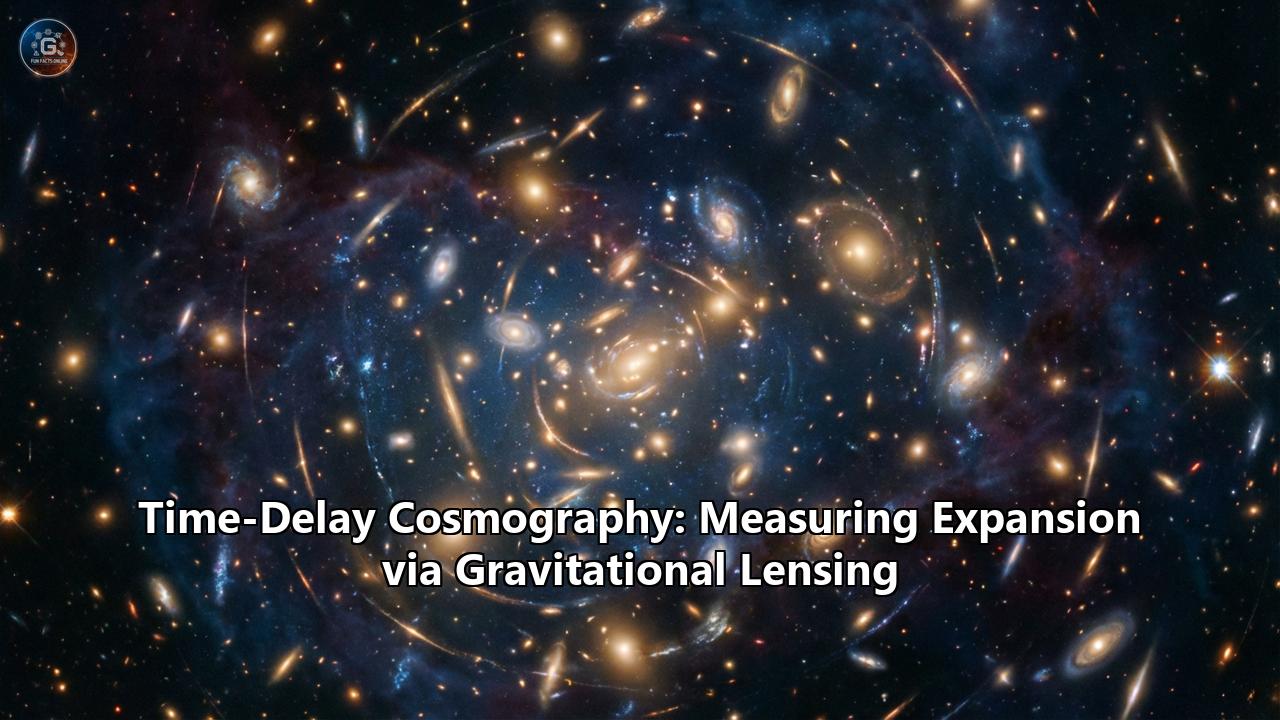
When a massive galaxy sits directly between Earth and a distant light source (like a quasar), this curvature acts like a giant glass lens. It bends the light from the background source, focusing it toward us. This phenomenon is called gravitational lensing.
Unlike a glass lens, which focuses light to a single point, a gravitational lens is complex. The mass of a galaxy is not distributed evenly; it is a mix of stars, gas, and a vast halo of invisible dark matter. Depending on the alignment and the mass distribution, this "cosmic lens" can distort the background source into arcs, rings (the famous "Einstein Rings"), or—crucially for cosmography—multiple images.
In these cases, we see the same quasar appearing in two, three, or four different places in the sky around the foreground galaxy. These are not different objects; they are mirages—ghostly duplicates of the same object, created because the light has taken multiple different paths around the intervening galaxy to reach our telescopes.
Part 2: The Tick-Tock of the Universe
Refsdal’s Insight (1964)
In 1964, a Norwegian astrophysicist named Sjur Refsdal proposed a brilliant idea. He realized that because the multiple images of a lensed quasar travel along different paths, the light along those paths must travel different distances.
Furthermore, the light does not just travel through empty space; it travels through the deep gravitational well of the lensing galaxy. According to General Relativity, time passes slower in a strong gravitational field (a phenomenon known as gravitational time dilation).
Therefore, the arrival time of a photon is affected by two factors:
- Geometric Delay: The path length difference. One route around the galaxy is physically longer than the other.
- Gravitational (Shapiro) Delay: The light traveling closer to the dense center of the galaxy is "slowed down" more by the deeper gravitational potential than the light traveling along the outskirts.
Refsdal realized that if the background source were to change in brightness—if it flickered—we would see that flicker happen at different times in each of the multiple images.
Imagine a distant quasar flares up. The light from that flare races toward Earth along four different paths.
- Image A arrives first.
- Image B arrives 10 days later.
- Image C arrives 15 days later.
- Image D arrives 30 days later.
These time delays are directly related to the physical size of the lens system. If the universe were small, the distances involved would be short, and the time delays would be measured in minutes. If the universe were vast, the distances would be huge, and the delays would be measured in years.
By measuring these time delays and modeling the mass of the lens, Refsdal showed that we could calculate the absolute distance to the lens and the source. And with absolute distance, we can calculate the expansion rate of the universe: the Hubble Constant ($H_0$).
The "Time-Delay Distance"
The quantity measured by this method is called the Time-Delay Distance ($D_{\Delta t}$). It is a combination of three angular diameter distances:
- Observer to Lens ($D_d$)
- Observer to Source ($D_s$)
- Lens to Source ($D_{ds}$)
The relationship is roughly:
$$ \Delta t \propto D_{\Delta t} \times (\text{Fermat Potential Difference}) $$
The "Fermat Potential" describes the geometry and mass distribution of the lens. If we can measure the time delay ($\Delta t$) and we can reconstruct the Fermat Potential (by mapping the mass of the galaxy), we can solve for $D_{\Delta t}$. Since $D_{\Delta t}$ is inversely proportional to $H_0$, this gives us the expansion rate.
Part 3: The Observational Challenge
Turning Refsdal’s theory into reality took decades. It requires a convergence of high-precision data from the world's best telescopes. The process involves three distinct, Herculean tasks.
1. The Monitoring Campaign (The "Movie")
To measure the time delay, astronomers must catch the "flicker." Quasars—active galactic nuclei powered by supermassive black holes—are naturally variable. They brighten and dim unpredictably as they consume matter.
However, these variations are not sharp flashes; they are slow, random meanderings in brightness. To detect the time shift between images, astronomers must monitor the lens system every few days for years.
This was the mission of COSMOGRAIL (COSmological MOnitoring of GRAvItational Lenses). Using a network of small, robotic telescopes across the globe, they stared at lensed quasars night after night, building up "light curves" that span over a decade. By sliding these light curves over each other until they match, they can pinpoint the time delay with precision often better than 3%.
2. The Lens Modeling (The "Map")
Knowing the time delay is useless if you don't know the path the light took. This requires a precise map of the lens galaxy's mass.
This is difficult because most of the mass is invisible Dark Matter. Astronomers use the Hubble Space Telescope (HST) to take sharp, high-resolution images of the distorted arcs of the quasar host galaxy. These arcs form a "fingerprint" that is extremely sensitive to the mass distribution of the lens. By using complex computer algorithms to reverse-engineer the distortion, they can reconstruct the mass profile of the foreground galaxy.
3. Stellar Kinematics (The "Speed")
There is a catch. A fundamental ambiguity exists in gravitational lensing known as the Mass-Sheet Degeneracy (MSD).
Imagine you have a lens model that fits the data perfectly. If you take that mass distribution and add a uniform "sheet" of mass on top of it (scaling the density profile), the image positions remain exactly the same, but the time delays change. This degeneracy allows for a range of possible $H_0$ values, limiting the method's precision.
To break this degeneracy, astronomers need a third piece of data: the speed of the stars inside the lens galaxy.
Stars orbiting within the galaxy feel the gravitational pull of the total mass (baryonic + dark matter). By measuring the velocity dispersion of these stars—how fast they are buzzing around—using powerful spectrographs on telescopes like Keck in Hawaii or the Very Large Telescope (VLT) in Chile, astronomers can "weigh" the galaxy independently of the lensing. This anchors the mass model and breaks the degeneracy.
Part 4: The Major Players and Recent Results
H0LiCOW and TDCOSMO
The modern era of time-delay cosmography has been defined by the H0LiCOW collaboration ($H_0$ Lenses in COSMOGRAIL's Wellspring). Led by Sherry Suyu and others, this team set the standard for rigorous "blind" analysis.
In a blind analysis, the researchers conceal the actual $H_0$ value from themselves during the data processing. They optimize their models and check for errors without ever seeing the final answer. Only when they are confident that all systematics are accounted for do they "unblind" the result.
In 2019, H0LiCOW released results from six lensed quasars. Their measurement was:
$H_0 = 73.3 \pm 1.7$ km/s/Mpc.This result was a bombshell. It agreed almost perfectly with the local distance ladder (Supernovae/Cepheids) and was in strong tension (over 3$\sigma$) with the Planck CMB results ($67.4$). It suggested that the tension was real—that the universe really is expanding faster than early-universe physics predicts.
The Evolution: TDCOSMO
Recognizing the importance of the result, the community expanded. H0LiCOW merged with other groups (STRIDES, SHARP) to form TDCOSMO.
They began to scrutinize their assumptions, particularly regarding the mass profile of galaxies. Were they assuming that galaxies follow a specific mathematical shape (like a power-law density profile) that might bias the result?
In 2020 and continuing through 2025, TDCOSMO relaxed these assumptions. They allowed the galaxies to be more complex, using the stellar velocity dispersion data to constrain the mass more flexibly.
When they relaxed the assumptions fully, the error bars widened, as expected. However, the central value remained stubbornly high, hovering around 71–74 km/s/Mpc depending on the specific dataset combination.
The most recent analysis (TDCOSMO-2025), which incorporates new, high-precision stellar kinematics from the James Webb Space Telescope (JWST), has tightened these constraints significantly. The infrared sensitivity of JWST allows it to peer through the dust of the lens galaxy and measure the speeds of stars with unprecedented accuracy.
The latest results continue to support a value of $H_0$ that is higher than the CMB prediction, reinforcing the reality of the Hubble Tension.
Part 5: Detailed Physics – How It Actually Works
To truly appreciate the elegance of this method, we must look at the mathematical framework: the Fermat Potential.
In geometric optics, Fermat's Principle states that light takes the path that minimizes travel time. In General Relativity, this is modified: light takes paths that are "stationary" in arrival time (saddle points, minima, or maxima) relative to the spacetime curvature.
The arrival time $\tau(\vec{\theta})$ for an image at position $\vec{\theta}$ on the sky is given by:
$$ \tau(\vec{\theta}) = \frac{1+z_d}{c} \frac{D_d D_s}{D_{ds}} \left[ \frac{1}{2} (\vec{\theta} - \vec{\beta})^2 - \psi(\vec{\theta}) \right] $$
Where:
- $\vec{\beta}$ is the true (unobserved) position of the source.
- The term $\frac{1}{2} (\vec{\theta} - \vec{\beta})^2$ represents the Geometric Delay (extra path length).
- The term $\psi(\vec{\theta})$ is the Gravitational Potential (Shapiro delay).
- The pre-factor $\frac{D_d D_s}{D_{ds}}$ is the Time-Delay Distance, which scales with $1/H_0$.
By measuring the difference in arrival time between two images ($\Delta t_{ij} = \tau_i - \tau_j$), the common factors allow us to isolate the distance scale.
The Mass-Sheet Degeneracy (MSD) Explained
The MSD is the "villain" in this story. It arises because we cannot directly observe the source position $\vec{\beta}$ or the perfect normalization of the potential $\psi$.
Mathematically, if we transform the potential:
$$ \psi'(\theta) = \lambda \psi(\theta) + \frac{1-\lambda}{2} \theta^2 $$
...we can produce the exact same image positions, but the time delay will be scaled by a factor of $\lambda$.
This means an infinite family of universes with different $H_0$ values could theoretically produce the image positions we see. However, these different universes would require the lens galaxy to have different masses. This is why the stellar velocity dispersion is the hero. It measures the mass directly (via gravity's effect on stars), effectively pinning down the value of $\lambda$ and breaking the degeneracy.
Part 6: Supernova Refsdal – A Dream Realized
While quasars have been the workhorses of time-delay cosmography, Sjur Refsdal originally dreamed of using supernovae.
Supernovae are ideal because they have a distinct light curve: they explode, peak, and fade. Unlike the random flickering of a quasar, a supernova event is singular. Once you map the delay, you are done.
For 50 years, this was impossible. Supernovae are rare, and catching one behind a lens is rarer still. But in November 2014, the Hubble Space Telescope spotted four images of a supernova (named "Supernova Refsdal" in his honor) in the MACS J1149.5+2223 galaxy cluster.
Models predicted that a fifth image of the supernova would appear on the other side of the cluster about a year later.
The astronomical community waited. In December 2015, right on schedule, the fifth image appeared. This successful prediction was a triumph for gravitational lensing theory. The time delays measured from Supernova Refsdal provided an independent measurement of $H_0$, adding another pillar of support to the method.
Part 7: The Future – JWST, Rubin, and Euclid
We are currently transitioning from the "precision" era to the "accuracy" era. The sample size of time-delay lenses is small—currently fewer than a dozen "gold standard" systems are used for cosmology.
This is about to change.
The Vera C. Rubin Observatory (LSST)
Starting soon, the Rubin Observatory will conduct the Legacy Survey of Space and Time (LSST). It will scan the entire southern sky every few nights. It is expected to discover thousands of lensed quasars and hundreds of lensed supernovae.
Instead of hand-picking a few lenses, astronomers will soon have statistical samples of thousands. This will crush the random statistical errors (precision) down to negligible levels.
Euclid and Roman Space Telescopes
These space-based observatories will provide the sharp imaging needed to model these thousands of new lenses without the blurring effects of Earth's atmosphere.
JWST's Role
The James Webb Space Telescope is the "cleaner." While Rubin finds the lenses, JWST can target the best ones to measure the stellar kinematics of the deflector galaxies with infrared spectroscopy. This is critical for breaking the mass-sheet degeneracy in the most difficult systems.
Conclusion: Resolving the Tension
Time-delay cosmography has matured from a theoretical curiosity into a cornerstone of modern cosmology. It offers a unique view of the universe's expansion, unburdened by the assumptions of the distance ladder or the cosmic microwave background.
Currently, the evidence from time-delay cosmography aligns more closely with the local, "fast" expansion rate ($H_0 \approx 73$ km/s/Mpc), deepening the mystery of the Hubble Tension.
If this trend holds as the sample size grows to hundreds of lenses in the coming decade, it may force us to rewrite the laws of physics. It could imply the existence of "Early Dark Energy," sterile neutrinos, or a breakdown of General Relativity on cosmic scales.
Whatever the answer, the bending of light and the ticking of cosmic clocks have given us the tools to find it. We are no longer just looking at the universe; we are measuring it, one delayed photon at a time.
Reference:
- https://royalsocietypublishing.org/doi/10.1098/rsta.2024.0130
- https://www.sciencedaily.com/releases/2025/12/251209043036.htm
- https://www.thebrighterside.news/post/new-gravitational-lens-measurements-reveal-a-faster-expansion-rate-for-the-universe/
- https://scitechdaily.com/gravitational-lensing-reveals-a-twist-in-the-universes-expansion/
- https://scienceblog.com/astronomers-clock-universes-expansion-using-cosmic-lenses/
- https://thedebrief.org/cosmology-as-we-know-it-may-be-broken-new-confirmation-of-the-hubble-tension-challenges-basic-physics/
- https://news.ssbcrack.com/cosmologists-use-new-techniques-to-resolve-hubble-tension-in-expanding-universe/
- https://www.aanda.org/articles/aa/full_html/2025/12/aa55801-25/aa55801-25.html
- https://www.semanticscholar.org/paper/263b4b153c5cc34fe014c0c234de753d25d882b1
- https://arxiv.org/abs/2507.12754
- https://arxiv.org/abs/1904.07237
- https://shsuyu.github.io/H0LiCOW/site/paperV.html
- https://www.spacedaily.com/reports/Gravitational_lens_time_delays_refine_Hubble_constant_999.html
- https://www.iflscience.com/gravitational-lenses-confirm-that-something-is-still-broken-in-the-universe-81824
- https://pmc.ncbi.nlm.nih.gov/articles/PMC11182856/
- https://arxiv.org/pdf/2210.15794
- https://galaxiesbook.org/chapters/III-04.-Gravitational-Lensing_2-The-lensing-and-Fermat-potentials.html
- https://indico.bnl.gov/event/13877/attachments/38517/63524/Treu-Marshall2016_Article_TimeDelayCosmography.pdf
- https://arxiv.org/abs/2007.02941