
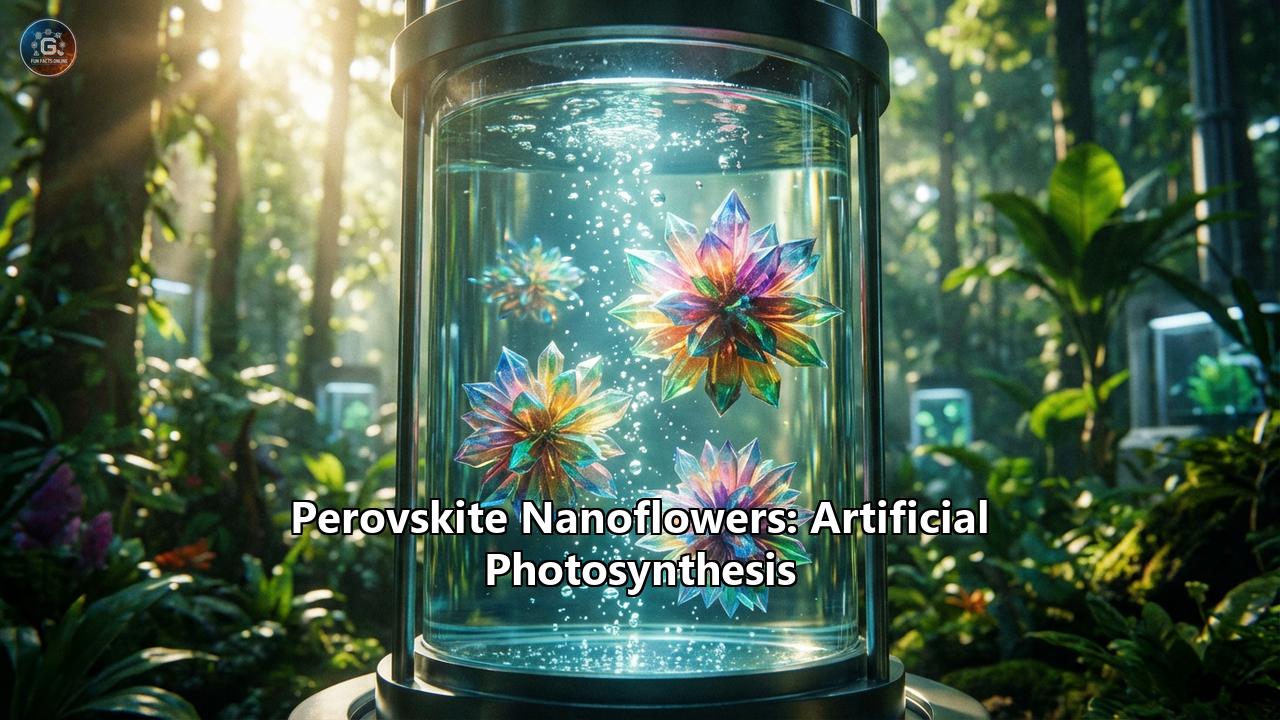
The dawn of a new industrial revolution is upon us—one that does not dig into the earth for ancient carbon but instead harvests it directly from the sky. At the heart of this revolution lies a microscopic marvel that mimics the elegance of a blooming garden: Perovskite Nanoflowers. These intricate nanostructures are not merely beautiful to behold under an electron microscope; they are the engines of Artificial Photosynthesis, a technology promising to convert sunlight, water, and carbon dioxide into clean, storable fuels.
This comprehensive exploration delves into the world of perovskite nanoflowers, dissecting the breakthrough science, the economic potential, and the planetary impact of turning our CO2 problem into an energy solution.
1. The Dream of Infinite Energy: Mimicking the Leaf
For billions of years, nature has held the patent on the ultimate energy conversion technology: photosynthesis. In a quiet, daily miracle, plants use sunlight to strip electrons from water and stitch carbon dioxide into sugars—fuel for life. Humanity has long dreamed of replicating this process, but with a twist: instead of sugars, we want liquid fuels like ethanol, methane, and hydrogen that can power our cars, industries, and cities.
This dream is known as Artificial Photosynthesis.
Until recently, the field was stifled by materials that were either too inefficient (like titanium dioxide) or too expensive (like platinum and iridium). Enter the Perovskite Nanoflower system. By combining the extraordinary light-harvesting capabilities of halide perovskites with the catalytic power of copper-based nanoflowers, researchers have unlocked a pathway to "solar fuels" that are not only carbon-neutral but potentially carbon-negative.
The "Artificial Leaf" Breakthrough
The defining moment for this technology came with the development of "floating artificial leaves." Unlike heavy, rigid solar panels, these devices are thin, flexible, and lightweight. They float on water, absorbing sunlight to generate a voltage. This voltage drives a chemical reaction at the surface of the "nanoflowers"—microscopic catalytic structures that bloom on the device's surface.
The result is a device that does not produce electricity for the grid, but liquid fuel. It takes the waste product of our civilization (CO2) and turns it back into the building blocks of our economy.
2. The Anatomy of a Perovskite Nanoflower
To understand why this technology is revolutionary, we must zoom in to the nanoscale—a realm where a nanometer is to a meter what a marble is to the Earth. Here, "Perovskite Nanoflowers" refers to two distinct but synergistic innovations: the Perovskite Light Absorber and the Catalytic Nanoflower.
The Engine: Halide Perovskites
Perovskites are a family of materials that share a specific crystal structure (calcium titanate, $ABX_3$). In the context of artificial photosynthesis, we use Lead Halide Perovskites (like $CsPbBr_3$) because they are semiconductors with "tunable bandgaps."
- Tunability: Unlike silicon, which absorbs a fixed spectrum of light, perovskites can be chemically tweaked to absorb specific wavelengths. This allows scientists to layer them, creating "tandem cells" that harvest almost the entire solar spectrum.
- High Voltage: Splitting CO2 requires a significant energy kick (potential). Perovskites generate exceptionally high photovoltages, providing the electrical "shove" needed to break the strong carbon-oxygen bonds in CO2.
The Catalyst: Copper Nanoflowers
While the perovskite absorbs light to create free electrons, those electrons need a place to do their work. This is where the Copper Nanoflower comes in.
- Morphology Matters: Catalysis happens on the surface. A flat sheet of copper has limited surface area. But by growing the copper into a 3D, flower-like structure with petals, creases, and folds, the surface area explodes.
- Active Sites: The sharp edges and defects on the "petals" of these nanoflowers serve as highly active sites where CO2 molecules get trapped and twisted, making them easier to break.
- Selectivity: Flat copper tends to make simple methane ($CH_4$). But the complex geometry of copper nanoflowers forces intermediate molecules to linger and interact, leading to C-C coupling. This means they produce multi-carbon products ($C_{2+}$) like ethylene (for plastics) and ethanol (fuel), which are far more valuable.
3. The Mechanism: How It Works
The operation of a Perovskite Nanoflower artificial photosynthesis system is a ballet of physics and chemistry performed at the speed of light.
- Light Absorption: A photon from the sun strikes the perovskite layer. Its energy kicks an electron up to a higher energy state, leaving behind a "hole."
- Charge Separation: The electron and hole are separated. The hole moves to the anode (oxidation side), while the electron moves to the cathode (reduction side).
- The Anode Reaction (Glycerol/Water Oxidation): At the anode, the "holes" need to be consumed. Traditionally, they split water to make oxygen ($O_2$). However, recent breakthroughs use glycerol (a waste product of biodiesel production) instead. Oxidizing glycerol is energetically easier than splitting water and produces valuable by-products like glyceric acid.
- The Cathode Reaction (CO2 Reduction): The high-energy electrons arrive at the Copper Nanoflower. Here, CO2 molecules from the air or water solution adsorb onto the copper petals.
- The Synthesis: The electrons bombard the CO2, breaking the C-O bonds and adding hydrogen protons (from the water). The nanoflower's geometry guides these fragments to fuse together, forming Ethanol ($C_2H_5OH$) and Ethylene ($C_2H_4$).
The result? A device that sits in the sun, drinks dirty water and CO2, and excretes clean fuel.
4. Synthesis: Growing the Flowers
Creating these devices requires a mix of delicate chemical artistry and scalable industrial processes.
Hot Injection Method for Perovskites
To make high-quality perovskite nanocrystals, scientists often use the "hot injection" method. Precursors (like cesium oleate) are injected into a boiling solution of lead halides. The instant the cool liquid hits the hot solvent, nuclei burst into existence. By controlling the temperature and surfactants (ligands), researchers can force these crystals to grow into dots, wires, or even flower-like platelets.
Electrodeposition of Copper Flowers
The copper nanoflowers are typically grown directly onto the perovskite device via electrodeposition. By applying a specific voltage in a copper salt solution, copper atoms stack up on the surface. The "trick" is to use specific additives (like amino acids) that act as "shape-directing agents." These agents block copper from growing flat, forcing it to bloom outward into intricate, petal-like fractals.
5. Economic Viability: Can It Compete with Oil?
For any technology to save the world, it must first survive the market. Techno-economic analyses (TEA) of perovskite-based artificial photosynthesis paint a promising picture, though hurdles remain.
The Cost Advantage
- Cheap Materials: unlike silicon (which requires high-purity processing) or iridium electrolyzers (which use rare earth metals), perovskites and copper are abundant and cheap.
- Low CapEx: Perovskites are "solution-processable." They can be printed like newspapers using roll-to-roll manufacturing. This drastically lowers the capital expenditure (CapEx) for building factories.
The Numbers
- Target Cost: To be competitive, green hydrogen needs to cost less than $2 per kg. Current TEA models suggest that perovskite photo-electrochemical cells, with their high efficiency (20%+), are one of the few technologies capable of hitting this target within the decade.
- LCOE (Levelized Cost of Energy): Estimates for perovskite modules hover around 3-5 cents per kWh, making them competitive with fossil fuels, especially when the "carbon tax" savings are factored in.
- Value-Added Products: Producing electricity is cheap ($0.03/kWh). But producing ethylene is lucrative ($0.60/kg). By targeting C2+ products, the perovskite nanoflower system generates revenue far beyond simple electricity generation.
6. Environmental Impact: Gigaton-Scale Solutions
The true potential of Perovskite Nanoflowers lies in their ability to reverse the carbon clock.
Efficiency vs. Forests
Natural photosynthesis is notoriously inefficient—plants convert only about 1-2% of solar energy into biomass. Perovskite artificial leaves have already demonstrated efficiencies of over 10%, with theoretical limits exceeding 30%.
- Land Use: To remove 10 gigatons of CO2/year using forests, we would need a new forest the size of Europe. Using artificial leaves with 19% efficiency, we could achieve the same result with a land area of just 30,000 square kilometers (roughly the size of Belgium).
- Water Neutrality: Unlike biofuels, which require massive irrigation, artificial leaves can operate on non-potable water, seawater, or even wastewater, preserving fresh water for human consumption.
Closing the Loop
This technology enables a Circular Carbon Economy. We burn fuel, release CO2, capture it, and use sunlight to turn it back into fuel. This stops the accumulation of greenhouse gases and turns carbon from a pollutant into a resource.
7. Overcoming Challenges: The Road to Stability
Despite the hype, significant barriers stand between the lab bench and the solar farm.
The "Water Problem"
Perovskites are essentially salts. Like salt, they dissolve in water. This is catastrophic for a device meant to float on water.
- Solution: Researchers have developed "impermeable" encapsulation layers using Field’s metal or graphite epoxies. These layers protect the perovskite from moisture while conducting electricity to the copper nanoflowers on top.
The "Lead Problem"
The most efficient perovskites contain Lead (Pb), a neurotoxin. Leaching lead into waterways is an environmental non-starter.
- Lead-Free Alternatives: Science is racing to develop Bismuth (Bi), Tin (Sn), and Double Perovskite alternatives. While currently less efficient (often <5%), bismuth-based nanoflowers (e.g., $Cs_3Bi_2I_9$) have shown exceptional stability and non-toxicity, making them a prime candidate for future eco-friendly iterations.
Stability
Solar panels last 25 years. Perovskites currently last months. For artificial photosynthesis to be viable, the catalytic nanoflowers must not degrade under the intense bombardment of high-energy electrons, and the perovskite must resist heat and UV light.
8. The Future Horizon: Solar Farms at Sea
Imagine the year 2040. You look out over the ocean near a coastal city. You don't see oil rigs. Instead, you see vast, shimmering arrays of floating platforms. These are Perovskite Nanoflower Farms.
- Operation: They bob gently on the waves, soaking up sunlight and seawater.
- Output: Pipes run from the arrays back to shore, carrying not oil, but liquid ethanol and compressed ethylene gas produced directly on the water.
- Synergy: These farms are co-located with offshore wind turbines. When the wind blows, the turbines power the grid. When the sun shines, the nanoflowers produce fuel for the night.
This is not science fiction. The components—the perovskite light absorbers, the copper nanoflowers, the reactor designs—already exist. The race is now one of engineering: scaling up from the size of a postage stamp to the size of a football field.
Conclusion
Perovskite Nanoflowers represent the pinnacle of biomimicry. We observed the leaf, understood its physics, and then rebuilt it using materials that outperform nature's own design. By marrying the light-harvesting power of perovskites with the catalytic precision of copper nanoflowers, we have unlocked the door to Artificial Photosynthesis.
The transition from a fossil-fuel economy to a solar-fuel economy will be the defining challenge of the 21st century. In this fight, these microscopic, blooming flowers might just be the most powerful weapon we have. They offer us a promise that is as poetic as it is practical: that our future energy will come not from burning the past, but from blooming in the sun.
Reference:
- https://dspace.mit.edu/handle/1721.1/119698
- https://pubs.acs.org/doi/abs/10.1021/acsenergylett.3c01865
- https://www.eurekalert.org/news-releases/729980
- https://www.sciencedaily.com/releases/2019/01/190116111011.htm
- https://www.researchgate.net/publication/355808765_Costing_Analysis_of_Scalable_Carbon-Based_Perovskite_Modules_Using_Bottom_Up_Technique