
The sands of Saqqara have always been jealous guardians of history. For millennia, they have shifted and swirled over the necropolis of Memphis, concealing the resting places of kings, queens, and the elite functionaries who kept the machinery of the Old Kingdom turning. But occasionally, the desert relents. It pulls back its golden curtain to reveal a window into a life lived four thousand years ago—a life dedicated to the delicate, dangerous, and divine art of healing.
The recent discovery of the mastaba of Teti Neb Fu has sent a jolt of electricity through the world of Egyptology, not merely because it is a new tomb, but because of who occupied it. Teti Neb Fu was not just a bureaucrat or a distant relative of royalty. He was a man of science and a man of magic, a "Physician of the Palace" and a "Magician of Serket." His tomb, with its vibrant wall paintings and its mesmerizing, enigmatic false door, serves as a portal not just to the underworld, but to the very mind of the Ancient Egyptian medical practitioner.
To understand the magnitude of this find, we must step through that false door ourselves. We must peel back the layers of time to the Sixth Dynasty, to the long twilight of the Old Kingdom under King Pepi II, and walk in the footsteps of a man who held the power of life and death in his hands—a man who looked into the mouths of pharaohs and whispered spells against the scorpion’s sting.
Part I: The Silence of the Necropolis
Saqqara is a city of the dead that teems with the memories of the living. Dominated by the Step Pyramid of Djoser, the oldest complete stone building complex known in history, the plateau is a vast archive of human ambition. By the time Teti Neb Fu was born, Djoser’s pyramid was already hundreds of years old, an ancient monument casting a long, jagged shadow over the desert.
The late Old Kingdom, specifically the reign of Pepi II Neferkare, was a time of immense cultural sophistication but also subtle decay. The centralized power of the pharaoh was beginning to wane, bleeding out into the provinces where local governors grew rich and ambitious. Yet, at the capital of Memphis, the court still glittered. It was a world of rigid hierarchy, where one’s proximity to the king determined one’s status in both this life and the next.
It was here, in this high-pressure environment of courtiers and god-kings, that Teti Neb Fu carved out his existence. His tomb was discovered in a sector of Saqqara that has recently yielded a trove of information about the Old Kingdom's elite. The excavation, a painstaking effort by a joint French-Swiss archaeological mission, began as a routine clearance of sand and rubble. But as the archaeologists dug deeper, the chaotic debris of centuries gave way to the orderly lines of mudbrick and limestone.
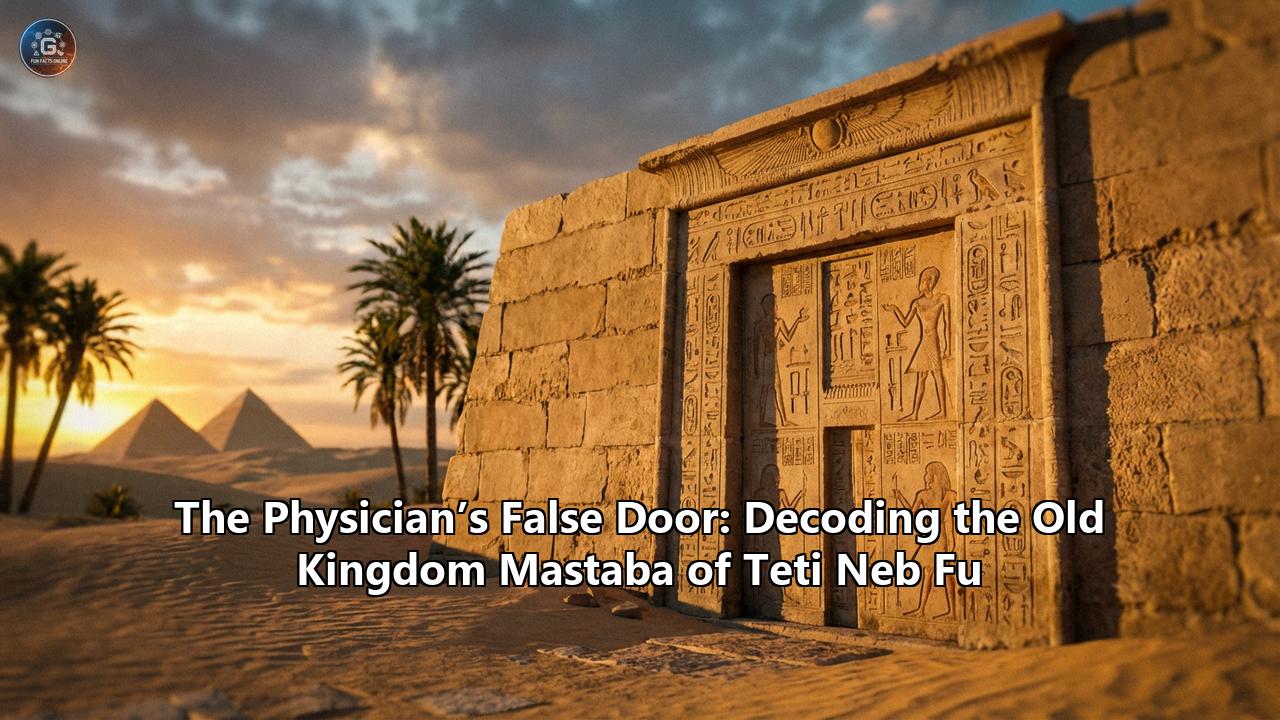
The first sign was the lintel—a heavy block of stone bearing the name "Teti Neb Fu." But it was the clearing of the burial shaft that stopped the breath of the excavators. There, rising from the dust, was a false door of startling preservation. The colors—ochre, malachite green, Egyptian blue, and charcoal black—seemed as fresh as the day the artist’s brush had laid them down. It was a "Physician’s False Door," a threshold crossed by a man who knew the secrets of the human body and the mysteries of the divine venom.
Part II: The Master of Pain and Plants
Who was Teti Neb Fu? The inscriptions on his false door and sarcophagus provide us with a "curriculum vitae" that is as impressive as it is revealing. He was not a general who conquered foreign lands, nor a vizier who managed the grain stores. His war was fought against the microscopic and the invisible—against infection, decay, and poison.
His titles illuminate the dual nature of Egyptian medicine:
- Chief Palace Physician (Wer-sinw-per-aa): This placed him at the very top of the medical hierarchy. He was responsible for the health of the royal family, a position of immense trust. To touch the body of the pharaoh was to touch a god.
- Chief Dentist (Wer-ibeh): Dentistry in ancient Egypt was a gruesome but necessary trade. The bread of the time was full of sand from the grinding stones, which wore down teeth aggressively, leading to abscesses and exposure of the pulp. Teti Neb Fu would have spent his days drilling into jawbones to drain fluid, packing cavities with medicinal pastes, and perhaps wiring loose teeth with gold wire.
- Director of Medicinal Plants: This is a rare and fascinating title. It suggests Teti Neb Fu was also a botanist and a pharmacologist. He would have overseen the royal gardens where opium poppies, mandrake, acacia, and garlic were grown. He understood the chemistry of nature, knowing exactly which leaf could soothe a fever and which root could stop a heart.
- Magician of Serket (Kherep-Serket): This is the title that captures the imagination. Serket was the scorpion goddess, the "One Who Causes the Throat to Breathe." In a land teeming with horned vipers, cobras, and deathstalker scorpions, venom was a daily terror. A "Magician of Serket" was a specialist in toxicology. He was the one called when a worker was stung in the fields or a prince was bitten in the garden.
This combination of titles destroys the modern misconception that ancient Egyptians relied solely on superstition. Teti Neb Fu was a man of science who understood anatomy and pharmacology, but he was also a priest who acknowledged that some maladies were spiritual in nature. If a snake bite caused the flesh to rot, he would apply a poultice of figs and honey (science), but he would also recite the incantations of Serket to drive out the "demon" of the venom (magic). For Teti Neb Fu, these were not two different disciplines; they were two hands of the same healer.
Part III: The Architecture of the Tomb
The mastaba of Teti Neb Fu is a classic example of late Old Kingdom funerary architecture, yet it possesses an intimacy that the massive royal pyramids lack. A "mastaba" (from the Arabic word for "bench") is a flat-roofed, rectangular structure with sloping sides. It serves as the house for the soul (Ka) in the afterlife.
The structure is built primarily of mudbrick, the humble material of the Nile valley, but lined with high-quality limestone where it mattered—the offering chapel. The exterior would have been plastered and whitewashed, blindingly bright under the midday sun.
Upon entering, one steps into a corridor that leads to the offering chapel. This room was the interface between the living and the dead. It was here that Teti Neb Fu’s family—his wife, children, and appointed "Ka-priests"—would come to leave bread, beer, and incense.
The walls of this chapel are a riot of color and activity. Unlike the somber tombs of later eras, Old Kingdom tombs are celebrations of life. The reliefs depict Teti Neb Fu inspecting his estates, watching over the harvest, and receiving lines of offering bearers.
One particularly striking scene, unique to a physician’s tomb, shows the "Director of Medicinal Plants" inspecting rows of jars. These are not standard grain jars; their shapes and labels suggest potions, oils, and dried herbs. It is a pharmacy carved in stone. We see servants crushing ingredients in mortars, filtering liquids through cloth, and presenting the finished medicines to the master. It is a freeze-frame of a laboratory from 2300 BCE.
Another scene hints at his dental work. A small, almost hidden register shows a seated figure (perhaps a patient) grimacing while a standing figure (a junior physician under Teti’s supervision?) works on their mouth. It is a rare and humanizing glimpse into the pain that Teti Neb Fu spent his life trying to alleviate.
Part IV: Decoding the False Door
The heart of the tomb, the focal point of all ritual activity, is the False Door. To the uninitiated, it looks like a blocked passageway—a door frame with a central niche that is solid stone. But to the Ancient Egyptians, this was a fully functional machine of the afterlife.
The False Door in Teti Neb Fu’s tomb is a masterpiece of the genre. It stands on the west wall, facing the land of the dead. It is carved from a single slab of fine Tura limestone, polished to a sheen that resembles marble.
The Structure:The door mimics the façade of a palace. It has a lintel, a drum, and recessed jambs. This architectural style goes back to the early dynasties, recalling the reed-and-mud structures of the pre-dynastic chieftains. For Teti Neb Fu, it signaled that his tomb was his eternal house.
The Inscriptions:The hieroglyphs cascading down the jambs are not merely decorative; they are functional code. They utilize the "Offering Formula" (Htp-di-nsw)—a magical legal contract between the deceased, the king, and the gods (usually Anubis or Osiris).
The text reads: "An offering which the King gives, and Anubis, Who is upon his Mountain, He who is in the Place of Embalming, Lord of the Sacred Land..."
It continues to list what Teti Neb Fu requires: "A thousand of bread, a thousand of beer, a thousand of oxen, a thousand of fowl, a thousand of alabaster vessels, and a thousand of clothing."
The repetition of "a thousand" was a magical failsafe. Even if his descendants forgot to bring real bread, the written word would become reality in the afterlife. As long as the inscription existed, Teti Neb Fu would not starve.
The Spirit Channel:The central niche of the door is painted a deep, reddish-brown to simulate wood. This is where the magic happened. The Egyptians believed that the Ka (life force) could detach from the mummified body in the burial chamber below, travel up the shaft, and pass through the solid stone of this niche to enter the chapel.
On the panel above the niche, Teti Neb Fu is depicted seated at an offering table. He is sniffing a jar of sacred ointment, his expression serene. He is wearing a leopard-skin sash—the mark of a high priest—draped over his physician’s linen kilt. This image is the target. It tells the Ka exactly where to go.
The Physician’s Touch:What makes this door unique are the subtle details related to his profession. At the bottom of the jambs, where ordinary tombs might show standard offering bearers, Teti Neb Fu’s door features figures carrying chests of medical instruments. We see copper knives, hooked probes, and small spoons for measuring drugs.
Even more fascinating is the invocation to Serket on the lintel. Usually, Anubis dominates the false door. But here, the Scorpion Goddess is given prominence. The text asks that Serket "wrap her arms of protection" around Teti Neb Fu, just as he used her power to protect the living. It is a touching reminder that the doctor who saved others now needs saving himself as he journeys through the dangerous landscape of the Duat (underworld).
Part V: The Magician of Serket
To fully appreciate Teti Neb Fu, we must delve deeper into his title "Magician of Serket." In the modern world, we draw a sharp line between a doctor and a magician. In the Old Kingdom, that line did not exist.
The "Kherep-Serket" was a state-sanctioned role. The desert was a dangerous place. Scorpions like the Deathstalker (Leiurus quinquestriatus) carry a neurotoxin that causes excruciating pain, convulsions, and respiratory failure. For a society that worked outdoors—building pyramids, farming the Nile floodplains—these creatures were a constant existential threat.
Teti Neb Fu’s treatment protocol likely involved a three-step process:
- Mechanical: Lancing the wound to bleed out the poison or sucking it out (a practice depicted in some texts).
- Pharmacological: Applying a paste of specific herbs. We know from the Ebers Papyrus (though written later, it contains much older knowledge) that onions, honey, and metallic salts were often used on bites to reduce inflammation.
- Magical: This was the crucial step. The venom was seen as a fluid demon invading the body. To expel it, Teti Neb Fu would recite a mythic narrative. He might chant the story of Horus, who was stung by a scorpion and healed by Thoth. By identifying the patient with the god Horus, the patient shared in the god’s inevitable victory over the poison.
As a "Magician of Serket," Teti Neb Fu was a psychological healer as much as a physical one. His presence, his chanting, and his confidence provided the patient with the will to survive the neurotoxic storm raging in their blood. The discovery of his tomb suggests that he was very good at this. One does not rise to the "Chief of the Palace" by losing patients.
Part VI: The Burial Chamber and the Sarcophagus
Beneath the chapel, down a vertical shaft cut into the bedrock, lies the burial chamber. This was the private sanctuary, never meant to be seen by living eyes after the funeral.
When the French-Swiss team lowered their robotic cameras into the shaft, they found that the chamber had been breached in antiquity. Tomb robbers, likely during the chaos of the First Intermediate Period (just a century or so after Teti’s death), had smashed their way in. They were looking for gold—the amulets on the mummy, the precious oils, the gilded masks.
However, the robbers left behind the greatest treasure for history: the sarcophagus and the wall texts.
The sarcophagus is a massive box of limestone. Its lid was skewed, evidence of the robbers' haste. But the inscriptions on the box are intact. They repeat Teti Neb Fu’s titles and include a rare prayer usually reserved for royalty: a request to become an "Imperishable Star" in the northern sky.
The walls of the burial chamber are painted with the "Pyramid Texts"—or at least, a non-royal version of them. These are spells designed to help the soul navigate the afterlife. They give Teti Neb Fu the passwords to pass the gatekeepers of the underworld.
One spell is particularly poignant for a dentist: "My teeth are the teeth of a snake; my molars are the molars of the god who crushes stone." It is a transformation spell, turning the vulnerable human body into a terrifying divine entity that cannot be harmed. For a man who spent his life fixing the crumbling teeth of others, the wish for indestructible, god-like teeth is deeply personal.
Part VII: The Shadow of Pepi II
The context of Teti Neb Fu’s life is dominated by the figure of King Pepi II. Pepi II is famous for having the longest reign in Egyptian history (reputedly 94 years, though some scholars argue for 64). He came to the throne as a child and died as a feeble old man.
Teti Neb Fu likely served during the middle-to-late years of this reign. It was a strange time. The pyramid complex of Pepi II at South Saqqara is smaller and shabbier than those of his ancestors. The economy was straining. The Nile floods were becoming lower, a precursor to the climate crisis that would eventually collapse the Old Kingdom.
Yet, the tomb of Teti Neb Fu shows no sign of poverty. It is rich and elaborate. This tells us something important about the social dynamics of the time. As the central authority of the king weakened, the power of high officials like Teti Neb Fu grew. They had the resources to build lavish tombs that rivaled those of the royal family. They were becoming independent lords of their own domains.
Teti Neb Fu’s tomb is located near the pyramid of Pepi II, clustering for protection. Even as the dynasty crumbled, the physician stayed close to his patient. It paints a picture of loyalty—or perhaps necessity. In a world that was slowly falling apart, the safest place was still in the shadow of the god-king.
Part VIII: The Discovery and its Methods
The excavation of this mastaba is a triumph of modern archaeology. The team did not just use shovels and brushes. They employed ground-penetrating radar (GPR) to map the subterranean anomalies before breaking ground. This allowed them to locate the burial shaft without destabilizing the surrounding sand.
Once inside, the conservation team faced a battle against time. The vibrant paints on the false door, having been sealed in darkness for four millennia, were at risk of fading or flaking the moment they were exposed to fresh air and humidity. The team used chemical stabilizers to bind the pigments to the stone before fully clearing the sand.
They also used macro-photography and 3D laser scanning to create a digital twin of the tomb. This means that even if the physical structure degrades, the data of Teti Neb Fu’s tomb is preserved forever. This digital model has allowed researchers to read faint inscriptions that are invisible to the naked eye, revealing more details about the "medicinal plant" inventory on the walls.
Part IX: A Dialogue with the Dead
Standing in front of the False Door of Teti Neb Fu, one cannot help but feel a sense of vertigo. We are looking at a man who looked at us. The eyes on his relief carving are wide and outlined in kohl, staring eternally out of the stone.
He asks for bread and beer. He asks for his name to be spoken. In Ancient Egypt, to speak the name of the dead was to make them live again (Se-ankh). By discovering his tomb, by reading his titles, and by writing articles like this one, we are fulfilling Teti Neb Fu’s greatest wish. We are granting him immortality.
But he gives us something in return. He gives us a reflection of ourselves. We see a man who worried about his status, who took pride in his professional skills, who feared the pain of a toothache and the terror of a snakebite. We see a society that valued healthcare, that organized complex systems to treat the sick, and that tried to make sense of the chaotic universe through a blend of rigorous observation and comforting ritual.
The False Door was meant to be a one-way portal for the Ka to come out. But for us, it is a two-way mirror. We look into the deep time of the Old Kingdom, and we see the face of a doctor, exhausted after a long day at the palace, hoping that his work has pleased his king and his gods.
Part X: The Legacy of the Physician
As the sand is cleared from the rest of the complex, more discoveries are likely to follow. Are there family members buried nearby? Are there papyrus scrolls hidden in the debris—perhaps medical texts written by Teti Neb Fu himself? The prospect is tantalizing.
For now, the Mastaba of Teti Neb Fu stands as a testament to the "Physician’s False Door." It reminds us that behind the gold of the pharaohs and the stone of the pyramids, there were people—men and women of intellect and skill—who kept the civilization alive.
Teti Neb Fu, the Magician of Serket, has returned from the silence. And as long as we study his tomb, the doctor is in.
Glossary of Terms
- Mastaba: A type of ancient Egyptian tomb in the form of a flat-roofed, rectangular structure with outward sloping sides, constructed out of mud-bricks or stone.
- False Door: An architectural element in tombs that served as an imaginary passage for the deceased's spirit (Ka) to enter the world of the living to receive offerings.
- Ka: The spiritual part of an individual in Egyptian mythology that survived the body's death and required sustenance (food and drink).
- Serket: An Egyptian goddess of fertility, nature, animals, medicine, magic, and healing venomous stings and bites, often depicted with a scorpion on her head.
- Old Kingdom: The period in the third millennium BC when Egypt attained its first continuous peak of civilization – the first of three so-called "Kingdom" periods (followed by the Middle Kingdom and New Kingdom).
- Pepi II: A pharaoh of the Sixth Dynasty in Egypt's Old Kingdom who reigned from c. 2278 BC. His reign is often cited as the longest in history.
Further Reading & Context
The discovery of Teti Neb Fu fits into a broader pattern of recent finds in Saqqara. In the last few years, the site has yielded the tomb of the treasurer of King Ramses II, hundreds of painted coffins from the Late Period, and a mummification workshop that taught us the chemical composition of embalming oils. Teti Neb Fu’s tomb adds a crucial piece to the puzzle of the Old Kingdom, specifically regarding the professional classes.
While we often focus on the collapse of civilizations—how the Old Kingdom fell into chaos shortly after Pepi II—Teti Neb Fu reminds us of the stability that preceded it. The medical profession was organized, respected, and highly specialized. There were hierarchies, training, and specialized roles (dentist vs. pharmacologist vs. toxicologist).
The "Physician’s False Door" is not just a piece of art; it is a document of professional pride. Teti Neb Fu wanted eternity to know exactly what he did. He didn't just want to be remembered as a rich man; he wanted to be remembered as a competent one. And 4,000 years later, he has succeeded.
Reference:
- https://www.ancient-origins.net/news-history-archaeology-ancient-places-africa/teti-neb-fu-magician-0021807
- http://www.thehistoryblog.com/archives/72120
- https://www.independent.co.uk/news/science/archaeology/ancient-egyptian-pharoah-doctor-magician-b2675613.html
- https://www.archaeology.wiki/blog/2025/01/07/tomb-of-a-royal-physician-discovered-in-saqqara/
- https://www.foxnews.com/travel/ancient-tomb-belonging-doctor-who-treated-egyptian-pharaohs-discovered-archaeologists
- https://archaeologymag.com/2025/01/tomb-of-royal-physician-discovered-in-egypt/
- https://egyptianstreets.com/2025/01/07/ancient-mastaba-tomb-of-royal-physician-unearthed-at-saqqara/
- https://www.ancientegyptblog.com/?p=1632
- https://www.egypttoursportal.com/en-za/blog/egyptian-civilization/false-doors-in-ancient-egypt/
- https://egyptunitedtours.com/false-doors-in-ancient-egypt/
- https://historicaleve.com/false-doors-of-egyptian-tombs/
- https://www.youtube.com/watch?v=Z19p4RKfnig