
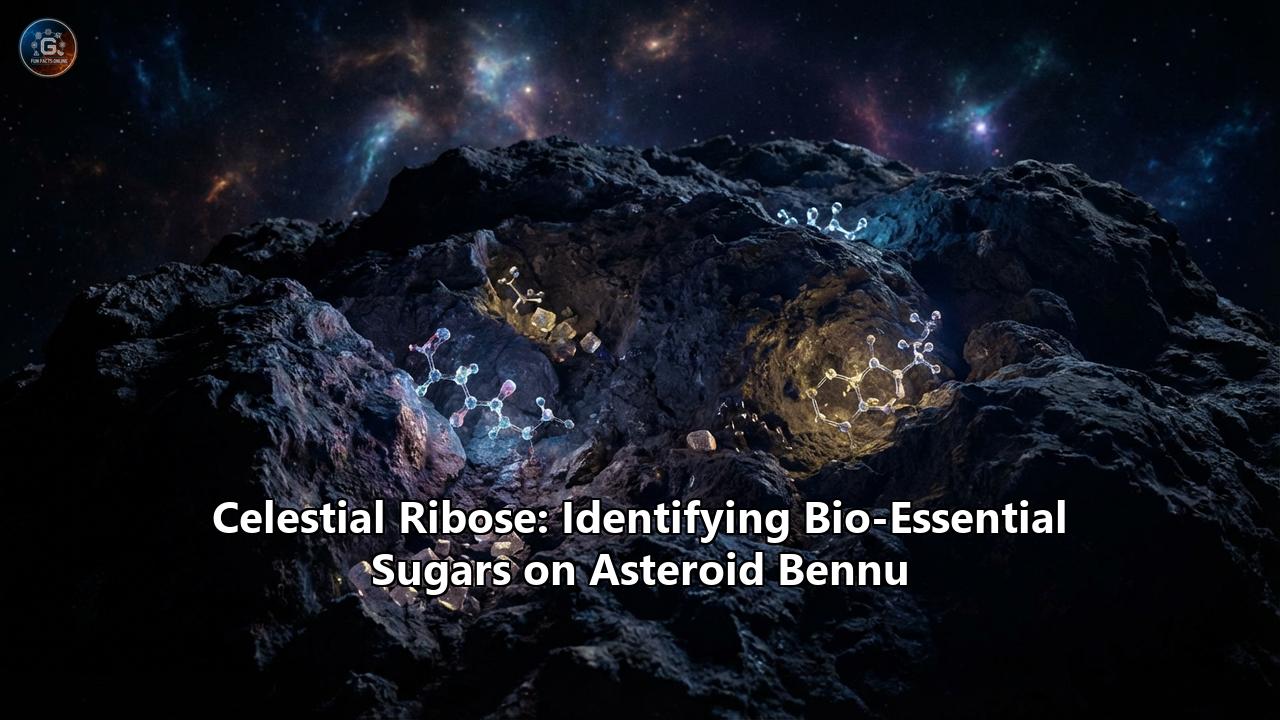
In the vast, silent expanse of our solar system, a small, diamond-shaped rock named Bennu has been circling the sun for billions of years, keeping secrets from the dawn of creation. For eons, it was just another point of light in the sky. But in September 2023, a capsule plummeted through Earth’s atmosphere, landing in the Utah desert and carrying with it a handful of black dust that would rewrite our understanding of life’s origins.
Inside that canister, returned by NASA’s OSIRIS-REx mission, scientists found more than just rock and dust. They found the molecular blueprints of biology. Among the carbon-rich grains were ribose, the sugar molecule that forms the backbone of RNA, and glucose, the fuel of life on Earth.
This discovery is not merely a chemical curiosity; it is a profound clue suggesting that the ingredients for life are not unique to Earth but are scattered throughout the cosmos, waiting for the right conditions to bloom. This is the story of that discovery, the science behind it, and what it means for the ancient question: Are we alone?
Part I: The Cosmic Time Capsule
To understand the magnitude of finding sugar in space, we must first understand the messenger that brought it to us. Asteroid 101955 Bennu is a "rubble pile" asteroid—a loose conglomeration of rocks held together by gravity. Unlike Earth, which melts, churns, and recycles its crust, Bennu is a fossil. It has remained virtually unchanged for 4.5 billion years, preserving the pristine chemistry of the solar nebula that birthed our sun and planets.
The OSIRIS-REx Mission
NASA’s OSIRIS-REx (Origins, Spectral Interpretation, Resource Identification, Security-Regolith Explorer) was a mission of high stakes and high precision. Launching in 2016, the spacecraft arrived at Bennu in 2018 and spent two years mapping the asteroid’s craggy, boulder-strewn surface. The mission culminated in a dramatic "Touch-and-Go" (TAG) maneuver in October 2020. The spacecraft descended, tapped the surface with its robotic arm, and blasted a burst of nitrogen gas to stir up regolith, capturing about 121 grams of material—far exceeding the mission's goal.
Because these samples were sealed in space and never exposed to Earth's atmosphere until they were in a specialized clean room, they represent the most pristine extraterrestrial material ever analyzed. Unlike meteorites found on the ground, which are instantly contaminated by Earth's biology (bacteria, pollen, hand oils), the Bennu samples offered a window into the pure, unadulterated chemistry of the early solar system.
Part II: The Sweetest Discovery
When the sample analysis began, led by teams including researchers from NASA, Tohoku University, and universities across the globe, the results were staggering. The black dust of Bennu was rich in carbon—nearly 5% by weight—and teeming with organic molecules.
Identifying Ribose
The headline discovery was ribose. In biological terms, ribose is a superstar. It is the "R" in RNA (Ribonucleic Acid). While DNA (Deoxyribonucleic Acid) stores our genetic code, RNA is the messenger that translates that code into proteins, the workhorses of the cell. In the "RNA World" hypothesis—one of the leading theories for the origin of life—it is believed that RNA evolved before DNA and proteins, acting as both a genetic storage molecule and a chemical catalyst.
Finding ribose on an asteroid suggests that this critical component of life didn't need to form from scratch in the chaotic environment of early Earth. Instead, it could have been delivered, fully formed, by the bombardment of asteroids and comets that pummeled our young planet 4 billion years ago.
The Glucose Surprise
Alongside ribose, the team identified glucose. This was a first. While sugar-like molecules had been hinted at in meteorites, the clear detection of glucose—the six-carbon sugar that powers cellular respiration in nearly every living thing on Earth—was unprecedented in such a pristine sample. This suggests that asteroids could carry not just the structural components of life (like ribose) but also its potential energy sources.
Part III: The "Space Gum" and the Chemical Factory
The surprises didn't stop at simple sugars. One of the most perplexing finds in the Bennu sample was a substance scientists colloquially dubbed "Space Gum."
A Polymer from the Void
Researchers identified a strange, gummy, organic material that didn't fit the profile of standard mineral or simple organic compounds. It was a complex, polymer-like substance rich in carbon, nitrogen, and oxygen.
Chemical analysis revealed that this "gum" likely formed through the reaction of ammonia and formaldehyde—two simple molecules abundant in the early solar system. In the presence of water (which existed as liquid inside Bennu’s parent body billions of years ago), these chemicals reacted to form hexamethylenetetramine (HMT) and other complex polymers.
This "space gum" is significant because it acts as a protective matrix. Just as amber preserves ancient insects on Earth, this organic polymer may have trapped and protected fragile molecules like ribose and amino acids, shielding them from the harsh radiation of space for billions of years until they could be safely delivered to a planet.
The Ammonia Connection
The detection of high levels of ammonia and ammonium salts was another key differentiator for Bennu. Ammonia is highly volatile; it boils away easily. Its presence in solid salts suggests that Bennu’s parent body formed in the frigid outer reaches of the solar system, perhaps beyond the orbit of Jupiter, before migrating inward. This supports the idea that asteroids act as cosmic freight trains, transporting volatiles and organics from the cold outer solar system to the warm, rocky inner planets.
Part IV: Bennu vs. Ryugu – A Tale of Two Asteroids
The return of the Bennu samples allowed for a fascinating direct comparison with samples from asteroid Ryugu, returned by the Japanese Space Agency’s (JAXA) Hayabusa2 mission in 2020. While both are carbon-rich, "C-type" asteroids, they are not identical twins.
- Sugar Content: Initial analyses of Ryugu samples did not yield the same clear signatures of sugars like ribose and glucose found on Bennu. This could be due to differences in the parent bodies' aqueous history or simply that the Bennu sample was larger, allowing for the detection of rarer molecules.
- Hydration and Alteration: Both asteroids underwent "aqueous alteration"—essentially soaking in warm water inside their parent bodies. However, Bennu’s chemistry indicates a different fluid history, richer in ammonia and potentially more conducive to the synthesis and preservation of specific sugars.
- The Homochirality Puzzle: A major question in the origin of life is "homochirality." Life on Earth uses exclusively "left-handed" amino acids and "right-handed" sugars. If life came from space, we might expect asteroids to show this same bias. However, samples from both Bennu and Ryugu showed a "racemic" mixture—an equal 50/50 split of left and right-handed molecules.
The Implication: This suggests that the "handedness" of life did not originate in space. The asteroids provided the raw materials (the bricks), but the architectural choice to use only left-handed bricks likely happened here on Earth, driven by local environmental conditions or the specific chemistry of the first replicating molecules.
Part V: The RNA World and the Origins of Life
The discovery of celestial ribose pours fuel on the fire of the RNA World Hypothesis. This theory proposes that before single-celled organisms (bacteria) existed, the Earth was populated by self-replicating RNA molecules.
For decades, critics of this hypothesis pointed to a "bottleneck": Ribose is unstable and difficult to synthesize under standard prebiotic Earth conditions (a problem known as the "sugar crisis" in abiotic chemistry). If the Earth couldn't make ribose easily, how could the RNA World begin?
The Bennu samples offer an elegant solution: Earth didn't need to make it.
The Cosmic Delivery Service
Imagine the Hadean Earth, 4 billion years ago. It was a hellscape of volcanoes and magma, sterile and hostile. But the sky was falling. The "Late Heavy Bombardment" saw millions of asteroids and comets raining down on the planet.
If asteroids like Bennu are typical, then this bombardment wasn't just destruction; it was a seeding event. Tons of carbon, water, amino acids (the building blocks of proteins), nucleobases (the letters of the genetic code), and sugars (ribose and glucose) were deposited into Earth's primitive oceans.
In these warm, organic-rich "soup" environments—perhaps in hydrothermal vents or tidal pools—these cosmic ingredients began to combine. The ribose bonded with nucleobases and phosphates (also found in meteorites) to form the first nucleotides. These nucleotides linked together, forming the first strands of RNA. And somewhere, in the dark oceans of a young Earth, one of those strands learned to copy itself. Life had begun.
Part VI: How We Know—The Science of Detection
You might wonder: How do scientists know these sugars are from space and not just contamination from the lab? The detection process involves some of the most sensitive instruments on Earth.
- Gas Chromatography-Mass Spectrometry (GC-MS): Scientists dissolve the asteroid dust in water and acid to extract the organic molecules. They then vaporize the mixture and send it through a long, coiled tube (the chromatograph). Different molecules travel at different speeds, separating them. A mass spectrometer then blasts them with electrons and weighs the fragments to identify their chemical fingerprint.
- Isotopic Analysis: This is the smoking gun. Carbon on Earth consists of two stable isotopes: Carbon-12 (99%) and Carbon-13 (1%). However, organic molecules formed in the cold vacuum of space often have a higher ratio of Carbon-13. The sugars found in Bennu were enriched in Carbon-13, a signature that is impossible to reproduce with terrestrial biological contamination. This isotopic fingerprint confirms their extraterrestrial origin beyond a shadow of a doubt.
- Presolar Grains: Inside the Bennu samples, researchers also found "presolar grains"—microscopic diamonds and silicates that formed in the explosions of ancient supernovae before our sun even existed. These grains act as tiny time capsules, proving the material has remained unprocessed since the solar nebula collapsed.
Part VII: Beyond Earth—Implications for the Universe
If Bennu—a random, small asteroid—is packed with the ingredients for life, it stands to reason that these ingredients are ubiquitous throughout the galaxy.
- Mars: The Red Planet was also bombarded by asteroids in its youth. If life ever started on Mars, it likely used these same cosmic building blocks.
- Europa and Enceladus: The icy moons of Jupiter and Saturn have subsurface oceans. Asteroid impacts could have delivered these sugars to their icy crusts, where they might filter down into the dark waters below.
- Exoplanets: As we gaze at distant stars and their planets, we can now assume that the "starter kit" for biology is not unique to our solar system. The chemistry that creates ribose and amino acids appears to be a universal imperative of carbon chemistry in space.
Conclusion: We Are Stardust (and Sugar)
The OSIRIS-REx mission has returned more than just dust; it has returned a profound change in perspective. We often view life as a miracle, a rare anomaly struggling against a cold, dead universe. But the sugars of Bennu tell a different story. They tell us that the universe is predisposed* to life. The vacuum of space is not an empty void, but a vast chemical factory, churning out the sugars, fats, and proteins necessary for biology, and storing them in freezing asteroid lockers.
We are, quite literally, made of stardust. But thanks to Bennu, we now know we are also made of celestial sugar, delivered across the heavens to sweeten the primordial seas of our home world.
Key Takeaways from the Bennu Analysis
| Molecule Found | Function in Biology | Significance of Discovery |
| :--- | :--- | :--- |
| Ribose | Backbone of RNA | Supports "RNA World" hypothesis; solves the "sugar shortage" problem of early Earth. |
| Glucose | Energy Source | First clear detection in pristine samples; implies energy sources were delivered from space. |
| Amino Acids | Proteins | Found in a "racemic" (50/50) mix, suggesting biological "handedness" evolved on Earth. |
| "Space Gum" | Polymer Matrix | Evidence of complex aqueous chemistry and protection of fragile organics. |
| Ammonium Salts | Nitrogen Source | Suggests Bennu formed in the cold outer solar system and migrated inward. |
Reference:
- https://svs.gsfc.nasa.gov/14932
- https://www.sci.news/space/bennu-sugars-14398.html
- https://www.nasa.gov/missions/osiris-rex/sugars-gum-stardust-found-in-nasas-asteroid-bennu-samples/
- https://www.yourweather.co.uk/news/astronomy/historic-discovery-nasa-confirms-sugars-and-essential-compounds-for-life-on-the-primitive-asteroid-bennu.html
- https://orbitaltoday.com/2025/12/09/asteroid-bennu-sample-gives-insight-into-the-formation-of-life-in-our-universe/
- https://www.cbsnews.com/news/space-gum-sugars-asteroid-bennu-samples-nasa-reveals/
- https://physicsworld.com/a/components-of-rna-among-lifes-building-blocks-found-in-nasa-asteroid-sample/
- https://www.space.com/astronomy/asteroids/nasa-discovers-space-gum-and-sugars-crucial-to-life-in-asteroid-bennu-samples-brought-to-earth-video
- https://samueli.ucla.edu/origin-of-life-favors-one-hand-of-chemical-building-blocks/
- https://www.nasa.gov/centers-and-facilities/goddard/first-look-at-ryugu-asteroid-sample-reveals-it-is-organic-rich/
- https://www.researchgate.net/publication/389209626_Origin_of_homochirality_in_terrestrial_biology
- https://www.hou.usra.edu/meetings/bennuryugu2025/pdf/2063.pdf
- https://www.reddit.com/r/science/comments/1pcaiyh/researchers_have_just_found_the_presence_of/
- https://www.techexplorist.com/analysis-ryugu-asteroid-sample-reveals-organic-rich/57156/