
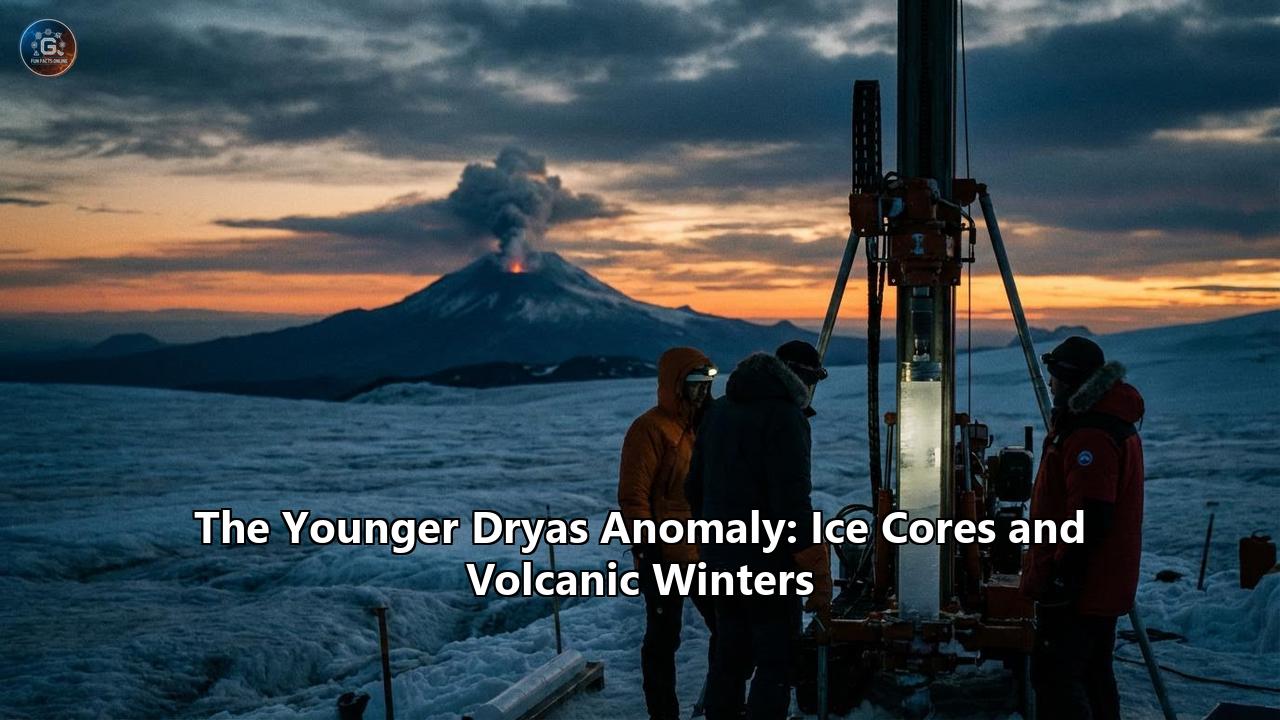
Imagine a world finally waking up from a deep, frozen slumber. Roughly 13,000 years ago, the Earth was doing just that. The relentless grip of the Last Glacial Maximum was loosening. Vast ice sheets that had crushed North America and Europe under miles of frost were in full retreat. Megafauna like mastodons and saber-toothed cats roamed alongside early human hunter-gatherers, such as the Clovis people, who were thriving in a rapidly warming, biologically rich landscape.
And then, almost overnight in geological terms, the warming stopped.
The planet violently lurched back into a brutal ice age. In Greenland, temperatures plummeted by an astonishing 4 to 10 degrees Celsius (7.2 to 18.0 degrees Fahrenheit)—and at the summit, up to 15 degrees Celsius (27 degrees Fahrenheit) colder than they are today. Across Europe, lush, advancing forests withered and gave way to bleak, freezing tundra. In lower latitudes, rainfall patterns drastically shifted southward, causing severe droughts.
This sudden, catastrophic deep-freeze lasted for roughly 1,300 years. Paleoclimatologists call this period the Younger Dryas, named after Dryas octopetala, a hardy, white-flowered alpine shrub that suddenly flourished across the newly frozen European landscapes.
For decades, the Younger Dryas has stood as one of the most profound mysteries in Earth's history. What could possess a warming planet to suddenly throw itself back into the Ice Age? Was it an ocean current collapse? A cosmic impact from the heavens? Or, as a wave of groundbreaking 21st-century research now suggests, was it an apocalyptic "volcanic winter" triggered by forces deep within the Earth itself?
To solve a 12,800-year-old murder mystery of the global climate, we must travel to the most unforgiving environments on Earth, drill miles into the ice, and read the frozen archives of our planet's past.
Earth’s Tape Recorders: The Magic of Ice Cores
If you want to know what the weather was like yesterday, you check an app. If you want to know what the atmosphere was breathing 13,000 years ago, you need an ice core.
The most vital evidence we have for the Younger Dryas comes from monumental drilling projects in Greenland, specifically the Greenland Ice Sheet Project 2 (GISP2) and the North Greenland Ice Core Project (NGRIP). Over millennia, snow falls on these massive ice sheets. Because it never melts, year after year, layer upon layer of snow is compacted into solid ice.
Within this ice, microscopic bubbles of ancient air are permanently trapped. By extracting cylinders of ice that are miles long, scientists can examine these distinct annual layers. They measure the ratio of oxygen isotopes (like δ18O) to determine exact global temperatures of the past. But the ice captures more than just temperature; it traps dust from ancient deserts, ash from long-forgotten volcanic eruptions, and chemical markers from the stratosphere.
When scientists first analyzed the Greenland ice cores encompassing the Younger Dryas boundary, they were stunned. The isotopic data showed that the transition from a warm climate to glacial conditions didn't happen over millennia. The severe cooling took hold in a matter of decades, or perhaps even less.
The ice cores also revealed chemical anomalies right at the boundary of this temperature drop: bizarre spikes in rare metals like platinum, and massive surges in sulfur and sulfate aerosols. These chemical fingerprints became the focal point of a fierce scientific debate that would rage for decades.
The Classic Suspects: Meltwater and Meteorites
Before exploring the latest volcanic revelations, it is essential to understand the two heavyweights that dominated the Younger Dryas debate for years: the Meltwater Pulse and the Extraterrestrial Impact.
The Ocean Conveyor Belt ShutdownThe long-standing, traditional explanation for the Younger Dryas is a catastrophic disruption of the Atlantic Meridional Overturning Circulation (AMOC). The AMOC is a massive system of ocean currents, including the Gulf Stream, that acts as a global conveyor belt. It pulls warm surface water from the tropics up to the North Atlantic, releasing heat into the atmosphere and keeping North America and Europe relatively balmy.
As the North American Laurentide Ice Sheet melted during the post-glacial warming, it formed a colossal inland body of freshwater known as Lake Agassiz. The theory posits that an ice dam suddenly broke, sending a biblical deluge of cold, fresh water pouring into the North Atlantic—possibly via the Mackenzie River. Because fresh water is less dense than salty water, it sat on the surface, capping the ocean and physically preventing the warm tropical waters from sinking and returning south. The conveyor belt ground to a halt. Without that oceanic heat, the Northern Hemisphere froze.
While elegant, this theory has faced modern scrutiny. Geological evidence for the exact routing of this meltwater, and the required sea-level rise precisely at the Younger Dryas onset, has proven inconsistent.
The Cosmic Impact HypothesisIn 2007, a highly controversial alternative took the scientific world by storm: The Younger Dryas Impact Hypothesis (YDIH). Proponents argued that a fragmented comet or asteroid exploded in the atmosphere over the Laurentide Ice Sheet. The resulting airburst purportedly triggered continent-wide wildfires, wiped out the Clovis people and Pleistocene megafauna, and kicked up enough atmospheric dust to block out the sun, plunging the Earth into a cosmic winter.
The smoking gun for this hypothesis? A distinct, anomalous spike in platinum (Pt)—a metal often associated with meteorites—found deep in the GISP2 ice core exactly around the time the cooling began. They also pointed to nanodiamonds, magnetic spherules, and "black mat" soil layers across North America as proof of a cosmic cataclysm.
However, the YDIH has been widely challenged by relevant experts. Many scientists struggled to reproduce the findings, arguing that a crater of the correct age was missing, the physics of the proposed airburst didn't add up, and the extinction of megafauna was a gradual process rather than an overnight wipeout.
The debate seemed deadlocked. But recently, a new generation of scientists began looking at that platinum spike—and a neighboring spike of sulfur—with fresh eyes. What if the anomaly in the ice wasn't from outer space, but from the fiery bowels of the Earth?
The Plot Twist: Deciphering the Platinum and Sulfur Spikes
By 2026, advances in ice core chronologies and high-resolution geochemical tracing completely reshaped our understanding of the Younger Dryas boundary.
Scientists realized that the platinum spike in the Greenland ice did not quite match the chemical signature of a meteorite. Unlike known extraterrestrial impacts, the ice lacked a corresponding high level of iridium, another space-bound metal. Furthermore, when researchers closely re-examined the precise dating of the ice core layers using updated timescales (like the GICC05 chronology), a startling chronological discrepancy emerged.
The platinum spike did not occur before or during the initial temperature drop. It actually appeared in the ice roughly 45 years after the Younger Dryas cooling had already begun, and it persisted for about 14 years. A meteorite impact is a sudden, instantaneous event; it cannot cause a decades-delayed, 14-year-long shower of platinum. Therefore, the cosmic impact could not have been the primary trigger for the cooling.
So, where did the platinum come from?
Recent research demonstrates that explosive volcanic eruptions can mobilize and fractionate heavy metals, transporting them vast distances through the stratosphere. Evidence from more recent Icelandic eruptions proves this phenomenon: the 8th-century Katla eruption left a 12-year spike of bismuth and thallium in Greenland ice, and the 10th-century Eldgjá eruption left a distinct cadmium signal. The platinum in the GISP2 ice core was likely the highly fractionated fallout from a sustained, massive volcanic event.
But if the platinum arrived 45 years late, what actually triggered the freezing?
Just millimeters away in the ice core records, aligning precisely with the onset of the Younger Dryas cooling around 12,870 ± 30 years ago, scientists found the true culprit: an absolutely massive volcanic sulfate spike.
The Mechanics of a Volcanic Winter
When a major volcano erupts, it doesn't just spew local lava and ash; it violently injects millions of tons of sulfur dioxide gas high into the stratosphere. Up there, the gas reacts with water vapor to form a veil of microscopic sulfate aerosols.
This aerosol veil acts like a planetary mirror. It reflects incoming solar radiation back into space, preventing the sun's heat from reaching the Earth's surface. This phenomenon is known as a volcanic winter. We have witnessed milder versions of this in recorded history. The 1815 eruption of Mount Tambora in Indonesia caused the infamous "Year Without a Summer" in 1816, leading to widespread crop failures and global cooling.
However, the sulfur spike found at the 12,870-year mark in the Greenland ice cores suggests an eruption of apocalyptic proportions, releasing enough sulfur to rival the most powerful eruptions in human history.
Crucially, recent climate modeling reveals that the geographic location of a volcano drastically dictates its global impact. When a tropical volcano erupts, its aerosols spread across both hemispheres, diluting the cooling effect. But if a massive extratropical volcano erupts in the Northern Hemisphere, its aerosol veil remains largely confined to that hemisphere. Because the shading is restricted to one half of the globe, the localized radiative impact is intensely amplified—up to 80% more time-integrated radiative forcing than a tropical eruption.
This massive injection of Northern Hemisphere sulfur initiated a sudden, severe drop in temperatures. But volcanic aerosols eventually fall out of the atmosphere after one to three years. How could a three-year volcanic winter cause a 1,300-year ice age?
The answer lies in Earth's incredibly sensitive climate tipping points.
At 12,870 years ago, the Earth was in a delicate "intermediate" glacial state. The climate was warming, but vast ice sheets still existed. When the volcanic winter hit, the abrupt cooling caused Arctic sea ice to rapidly expand. This fresh, bright sea ice reflected even more sunlight (the albedo effect), cooling the region further.
Simultaneously, the expanding sea ice and changing wind patterns disrupted the ocean surface, likely achieving what the old meltwater theory proposed: it choked off the Atlantic Meridional Overturning Circulation. The warm waters of the Gulf Stream stopped flowing north.
The volcanic eruption was the biochemical match that lit the powder keg. It provided the initial, violent push, allowing the sea-ice and ocean-circulation positive feedback loops to take over, locking the Northern Hemisphere into 1,300 years of freezing misery.
The Prime Suspect: The Laacher See Volcano
For several years, scientists thought they had identified the exact volcano responsible for this cataclysm: the Laacher See volcano in western Germany.
Today, Laacher See is a picturesque, peaceful caldera lake near Bonn. But during the Late Pleistocene, it was a monster. When it erupted, it sent plumes of pumice and ash 23 kilometers (14 miles) into the stratosphere. It blanketed much of central Europe with thick volcanic fallout, and its material is so ubiquitous that geologists use it as a standard time marker for the period. It was incredibly sulfur-rich, making it the perfect candidate for triggering a volcanic winter.
However, science is a rigorous process of constant refinement. To definitively link Laacher See to the Younger Dryas onset, researchers needed to pinpoint the exact year it erupted.
They turned to two highly innovative dating methods. First, dendrochronology (tree-ring dating). In 2021, a team led by Frederick Reinig analyzed subfossilized birch and poplar trees that had been instantly buried and preserved by the pyroclastic flows of the Laacher See eruption. By measuring radiocarbon in the tree rings, they firmly dated the eruption to 13,006 ± 9 calibrated years before present.
Second, scientists examined speleothems—stalagmites and stalactites in caves. Deep inside the Herbstlabyrinth Cave in western Germany, just 70 kilometers from the volcano, researchers found a pristine chemical signature of the eruption trapped within the calcium carbonate layers of the cave formations. This allowed them to date the eruption to roughly 13,008 years ago.
The results from both the buried trees and the cave deposits were breathtakingly precise, but they presented a massive twist in the narrative. The Laacher See eruption occurred around 13,006 to 13,008 years ago. The onset of the Younger Dryas cooling, firmly established by the Greenland ice cores, began at 12,870 ± 30 years ago.
Laacher See erupted roughly 130 to 150 years before the Younger Dryas began.
While Laacher See undoubtedly caused severe regional devastation and massive climate disruption in Europe, it was a century too early to be the direct trigger for the Younger Dryas. The geochemical signature of the GISP2 platinum spike also proved dissimilar to the specific magmatic makeup of Laacher See. The prime suspect had been cleared of the primary charge.
The Phantom Volcano and the Cluster Effect
If Laacher See didn't trigger the Younger Dryas, what did?
The massive sulfur spike at 12,870 years ago is undeniably real. The ice cores do not lie. This means that at the exact moment the Younger Dryas began, an unidentified, highly explosive, sulfur-rich volcano erupted in the extratropical Northern Hemisphere.
Scientists are now on a global hunt for this "phantom volcano." Because evidence of ancient eruptions is frequently obliterated by subsequent volcanic activity, glacial grinding, or rising sea levels, locating the exact crater is a monumental task. The prime candidates are located in highly active, glaciated, or submarine regions: Iceland, the Aleutian Islands of Alaska, or the Kamchatka Peninsula in Russia. A massive submarine volcanic complex could also explain why a crater has not been easily identified on land.
Furthermore, paleoclimatologists now believe that the Younger Dryas may not have been triggered by a single event, but by a "cluster" of volcanic eruptions. The Laacher See eruption at 13,006 BP may have primed the climate system, destabilizing the ice sheets and ocean currents. Then, a century later, the phantom volcano at 12,870 BP delivered the knockout blow, forcing the climate past the point of no return.
This aligns perfectly with modern observations of how the Earth's climate behaves under stress. During deglaciation periods—when ice volume is intermediate and the atmosphere is undergoing rapid changes—the Earth is exceptionally vulnerable to external shocks. Multiple volcanic events clustered together can relentlessly batter the climate system until a tipping point is breached.
Echoes from the Ice: Why the Younger Dryas Matters Today
The story of the Younger Dryas anomaly is far more than a geological curiosity; it is a profound cautionary tale written in ice.
For decades, we viewed the Earth's climate as a massive, slow-moving machine that took thousands of years to change course. The ice cores of Greenland shattered that illusion. They proved that the Earth's climate is highly non-linear. It is capable of terrifying, abrupt shifts. A climate system in transition can flip from warming to freezing in the span of a single human lifetime.
Today, we are living in another period of rapid climate transition. As anthropogenic global warming accelerates, the Arctic sea ice is rapidly shrinking, and the Greenland ice sheet is melting, once again pouring vast amounts of cold fresh water into the North Atlantic. Oceanographers are already detecting signs that the Atlantic Meridional Overturning Circulation (AMOC) is weakening, carrying eerie parallels to the precursors of the Younger Dryas.
While we do not currently face a Laurentide Ice Sheet waiting to collapse, the volcanic winter hypothesis adds a critical layer of risk to our modern predictive models. We now know that during periods of climate instability, a major high-latitude volcanic eruption can act as a catalyst, forcing the climate into sudden, cascading feedback loops.
Large-scale explosive volcanism is an inevitable reality of our planet. While an eruption on the scale of the 12,870 BP phantom volcano is rare, it is only a matter of time before the Earth violently clears its throat once again. Understanding how sulfate aerosols, expanding sea ice, and ocean currents interact gives scientists vital tools to predict how our modern, warming world might react to the next major global disruption.
The Masterpiece of Planetary History
The Younger Dryas stands as one of the most thrilling detective stories in modern science. It has taken us from the microscopic analysis of cave stalagmites in Germany to the hazardous extraction of buried prehistoric trees, and to the frozen, unforgiving summits of the Greenland ice sheet.
We have moved past the theories of cosmic comets striking the Earth, replacing them with a narrative that is perhaps even more awe-inspiring. The Earth is a deeply interconnected, living system. A single crack in the crust, unleashing a veil of sulfur into the stratosphere, was enough to blind the sun, freeze the oceans, and reshape the destiny of life on this planet for over a millennium.
The ice cores have revealed their secrets, but the hunt for the phantom volcano continues. As we face our own climate uncertainties in the 21st century, we would do well to listen to the warnings locked within the frost. The Earth's climate is a sleeping giant, and the Younger Dryas is the ultimate proof of how quickly it can wake up.
Reference:
- https://en.wikipedia.org/wiki/Younger_Dryas
- https://www.sciencedaily.com/releases/2026/03/260319044714.htm
- https://eos.org/articles/cave-deposit-links-greenlands-and-europes-climate-records-with-a-german-volcano
- https://cp.copernicus.org/articles/14/969/2018/
- https://pmc.ncbi.nlm.nih.gov/articles/PMC12445550/
- https://journals.plos.org/plosone/article?id=10.1371/journal.pone.0331811
- https://en.wikipedia.org/wiki/Younger_Dryas_impact_hypothesis
- https://www.pnas.org/doi/10.1073/pnas.1303924110
- https://epic.awi.de/id/eprint/55800/
- https://pmc.ncbi.nlm.nih.gov/articles/PMC7848538/