
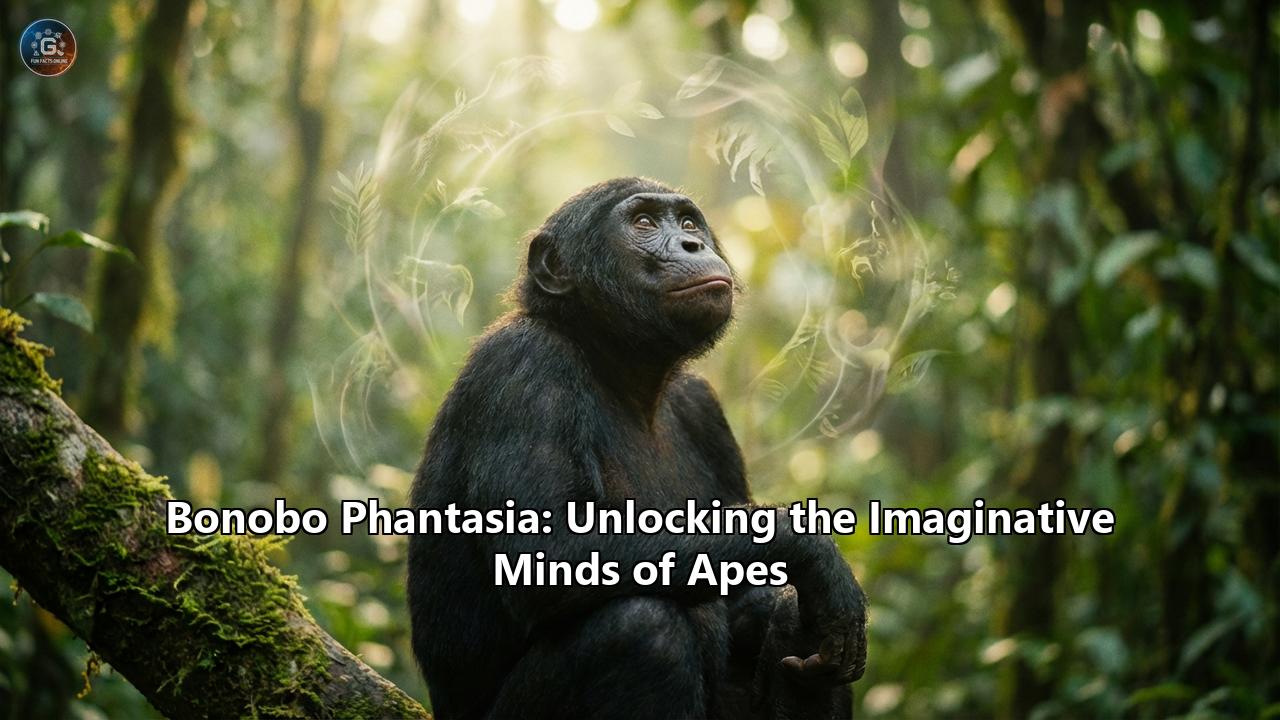
Chapter 1: The Invisible Cup
The scene, at first glance, appears mundane, perhaps even trivial. In a research facility in Iowa, a researcher sits across a table from a bonobo. There are no flashing lights, no complex machinery, just a simple plastic pitcher and two empty cups. The researcher picks up the pitcher, which is clearly empty, and mimics the motion of pouring a liquid into one of the cups. She makes the sound of pouring—glug, glug, glug—and then sets the pitcher down. She looks at the bonobo, a 43-year-old male named Kanzi, and asks a question that, until recently, science believed no animal could truly answer.
"Where is the juice?"
Kanzi does not hesitate. He points a long, dark finger at the cup the researcher just "filled." He ignores the other cup, the one that remains "empty" in this shared fiction.
This simple gesture, recorded in a groundbreaking study published in Science on February 5, 2026, shattered a long-standing barrier in cognitive science. It was not a trick. It was not a conditioned response to a treat. It was evidence of phantasia—the ability to visualize the nonexistent, to hold a mental image in the mind’s eye that contradicts the physical reality in front of it.
For centuries, philosophers and scientists have argued that imagination is the distinct spark of humanity—the "Promethean fire" that allowed us to dream of gods, build empires, and fly to the moon. Animals, we were told, live in the tyranny of the now. They react to what they can see, smell, and touch. But Kanzi was not reacting to the now. He was reacting to a "secondary representation"—a shadow world created entirely inside his mind, and shared, telepathically in a sense, with a human being.
This phenomenon, which we might call "Bonobo Phantasia," suggests that the roots of our creative capacity are far older than the human species itself. It implies that in the deep, verdant forests of the Miocene era, some 6 to 9 million years ago, the common ancestor we share with bonobos and chimpanzees was already beginning to dream.
Chapter 2: The Architecture of Make-Believe
To understand the magnitude of Kanzi’s achievement, we must first dismantle our own easy familiarity with imagination. For a human child, "pretend play" is as natural as breathing. A toddler picks up a banana and answers it like a telephone. A preschooler straddles a broomstick and rides a dragon. We call it "child's play," but neurologically, it is a high-wire act of cognitive sophistication.
This ability requires what psychologists call decoupling. The brain must hold two conflicting models of reality simultaneously.
- Primary Representation: The banana is a yellow, curved fruit. (Reality)
- Secondary Representation: The banana is a communication device. (Pretense)
If the child confuses the two, they are hallucinating. If they cannot form the second, they are stuck in the literal. The magic lies in the decoupling—knowing it is a fruit, but treating it as a phone.
For decades, the "metacognitive gap" hypothesis posited that while great apes are intelligent—capable of using tools, solving puzzles, and learning symbols—they lacked this specific architecture. They were thought to be "behaviorists" by nature, solving problems through trial and error or direct observation, but unable to simulate a counterfactual reality.
The 2026 study, led by cognitive scientists Christopher Krupenye of Johns Hopkins University and Amalia Bastos of the University of St. Andrews, dismantled this hypothesis. They didn't just ask Kanzi to play; they subjected him to a rigorous "violation of expectation" protocol.
In one variation, the researcher pretended to pour juice into a cup, then pretended to dump that juice out, then pretended to pour it back in. Kanzi had to track the invisible liquid through these invisible transfers. If he were merely pointing at the cup the researcher touched last, he would fail the complex sequences. He didn't. He tracked the volume of the imaginary liquid. When offered a choice between a cup with "invisible juice" and a cup with "invisible nothing," he consistently chose the juice.
This indicates that Kanzi’s brain is maintaining a persistent, manipulatable mental object. The juice exists in his mind. He can watch it move. He can see it spill. He can anticipate its taste. This is the definition of imagination: the presence of the absent.
Chapter 3: Kanzi, The Einstein of Apes
To speak of "bonobo imagination" is, inevitably, to speak of Kanzi. Born in 1980, Kanzi is no ordinary ape. He is arguably the most "enculturated" non-human being on the planet. His life story reads like a biography of a genius discovered in the wild.
Kanzi was not originally the subject of language research; his adoptive mother, Matata, was. Researchers tried for years to teach Matata to use lexigrams—abstract symbols representing words—to communicate. Matata, captured in the wild as an adult, struggled to grasp the concept. But Kanzi, then an infant playing at her feet, was watching.
One day, after Matata was temporarily moved away, Kanzi spontaneously began using the lexigram keyboard. He hadn't been taught; he had absorbed the system, much like a human child acquires language by listening to their parents. He didn't just ask for food; he commented on the world. He understood spoken English at the level of a young human child. If you told Kanzi, "Put the soap in the water," he would do it, even if he had never heard that specific sentence before.
Over the decades, Kanzi has demonstrated abilities that blur the line between ape and human:
- Stone Knapping: He learned to fracture rocks to create sharp flakes, which he used to cut rope and open drums of food—a skill our ancestors developed 2.6 million years ago.
- Music and Art: He has engaged in "jam sessions" with musicians and created paintings that, while abstract, show a deliberate sense of composition.
- Theory of Mind: In 2025, Krupenye’s team showed that Kanzi could understand when a human was "ignorant." If a researcher dropped an object and didn't see where it went, Kanzi would guide them to it. If the researcher did see it, Kanzi wouldn't bother.
The "Tea Party" experiment was the capstone of this career. It showed that Kanzi’s use of symbols was not just a functional tool to get M&Ms or bananas. It was a window into a mind that could generate its own content. When Kanzi presses the lexigram for "Monster" while wearing a mask and chasing a researcher, he is not warning of a predator. He is telling a scary story. He is engaging in performance art.
Chapter 4: Inside the Ape Mind — The Neuroscience of Imagination
If Kanzi can imagine, where does that imagination live? Since we cannot easily slide a bonobo into an fMRI machine while he plays a pretend tea party, we must look to comparative neuroscience to map the "hardware" of fantasy.
The 2026 findings align with a growing body of neurological evidence concerning the Default Mode Network (DMN). In humans, this network—including the medial prefrontal cortex, the posterior cingulate cortex, and the precuneus—lights up when we are not focused on the outside world. It is the "daydreaming" network. It is active when we remember the past or imagine the future.
Recent comparative studies of primate brains have yielded fascinating insights:
- The Precuneus Connection: The precuneus is a hub for mental imagery and self-consciousness. Functional connectivity studies have shown that the precuneus in macaques and apes shares a similar "intrinsic architecture" to humans. It connects to the prefrontal cortex (decision making) and the inferior parietal cortex (sensory integration). This suggests the "wiring" for internal visualization was laid down long before we became human.
- The Hippocampal Stage: Imagination is often described by neuroscientists as "Mental Time Travel." To imagine a future (or a pretend tea party), you essentially cut-and-paste memories from the past. The hippocampus, famous for memory storage, is the engine of this process. Studies show that when rats or apes sleep, their hippocampi "replay" the routes they took that day—and sometimes "pre-play" routes they haven't taken yet but are planning. Kanzi’s ability to track invisible juice likely piggybacks on this spatial memory system. He is "remembering" the location of the juice, even though the juice isn't there.
- The Von Economo Neuron: These specialized, spindle-shaped neurons are found in high concentrations in humans, elephants, whales, and great apes. They are located in the anterior cingulate and fronto-insular cortex—areas linked to social intuition and "gut feelings." They are thought to allow for rapid processing of complex social situations. While not solely responsible for imagination, their presence in bonobos supports the idea that they have the high-speed neural circuitry required for complex social simulations, of which "pretend play" is a variant.
However, there are differences. The Arcuate Fasciculus—the white matter highway connecting the language processing areas (Broca’s and Wernicke’s territories)—is much more robust and complex in humans. This allows us to attach complex, recursive grammar to our imagination. Kanzi can imagine the juice; a human can imagine a juice that grants eternal life. The content of our imagination is richer due to language, but the mechanism of imagining appears to be a shared heritage.
Chapter 5: The "Hippie" Advantage
Why bonobos? Why is it Kanzi, a bonobo, who has become the avatar of ape imagination, rather than a chimpanzee?
While chimpanzees and bonobos share 99.6% of their DNA, their psychological profiles are radically different, a divergence that occurred only about 1-2 million years ago.
- Chimpanzees (Pan troglodytes): Patriarchal, aggressive, and xenophobic. They use tools primarily for extraction (termites, nuts) and warfare.
- Bonobos (Pan paniscus): Matriarchal, egalitarian, and xenophilic. They are often called the "Hippie Apes." They resolve conflict through sex and play rather than violence.
Evolutionary anthropologists hypothesize that the bonobo's "self-domestication" might be the key to their imaginative potential. In a hypothesis known as survival of the friendliest, reduced aggression leads to a prolonged juvenile period. Bonobos retain "childlike" traits (neoteny) into adulthood—they are playful, curious, and socially flexible throughout their lives.
Play is the crucible of imagination. In a high-stakes, violent environment (like that of the chimpanzee), vigilance is costly. You cannot afford to daydream if a rival male might ambush you. In the relatively safer, food-rich forests south of the Congo River, bonobos evolved a society where social bonding was the currency of survival.
This "release from aggression" may have freed up cognitive resources for more complex forms of play. When adult bonobos play "blind man's bluff" (covering their eyes and stumbling around) or engage in intricate grooming games, they are exercising the DMN. Kanzi’s success in the "imagination test" might be a direct result of his species' evolutionary pivot toward playfulness. He is biologically predisposed to say "Yes, and..."—the first rule of improv comedy and pretend play.
Chapter 6: Beyond Kanzi — The Wild Dreamers
Skeptics might argue that Kanzi is a fluke—a "hairy human" created by living in a lab. Is there evidence of Bonobo Phantasia in the wild?
While we cannot interview wild bonobos, ethologists have recorded behaviors that scream of latent imagination:
- The Stick Dolls: In the Kanyawara community of wild chimpanzees (cousins to bonobos), young females have been observed carrying sticks for hours. They do not use them for termites or digging. They cradle them. They build nests for them. They treat them exactly as mothers treat infants. This "stick-carrying" behavior ceases once they have real babies. It is hard to interpret this as anything other than imaginative role-play: "This stick is my baby."
- The Rain Dance: Jane Goodall famously observed chimpanzees performing "rain dances"—rhythmic, high-energy displays during thunderstorms. They would sway, stomp, and hurl rocks at the invisible enemy of the thunder. Is this a proto-religious ritual? An imaginative battle with the elements? It implies a projection of agency onto the inanimate world.
- Mourning and Death: Bonobos and chimps have been seen cleaning the teeth of dead relatives, guarding their bodies, and exhibiting signs of grief. To mourn is to imagine a presence that is no longer there. It is the flip side of the "invisible juice"—tracking a being who has vanished from the physical world but remains in the mental one.
These anecdotes suggest that the "enculturated" Kanzi is not acquiring a new power, but unlocking a dormant one. The capacity to overlay the physical world with a mental one is likely a standard feature of the Pan genus operating system, usually utilized for social maneuvering (e.g., "What is he thinking about me?"), but flexible enough to handle "make-believe" when the environment (or a human researcher) encourages it.
Chapter 7: The Deep Time of Dreaming
The implications of the February 2026 study reverberate backward through time. If bonobos can imagine, and humans can imagine, then the capacity did not arise de novo in humans. It was likely present in the Last Common Ancestor (LCA), a mysterious ape that lived in the dense African rainforests 6 to 9 million years ago.
Picture this ancestor. It was likely smaller than a chimp, perhaps walking upright occasionally but mostly arboreal. We used to view it as a brutish creature of instinct. Now, we must view it as a dreamer.
This rewrites the story of human evolution. We did not "invent" imagination; we weaponized it.
- The Ape Version: Used for social play, "mental time travel" to remember fruit locations, and perhaps simple theory of mind ("He doesn't know the leopard is there").
- The Human Version: We took that same cognitive machinery and dialed it up. We used "secondary representation" not just to track invisible juice, but to track invisible herds of mammoth (hunting strategy). We used it to see tools within stones (abstract planning). We used it to create spirits, laws, and nations (social fictions).
The "Great Leap Forward" (the explosion of art and culture 50,000 years ago) was perhaps not the birth of imagination, but the scaling of it. We added language to the mix, allowing us to export our phantasms from one brain to another. Kanzi can imagine the juice, but he cannot write a poem about it. The limitation is not in the imaging, but in the broadcasting.
Chapter 8: The Philosophical Mirror
The revelation of Bonobo Phantasia forces a profound philosophical reckoning. For millennia, we have used the "mental wall" to justify our dominion over nature. We think, they react. We create, they consume. We have souls (imagination), they have instincts.
Kanzi looking for the invisible juice dissolves this wall. It suggests that the inner life of an ape is not a dark, empty room, but a theater.
- Animal Rights: If a bonobo can imagine a better future, does keeping him in a cage constitute a specific kind of psychological torture? If they can "pretend," they can likely "hope" and "dread" in ways more complex than we assumed.
- The Nature of Reality: If an ape can share a fiction with a human, what does that say about our reality? Much of human life is "pretend play"—money is paper we pretend has value; laws are rules we pretend exist. We are the species that took the bonobo game of "invisible juice" and built a civilization out of it. We are not separate from nature; we are just the most intense role-players in the primate family.
Conclusion: The Shared Dream
In the forests of the Congo, a bonobo weaves a nest high in the canopy. He looks out over the mist. We do not know what he is thinking. Perhaps he is planning where to find figs tomorrow. Perhaps he is replaying a grooming session from yesterday. Or perhaps, just for a moment, he is imagining something that isn't there—a ghost in the leaves, a game to play, a future yet to come.
Kanzi has shown us that the lights are on behind those dark, soulful eyes. The ability to escape the prison of the present moment is not a unique human gift. It is a legacy we share. We are not the only dreamers on this planet; we are simply the ones who woke up and wrote it down.
As we look at the "invisible cup" in Kanzi's hand, we see more than a clever trick. We see a bridge across six million years of time, connecting our minds to theirs in the shared, shimmering space of the imagination. The challenge now is not just to study this mind, but to protect it—before the dreamers of the forest vanish into the very myth they helped us create.
Reference:
- https://www.nationalgeographic.com/animals/article/bonobos-imagination-make-believe-study
- https://pmc.ncbi.nlm.nih.gov/articles/PMC2775700/
- https://www.researchgate.net/publication/223539871_The_development_of_representational_play_in_chimpanzees_and_bonobos_Evolutionary_implications_pretense_and_the_role_of_interspecies_communication
- https://pmc.ncbi.nlm.nih.gov/articles/PMC11496716/
- https://pmc.ncbi.nlm.nih.gov/articles/PMC11579524/
- https://www.cambridge.org/core/books/abs/ritual-play-and-belief-in-evolution-and-early-human-societies/pretend-play-cognition-and-lifehistory-in-human-evolution/79EFED673D3A4C911EC4F97F3DF7AD5A
- https://www.pnas.org/doi/abs/10.1073/pnas.0905314106
- https://pmc.ncbi.nlm.nih.gov/articles/PMC3210672/
- https://www.youtube.com/watch?v=9aAPxszjuO8
- https://pmc.ncbi.nlm.nih.gov/articles/PMC3725404/
- https://www.researchgate.net/publication/12091316_Prefrontal_cortex_in_humans_and_apes_A_comparative_study_of_area_10
- https://uva.theopenscholar.com/files/early-development-lab/files/lillard_why_do_the_children_pretend_play.pdf
- https://hub.jhu.edu/2026/02/05/apes-share-human-ability-to-imagine/
- https://en.wikipedia.org/wiki/Mental_time_travel
- https://www.mundoamerica.com/entertainment/2026/02/06/6985b65de85ecee26a8b4599.html
- https://pmc.ncbi.nlm.nih.gov/articles/PMC5110243/