
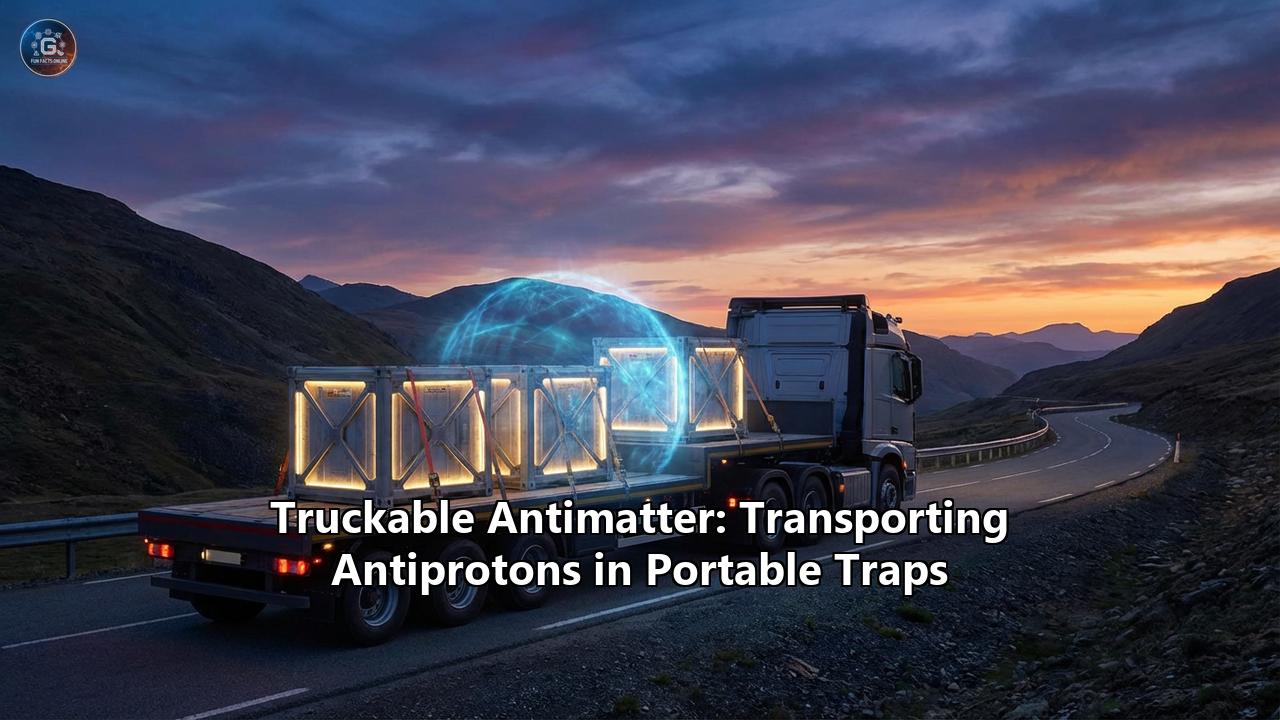
It sounds like the plot of a high-stakes heist movie or a Dan Brown novel: a nondescript truck winding through the scenic roads of the Swiss-French border, carrying a payload so volatile that touching the walls of its container would unleash a burst of pure energy. Inside the vehicle is not gold, nor diamonds, nor a biological weapon, but something far rarer and more precious. It is carrying the mirrored ghost of our reality. It is carrying antimatter.
For decades, antimatter has been the prisoner of the massive particle accelerators that create it. It is the most expensive substance on Earth, estimated at trillions of dollars per gram, and notoriously difficult to keep alive. It vanishes in a flash of gamma rays the instant it meets ordinary matter—which is to say, the instant it meets anything that isn't a carefully manipulated vacuum. But now, a revolution is quietly taking place at CERN, the European Organization for Nuclear Research. The era of static, laboratory-bound antimatter is ending. The era of "truckable" antimatter has begun.
This is the story of how physicists are building the ultimate "thermos"—a portable trap capable of taking the most fragile substance in the universe on a road trip.
Part I: The Factory at the Edge of Town
To understand why we need to put antimatter on a truck, we must first understand where it comes from and why it is currently stuck there.
Deep within the complex of CERN, near Geneva, sits a unique facility known as the Antimatter Factory. While the famous Large Hadron Collider (LHC) smashes protons together to hunt for new particles like the Higgs boson, the Antimatter Factory has a different, quieter goal: to slow things down.
The facility houses the Antiproton Decelerator (AD) and its newer companion, ELENA (Extra Low ENergy Antiproton ring). Creating antimatter is a brute-force affair. A beam of protons from CERN’s Proton Synchrotron is slammed into a block of iridium. The violence of this collision creates a shower of new particles, including a tiny fraction of antiprotons. These newborn antiparticles are traveling at near light speed, hot and unruly. To be useful, they must be tamed. The AD uses strong magnets and electric fields to steer and slow these particles, while ELENA further decelerates them to a "walking pace" (in particle physics terms), making them cold enough to be trapped.
The "Noise" Problem
Here lies the paradox. The very machinery required to create antimatter—the massive accelerators, the pulsing magnets, the high-voltage klystrons—creates a chaotic environment. The Antimatter Factory is "noisy" in the electromagnetic sense. For physicists trying to measure the properties of an antiproton with exquisite precision, this magnetic noise is like trying to listen to a whisper in a heavy metal concert.
Precision experiments, like BASE (Baryon Antibaryon Symmetry Experiment), are trying to determine if the proton and antiproton are exactly identical in mass and magnetic moment, as the Standard Model of physics predicts. A discrepancy of even one part in a trillion could unravel our understanding of the universe and explain why we exist (since the Big Bang should have created equal parts matter and antimatter, which would have annihilated each other instantly).
To find that discrepancy, physicists need silence. They need a laboratory far away from the thrumming accelerators of CERN. But you cannot simply put an antiproton in your pocket and walk away. Hence, the need for a portable trap.
Part II: The Ultimate Thermos
Transporting antimatter is an engineering nightmare. You are trying to move something that cannot touch any physical object. It must be suspended in a perfect void, held in place by invisible hands.
The solution comes in the form of two pioneering projects: BASE-STEP and PUMA.
The Penning Trap
At the heart of both projects is a device called a Penning trap. Named after Frans Michel Penning, this device uses a combination of a strong magnetic field and a weak electric field to confine charged particles.
- The Magnetic Field: A powerful superconducting magnet (typically around 4 Tesla) forces the charged antiprotons to spin in tight circles, preventing them from flying out sideways.
- The Electric Field: Electrodes above and below the particles create a "potential well," gently pushing them back towards the center if they try to escape upwards or downwards.
Inside this trap, the antiprotons float in a vacuum so perfect it rivals deep space. The pressure is around $10^{-16}$ to $10^{-17}$ millibar. To put that in perspective, that is trillions of times lower than the atmospheric pressure at sea level, and significantly lower than the vacuum near the International Space Station. In such a vacuum, an antiproton can circulate for years without hitting a single gas molecule.
BASE-STEP: The Precision Carrier
The BASE-STEP (Symmetry Tests in Experiments with Portable Antiprotons) project is the brainchild of the BASE collaboration. Their device is a marvel of miniaturization. While typical superconducting magnets are room-sized behemoths, the BASE-STEP magnet is compact enough to fit on a small truck.
The entire apparatus weighs about one tonne. It includes:
- The Superconducting Magnet: Keeps the particles radially confined.
- The Cryostat: A vessel filled with liquid helium to keep the system near absolute zero (around 4 Kelvin or -269°C). This cold is vital not just for the magnet, but for the vacuum; at these temperatures, any stray gas molecules "freeze" onto the walls of the chamber, cleaning the vacuum to pristine levels.
- The Battery Bank: A transportable power supply to keep the monitoring electronics and active shielding running during transit.
PUMA: The Nuclear Hunter
The second project, PUMA (antiProton Unstable Matter Annihilation), has a different destination and a different goal. While BASE-STEP wants to take antiprotons to a quiet room for measurement, PUMA wants to take them to a fight.
PUMA aims to transport one billion antiprotons from the Antimatter Factory to a different facility at CERN called ISOLDE. ISOLDE produces rare, radioactive atomic nuclei that decay in milliseconds. These nuclei are too short-lived to be moved to the antimatter trap, so the antimatter must come to them.
The PUMA trap is a "double-zone" trap. One zone stores the antiprotons during transport. The second zone is a "collision chamber" where the antiprotons will be released into a cloud of exotic radioactive nuclei. When an antiproton annihilates with a proton or neutron on the surface of these nuclei, it acts like a scalpel, peeling away the skin of the atom to reveal its internal structure.
Part III: The Road Trip
Building the trap is one thing; driving it down a potholed road is another.
In October 2024, the BASE-STEP team conducted a historic "dress rehearsal." They loaded their one-tonne trap onto a truck. Inside the trap, suspended in the magnetic field, was a cloud of 70 protons. Protons are the matter-counterparts to antiprotons; they are identical in mass but opposite in charge. Crucially, they don't annihilate if they hit the container walls—they just get lost. This made them the perfect crash-test dummies.
The Vibration Challenge
The truck set off from the Antimatter Factory, winding its way through the CERN campus. The journey was only a few kilometers, but for the physicists watching the telemetry, it was a white-knuckle ride.
- G-Forces: A pothole or a sudden brake generates G-forces. If the jolt is too strong, the magnetic field lines could shift, or the electric potentials could wobble, causing the particle cloud to splash against the container walls.
- Helium Slosh: The liquid helium cooling the magnet is a fluid. Sudden movements can cause it to slosh, potentially warming parts of the magnet or inducing "quenching"—a catastrophic loss of superconductivity where the magnet suddenly gains resistance and boils off all its coolant.
To mitigate this, the trap is suspended on an intricate system of air springs and vibration dampers, similar to the technology used to transport delicate satellites. The October 2024 test was a resounding success. The 70 protons survived the trip, proving that the electromagnetic suspension system was robust enough to handle the bumps of a Swiss road.
The "Grace Period"
One of the most anxiety-inducing aspects of the transport is the power requirement. The trap relies on active cooling systems. If the truck breaks down or gets stuck in traffic, the clock starts ticking. The BASE-STEP system is designed with a "grace period." If the generator fails, the thermal inertia of the liquid helium reservoir can keep the trap cold and the vacuum stable for about four hours. After that, the trap warms up, the vacuum degrades, and the antimatter annihilates.
Part IV: Destination - The Future of Medicine
While PUMA and BASE-STEP are focused on fundamental physics, the technology they are pioneering has a potential application that could change lives: Antiproton Therapy.
For decades, doctors have used radiation to kill cancer cells. The most advanced form of this is proton therapy. Protons are heavy charged particles. Unlike X-rays, which deposit energy all the way through the body (damaging healthy tissue in front of and behind the tumor), protons deposit most of their energy at a specific depth known as the Bragg Peak. By tuning the energy, doctors can make the protons stop exactly inside the tumor, sparing the healthy tissue behind it.
Antiprotons can do everything protons can do, but with a lethal "bonus."
The Annihilation Advantage
When an antiproton enters the body, it behaves exactly like a proton, stopping at the tumor site. But the moment it stops, it doesn't just sit there. It captures an electron, forms a pseudo-atom, and then spirals into the nucleus of a nearby cancer cell atom.
- The Explosion: The antiproton annihilates with a nucleon in the cancer cell. This releases a burst of energy (almost 2 GeV) in the form of pions and nuclear fragments.
- The Kill Ratio: Experiments like ACE (Antiproton Cell Experiment) at CERN have shown that antiprotons are up to 4 times more effective at killing cancer cells than protons. The annihilation energy essentially blows the cancer cell nucleus apart from the inside.
- Real-Time Imaging: The pions released during annihilation fly out of the body. By detecting these pions, doctors could image the tumor in real-time, verifying exactly where the beam is hitting. This is a huge advantage over proton therapy, where the exact stopping point is often a calculated guess.
The Delivery Problem
So why aren't we using antiprotons to cure cancer today? Because you can't bring a patient to the Antimatter Factory. The beamlines are fixed, the facility is experimental, and it is not a hospital.
This is where the portable trap changes everything. In the future, "bottled" antimatter could be driven from a production facility like CERN to hospitals in Geneva, Paris, or Milan. A local clinic wouldn't need a billion-dollar particle accelerator; they would just need a "docking station" to receive the trap and extract the antiprotons for treatment.
Part V: Safety and The "Angels & Demons" Myth
Whenever the words "transport" and "antimatter" are combined, the public imagination turns to Angels & Demons, where a canister of antimatter is used as a bomb to threaten the Vatican.
Is a truck carrying antimatter a rolling nuclear weapon? The answer is a definitive no.
The Numbers Game
The confusion comes from mixing up efficiency with quantity. Yes, antimatter annihilation is the most energy-dense process known to physics (100% mass-to-energy conversion, compared to less than 1% for nuclear fusion). However, the amount of antimatter being transported is infinitesimally small.
- The Cargo: PUMA aims to transport about one billion antiprotons.
- The Mass: One billion antiprotons have a mass of roughly $1.6 \times 10^{-15}$ grams. That is a roughly a femtogram.
- The Energy: If that entire cloud of one billion antiprotons were to annihilate at once (say, if the truck crashed), the energy released would be approximately 0.3 Joules.
0.3 Joules is roughly the energy of a small apple falling from a height of one meter. It is less energy than a single match flame. It wouldn't even dent the metal walls of the trap, let alone create a crater.
To create a dangerous explosion—say, equal to the Hiroshima bomb (15 kilotons)—you would need roughly 0.7 grams of antimatter. Producing that amount with current technology would take billions of years and cost more money than exists in the global economy. The "bomb" risk is non-existent. The real risk is simply economic: if the trap fails, you lose a few months' worth of scientific production and millions of dollars in research time.
Part VI: The Antimatter Economy
The successful transport of protons in 2024 and the upcoming antiproton runs in 2025 mark the beginning of a new chapter in physics: the democratization of antimatter.
Currently, if you want to study antimatter, you must move your entire experiment, your students, and your funding to a small hall in Geneva. You must fight for beam time and deal with the magnetic noise of the accelerators.
Portable traps break this monopoly. They envision a future where:
- Remote Research: High-precision labs at universities in Germany, France, or the UK could order a "refill" of antiprotons. They could study the particles in their own magnetically shielded, vibration-isolated basements, achieving precisions impossible at CERN.
- Exotic Hybrids: We can bring antimatter to other particle sources. PUMA is going to ISOLDE, but future traps could go to light sources, neutron sources, or high-intensity laser facilities, creating new states of matter that have never been seen before.
- Fundamental Answers: By allowing more teams to work on antimatter simultaneously in different locations, we accelerate the search for the answers to the biggest questions in cosmology. Why is the universe made of matter? Does antimatter fall up or down? (Current experiments say down, but we need more precision).
Conclusion
The image of a truck rolling down the highway, indistinguishable from any other delivery vehicle but carrying the seeds of cosmic destruction and creation suspended in a magnetic bottle, is a testament to human ingenuity.
We have moved from fearing antimatter as a sci-fi superweapon to manufacturing it, cooling it, and soon, shipping it like Amazon packages. The "truckable trap" is more than just a box; it is a vessel of discovery, promising to carry us beyond the standard model of physics and perhaps, one day, into a new era of medicine. The cargo is invisible, but its weight in the history of science is immense.
Reference:
- https://www.techjuice.pk/cern-finds-an-innovative-way-to-transport-antimatter/
- https://www.fnal.gov/pub/science/inquiring/questions/antimatter1.html
- https://www.quora.com/How-much-energy-would-be-created-by-the-annihilation-reaction-of-one-average-human-with-the-corresponding-amount-of-antimatter
- https://www.sciencenews.org/article/antimatter-protons-travel-truck
- https://cerncourier.com/a/trial-trap-on-a-truck/
- https://www.sciencealert.com/physicists-may-have-figured-out-how-to-safely-transport-antimatter
- https://futurism.com/cern-transport-antimatter
- https://en.wikipedia.org/wiki/Antimatter
- https://home.cern/news/news/physics/transportable-antiproton-trap-unlock-secrets-antimatter
- https://newatlas.com/physics/cern-base-step-transport-antimatter/
- https://home.web.cern.ch/news/news/physics/cern-approves-two-new-experiments-transport-antimatter
- https://www.moffitt.org/taking-care-of-your-health/taking-care-of-your-health-story-archive/proton-radiation-therapy-vs.-photon-radiation-therapy-for-standard-care
- https://en.wikipedia.org/wiki/ACE_experiment
- https://www.cancercenter.com/community/blog/2021/12/whats-the-difference-proton-photon-therapy
- https://www.ilcn.org/proton-beam-therapy-versus-photon-beam-therapy-the-debate-continues/
- https://home.cern/science/experiments/ace
- https://www.interactions.org/node/12401