
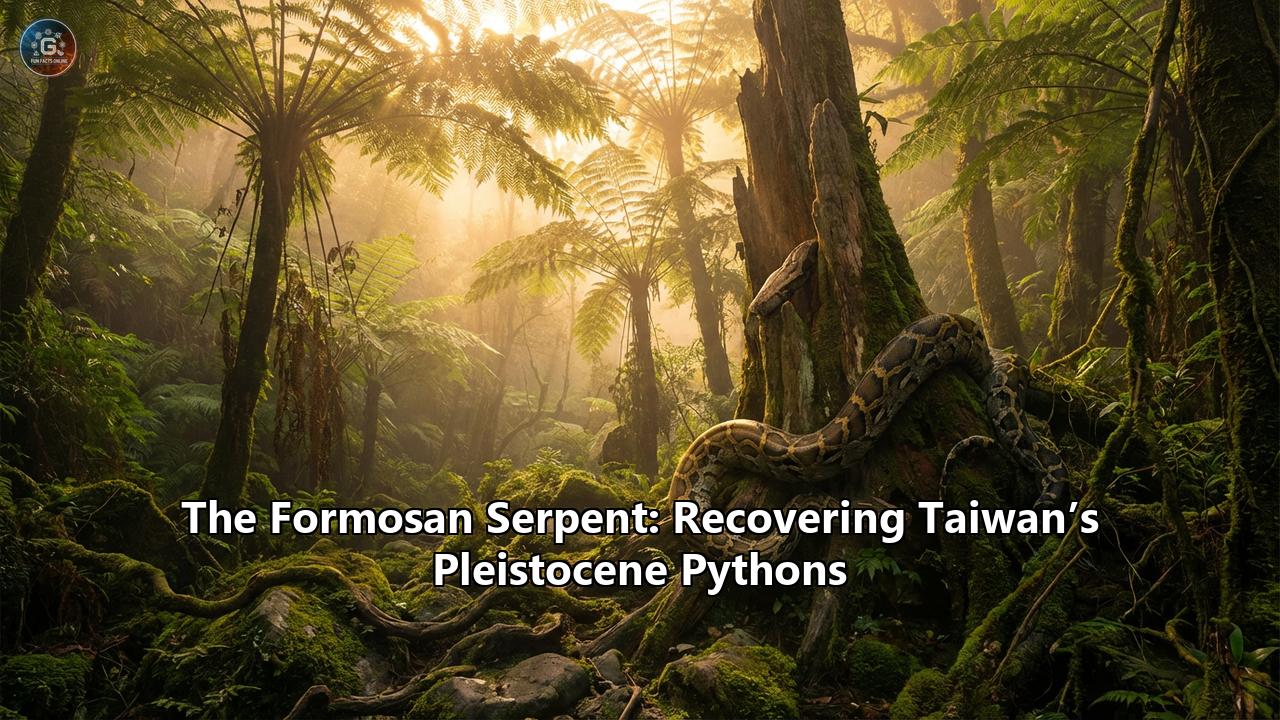
For decades, the paleontological narrative of Taiwan was a story of giants that walked the earth—mammoths, stegodons, saber-toothed cats, and rhinos—but the undergrowth remained largely silent. The island’s dense, humid forests of the past were assumed to be crawling with smaller reptiles, ancestors of the bamboo vipers and cobras that inhabit the island today. But a true leviathan, a serpent capable of rivaling the great constrictors of Southeast Asia, was missing from the record. That silence was broken in early 2026 with a discovery that shook the foundations of Taiwanese herpetology and paleontology.
Hidden within the unassuming beige mudstones of the Chiting Formation near Tainan City lay a single, massive clue: a fossilized trunk vertebra. To the untrained eye, it was a lump of stone. To the researchers at National Taiwan University, it was the key to a lost world. This was not just a snake; it was a monster. It was the first confirmation that the genus Python—the same lineage that includes the massive Burmese and Reticulated pythons—once ruled the main island of Taiwan.
This discovery has birthed the legend of the "Formosan Serpent," a creature that reached lengths of four meters (over 13 feet), dwarfing any snake currently living on the island. Its recovery is not just about a new species; it is about recovering a lost chapter of time, the Middle Pleistocene, when Taiwan was not an island fortress but a wild frontier connected to the Asian mainland, a land where dragons—both serpentine and crocodilian—battled for supremacy in a humid, ancient jungle.
Part I: The DiscoveryThe story begins in the Chiting Formation, a geological treasure trove in southwestern Taiwan. This region is famous among geologists for its badland topography—jagged, moon-like landscapes formed by the erosion of soft mudstone and sandstone. These layers, deposited between 800,000 and 400,000 years ago, are the pages of a book entitled "The Middle Pleistocene."
For years, fossil hunters and scientists had pulled the teeth of elephants and the jaws of crocodiles from these hills. But the vertebrae of snakes are fragile. They are composed of delicate bone that easily disintegrates in the turbulent waters of ancient rivers or crushing sediment. Finding one is rare; finding one of this magnitude is a singularity.
The specimen, cataloged as NTUM-VP 220601, was identified by a team led by Yi-Lu Liaw and Cheng-Hsiu Tsai from the National Taiwan University. Their paper, published in Historical Biology in 2026, details the meticulous process of unlocking the bone's secrets. Using advanced 3D scanning and geometric morphometrics—essentially mapping the landscape of the bone’s surface—they compared the fossil to living snakes.
The architecture of the vertebra was unmistakable. It possessed a massive zygosphene (a locking mechanism between vertebrae) and a specific width-to-length ratio that screamed "constrictor." But it wasn't just any constrictor. It lacked the specific features of boas and matched perfectly with the Pythonidae family. When they ran the size estimates, the numbers were staggering. The snake that once owned this backbone was approximately 4 meters long.
To put this in perspective, the largest snake in Taiwan today is the beauty rat snake (Elaphe taeniura), which can struggle to reach 2.5 meters and is as slender as a whip. The Formosan Serpent was a thick-bodied ambush predator, a heavy-weight wrestler in a world of light-weights.
Part II: Anatomy of the TitanWhat did the Formosan Serpent look like? While we currently possess only vertebrae, the laws of biology allow us to reconstruct the beast with high fidelity. As a member of the genus Python, it likely bore a strong resemblance to the modern Burmese Python (Python bivittatus), its closest living relative found today on the nearby Kinmen Islands and mainland Asia.
The Body of a constrictor:A 4-meter python is a biological hydraulic press. Its body is a masterpiece of muscle, designed for one purpose: constriction. Unlike venomous snakes, which rely on chemical warfare, the Formosan Serpent relied on mechanical advantage. It would have had a robust, heavy midsection. Its skin was likely patterned with complex blotches of brown, tan, and black—a camouflage necessary to disappear into the leaf litter of the Pleistocene forest floor.
The Skull and Jaws:Though the skull is missing, we can infer it possessed the recurved, needle-sharp teeth typical of pythons. These teeth are not for chewing; they are grappling hooks. Upon striking, the python slams its mouth onto prey, the teeth angling backward to prevent escape. Then, the coils follow. The skull would have been kinetic, with a jaw capable of unhinging to swallow prey larger than its own head—perhaps a young deer or a piglet.
Sensory Systems:Like its modern cousins, the Formosan Serpent almost certainly possessed heat-sensing pits along its upper lip. These biological thermal cameras would have allowed it to hunt in total darkness, detecting the infrared heat signature of a warm-blooded mammal against the cool night air. In the dense, canopy-covered forests of ancient Tainan, where light was scarce, this sixth sense was a superweapon.
Part III: The World of the Middle PleistoceneTo understand the serpent, we must understand its world. The Taiwan of 800,000 years ago was not the island we know today. It was a time of fluctuating ice ages.
The Land Bridge:During the glacial periods of the Pleistocene, massive volumes of the Earth's water were locked up in polar ice caps. Global sea levels plummeted, often by over 100 meters. The Taiwan Strait, currently a shallow sea separating the island from China, dried up. It became a vast, grassy plain—a superhighway for migration.
This land bridge was the conduit that brought the giants to Taiwan. It allowed the Stegodon (an ancient relative of the elephant with massive, roof-like tusks) to lumber across from the Fujian province. It allowed the rhinos to trot into the wetlands of Tainan. And slithering silently behind them, following the scent trails of these great migrations, came the pythons.
The Climate and Flora:The Chiting Formation suggests a paleoenvironment that was "humid fluvial." Imagine a landscape dominated by braided river systems, vast wetlands, and open woodlands. It was wetter than modern southern Taiwan.
Pollen analysis from the region paints a picture of a dynamic flora. In the lowlands, where the python hunted, the vegetation was tropical and subtropical. Dense thickets of evergreen oaks (Quercus), bushy shrubs, and tall grasses provided ample cover. The air was thick with humidity, buzzing with insects, and heavy with the scent of damp earth and decaying vegetation—a perfect incubator for a reptile that relies on ambient temperature to fuel its metabolism.
Part IV: The Chochen Fauna - A Neighborhood of GiantsThe Formosan Serpent was not alone. It lived in a biological community known as the "Chochen Fauna" (or Zuozhen Fauna). This assemblage of animals represents the zenith of Taiwan’s prehistoric biodiversity.
*The Rival: Toyotamaphimeia---
Perhaps the most dramatic relationship in this ancient ecosystem was between the python and the crocodile. In 2023, paleontologists described a massive extinct crocodilian from Taiwan, Toyotamaphimeia taiwanicus. This was a gavialid crocodile, distinct from the estuarine crocodiles of today.
Imagine the riverbanks of ancient Tainan. On the mudflat, a 4-meter python basks in the sun. In the water, a massive crocodile watches. These two apex predators occupied similar niches. They both hunted medium-sized mammals; they both required water; they both ruled the interface between land and river. It is highly probable that they were competitors. In modern Florida, alligators and invasive Burmese pythons engage in lethal battles. It is not a stretch to envision the Formosan Serpent and Toyotamaphimeia locked in a similar prehistoric struggle—a clash of scales and teeth that would have churned the waters of the ancient Chiting rivers.
The Prey:A 4-meter snake needs substantial fuel. The Chochen Fauna provided a buffet.
- Deer: The Cervus species of the time were abundant. A fawn or a smaller doe would have been an ideal meal.
- Wild Boar: Ancestors of the modern Formosan wild boar roamed these forests. Pigs are a favorite prey of modern large pythons due to their density and noise.
- Macaques: The ancestors of the Formosan rock macaque were likely present, filling the canopy. Pythons are excellent climbers; a sleeping monkey would have been an easy target.
- Baby Megafauna: While a full-grown Stegodon or Rhinoceros was too large, their calves were vulnerable. The python likely played a role in culling the young of these giants, acting as a population control mechanism.
Was the python the king? Not entirely. The Chochen Fauna also included Homotherium, the scimitar-toothed cat. While a cat might hesitate to attack a fully grown 4-meter snake, a younger python would have been a substantial meal for a feline predator. The python was part of a "guild of giants," a complex web of predators that kept the herbivores in check.
Part V: A Day in the Life of the SerpentLet us reconstruct a day in the life of this lost reptile, 500,000 years ago.
The dawn breaks over the braided river valley of what is now Tainan. The air is cool, and mist clings to the surface of the water. The Formosan Serpent, coiled tightly within the hollow of a rotted ancient oak, begins to stir. It is cold-blooded, and the night has sapped its energy. It slowly unfurls, its massive scales sliding silently over the wood.
It moves towards a sunlit patch of riverbank. For three hours, it does nothing but lie still. To an observer, it looks like a fallen log. But inside, its blood is warming, its metabolism clicking into gear.
By mid-afternoon, it is ready to hunt. It slips into the river. It is a graceful swimmer, its body undulating just below the surface. It crosses the channel to a game trail used by Sika deer. Here, the serpent hauls itself out, the water glistening on its patterned skin. It finds a spot near the trail, burying itself partially in the leaf litter, leaving only its head exposed, eyes unblinking, heat pits scanning.
Hours pass. The sun begins to dip. A young boar, separated from its sounder, trots down the path, rooting for tubers. The python senses the vibration of hooves before it hears the animal. Then, the thermal image of the boar blooms in the snake's sensory pits—a glowing red ghost against the cooling blue background of the forest.
When the boar is within striking distance—less than a meter—the explosion of violence is too fast for the mammalian eye to track. The strike takes less than a second. The teeth hook into the boar’s shoulder. The momentum of the snake’s heavy body knocks the prey off its feet. Instantly, the coils are thrown. One loop, two loops. The snake tightens. It feels for the boar’s heartbeat. Every time the boar exhales, the snake tightens further, stealing the space in the lungs.
Silence returns to the forest. The struggle is over. The python spends the next hour consuming its prize, unhinging its jaw to engulf the meal. Once swallowed, the snake is vulnerable, weighed down by its feast. It retreats to a safe, hidden burrow—perhaps a cave in the limestone cliffs—to digest. It will not need to eat again for months.
Part VI: The Great DisappearanceWhy is the Formosan Serpent gone? Why do hikers in Taiwan today not have to worry about 13-foot constrictors?
The extinction of the Formosan Serpent is likely tied to the broader collapse of the Chochen Fauna. Around the transition from the Middle to Late Pleistocene, and certainly by the arrival of the Holocene, Taiwan’s giants vanished.
Theory 1: The Climate ShiftThe Pleistocene was a time of radical change. As glacial periods ended and the world warmed, sea levels rose. The land bridge to China was severed, turning Taiwan into an island. This isolation had two effects:
- Genetic Isolation: The population was cut off from the mainland gene pool.
- Habitat Change: Rising seas changed the local climate. The broad, open river valleys might have given way to denser, more closed rainforests or different vegetation patterns that supported less prey biomass.
A predator is only as secure as its food source. The extinction of the megaherbivores—the stegodons and rhinos—removed a significant chunk of the biomass from the island. While the python didn't eat adult elephants, the disappearance of the large herbivores likely triggered a "trophic cascade." The landscape changed (without elephants to knock down trees, forests became denser), and the diversity of medium-sized prey may have shifted.
Theory 3: The Thermal LimitPythons are sensitive to cold. While the current climate of Taiwan is subtropical, there were periods during the Last Glacial Maximum (around 20,000 years ago) where temperatures in Taiwan dropped significantly. If the python population was already stressed by isolation, a prolonged cold snap could have wiped them out, especially if they were unable to find deep enough hibernacula (winter dens).
Theory 4: The Arrival of Man?Did early humans kill the serpent? There is evidence of hominins in the region (Penghu Man, Zuozhen Man) dating back tens to hundreds of thousands of years. Large snakes are often targeted by humans for food and skin, or killed out of fear. However, given the timeline of the fossil (up to 800,000 years old), it is possible the snake vanished before modern humans established a heavy footprint. But if they survived into the Late Pleistocene, human hunting could have been the final nail in the coffin.
Part VII: The Modern VoidToday, Taiwan has over 50 species of snakes. We have the fierce Hundred-Pacer (Deinagkistrodon), the elegant Cobra (Naja atra), and the massive-for-its-kind King Rat Snake (Elaphe carinata). But none are giants.
The ecological niche of the "apex reptile predator" is empty. There is no creature in modern Taiwan that can take down a wild boar or a muntjac deer with the efficiency of the Formosan Serpent. This void has consequences. The population of macaques and wild boars in Taiwan often booms, causing conflict with farmers. In the Pleistocene, the python (along with the clouded leopard and bears) would have been a natural check on these populations.
The discovery of the fossil highlights just how "depauperate" (species-poor) our modern world is compared to the past. We are living in the aftermath of a great dying, walking through a landscape that is missing its kings.
Part VIII: The Scientific SignificanceThe recovery of the Formosan Serpent is a triumph for the "Historical Biology" of East Asia.
- Biogeography: It proves that Python had a much wider range in the past. It suggests that the python populations on the mainland (China/Southeast Asia) were pulsing in and out of islands like Taiwan with the beating heart of the glacial cycles.
- Conservation Benchmarking: To understand how to protect nature, we must know what "natural" looks like. This fossil tells us that a "natural" Taiwan includes giant reptiles. While we cannot bring them back (Jurassic Park remains fiction), this knowledge helps us appreciate the resilience of the species that did survive.
- The Power of Technology: The use of 3D scanning to identify a single damaged vertebra showcases the future of paleontology. We no longer need complete skeletons to tell big stories. A single bone, analyzed with the right algorithm, can resurrect a monster.
The Formosan Serpent sleeps in the stone of Tainan, a silent witness to a time when Taiwan was a wilder, more dangerous, and more magnificent place. It reminds us that the island’s history is deep, written not just in human archives, but in the very bedrock beneath our feet.
When you walk the trails of Kenting or the forests of Alishan, and you hear the rustle of leaves, you might see a small rat snake slither away. But in your mind’s eye, remember the Formosan Serpent. Remember the 4-meter giant that once lay in those same shadows, the lost dragon of Taiwan’s Pleistocene. It is no longer a myth; it is science. And it is a spectacular addition to the natural heritage of this beautiful island.
Reference:
- https://en.wikipedia.org/wiki/Last_Glacial_Period
- https://www.researchgate.net/publication/255634095_Late_Holocene_Pollen_Sequence_of_the_Ilan_Plain_Northeastern_Taiwan_and_its_Environmental_and_Climatic_Implications
- https://www1.ihp.sinica.edu.tw/en/Publications/Bulletin/94/Article/227
- https://www.nmp.gov.tw/en/cp.aspx?n=2171
- https://en.wikipedia.org/wiki/Prehistory_of_Taiwan
- https://www.youtube.com/watch?v=nroKZkWunhw
- https://www.sixthtone.com/news/1018027