
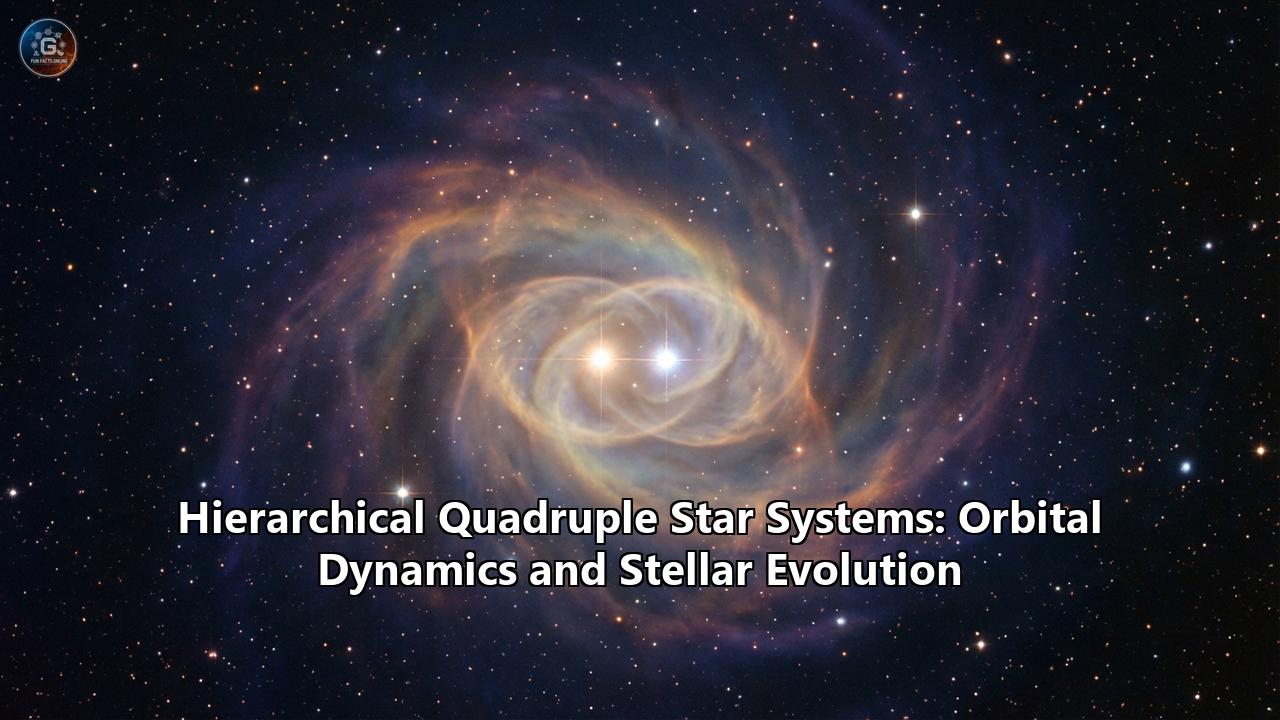
When we gaze up at the night sky, our Earth-centric bias leads us to view the stars as solitary lanterns burning in the dark. Because our own Sun travels through the Milky Way without a stellar companion, it is easy to assume that single stars are the standard configuration of the cosmos. However, modern astrophysics has revealed a universe that is far more crowded, complex, and socially intertwined. A significant fraction of the stars in our galaxy are bound in binary systems, and beyond that, an estimated 10% of solar-type stars reside in triple systems. Yet, it is within the rarest and most intricate architectural triumphs of gravity—hierarchical quadruple star systems—that the true mechanical genius of the cosmos is put on display.
Making up roughly 1% of solar-type stellar systems, quadruple stars are not mere astronomical curiosities; they are cosmic laboratories. Within their gravitational embrace, we can observe the extremes of orbital dynamics, the chaotic exchange of orbital parameters, the bizarre phenomenon of stellar rejuvenation, and the explosive forging of the universe's heaviest elements through thermonuclear supernovae. To understand a quadruple star system is to understand a multi-generational, billion-year-long gravitational dance that ends, more often than not, in spectacular destruction.
The Architectural Blueprints: How to Build a Quadruple System
If you were to take four stars and place them at random in the vacuum of space, giving them arbitrary velocities, the result would be a rapid descent into chaos. According to the laws of the $N$-body problem, non-hierarchical multiple star systems are inherently unstable. The complex, unpredictable transfer of kinetic and potential energy between the four bodies would quickly result in one or more stars being violently ejected from the system, reducing the quartet to a stable binary or a triple system.
For a quadruple system to survive for millions or billions of years, it must arrange itself into a strict, nested hierarchy—essentially cosmic Russian nesting dolls. Astronomers categorize these stable configurations into two primary architectures: the "2+2" and the "3+1" configurations.
The 2+2 Configuration (The Double-Double):In a 2+2 system, two distinct pairs of binary stars exist. Pair A consists of two stars orbiting a shared center of mass, and Pair B consists of two other stars orbiting their own shared center of mass. These two binary pairs then orbit around a grand, central barycenter. From a distance, Pair A and Pair B act as single point masses relative to one another. A famous visual example of this is Epsilon Lyrae, widely known among amateur astronomers as the "Double Double." However, modern transit surveys like the Transiting Exoplanet Survey Satellite (TESS) are revealing much tighter, highly interactive 2+2 systems. Recent discoveries include the immensely compact quadruples TIC 392229331 and TIC 285853156, which have incredibly short outer orbital periods of just 145 and 152 days, respectively. These systems are so compressed that their mutual gravitational perturbations happen on human timescales.
The 3+1 Configuration:In this architecture, the system is built upon a hierarchical triple. A close binary pair is orbited by a third star at a moderate distance. This entire three-star arrangement is then orbited by a distant fourth star. While stable, the 3+1 configuration is notoriously susceptible to long-term dynamical instability. If the orbit of the third star becomes too eccentric, it can easily disrupt the delicate balance of the inner binary, leading to a catastrophic stellar collision or an ejection.
Orbital Dynamics: The Mechanics of Chaos and Secular Evolution
The true magic of quadruple star systems lies not just in their physical arrangement, but in their orbital evolution. The orbits of these stars are not static, unchanging ellipses. Because the gravitational pull of the distant components is constantly tugging on the inner binaries, the system undergoes what astronomers call "secular evolution"—long-term, periodic changes in the shape and tilt of the orbits that occur over thousands to millions of years.
At the heart of this evolution is a mesmerizing gravitational phenomenon known as the von Zeipel-Lidov-Kozai (ZLK) mechanism. First theorized in the early 20th century by Swedish astronomer Hugo von Zeipel (1910), and later independently rediscovered by Soviet dynamicist Mikhail Lidov (1961) and Japanese astronomer Yoshihide Kozai (1962), this mechanism explains how a distant tertiary body can drastically alter the orbit of an inner binary.
In a standard triple system, the ZLK mechanism dictates that the inner binary exchanges its orbital inclination (its tilt) for eccentricity (its elongation). The distant third star exerts a tidal torque that slowly pumps up the eccentricity of the inner binary, making its orbit highly elliptical, while simultaneously decreasing its inclination. When the orbit becomes nearly flat relative to the third star, the process reverses: the orbit circularizes, and the inclination rises again. This cyclic exchange can drive an initially circular orbit into a highly eccentric one, causing the two inner stars to pass dangerously close to one another at periastron (their closest point of approach).
In quadruple star systems, however, the ZLK mechanism is put into overdrive. Because of the additional degrees of freedom provided by the fourth star, quadruple systems lack the commuting constants of motion that constrain triple systems. When mathematical models expand the Hamiltonian equations to the "octupole order" to account for these complex interactions, a startling reality emerges: quadruple systems are subjected to immensely enhanced eccentricity oscillations compared to triple systems.
The fraction of inner binaries that reach extreme eccentricities is significantly higher in quadruples. Furthermore, unlike triple systems where the fraction of highly eccentric systems plateaus, in quadruple systems, the fraction of systems reaching extreme eccentricities actively grows over time. The inner binaries are driven into chaotic, highly elliptical orbits where tidal friction begins to sap their orbital energy. This friction robs the stars of angular momentum, causing their orbits to shrink dramatically. Population synthesis simulations have shown that this exact combination of ZLK oscillations and tidal friction is responsible for creating the mysterious "short-period" binaries we frequently observe in the universe—stellar pairs that orbit each other in a matter of mere days.
Beyond the ZLK mechanism, compact 2+2 quadruple systems can also become locked in intricate orbit-orbit resonances. Much like the moons of Jupiter, the two binary pairs can migrate through tidal dissipation or magnetic braking until their orbital periods sync up into integer ratios, such as 3:2, 2:1, or 1:1. This resonant capture acts as an anchor, binding the evolutionary fates of all four stars together in a mathematically perfect harmony.
Stellar Evolution in the Quadruple Crucible
To fully appreciate a quadruple star system, one must realize that the stars themselves are not static billiard balls; they are aging, evolving, and expanding nuclear furnaces. As the millions of years tick by, the most massive star in the quadruple will burn through its hydrogen fuel the fastest. Once its core hydrogen is depleted, the star will expand outward into a red giant or supergiant.
If this star were single, it would simply swell up and eventually blow off its outer layers. But in the tight, gravitationally restricted confines of a binary pair within a quadruple system, expanding outward comes with severe consequences. As the star expands, it eventually fills its "Roche lobe"—the teardrop-shaped region of space around a star within which orbiting material is gravitationally bound to it. Once the star's outer atmosphere breaches this boundary, the material is siphoned off by the immense gravitational pull of its companion star.
This process, known as Roche Lobe overflow, results in massive amounts of stellar material—often half a solar mass or more—pouring onto the smaller companion. The consequences of this mass transfer are profound. The recipient star, suddenly flushed with fresh, unburned hydrogen fuel, undergoes a process known as stellar rejuvenation. From the outside, the star appears to age backward, burning hotter and brighter, looking millions of years younger than it actually is. This phenomenon acts as a trap for astronomers attempting to date stellar populations, as mass-transfer binaries completely defy standard single-star evolutionary models.
However, mass transfer is not always a peaceful exchange. If the giant star expands too rapidly, the smaller companion cannot accrete the incoming material fast enough. The companion star becomes completely engulfed in the outer atmosphere of the giant, triggering a "Common Envelope" phase. Friction from moving through the dense stellar gas causes the companion to rapidly spiral inward toward the giant's core. This orbital decay releases an immense amount of gravitational potential energy, which eventually blows the shared envelope completely out of the system. What remains is an ultra-tight binary consisting of the giant's stripped core (often a white dwarf) and the surviving companion.
In a quadruple system, the ejection of a common envelope can have systemic repercussions. The sudden loss of mass from the inner binary weakens its gravitational grip on the outer binary, causing the entire quadruple framework to expand or, in extreme cases, destabilize entirely.
The Explosive Endgame: Supernovae and Compact Objects
The ultimate destiny of a quadruple star system is dictated by the mass of its components. Over billions of years, the stars will eventually die, leaving behind stellar remnants: dense white dwarfs, rapidly spinning neutron stars, or black holes. When a quadruple system evolves into a quartet of dead stars, the gravitational dynamics become terrifyingly violent.
One of the greatest unsolved mysteries in modern astrophysics is the precise origin of Type Ia supernovae. These colossal thermonuclear explosions are used as "standard candles" to measure the expansion rate of the universe, yet their exact progenitors remain debated. It is widely accepted that Type Ia supernovae occur when a white dwarf star accretes too much mass and exceeds the Chandrasekhar limit (roughly 1.4 times the mass of the Sun), triggering a runaway fusion reaction. However, recent observations suggest that up to 85% of Type Ia supernovae result from the explosive merging of two white dwarfs, both of which have masses below the Chandrasekhar limit (sub-Chandrasekhar mass models).
Quadruple star systems have recently emerged as the premier factories for these cataclysmic events. Because quadruple systems force their inner binaries into wildly eccentric orbits via the enhanced octupole-order von Zeipel-Lidov-Kozai mechanism, they act as cosmic particle accelerators for white dwarfs. When two white dwarfs are part of an inner binary in a quadruple system, the distant pairs' gravitational perturbations drive the white dwarfs into highly elliptical orbits, bringing them incredibly close to one another.
As they whip past each other at a fraction of the speed of light, they emit gravitational waves—ripples in the fabric of spacetime. The emission of gravitational waves drains orbital energy from the system, causing the white dwarfs to spiral toward each other. Taking into account general relativistic precession and tidal dissipation, astrophysical models show that the merger rate of white dwarfs is enhanced by a staggering factor of 3.5 to 10 in quadruple systems compared to triple systems.
We are already witnessing the precursors to these explosions in our own galaxy. In 2017, astronomers utilizing the Gaia-ESO Survey discovered HD 74438, a 2+2 quadruple system located in the young open star cluster IC 2391. At only 43 million years old, HD 74438 is the youngest spectroscopic quadruple known, and its outer orbital period is a mere 6 years. Advanced simulations of HD 74438's future indicate that the outer binary is actively pumping the eccentricity of the inner binary. Over the coming millions of years, the stars will evolve into white dwarfs, and the intense gravitational dynamics of their 2+2 architecture will force them to collide, sparking a brilliant thermonuclear Type Ia supernova.
Planetary Guests: Worlds with Four Suns
Could life exist in such a chaotic gravitational environment? Surprisingly, yes. The same strict hierarchical rules that keep the four stars from flying apart also create stable orbital pockets where exoplanets can reside.
In a 2+2 quadruple system, a planet would most likely be "circumbinary"—meaning it orbits one of the tight binary pairs, much like the fictional planet Tatooine, but with two more distant suns shining in its sky. The most famous example of a confirmed exoplanet in a quadruple system is Kepler-64b (also known as PH1, discovered by the citizen science project Planet Hunters). Kepler-64b is a gas giant that orbits a tight binary pair, while a second binary pair orbits the system from a distance of about 1,000 astronomical units (1,000 times the distance from the Earth to the Sun).
However, finding these planets is exceptionally difficult. In planetary transit surveys like NASA's TESS or the upcoming European Space Agency's PLATO mission, eclipsing multiple star systems act as the ultimate "astrophysical impostors". When a faint, background eclipsing binary within a quadruple system passes in front of its brighter companions, the slight dip in the total light output can perfectly mimic the transit of an Earth-sized exoplanet. Astronomers must utilize highly advanced photodynamical models and spectroscopic radial velocity measurements to disentangle the overlapping light curves and definitively prove whether they are looking at a four-star system or a genuine planetary transit. As a byproduct of this rigorous vetting, citizen scientists and machine learning algorithms have recently cataloged over 100 new quadruple star candidates within the TESS Full-Frame Images, vastly expanding our map of these complex systems.
The Symphony of the Spheres
Hierarchical quadruple star systems represent the pinnacle of celestial mechanics. They are delicate clockworks of gas and gravity, where the slightest perturbation from a distant companion can ripple inward, fundamentally altering the evolutionary destiny of a star. Through the sheer mathematical beauty of the von Zeipel-Lidov-Kozai mechanism, orbits are stretched and flipped, driving stars to share their lifeblood through mass transfer, rejuvenate their dying cores, or spiral into catastrophic, universe-illuminating collisions.
As our telescopes peer deeper into the Milky Way, analyzing the spectral fingerprints of millions of stars simultaneously, the illusion of the solitary star continues to shatter. The cosmos is deeply interconnected. In the grand, chaotic ballroom of the galaxy, the quadruple star system stands as a testament to the chaotic, destructive, and deeply creative power of gravity—a four-part harmony echoing across billions of years of cosmic history.
Reference:
- https://en.wikipedia.org/wiki/HD_74438
- https://sciencesprings.wordpress.com/tag/quadruple-system-hd-74438-is-a-member-of-the-young-open-star-cluster-ic-2391/
- https://www.researchgate.net/publication/390846184_The_Discovery_of_Two_Quadruple_Star_Systems_with_the_Second_and_Third_Shortest_Outer_Periods
- https://www.researchgate.net/publication/392116450_The_Discovery_of_Two_Quadruple_Star_Systems_with_the_Second_and_Third_Shortest_Outer_Periods
- https://arxiv.org/abs/2504.12239
- https://www.techexplorist.com/astronomers-spotted-quadruple-stars-spark-supernova-explosions/47355/
- https://en.wikipedia.org/wiki/Kozai_mechanism
- https://presentations.copernicus.org/EPSC2020/EPSC2020_269_presentation.pdf
- https://www.researchgate.net/publication/337164032_The_Lidov-Kozai_Oscillation_and_Hugo_von_Zeipel
- https://universemagazine.com/en/how-quadruple-star-systems-turn-into-supernovae/
- https://www.sci.news/astronomy/type-ia-supernovae-quadruple-systems-10812.html
- https://ouci.dntb.gov.ua/en/works/4Lwq08a7/
- https://academic.oup.com/mnras/article/542/1/364/8215206
- https://www.semanticscholar.org/paper/101-Eclipsing-Quadruple-Star-Candidates-Discovered-Kostov-Powell/4b702034493a1ea297045b2d12858493215ddecd