
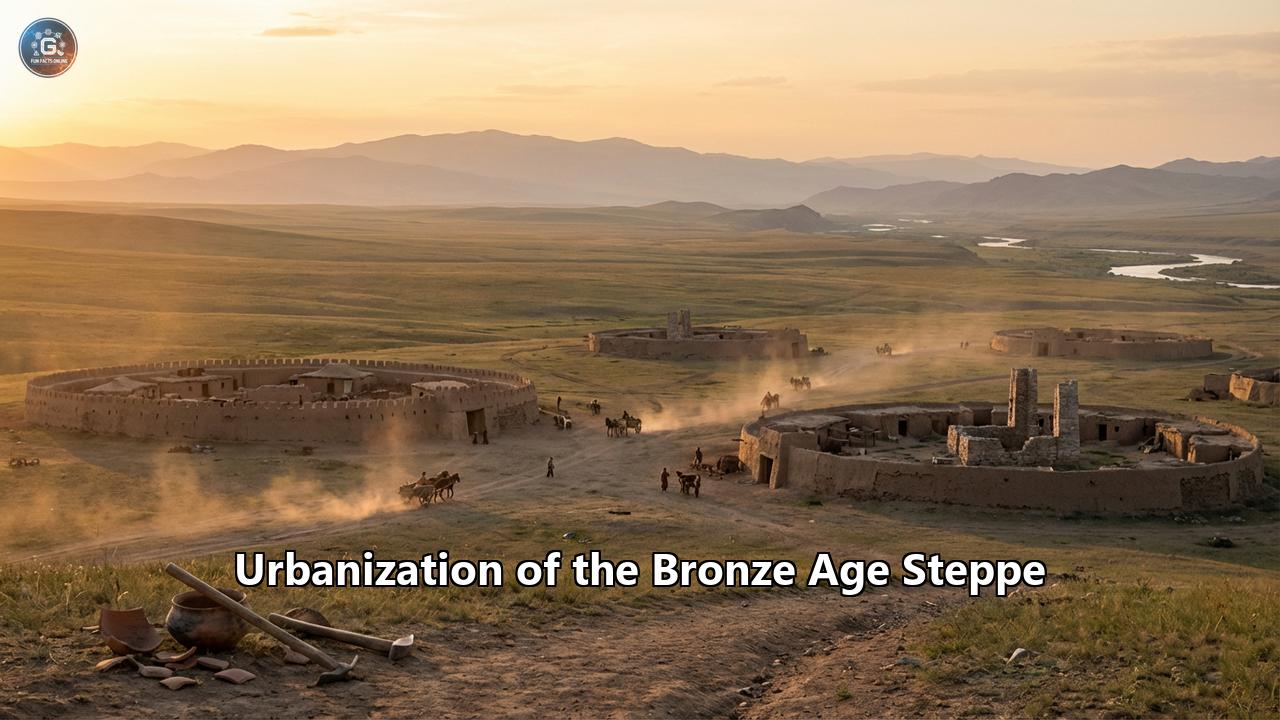
The wind howls across the Ural-Tobol steppe, a vast, treeless ocean of grass that stretches from the borders of Europe deep into the heart of Asia. For centuries, history books told us that this landscape was the eternal domain of the nomad—a place where human existence was defined by movement, where the only permanent structures were the burial mounds of chieftains, and where civilization was something that happened elsewhere, in the fertile river valleys of Mesopotamia, Egypt, or the Indus.
But beneath the grass, the steppe has been keeping a secret.
In the late 20th and early 21st centuries, a series of archaeological discoveries shattered the old narrative of the "barbarian" steppe. Instead of a primitive void, researchers found the charred, fossilized remains of a sophisticated, industrial civilization that flourished over 4,000 years ago. They found cities built in circles like star-maps, fortified industrial centers that churned out tons of copper and bronze, and the earliest known war chariots in human history.
This is the story of the Urbanization of the Bronze Age Steppe—a lost chapter of human history that challenges our very definition of what a "city" is, and reveals how a mysterious people on the edge of the known world forged the technologies and genes that would shape the future of Eurasia.
Part I: The Invisible Empire
The Discovery of the "Country of Towns"
The story begins not with a whimper, but with a near-disaster. In 1987, Soviet engineers were preparing to flood a valley in the southern Ural Mountains to create a reservoir. Aerial surveys had spotted strange circular embankments in the area, dismissed by many as Soviet-era agricultural remnants or natural formations. But a team of archaeologists, led by Gennady Zdanovich, was granted a brief window to investigate before the waters rose.
What they found stopped the bulldozers.
They uncovered Arkaim, a fortified settlement dated to around 2100 BCE. But Arkaim was not a mere village. It was a machine for living—a perfectly circular, planned city with concentric walls, elaborate drainage systems, and a layout that seemed to mirror the heavens.
The discovery of Arkaim led to a feverish search of the surrounding region. Soon, satellite imagery and aerial photography revealed that Arkaim was not alone. It was part of a massive network of over 20 similar fortified settlements spread across an area the size of northern Italy. Archaeologists dubbed this the "Country of Towns" (Strana Gorodov).
These were not organic cities that grew haphazardly over centuries like London or Rome. They were planned communities, built from scratch with a singular vision, inhabited for a few centuries, and then—in a final, puzzling act—ritually burned to the ground and abandoned.
The Semiyarka Revelation: A New Scale of Industry
While Arkaim and the Sintashta culture (named after the Sintashta river site) have been known for decades, the story of steppe urbanization is still being rewritten today. In late 2025, the archaeological world was rocked by findings at Semiyarka in the Kazakh steppe.
For years, Semiyarka was thought to be a minor site. But new excavations revealed a "proto-city" of staggering proportions—covering nearly 140 hectares (350 acres). Unlike the compact fortress-cities of the Urals, Semiyarka was a sprawling industrial hub.
Here, researchers found an entire "industrial zone" dedicated to tin-bronze production. The scale was unlike anything previously seen in the steppe. Thousands of tons of slag, endless rows of furnaces, and evidence of complex labor organization suggested that this was not just a settlement; it was a factory-city, a "Detroit of the Bronze Age" that supplied the weapons and tools for a continent-spanning trade network.
The Semiyarka discovery proved that steppe urbanization wasn't a fluke or a short-lived experiment. It was a fundamental restructuring of human society in a landscape previously thought to be incapable of supporting cities.
Part II: Anatomy of a Steppe City
The Circular Fortress
The architecture of the Sintashta-Arkaim culture is unique in the ancient world. Imagine a giant wagon wheel pressed into the earth.
- The Walls: Arkaim was surrounded by two concentric defensive walls built from clay blocks packed into timber frames. The outer wall was nearly 5 meters thick and surrounded by a deep moat.
- The Labyrinth: The entrance was not a simple gate. It was a labyrinthine passage designed to confuse attackers and, perhaps, to serve a ritual function, forcing visitors to walk a specific path before entering the sanctum of the city.
- The Apartments: Inside the walls, the houses were not free-standing. They were arranged like slices of pie, sharing common walls and facing inward toward a central square. Each "house" was a multi-room apartment ranging from 100 to 180 square meters.
- Modern Amenities: These were not primitive huts. Each dwelling had a well, a cellar for cold storage, and—most remarkably—a complex drainage system that channeled rainwater and sewage out of the city, a feat of civil engineering that rivals the famous plumbing of Mohenjo-Daro in the Indus Valley.
A City of Fire and Metal
What makes these cities truly distinct is that they were not just for living; they were for producing.
Excavations at Arkaim and Sintashta revealed a furnace in almost every single house. This was not a society where a few smiths worked in a separate quarter. This was a society where everyone was a metallurgist. The city was a collective factory.
Imagine the sensory experience of Arkaim: the roar of dozens of furnaces firing simultaneously, the smell of sulfur and charcoal smoke hanging heavy in the air, the glow of molten copper illuminating the night. These were "cities of fire," industrial bastions in a hostile landscape.
Part III: The Engines of Urbanization
Why build cities in the steppe? The environment is harsh, with brutal winters and dry summers. The grass is better suited for mobile herding than sedentary farming. What drove these people to settle down behind high walls?
1. The Metallurgy Boom
The primary engine was metal. The Ural Mountains are rich in copper and arsenic ores. The Sintashta people realized that by settling near these deposits and organizing their labor, they could produce metal on a scale that mobile herders could not.
They weren't just making trinkets. They were producing heavy weapons—axes, spearheads, and daggers—that were traded south to the rich city-states of the Bactria-Margiana Archaeological Complex (BMAC) in Central Asia, and potentially as far as Mesopotamia. The steppe cities became the primary suppliers of raw materials for the "civilized" world's wars.
2. The Invention of the Chariot
The second engine was warfare. The Sintashta culture is widely credited with one of the most terrifying inventions in military history: the spoked-wheel war chariot.
Before Sintashta, carts had heavy, solid wooden wheels. They were slow and clumsy. The Sintashta engineers used bent wood and leather to create a lightweight wheel with spokes. This allowed for a vehicle that was fast, maneuverable, and devastating on the open plains.
The chariot required a specialized infrastructure. You needed carpenters to bend the wood, tanners to cure the leather, smiths to cast the bronze bits, and trainers to break the horses. This complexity required a settled population—a city—to sustain it.
3. Climatic Pressure
Environmental historians suggest a third driver: Climate Change. Around 2500-2000 BCE, the steppe became colder and drier. The lush marshes that mobile herders relied on for winter pasture began to shrink.
Faced with dwindling resources, the population had two choices: fight or innovate. They chose both. They settled down in the remaining prime river valleys, built walls to protect their herds from rivals, and turned to metallurgy to trade for the food they couldn't grow. The "fortress city" was a survival bunker against a drying world.
Part IV: Society and the Spirit
The Warrior Elite
The cemeteries surrounding these cities reveal a highly stratified society. We find the graves of "Chariot Warriors"—men buried with their vehicles, their weapons, and sacrificed horses.
These were the knights of the Bronze Age. They likely controlled the metal trade and "protected" the city. The physical stress markers on their skeletons show they were physically robust, trained from childhood in archery and horsemanship.
Interestingly, isotopic analysis suggests that while the elite men were often local, the women frequently came from far away. This hints at a system of exogamy—marrying women from distant tribes to seal alliances and trade deals.
The Cosmic City: Mandala of the Steppe
Arkaim is often called the "Russian Stonehenge" because of its potential use as an astronomical observatory. The orientation of the walls and gates aligns with the sunrise and sunset on the solstices and equinoxes.
But it goes deeper than that. The layout of Arkaim—circles within circles, divided into quadrants—bears a striking resemblance to the Mandala in Indian tradition and the Vara of Yima in Iranian mythology.
In the Zoroastrian Avesta, the mythical king Yima is told by the god Ahura Mazda to build a "Vara" (an enclosure) to protect the seeds of life from a terrible coming winter. He is instructed to build it in a circle, with streets and water channels.
Many scholars believe Arkaim is the archaeological reality behind this myth. The "winter" was the climatic downturn; the "Vara" was the fortified city. These cities were not just factories; they were religious models of the universe, designed to create order in a chaotic world.
The Rituals of Death
The burial rites were spectacular and gruesome. The Sintashta people practiced the "head and hooves" ritual. They would skin a horse, leaving the head and lower legs attached to the hide, and place this in the grave, likely believing the "spirit horse" would carry the deceased to the afterlife.
In some graves, children were buried with full sets of weapons and chariot gear—items they could never have used in life. This suggests hereditary status; you were born a warrior, you didn't just become one.
Part V: The Great Abandonment and Legacy
The Mystery of the Fires
Around 1700-1600 BCE, something strange happened. The people of the Country of Towns packed up their belongings, leaving almost nothing of value behind. Then, they set their cities on fire.
This was not the destruction of war. The fires were controlled, systemic.
Why?
- Ecological Collapse: The "Fuelling the Anthropocene" theory suggests they simply burned through their environment. Producing tons of copper required cutting down millions of trees for charcoal. They may have deforested the entire region, turning their oasis into a wasteland.
- The Return to Mobility: The chariot and the selective breeding of stronger horses eventually made the heavy fortifications obsolete. A new, more mobile way of life became possible. They realized that sitting in a fortress made you a target, but moving with a vast herd made you a ghost.
The Indo-Iranian Diaspora
They didn't just disappear. They moved south and east. The descendants of the Sintashta culture are the Andronovo peoples, who swept down into Central Asia, Iran, and India.
They carried with them their language (Proto-Indo-Iranian), their rituals (fire worship, horse sacrifice, the Soma/Haoma cult), and their chariots.
When you read the Rigveda or the Avesta, you are reading the oral memories of these people. The hymns that describe Indra, the thunder god, smashing the fortresses of his enemies may well be a mythological memory of the battles between these steppe warlords. The Sanskrit word for "city" or "fortress"—Pur—originally referred to these circular earthworks of the steppe.
Conclusion: The Crucible of the North
The urbanization of the Bronze Age steppe forces us to rethink the history of human development. Civilization did not only arise in the "fertile crescents" of the south. In the harsh, cold grasslands of the north, a different kind of civilization emerged—one driven by metal, fire, and the horse.
They were the "Invisible Empire." They built no stone pyramids to last forever. They built in wood and earth, and when their time was done, they burned their works and rode away. But their legacy is written in the genetics of half of Eurasia, in the languages spoken by billions today, and in the very concept of the war machine.
Arkaim and Semiyarka were not failed experiments. They were the incubators of the modern world.
Reference:
- https://www.cambridge.org/core/blog/2025/12/01/forging-a-bronze-age-city-the-next-chapter-at-semiyarka/
- https://medium.com/teatime-history/a-lesser-known-ancient-settlement-revolutionized-human-mobility-018d4ac26a3d
- https://www.youtube.com/watch?v=hNdLXKtWg3A
- https://www.researchgate.net/figure/Sintashta-Mogila-Grave-30-which-contains-an-inhumation-plus-two-horses-represented-by_fig2_271507581
- https://bharatia7.wordpress.com/2022/11/25/sintashta-arkaim/