
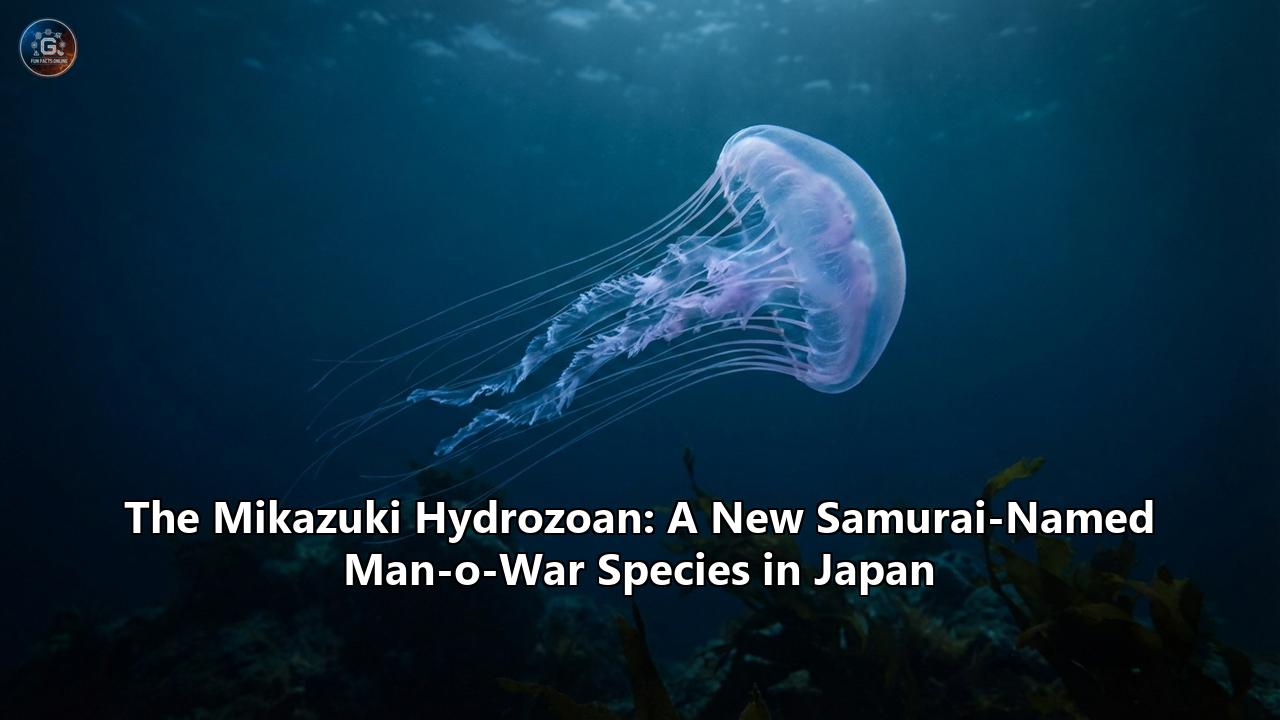
In the shifting tides of the Anthropocene, where the warming oceans are rewriting the maps of marine life, a remarkable discovery has emerged from the cool, slate-grey waters of Sendai Bay. It is a story that bridges the gap between modern marine biology and feudal Japanese history, a narrative that connects the microscopic precision of DNA sequencing with the golden crescent of a samurai warlord’s helmet. This is the story of Physalia mikazuki, the "Samurai Jellyfish," a new species of Portuguese man-o-war that has drifted out of the scientific unknown and onto the sandy shores of northeastern Japan.
The discovery of Physalia mikazuki is not merely an addition to a taxonomic list; it is a signal flare from a changing ocean. It represents a convergence of accidents, curiosity, and rigorous science, culminating in a name that honors one of Japan’s most legendary figures: Date Masamune, the "One-Eyed Dragon" of Sendai. To understand this creature, one must understand the environment that pushed it north, the biology that makes it a "superorganism," and the history of the land where it washed ashore.
Part I: The Blue Enigma of Gamo Beach
The story begins not in a high-tech laboratory, but on the windswept sands of Gamo Beach in Miyagi Prefecture. It was July 2024, a time when the summer heat was beginning to settle over the Tohoku region. The waters here are historically temperate, governed by the cold Oyashio Current that flows down from the Arctic, clashing with the warm Kuroshio Current moving up from the south. For centuries, this oceanographic battleground has dictated the marine life of the region, keeping the tropical drifters at bay.
But 2024 was different. The ocean was running a fever. Marine heatwaves were pulsing through the Pacific, and the invisible barriers of temperature were breaking down.
Yoshiki Ochiai, a doctoral student at Tohoku University, was at the beach that day for an entirely different research project. He was scanning the shoreline, perhaps looking for crustaceans or samples of sediment, when a flash of iridescent blue caught his eye. It was a color that didn't belong in the muted palette of a Tohoku beach—a vibrant, electric cobalt that seemed to glow against the wet sand.
Lying stranded on the tide line was a creature that looked like a deflated balloon, trailing long, tangled blue threads. To the untrained eye, it was a jellyfish. To a marine biologist, it was a siphonophore, specifically a Physalia, commonly known as a Portuguese man-o-war. But finding a man-o-war here, this far north, was an anomaly. These are creatures of the tropics and subtropics, sailors of the warm trade winds, not residents of the chilly waters of Sendai.
The serendipity of science often rides on the back of mundane logistics. Ochiai didn't have a specialized transport tank or a team of assistants. He had a Ziploc bag and a scooter. In a moment that has now become part of the species' origin story, he scooped the gelatinous blob into the bag, hopped on his scooter, and buzzed back to the laboratory at Tohoku University.
At the lab, the excitement began to curdle into confusion. The specimen didn't quite fit the textbook description of the common Portuguese man-o-war, Physalia physalis, nor did it perfectly match the smaller Pacific species, Physalia utriculus, often called the Bluebottle. It was something else.
The team, led by Professor Cheryl Ames of the Graduate School of Agricultural Science and the Advanced Institute for Marine Ecosystem Change (WPI-AIMEC), along with first author Chanikarn Yongstar, began a detective process that would span months. They weren't just looking at a jellyfish; they were looking at a biological puzzle box.
Part II: The Detective Work of Taxonomy
Taxonomy, the science of naming and classifying organisms, is often viewed as a dusty, archaic field filled with old men staring at preserved specimens in jars. But in reality, it is a high-stakes arena of genetic detective work and morphological scrutiny. The team at Tohoku University had to prove that their "scooter specimen" was indeed new to science.
This required a dual approach: the old way and the new way.
The Old Way: Morphological AnalysisFirst, Chanikarn Yongstar had to look at the animal. Really look at it. A Portuguese man-o-war is not a single animal; it is a colonial organism made up of specialized parts called zooids. To identify a species, one must map the architecture of this colony.
Yongstar spent hours poring over the specimen, comparing it to centuries-old illustrations. She looked at the "tangled parts"—the gonodendra (reproductive parts), the gastrozooids (feeding parts), and the dactylozooids (defensive/hunting parts). She noted specific differences that set this creature apart:
- The Float (Pneumatophore): It was smaller than the Atlantic P. physalis, reaching only about 72mm in length compared to the monster 300mm floats of its larger cousin. But it was the shape that was distinct—an asymmetrical, triangular sail with a distinct curvature.
- The Tentacles: Unlike the single fishing tentacle often seen in P. utriculus, this specimen had a specific arrangement of multiple tentacles.
- The Gastrozooids: The feeding polyps had distally swollen, balloon-like yellow tips, a feature that distinguished them from the flask-shaped stomaches of other species.
While the physical structure provided clues, the DNA provided the verdict. The team sequenced specific gene regions—the 16S rRNA and the COI mitochondrial genes. These are the "barcodes" of life. When they ran these sequences against global databases, the results were conclusive. The DNA didn't match Physalia physalis. It didn't match Physalia utriculus. It was a distinct genetic lineage.
The data told a fascinating story. This wasn't a sudden mutant. The genetic markers suggested that this species had likely existed for a long time, drifting in the Indo-Pacific, perhaps confused with other species or simply overlooked in the vastness of the ocean. It was a "cryptic" species, hiding in plain sight until the warming currents pushed it into the hands of a curious student in Sendai.
Part III: The Shadow of the One-Eyed Dragon
With the science settled, the team faced a creative challenge: naming the new species. Scientific names are often dry, descriptive Latin terms. They could have named it Physalia sendaiensis (after the city) or Physalia borealis (for the north). But the creature’s morphology suggested something more poetic.
The float of the new species was characterized by a sharp, crescent-like curve. When the team looked at the blue, arched sail of the animal, it evoked a powerful image from the history of the very region where it was found.
Sendai is the city of Date Masamune.
The Wolf of the NorthTo understand the weight of the name Physalia mikazuki, one must understand Date Masamune. Born in 1567, Masamune was one of the most feared and respected daimyō (feudal lords) of the Sengoku (Warring States) period. He was a brilliant tactician, a ruthless leader, and a man of immense cultural refinement.
As a child, he lost his right eye to smallpox. Legends vary on the details—some say he plucked it out himself when it became a liability in battle; others say he ordered a retainer to gouge it out. Regardless, the loss earned him the moniker Dokuganryū, the "One-Eyed Dragon of Ōshū."
Masamune was known for his flair. In an era of somber functionality, he appreciated aesthetics. His armor was legendary. He wore a suit of black lacquered plates, dark as a moonless night. But the centerpiece of his armor was his kabuto (helmet). Adorning the front of the helmet was a massive, asymmetrical golden crescent moon—a mikazuki.
The crescent moon was not just a decoration; it was a symbol of his ambition. Just as the crescent moon waxes until it becomes full, Masamune’s power was always rising. The helmet made him instantly recognizable on the battlefield. When enemies saw the golden crescent rising over the horizon, they knew the One-Eyed Dragon had arrived.
The Cultural SynthesisProfessor Cheryl Ames and her team saw a poetic parallel. The new man-o-war, with its vibrant blue colors and its distinct, crescent-shaped float, was a natural conqueror of the currents, drifting north just as Masamune had expanded his domain.
They named it Physalia mikazuki.
The name "Mikazuki" literally translates to "third-day moon" or crescent moon. By choosing this name, the researchers did something brilliant: they anchored a drifting, global biological phenomenon to a specific local culture. They made the jellyfish a citizen of Sendai.
This naming follows a beautiful tradition in Japan of connecting nature with culture. It turns a "venomous pest" into a point of local pride. The "Samurai Jellyfish" is now a mascot of sorts, a biological emblem of the region's history.
Part IV: Anatomy of a Drifter
Now that we know its name and its history, let us look closer at the animal itself. What makes Physalia mikazuki tick? To understand it, we must abandon the idea of an "individual" animal. A man-o-war is a siphonophore, which means it is a colonial organism. It is a floating city of genetically identical individuals, called zooids, all working together as one unit.
Imagine if your stomach, your hands, your reproductive organs, and your legs were all separate animals that were fused together, unable to survive alone but functioning perfectly as a team. That is a siphonophore.
1. The Pneumatophore (The Sail)The most visible part of P. mikazuki is the pneumatophore. This is the "crescent helmet." It is a gas-filled bladder that sits on top of the water.
- Structure: It is an asymmetrical, triangular sac made of a tough, flexible membrane.
- Color: In P. mikazuki, this float is a stunning translucent blue-green, often with deep purple or violet hues along the crest. It glows like a jewel on the water's surface.
- Function: It acts as both a flotation device and a sail. The animal cannot swim. It is at the mercy of the wind and currents. The creature can adjust the angle of its sail to catch the wind, tacking across the ocean surface like a biological sailboat.
- The Gas: The bladder is filled with a mixture of gases similar to the atmosphere (nitrogen, oxygen, argon), but with a higher concentration of carbon monoxide, which is generated by the animal’s own metabolism to maintain inflation.
Hanging below the float are the gastrozooids. These are the mouths and stomachs of the colony.
- Appearance: In P. mikazuki, these are elongated tubes with the distinctive yellow, balloon-like tips mentioned in the research.
- Function: When the tentacles catch prey, they haul it up to the gastrozooids. These polyps spread out and cover the prey, releasing enzymes that liquefy the fish or crustacean. The nutrients are then absorbed and shared with the rest of the colony through a shared canal system.
These are the infamous tentacles.
- Reach: While the float is small (under 10cm), the tentacles can extend for meters underwater. They are invisible nets drifting in the dark.
- Weaponry: The tentacles are lined with batteries of nematocysts—microscopic stinging cells. Upon contact with a fish (or a human swimmer), these cells fire a harpoon-like barb injected with neurotoxin.
- Differentiation: P. mikazuki has a specific arrangement of these tentacles that differs from the single long thread of the Bluebottle (P. utriculus).
The colony also contains specialized reproductive units. These zooids are responsible for producing gametes. Siphonophore reproduction is complex, involving the release of eggs and sperm into the water, where they fertilize to form a larva that eventually grows into a new colony.
Part V: The Venom and the Danger
With the name "Samurai Jellyfish," one might expect a formidable weapon. Indeed, Physalia mikazuki is armed.
The StingThe venom of the Physalia genus is a complex cocktail of proteins and peptides. It is designed to paralyze small fish instantly so they don't damage the delicate tentacles while struggling.
- Neurotoxins: These attack the nervous system, blocking muscle contractions and causing paralysis.
- Cytotoxins: These attack cells, causing pain and tissue damage.
For a human, a sting from P. mikazuki is rarely fatal, but it is intensely painful. The sensation is often described as a "whip lash" or a burn from a hot iron. The pain can last for hours and may be accompanied by welts, redness, and swelling.
- Symptoms: Intense local pain, red whip-like marks on the skin, potential nausea or dizziness if the sting is extensive.
- Treatment: The discovery of this new species reignites the debate on treatment. For years, vinegar was the standard treatment for box jellyfish, but for Physalia, it was controversial. Some studies suggested vinegar could trigger unfired stinging cells in man-o-wars to discharge, making the pain worse. However, recent consensus often leans towards removing the tentacles carefully (with tweezers or a credit card, never bare hands) and rinsing with seawater. Heat (hot water immersion) is arguably the most effective treatment for breaking down the protein-based venom and relieving pain.
The arrival of P. mikazuki in Sendai Bay poses a new challenge for local authorities. These waters were previously thought safe from such tropical stingers. Now, lifeguards at Gamo Beach and surrounding areas must be trained to recognize the blue crescent floats. Signs may need to be erected, warning bathers of the "Samurai's Sting."
Part VI: The Messenger of Climate Change
Why is Physalia mikazuki here? Why now?
The discovery of this species is inextricably directly to the global climate crisis. It is a biological indicator of the "tropicalization" of temperate oceans.
The Kuroshio Current ExtensionJapan's eastern coast is dominated by the Kuroshio Current, the "Black Stream." It is the Pacific equivalent of the Gulf Stream, a massive flow of warm water moving north from the Philippines.
Normally, the Kuroshio turns east into the Pacific before it reaches the northern Tohoku region. However, as the oceans warm, the Kuroshio is becoming more energetic, more unstable, and its warm fingers are reaching further north.
The SimulationTo prove how the jellyfish got to Sendai, the Tohoku University team didn't just guess; they ran computer simulations. They used "particle tracking" models, dropping virtual "beach balls" into the ocean currents in the model and watching where they drifted over months.
The results were striking. The simulation showed a clear highway of warm water transporting surface drifters from the southern coasts of Japan, past Tokyo, and directly into Sendai Bay.
A Warning from the Waves Physalia mikazuki is not traveling alone. It is the vanguard of a migration. As the water warms, tropical fish, corals, and other invertebrates are moving poleward. This reshuffles the deck of the ecosystem.- Competition: New species compete with native species for food.
- Predation: Tropical predators enter ecosystems that haven't evolved defenses against them.
- Economic Impact: The fisheries of Tohoku are famous for cold-water species like oysters, scallops, and salmon. If the water warms enough to support man-o-wars, it is also warming enough to stress these commercially vital native species.
The Samurai Jellyfish is beautiful, but it is also a red flag. It tells us that the invisible walls between climate zones are crumbling.
Part VII: The Future of the Samurai
What happens next for Physalia mikazuki?
Scientific ResearchThe formal description of the species is just the beginning.
- Venom Profiling: Scientists will want to analyze the specific venom composition of P. mikazuki. Does it differ from the tropical species? Is it more potent? Could it have pharmaceutical applications?
- Lifecycle Mapping: Where does it breed? Is there a resident population establishing itself in the north, or are these just seasonal tourists brought by the summer currents?
- Ecological Monitoring: Will we see "blooms" of these jellyfish? Man-o-war blooms can number in the thousands, clogging fishing nets and closing beaches.
In Sendai, the species is likely to become a local icon. Date Masamune is already plastered on everything from rice cake packaging to souvenir keychains. A jellyfish named after him is destined for local stardom. We can expect to see Physalia mikazuki exhibits at the Sendai Umino-Mori Aquarium, educating the public about both history and climate change.
It serves as a powerful educational tool. It is hard to get the public interested in "ocean acidification" or "isotherm shifts." It is much easier to get them interested in a "venomous blue samurai invader." By personifying the phenomenon through the lens of Date Masamune, the scientists have created a hook that engages the public imagination.
Conclusion: The Drift of History
The ocean is a place of endless drifting. Nutrients drift up from the deep; plastics drift from the cities; genetic lineages drift across millennia. And sometimes, a blue, balloon-like creature drifts onto a beach and changes our understanding of the world.
Physalia mikazuki is a triumph of modern science—a testament to the sharp eyes of students like Yoshiki Ochiai and the rigorous analysis of researchers like Chanikarn Yongstar and Cheryl Ames. But it is also a creature of history. It carries on its back the legacy of the Date clan, a reminder of the samurai who once looked out at these same waves and dreamed of conquest.Today, the conquest is different. It is not a conquest of land, but of understanding. We are racing to understand an ocean that is changing faster than we can map it. The Samurai Jellyfish has arrived in the north, wearing its crescent helmet, a beautiful, venomous messenger telling us that the world is on the move.
As we stand on the shores of the Anthropocene, looking at the blue invaders in the surf, we are reminded of Date Masamune's famous poem:
"Reaching for the moon,My sleeve is wet with the dew.
Is the moon also crying?"
The ocean is changing. The moon-crested drifters are here. And the story of the Samurai Jellyfish has only just begun.
Appendix: A Deeper Dive into the Science and Culture
To fully appreciate the scope of this discovery, we must expand on several key areas that form the foundation of this event.
1. The Biology of the Superorganism: Siphonophores Explained
To call Physalia mikazuki a "jellyfish" is a convenient lie. True jellyfish (scyphozoans) are single animals. They are born, they grow, they have a single mouth and a single body.
Siphonophores are members of the class Hydrozoa, and they are arguably some of the most fascinating life forms on Earth. They challenge our very concept of what an "individual" is.
- The Zooid Concept: A siphonophore begins as a single fertilized egg. But as it grows, it doesn't just get bigger; it clones itself. It buds off new units called zooids.
- Specialization: In most colonial animals (like corals), all the clones are the same. In siphonophores, the clones mutate to perform specific jobs.
Some clones become Propulsion units (though Physalia uses wind, other siphonophores have pulsating bells).
Some clones become Mouths (gastrozooids). They can't move or reproduce; they only eat.
Some clones become Gonads. They can't eat; they only make babies.
Some clones become Tentacles. They are just capturing devices.
- The Neural Network: These zooids are connected by a shared nervous system. If you poke the tail of a siphonophore, the whole colony reacts. They share nutrients through a common "stem."
2. The Venom Chemistry
The "sting" of the man-o-war is a marvel of biological engineering.
- The Nematocyst: Inside the tentacle cells are tiny capsules called nematocysts. Inside each capsule is a coiled, barbed thread.
- The Trigger: The capsule has a mechanical trigger (cnidocil). When a fish (or human) brushes against it, the trigger pops.
- The Firing: In roughly 700 nanoseconds (one of the fastest mechanical events in nature), the capsule explodes, turning inside out and firing the barb into the skin with the acceleration of a bullet.
- The Toxin: The venom is a pore-forming toxin. It punches holes in the cell membranes of the victim's cells. This causes potassium to leak out of the cells and calcium to rush in. This massive ion imbalance causes nerve cells to fire uncontrollably (pain) and then stop functioning (paralysis).
3. The Legacy of Date Masamune
The choice of Date Masamune as the namesake is not superficial. Masamune was a figure who defined the identity of the Tohoku region.
Before Masamune, the Tohoku region was often seen by the central powers in Kyoto and Edo (Tokyo) as a backward, barbaric frontier. Masamune changed that.
- Urban Planning: He built Sendai Castle (Aoba Castle) and laid out the city of Sendai in a grid pattern that still exists today.
- Diplomacy: He was outwardly aggressive but incredibly savvy. He even sent a diplomatic mission to the Pope in Rome (the Keichō Embassy) in 1613, led by his retainer Hasekura Tsunenaga. He was a globalist before the term existed.
- Date Culture (Date-otoko): Masamune was so stylish that the term Date-otoko ("Date man") became Japanese slang for a dandy or a cool, stylish man. The Physalia mikazuki, with its flashy blue colors and elegant sail, fits this "Date-otoko" image perfectly. It is a stylish drifter.
4. The Climate Context: The "Hot Blob" and the Kuroshio
The Pacific Ocean has been experiencing anomalies known as "Hot Blobs"—vast areas of unusually warm water.
- The Mechanism: Greenhouse gases trap heat. Over 90% of this excess heat is absorbed by the ocean.
- The Impact on Japan: Japan is particularly vulnerable because the Kuroshio Current is a heat conveyor belt. As the overall ocean baseline temperature rises, the Kuroshio carries even hotter water further north.
- Range Extension: We are seeing a phenomenon called "tropicalization." Coral reefs are moving north. Tropical fish like the butterflyfish are being seen in Tokyo Bay. And now, the Portuguese man-o-war is establishing a foothold in Sendai.
- The Future Ecosystem: If Physalia mikazuki becomes permanent in Sendai, it changes the food web. It eats fish larvae. If it eats the larvae of commercially important fish like flounders or sardines, it could impact the local fishing economy.
Final Thoughts
The discovery of Physalia mikazuki is a story that fits perfectly into our current moment in history. It is a story of connection.
- It connects the past (Samurai history) with the present (DNA science).
- It connects the tropics with the temperate zones via climate change.
- It connects science with culture.
It reminds us that we do not live in a static world. The ocean is a dynamic, living fluid that is constantly rewriting its own story. And sometimes, to read that story, you just need a student with a keen eye, a scooter, and a Ziploc bag.
The Samurai Jellyfish is now part of the permanent record of life on Earth. Long after the currents shift again, the name Physalia mikazuki will remain, a testament to the time when the crescent moon rose from the waves of Sendai.
Reference:
- https://www.tohoku.ac.jp/en/press/researchers_in_japan_discover_new_jellyfish_species_deserving_of_a_samurai_warrior_name.html
- https://wattention.com/masamune-culture/
- https://wpi-aimec.jp/en/highlights/3140/
- https://store.kyotohandicraftcenter.com/blogs/blog-news/guardians-of-honor-the-stories-behind-japan-s-iconic-samurai-helmets
- https://www.researchgate.net/publication/279457969_A_case_of_severe_stinging_caused_by_venomous_marine_animal_Portuguese_man_of_war_Physalia_species_in_all_probability
- https://indiandefencereview.com/new-jellyfish-discovery-in-japan-samurai/
- https://orientalsouls.com/blog/samurai-armor-helmet/famous-japanese-samurai-armor-features-of-date-masamunes-armor/
- https://livejapan.com/en/in-tohoku/in-pref-miyagi/in-sendai_matsushima/article-a3000059/
- https://www.kupi.com/en-ae/explore/japan/sendai/history
- https://www.tohokukanko.jp/en/features/detail_189.html
- https://en.wikipedia.org/wiki/Date_Masamune
- https://grokipedia.com/page/physalia-mikazuki
- https://www.reliks.com/kabuto-symbol-of-the-samurais-status-and-identity/
- https://www.frontiersin.org/journals/marine-science/articles/10.3389/fmars.2025.1653958/full
- http://novataxa.blogspot.com/2025/11/mikazuki.html
- https://en.wikipedia.org/wiki/Portuguese_man_o%27_war