
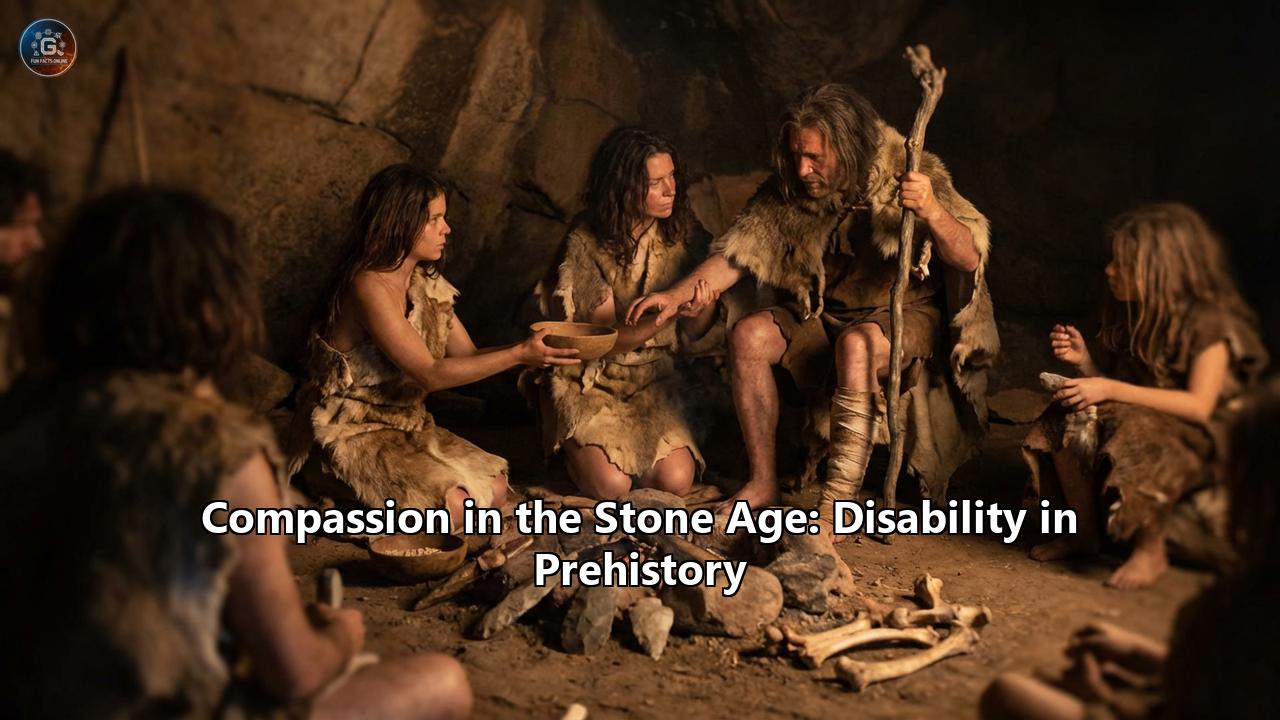
The wind howls across the steppe, carrying with it the biting chill of the last Ice Age. Inside a skin tent, illuminated by the flickering orange glow of a hearth, a figure lies curled under furs. He is an old man by the standards of his time—perhaps forty or fifty. His right arm is withered, the result of a trauma long ago that left the limb useless. He is deaf in one ear, walks with a severe limp, and is partially blind. By the brutal logic of survival of the fittest, he should have died decades ago. He cannot hunt the mammoth that roam the tundra; he cannot defend the group from prowling cave lions. And yet, he is here. He is fed, warm, and safe. Someone has chewed his food for him because his teeth are worn to nubs. Someone has guided him over the treacherous terrain.
This man is known to modern science as Shanidar 1, a Neanderthal who lived roughly 45,000 years ago in what is now Iraqi Kurdistan. His skeleton is not just a collection of bones; it is a testament to a profound and often overlooked truth about our prehistoric ancestors: they were capable of deep, sustained, and organized compassion.
For centuries, the popular image of the "Stone Age" human—whether Neanderthal or Homo sapiens—was one of brutish individualism. It was a Hobbesian world where life was "nasty, brutish, and short," and where the weak were left behind to freeze or starve. This narrative fit neatly with early Darwinian interpretations of evolution as a relentless competition where only the physically strongest survived. But as the spade of the archaeologist has dug deeper, and as the eye of the pathologist has looked closer, a different story has emerged. It is a story of cripples who became shamans, of paralyzed teenagers carried for miles, and of the elderly cared for with a tenderness that defies the "savage" stereotype.
This article explores the fascinating, complex, and deeply moving history of disability in prehistory. It examines the "Bioarchaeology of Care," a field that reconstructs the lives of those who survived against the odds, and asks what their survival tells us about the very nature of humanity.
Part I: The Bioarchaeology of Care – A New Lens on the Past
To understand disability in the Stone Age, we must first understand how we see it. For a long time, archaeologists noted pathologies—a healed fracture here, a fused spine there—as mere medical curiosities. They were footnotes in site reports focused on flint tools and kill sites. It wasn't until recently, with the development of the "Bioarchaeology of Care" framework by researchers like Lorna Tilley, that these bones began to speak as biographies.
The framework asks four simple but revolutionary questions when a disabled skeleton is found:
- What was the biological impact of the disability? (e.g., Could they walk? Could they chew?)
- What were the functional implications? (e.g., If they couldn't walk, they couldn't hunt or gather.)
- What care was required? (e.g., Did they need to be carried? Fed? nursed?)
- What does this care say about the society? (e.g., Did they value this person despite their lack of economic output?)
This shift in perspective forces us to confront the logistical reality of the Stone Age. In a nomadic hunter-gatherer society, everything must be carried. Food is often scarce. Mobility is life. To keep a non-ambulatory person alive is not a passive act of "tolerance"; it is an active, costly investment. It requires a surplus of food, a division of labor, and, crucially, the will to do so.
Part II: The Neanderthal Paradox – Shanidar and the "Old Man"
Perhaps the most compelling evidence for prehistoric compassion comes from the very cousins we once dismissed as knuckle-dragging brutes: the Neanderthals.
Shanidar 1: The SurvivorShanidar 1, often affectionately called "Nandy" by anthropologists, is the rock star of prehistoric disability. His injuries were catastrophic. A blow to the left side of his face likely left him blind in that eye. A massive injury to his right arm resulted in amputation or at least withering so severe the arm was useless. He had a broken foot that healed but left him with a painful limp. He also suffered from a degenerative condition called DISH (Diffuse Idiopathic Skeletal Hyperostosis).
Yet, he lived. His injuries showed signs of healing, meaning he survived the initial trauma by years, perhaps decades. In a world of ambush hunting where two hands and speed were essential, Shanidar 1 was "economically" useless in the traditional sense. Yet his group not only protected him but likely processed his food for him. His survival suggests that Neanderthal society was not based solely on physical utility. He may have been a repository of knowledge, a storyteller, or simply a loved father or brother.
The Old Man of La Chapelle-aux-SaintsAnother famous Neanderthal, found in France, was initially described in the early 20th century as a stooped, beast-like creature. This description fueled the "primitive" stereotype for decades. Modern analysis, however, revealed that he was simply an old man (around 40, which was ancient for the time) suffering from severe arthritis. He had lost most of his teeth long before he died. In a time before blenders or soup, surviving without teeth meant someone else—another adult—was chewing his food for him or mashing it into a soft pulp. This "pre-mastication" is an intimate act of care, echoing the bond between a mother and infant, but extended to an unproductive elder.
Part III: The Boy in the Bog and the Paralyzed Swimmer
As we move from Neanderthals to anatomically modern humans (Homo sapiens) and the Mesolithic/Neolithic transitions, the evidence for care becomes even more detailed.
The Windover Boy (Florida, USA)In a peat bog in Florida, archaeologists discovered the Windover cemetery, dating back about 7,500 years. The peat preserved organic matter incredibly well, including brain tissue and fabrics. Among the 168 individuals found was a boy, roughly 15 years old, who suffered from spina bifida.
Spina bifida is a congenital defect where the spine does not fuse properly. This boy had a severe case (spina bifida aperta) that likely left him paralyzed from the waist down. He also had a severe infection in his legs that caused bone deformation. In a semi-nomadic wetland society, a paralyzed teenager is a massive logistical challenge. He would have needed to be carried, cleaned, and bathed to prevent bedsores and sepsis. He could not have contributed to hunting or gathering in the swamps. Yet, he survived to adolescence. The community didn't just tolerate him; they integrated him. The care he received was consistent and long-term, implying he was a valued member of the social fabric, perhaps for his personality, his mind, or simply his existence as kin.
Man Bac Burial 9 (Vietnam)Jump forward to the Neolithic period in Vietnam, about 4,000 years ago. At the site of Man Bac, archaeologists found a young man (Burial 9) curled in a fetal position. He suffered from Klippel-Feil syndrome, a rare genetic condition that fused his cervical vertebrae. He was essentially paralyzed from the neck down, with very limited mobility in his upper body. He lived into his early 20s.
His condition meant he could not feed himself or even perform basic self-care. For over a decade, someone brought him water, fed him, and likely helped him with bodily functions. The positioning of his burial—carefully arranged, not discarded—suggests he was mourned. This case is pivotal because it shows that even in the transition to agriculture, where labor was a premium resource, the "non-productive" were not discarded.
Part IV: The "Shaman" Hypothesis – Disability as Divine Connection
One of the most fascinating theories in prehistoric anthropology is the link between disability and spirituality. In many ethnographic records of hunter-gatherer societies, individuals with physical or mental differences are often seen as liminal beings—people who exist between the worlds of the living, the dead, and the spirits. Their physical difference is not a defect, but a mark of the divine.
The Double Burial of Sunghir (Russia)On the Russian plains, 34,000 years ago, a group of mammoth hunters buried two boys head-to-head in a long, narrow grave. The burial is one of the richest ever found from the Paleolithic. They were covered in thousands of ivory beads, each of which took hours to carve. They wore ivory bracelets and had spears made of straightened mammoth tusk.
But it is their bones that tell the real story. Both boys were physically disabled. One had distinct bowing of the legs (possibly congenital rickets), and the other had a severe facial deformity. The sheer wealth of their grave goods dwarfs that of the healthy adults found nearby. Why would two disabled children be buried with the wealth of kings?
One theory is that their disabilities marked them as special. They may have been perceived as touched by the spirits. Their inability to participate in the mundane tasks of the tribe might have set them apart for ritual roles. They weren't burdens; they were potentially the spiritual anchors of their community.
The "Shaman" of Dolní Věstonice (Czech Republic)At the Gravettian site of Dolní Věstonice (c. 26,000 years ago), archaeologists found the burial of a woman with a severe facial asymmetry, likely caused by a stroke or a tumor, and other skeletal deformities. Buried near her was a unique artifact: a small ivory head carved with the exact same facial asymmetry.
This suggests that her face was not just "tolerated" but was iconic enough to be immortalized in art. She may have been a shaman or healer, her physical pain giving her the authority to mediate with the spirit world. The famous "Triple Burial" at the same site also includes an individual with skeletal abnormalities, further linking this community's ritual life with physical difference.
Romito 2: The Dwarf in the Cave (Italy)In the Romito Cave in Calabria, Italy, dating to the late Upper Paleolithic (around 11,000 years ago), archaeologists found the skeleton of a young man (Romito 2) who had acromesomelic dysplasia, a form of dwarfism. He was very short, with bowed limbs. He lived to be about 17.
He was buried in the arms of an older woman, possibly his mother. The cave itself contains stunning rock art, including a famous engraving of a bull. The fact that he was buried in such a significant, ritualized space suggests his status was not diminished by his stature. He was a part of the community, literally held in death by those who held him in life.
Part V: Medical Knowledge in the Stone Age
Compassion was often paired with skill. The care provided to these individuals wasn't just emotional; it was technical. The Stone Age pharmacopeia and surgical kit were surprisingly advanced.
The First Surgeons: TrepanationOne of the most harrowing yet impressive feats of prehistoric medicine is trepanation—the drilling or scraping of a hole into the skull. Evidence for this practice dates back to the Neolithic (and potentially the Mesolithic). Skulls found in France, Ukraine, and Peru show clear holes that have healed. The bone regrowth around the edges proves the patient survived the surgery—sometimes for years.
Why do it? It may have been to treat headaches, epilepsy, or mental illness (releasing "evil spirits"), or to treat cranial trauma from club blows. Regardless of the reason, the survival rate was shockingly high—in some samples, over 70% of patients survived. This implies a knowledge of infection control, perhaps using herbal antiseptics, and post-operative care.
Herbal MedicineWe know Neanderthals used medicinal plants. Dental calculus (hardened plaque) from Neanderthals at El Sidrón cave in Spain revealed traces of yarrow and chamomile. These bitter plants have no nutritional value but are well-known anti-inflammatories and astringents. Another individual was found to have traces of poplar (which contains salicylic acid, the active ingredient in aspirin) and Penicillium mold (the source of penicillin) in his mouth, suggesting he was self-medicating for a dental abscess.
Bone Setting and AmputationAt the Neolithic site of Buthiers-Boulancourt in France, an elderly man was found with a healed amputation of his left forearm. The cut was clean, and the bone had healed well. This wasn't a jagged trauma from a bear attack; it was surgery. Someone cut through the flesh, sawed the bone, cauterized or stitched the wound, and nursed the man through the dangerous period of blood loss and infection. He lived for months or years afterward, using his stump.
Part VI: The Debate – Compassion or Calculus?
While the evidence of care is undeniable, the interpretation of why it happened is a subject of heated debate among anthropologists.
The "Survival Necessity" ArgumentSome scholars argue that we shouldn't project modern emotions like "compassion" onto the deep past. They suggest that keeping a disabled person alive was a pragmatic decision. In a group of 30 people, every pair of eyes counts. A man who cannot run can still spot predators. A woman who cannot walk can still scrape hides, crack nuts, or teach children how to make tools.
Grandmothering, or the "Grandmother Hypothesis," suggests that older, post-reproductive women were vital for the survival of grandchildren, allowing the species to thrive. Keeping an elderly, arthritic woman alive wasn't charity; it was an investment in the next generation's survival.
The "Moral Obligation" ArgumentOthers, like Penny Spikins from the University of York, argue that compassion is a fundamental human trait, evolved to bind groups together. The emotional bond between mother and child was extended to the wider group. The burial of the Romito dwarf in the arms of a woman, or the fetal positioning of the paralyzed Man Bac boy, speaks to an emotional connection that transcends utility. We cared for them because we loved them.
The truth is likely a synthesis. Humans are unique because we are "obligate cooperators." We cannot survive alone. Our ability to feel empathy drives us to care, and that care, in turn, allows the group to retain valuable knowledge and social cohesion. A group that abandons its weak might survive the winter, but a group that cares for them builds a loyalty and depth of experience that helps them survive the millennium.
Part VII: Conclusion – The Mirror of the Past
When we look at the skull of Benjamina, a Homo heidelbergensis child from 530,000 years ago found in the Sima de los Huesos ("Pit of Bones") in Spain, we see a child who suffered from craniosynostosis (premature fusion of the skull plates). This would have caused cognitive delays and a deformed appearance. Yet, she was not abandoned. She lived to be 10 or 12 years old. Half a million years ago, long before Homo sapiens walked the earth, our ancestors looked at a "different" child and decided she was one of them.
The evidence from the Stone Age shatters the myth of the ruthless savage. It reveals a humanity that is recognizable to us—fraught with danger, yes, but buffered by deep networks of care. Disability was not a death sentence; it was a facet of life, managed with ingenuity, patience, and love.
In the end, the survival of Shanidar 1, the Windover Boy, and Romito 2 tells us that the "fittest" were not just the strongest or the fastest. The fittest were those who were loved the most. Our ancestors survived the Ice Ages not just because they could make fire, but because they could make room for each other.
Reference:
- https://mimirsbrunnr.com/2019/04/17/the-shaman-of-dolni-vestonice/
- https://www.youtube.com/watch?v=t7J_oybRfuc
- https://www.mdpi.com/2077-1444/15/1/123
- https://www.zmescience.com/science/archaeology/prosthetic-europe-50109/
- http://www.connellodonovan.com/dolni.html
- http://www.ancient-wisdom.com/czechdolnivestonice.htm
- https://www.zmescience.com/science/news-science/ancient-34000-burial-children-04322/