
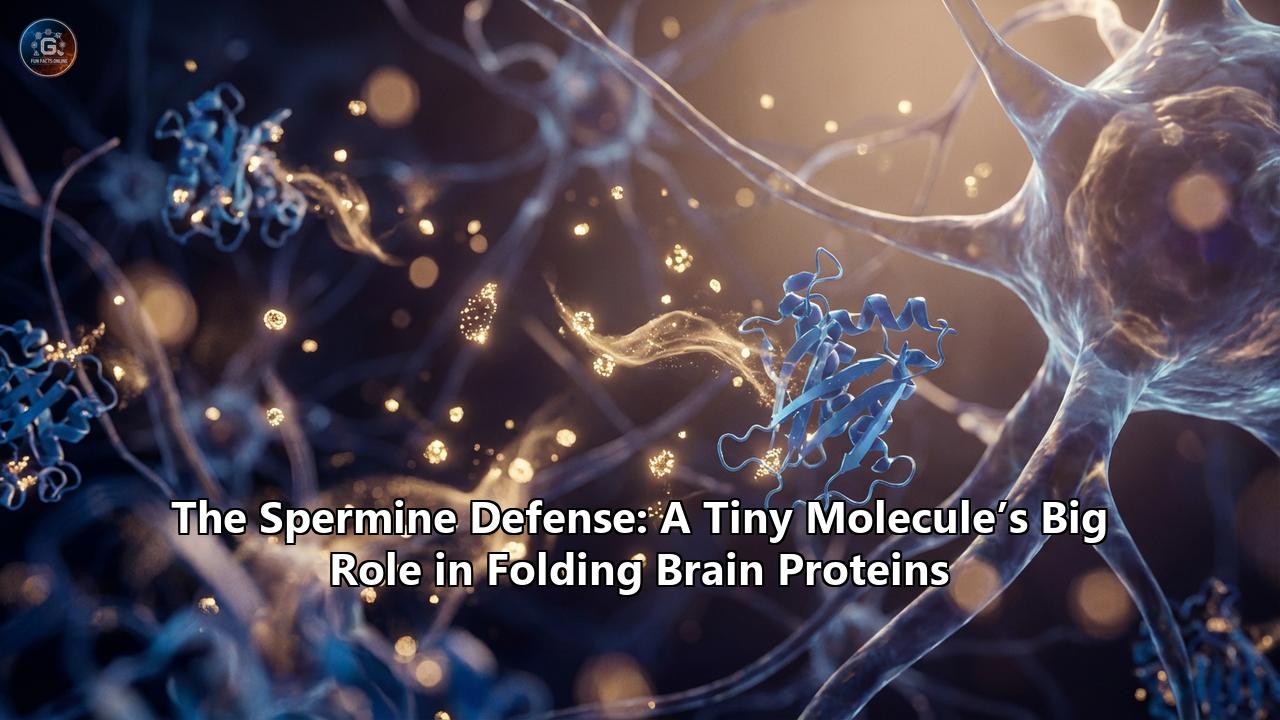
In the labyrinthine biological architecture of the human brain, a silent war is constantly being waged. It is a battle of geometry, a struggle to keep the billions of proteins that power our thoughts and memories folded in their correct, functional shapes. When this folding process fails, the consequences are catastrophic. Proteins that should be neat, functional machines instead collapse into sticky, toxic tangles—long, spaghetti-like fibrils that choke neurons and lead to the devastating cognitive decline seen in Alzheimer’s, Parkinson’s, and other neurodegenerative diseases.
For decades, scientists have searched for a way to stop this "spaghetti-fication" of brain proteins. They have looked for drugs that can cut the fibers or antibodies that can flag them for destruction. But a recent breakthrough from the Paul Scherrer Institute (PSI) in Switzerland suggests that the solution might have been hiding inside our cells all along. It involves a tiny, ancient molecule with a somewhat unfortunate name: spermine.
This molecule, known for over a century but only recently understood in this context, acts as a powerful defense mechanism. If toxic brain proteins are the unruly spaghetti, spermine is the cheese that binds them together—not into a sticky mess, but into manageable, tasty morsels that the cell can easily digest. This is the story of the "Spermine Defense," a molecular mechanism that challenges our understanding of aging, protein folding, and the very nature of how our brains protect themselves.
Part I: The Protagonist – What is Spermine?
To understand the defense, we must first understand the defender. Spermine is a polyamine, a class of small organic compounds having two or more primary amino groups. Chemically, it is simple—a short carbon chain peppered with nitrogen atoms. But biologically, it is profound.
1. An Ancient LineagePolyamines like spermine are ubiquitous. They are found in almost every living organism, from the simplest bacteria to the most complex mammals. This evolutionary conservation suggests they play a role so fundamental that life itself can barely exist without them.
Spermine was first discovered in 1678 by Antonie van Leeuwenhoek, the father of microbiology, who observed crystals forming in human semen (hence the name). It took nearly 250 years for its chemical structure to be fully elucidated. For a long time, it was viewed merely as a metabolic byproduct or a simple growth factor.
2. The Biosynthetic Assembly LineYour body manufactures spermine through a tightly regulated assembly line. It starts with the amino acid arginine, which is converted into ornithine. From there, the enzyme ornithine decarboxylase (ODC) creates putrescine.
- Putrescine is the base.
- Another enzyme adds a molecular group to create spermidine (a crucial molecule for longevity).
- Finally, spermine synthase adds another group to creating spermine.
This hierarchy is important because these molecules can interconvert. Your cells constantly balance the levels of putrescine, spermidine, and spermine. If one is missing, the whole system can crash.
3. The Electrostatic SuperpowerSpermine's secret weapon is its positive charge. In the neutral pH environment of a cell, spermine carries four positive charges. Most large biological molecules—like DNA, RNA, and many proteins—are negatively charged.
In the world of molecular physics, opposites attract. Spermine acts as a portable "cationic shield." It zips around the cell, sticking to negatively charged regions of DNA to protect it from mutation, or binding to RNA to help regulate how genes are read. But its most surprising role is how it interacts with the misfolded proteins of the brain.
Part II: The "Cheese on Pasta" Breakthrough
The central problem in diseases like Parkinson’s is a protein called alpha-synuclein. In a healthy brain, alpha-synuclein aids in neurotransmitter release. But in Parkinson’s, it misfolds. Monomers (single proteins) clump into oligomers (small groups), which then lengthen into insoluble amyloid fibrils. These fibrils are the "spaghetti"—long, tangled, and toxic to neurons.
The Old View: Aggregation is BadFor years, the dogma was simple: Any clumping of proteins is bad. Early experiments showed that adding spermine to alpha-synuclein in a test tube made it aggregate faster. Therefore, scientists assumed spermine might be a villain, accelerating the disease.
The New View: The Right Kind of ClumpA pivotal study led by Jinghui Luo at the Paul Scherrer Institute completely flipped this narrative. Using advanced imaging techniques like Small Angle X-ray Scattering (SAXS) and cryo-electron microscopy, the team watched exactly how spermine interacted with alpha-synuclein.
They discovered that spermine drives a process called biomolecular condensation. Instead of allowing the proteins to twist into rigid, toxic fibers, spermine acts as a "molecular glue." It pulls the proteins together into soft, liquid-like droplets.
Think of a plate of plain spaghetti. The noodles act independently, sliding around and getting tangled in a way that makes them hard to scoop up. Now, imagine melting cheese over them. The cheese binds the noodles into a cohesive ball.
- Without Spermine: The proteins form long, sharp fibrils that pierce cell membranes and kill the cell.
- With Spermine: The proteins condense into a compact droplet.
The genius of this mechanism lies in the cleanup crew. Our cells have a waste disposal system called autophagy (literally "self-eating"). Autophagy involves creating a double-membraned sack (an autophagosome) that swallows trash and delivers it to a lysosome for acid digestion.
It turns out that the autophagy machinery struggles to swallow long, rigid fibers. It's like trying to stuff a dry spaghetti noodle into a small trash bag—it pokes through or doesn't fit. However, the condensates created by spermine are compact and "tasty" for the autophagosome. They fit perfectly inside.
By clumping the proteins into these droplets, spermine effectively packages the toxic waste for rapid removal. In experiments with nematodes (C. elegans), worms treated with spermine didn't just have different protein aggregates—they lived longer, moved better, and had healthier mitochondria. The "Spermine Defense" was real.
Part III: The Paradox – Friend or Foe?
If you search the scientific literature, you will find a confusing contradiction. Some papers claim polyamines are neuroprotective; others claim they are neurotoxic. How do we resolve this?
1. The Context of ConcentrationBiology is rarely black and white. It is a game of Goldilocks.
- Too Little: Without spermine, DNA destabilizes, and autophagy slows down.
- Just Right: Spermine induces the protective condensation of proteins and facilitates their clearance.
- Too Much: Extremely high levels of polyamines can over-stabilize DNA (preventing necessary gene reading) or produce toxic byproducts. When spermine is broken down by the body, it produces acrolein and hydrogen peroxide—compounds that cause oxidative stress.
The "Spermine Defense" relies on a delicate balance. In a healthy young brain, spermine levels are tightly regulated, and the defense works. As we age, this regulation falters.
2. The Blood-Brain Barrier DilemmaHere lies a critical challenge. While you can eat spermine-rich foods (more on that later), the Blood-Brain Barrier (BBB) is notoriously strict. It does not easily let polyamines from the blood pass into the brain.
The brain relies heavily on synthesizing its own spermine. This means that simply flooding the blood with spermine might not rescue a brain that has lost the ability to make it. However, circulating spermine does rejuvenate the immune system and improve overall vascular health, which indirectly supports the brain. Furthermore, precursors or specific transport mechanisms under study might allow for therapeutic intervention.
Part IV: A Case Study in Deficiency – Snyder-Robinson Syndrome
To truly appreciate a hero, look at a world without him. Snyder-Robinson Syndrome (SRS) is a rare genetic disorder caused by a mutation in the SMS gene—the gene that codes for spermine synthase.
Boys born with this condition cannot convert spermidine into spermine. The result is heartbreaking and revealing. They suffer from:
- Intellectual disability
- Muscle loss
- Thinning bones (osteoporosis)
- Seizures
The lack of spermine leads to a collapse of cellular integrity. Lysosomes (the recycling centers) bloat and fail. Mitochondria (the power plants) sputter out. This tragedy underscores that spermine is not just a "bonus" molecule for longevity; it is an absolute requirement for the development and maintenance of a functioning nervous system. It proves that the "Spermine Defense" is a foundational pillar of brain health.
Part V: Beyond the Brain – The Fountain of Youth?
While our focus is the brain, the Spermine Defense operates system-wide.
1. Mitochondrial MagicMitochondria are the batteries of our cells. As we age, they wear out. Spermine has been shown to enter mitochondria and stabilize their machinery, ensuring efficient energy production. In the Nature Communications study, the worms treated with spermine didn't just have cleaner brains; they had "younger" mitochondria.
2. DNA BodyguardYour DNA is under constant attack from radiation and oxidative stress. Spermine wraps around the DNA double helix like a protective sheath. Its positive charge neutralizes the negative repulsion between DNA strands, allowing DNA to pack tightly and shielding it from damage.
3. The Autophagy SwitchSpermine (and its precursor spermidine) mimics the effects of fasting. When you fast, your body runs out of easy energy and switches into repair mode (autophagy). Spermine tricks the cell into thinking it is fasting, activating the same deep-clean protocols without the hunger pangs. This is why it is often called a "caloric restriction mimetic."
Part VI: The "Dark Side" – The Cancer Connection
Before you rush to buy spermine supplements, a word of caution.
Spermine is a growth factor. It helps cells divide and protects them from death.
- In Healthy Tissue: This promotes regeneration and repair.
- In Cancerous Tissue: This promotes tumor growth.
Cancer cells differ from normal cells in that they have an insatiable appetite for polyamines. They often ramp up their own internal production of spermine to fuel their rapid division. This is why some cancer drugs work by blocking polyamine synthesis.
This "double-edged sword" means that while spermine is excellent for preventing neurodegeneration (where cells die too fast), it must be used with caution in the context of cancer (where cells don't die enough). This is why dietary sources are generally considered safer than high-dose synthetic supplements—they provide a physiological boost without flooding the system.
Part VII: Practical Application – Can You Eat the Defense?
While the brain makes its own spermine, maintaining high systemic levels of polyamines (spermine and spermidine) is linked to longevity and better cognitive health in population studies. The "Blue Zones" (areas where people live longest) often feature diets rich in these compounds.
The "High-Polyamine" Menu:- Wheat Germ: The undisputed king of polyamines. Adding wheat germ to smoothies or yogurt is the easiest way to boost intake.
- Aged Cheese: The "Cheese on Pasta" analogy is chemically fitting. Fermented, aged cheeses (like Blue cheese, Cheddar, or Parmesan) are rich in spermidine and spermine. The fermentation bacteria produce it.
- Soy Products: Natto (fermented soybeans) is a powerhouse. Tofu and miso are also good sources.
- Mushrooms: Shiitake and other fungi are surprisingly high in these molecules.
- Green Peas & Peppers: Fresh veggies, particularly green peppers, are excellent plant-based sources.
- Fasting: Intermittent fasting naturally upregulates the body's own polyamine production and autophagy.
- Gut Health: Much of our circulating polyamines come from our gut bacteria. A diet high in fiber and fermented foods supports the microbes that manufacture these "defense molecules" for us.
Conclusion: The Future of Folding
The discovery of the "Spermine Defense" fundamentally shifts our approach to neurodegenerative disease. For too long, we viewed the aggregation of proteins as a simple mechanical failure, a clogging of the pipes. Now, we see it as a nuanced biological process where the type of aggregate matters.
We now know that the body has a built-in mechanism—a molecular cheese—to handle the spaghetti mess. The failure of this mechanism in aging brains, whether through the loss of spermine synthesis or the overwhelming of the autophagy system, is a key driver of disease.
The future of treatment may not lie in synthetic drugs that attack the proteins, but in restoring the ancient, natural defenses of the cell. Whether through gene therapies to correct spermine synthase, drugs that mimic spermine’s "gluing" ability, or lifestyle changes that boost our polyamine levels, we are inching closer to a world where we can help the brain fold its own proteins correctly, preserving the memories and minds that make us who we are.
The "Spermine Defense" is a reminder that sometimes, the most powerful medical breakthroughs come from understanding the microscopic custodians that have been keeping us alive for millions of years.
Reference:
- https://neuroganhealth.com/blogs/news/spermidine-foods
- https://pmc.ncbi.nlm.nih.gov/articles/PMC6637774/
- https://omre.co/blogs/news/foods-high-spermidine
- https://www.mdpi.com/2218-273X/13/7/1114?type=check_update&version=2
- https://purovitalis.com/foods-high-in-spermidine-the-complete-list/
- https://pmc.ncbi.nlm.nih.gov/articles/PMC10630864/
- https://pubmed.ncbi.nlm.nih.gov/29097652/
- https://www.ncbi.nlm.nih.gov/books/NBK144284/
- https://www.researchgate.net/publication/320807042_Spermine_synthase_deficiency_causes_lysosomal_dysfunction_and_oxidative_stress_in_models_of_Snyder-Robinson_syndrome
- https://ouci.dntb.gov.ua/en/works/9Z326gY7/
- https://www.newphaseblends.com/foods-contain-spermidine/