
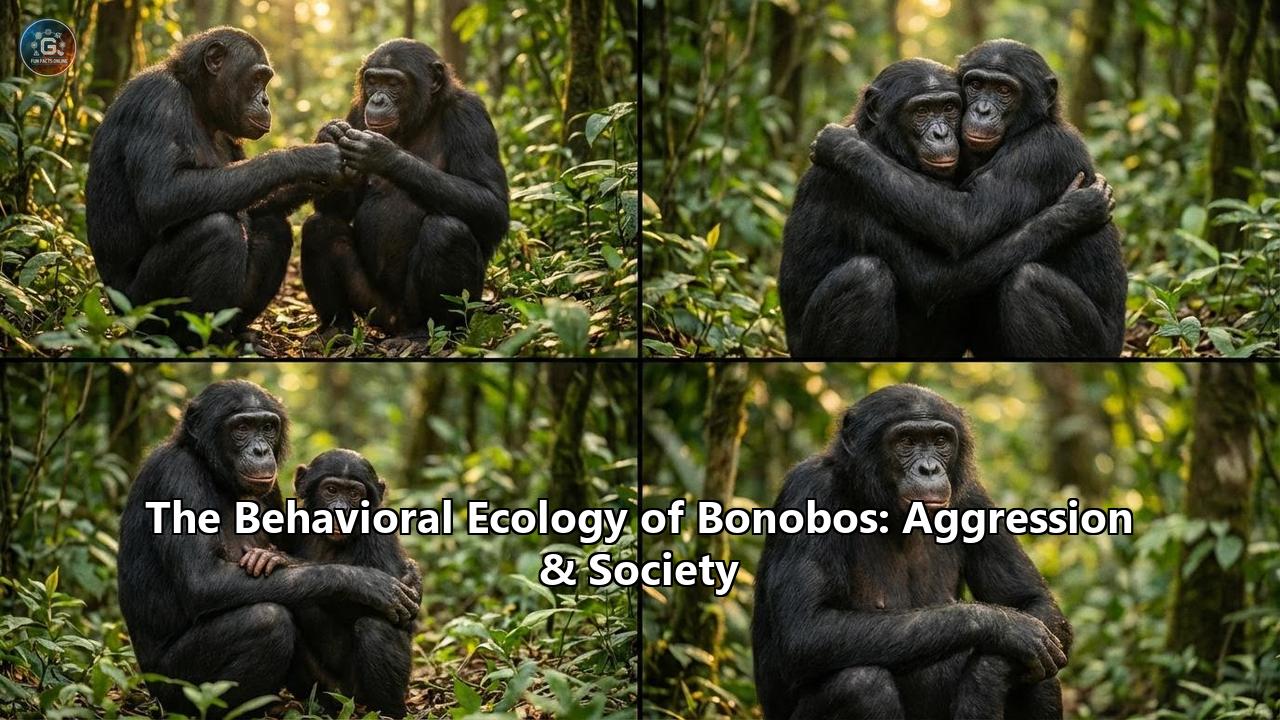
For decades, the bonobo has carried a heavy cultural burden: the expectation of being the primate world’s ultimate pacifist. Discovered as a distinct species in the 1920s, Pan paniscus gained widespread fame in the late 20th century as the "hippie ape"—our peace-loving, matriarchal, hyper-sexual cousin. If chimpanzees (Pan troglodytes), with their lethal border patrols, infanticide, and violent male hierarchies, represented the dark, warlike side of human nature, the bonobo was presented as our better angel. According to the popular narrative, they had evolved a society where females ruled, war was obsolete, and every social dispute was settled with a quick, recreational sexual encounter. "Make love, not war" wasn't just a 1960s slogan; it was seemingly the evolutionary strategy of an entire species.
But nature is rarely so neatly categorized. Over the past few years, a wave of groundbreaking research has completely upended this utopian stereotype. Behavioral ecologists spending tens of thousands of hours observing wild bonobos deep in the Congo Basin, as well as those studying them in captivity, have uncovered a society that is vastly more complex, politically calculated, and—surprisingly—more frequently aggressive than we ever imagined. The bonobo is not a furry pacifist. It is a highly intelligent survivor navigating a fascinating ecological niche through female syndicates, strategic maternal manipulation, and a startling amount of male-on-male brawling. To understand the true behavioral ecology of the bonobo is to look into a deeply nuanced mirror of our own evolutionary history.
The River That Divided the Apes: An Ecological Divergence
To understand why bonobos behave the way they do, we must first look at the ground they walk on. Bonobos are endemic exclusively to the Democratic Republic of the Congo (DRC), living in the dense, humid forests south of the massive Congo River.
Roughly 1.5 to 2 million years ago, a severe drought likely caused the Congo River to temporarily dry up or narrow, allowing the common ancestor of chimpanzees and bonobos to cross to the southern bank. When the waters returned, the populations were permanently separated. The apes trapped on the northern bank evolved into chimpanzees; those on the southern bank became bonobos.
But geography wasn't the only difference; the ecology of the two banks was radically distinct. North of the river, chimpanzees had to share their habitat with massive, ground-dwelling gorillas, who outcompeted them for the nutrient-rich terrestrial herbaceous vegetation (THV) that blankets the forest floor. Forced into the canopy, chimpanzees had to rely heavily on fruit trees. Fruit is an unpredictable, patchy resource. When a fig tree fruits, it triggers intense competition. To survive this scarcity, chimpanzees evolved a fission-fusion society where females dispersed to forage alone or in small groups to avoid starvation, leaving the males to bond, defend vast territories, and brutally attack neighboring groups to protect their food supply.
South of the river, the story was entirely different. There were no gorillas on the left bank of the Congo River. The ancestors of the bonobo had the forest floor to themselves. This meant they had unrestricted access to massive, stable patches of THV—pith, stems, and shoots that are available year-round. Because food was so abundant and reliable, female bonobos did not have to forage alone. They could travel together in large, stable parties without the threat of starvation.
This single ecological quirk—the ability of females to forage side-by-side without intense competition—changed the entire trajectory of bonobo evolution. It set the stage for female bonding, which in turn birthed one of the most remarkable social structures in the mammalian kingdom.
The Matriarchy: Female Coalitions and the Mechanics of Dominance
In the vast majority of mammalian species where males are physically larger than females, the society is patriarchal. Bonobos exhibit noticeable sexual dimorphism; males are about 20% heavier than females and possess significantly larger, sharper canine teeth. Yet, bonobo society is fiercely matriarchal. Females dictate the movement of the group, get priority access to the best food, and ultimately decide who mates and when.
How do smaller females dominate larger, heavily armed males? The answer lies in the power of the syndicate.
A landmark study published in 2025 in the journal Communications Biology analyzed 30 years of behavioral data across six wild bonobo communities in the DRC. The researchers definitively proved what field biologists had long suspected: girl power in bonobos is maintained through highly coordinated female alliances. Female bonobos form coalitions—usually groups of three to five individuals—to enforce their dominance over males.
When a male acts out of line, perhaps by attempting to sexually coerce a female, monopolizing a food source, or acting aggressively toward an infant, the females do not face him alone. Instead, a coalition will gang up on the male, chasing him through the canopy, screaming, and sometimes inflicting serious physical injuries. The study recorded 1,786 intersexual conflicts and found that females won a staggering 61.5% of them. In 85% of the cases where these female coalitions displayed aggression, their target was a male.
"You can win a conflict by being stronger, by having friends to back you up, or by having something that someone wants and cannot take by force," noted Martin Surbeck, a behavioral ecologist at Harvard University and the lead author of the study. For bonobos, the strategy is solidarity. The propensity of females to form these coalitions is directly associated with the degree of power they hold over males. Remarkably, these fiercely bonded females are not even related. Bonobo society is characterized by female exogamy—meaning adolescent females leave the group they were born into and migrate to a new community. When a young female arrives in a new group, she immediately seeks out the highest-ranking older females, offering grooming and sexual favors to build the alliances that will eventually guarantee her survival and status.
Shattering the Hippie Myth: The Reality of Male Aggression
Because of the matriarchal structure and the visible punishment of bad male behavior by female coalitions, scientists long assumed that male bonobos had simply evolved to be docile. The "self-domestication" hypothesis posited that because female bonobos chose to mate only with friendly, non-aggressive males, aggression had literally been bred out of the bonobo genome.
Recent data has blown this theory out of the water.
In April 2024, a blockbuster study published in the journal Current Biology fundamentally rewrote our understanding of bonobo violence. Researchers meticulously tracked male aggression in three bonobo communities at the Kokolopori Bonobo Reserve in the DRC and compared it directly to chimpanzee communities at Gombe National Park in Tanzania. To their profound surprise, the researchers found that male bonobos engaged in aggressive acts nearly three times as often as male chimpanzees. Even when filtering the data to look strictly at "contact aggression"—actual physical violence such as hitting, kicking, biting, and trampling, as opposed to just charging or screaming—bonobos were still three times more violent than their so-called warrior cousins.
A parallel study published in 2026 in the journal Science Advances, which examined 22 groups of chimpanzees and bonobos living in European zoos, confirmed these wild observations. The researchers analyzed over 3,200 instances of directed aggression and found no significant difference in the overall magnitude of aggression between the two species.
“I was looking at them and thinking, ‘Where’s the peaceful bonobo in all this?’” remarked biological anthropologist Maud Mouginot, reflecting on days spent watching male bonobos ruthlessly bite, push, and scream at each other in the jungle.
If bonobos are so aggressive, why did they earn their peaceful reputation in the first place? The key lies not in the amount of aggression, but in its nature and target.
Chimpanzee aggression is relatively infrequent, but when it happens, it is highly organized, coalitionary, and frequently lethal. Male chimpanzees rely heavily on one another to defend their territory and wage war on neighboring groups. Because they need their brothers-in-arms to survive, infighting within a chimpanzee coalition is incredibly costly. Therefore, they fight less often internally. When chimps do direct their aggression inward, it is largely targeted at females to coerce them into mating. Furthermore, chimpanzee aggression often escalates to murder; male chimps frequently kill rival males and commit infanticide.
Bonobo aggression, by contrast, is highly individualistic and non-lethal. Male bonobos do not form hunting parties or border patrols, so they don't need to maintain strategic peace with their male peers. As a result, male bonobos bicker, squabble, and physically brawl with one another constantly. Crucially, however, male bonobo fights are almost exclusively one-on-one. In the 2024 study, chimpanzee aggression involved "coalitions" of males teaming up 13.2% of the time, whereas male bonobo aggression involved groups teaming up only 1% of the time.
Furthermore, because of the female matriarchy, male bonobos rarely direct their physical violence toward females. In fact, the 2026 zoo study highlighted that female bonobos actually instigate higher levels of aggression toward males than the reverse. As for lethality, despite the frequent slapping, kicking, and biting among males, there has never been a recorded instance of a bonobo killing a competitor.
In summary: chimpanzees wage calculated, lethal warfare. Bonobos engage in frequent, intense, but ultimately non-lethal bar fights.
The Mating Game and the "Mama's Boy" Strategy
The discovery of high rates of male bonobo aggression led scientists to an even more perplexing question: why do they fight? In chimpanzees, aggression is a tool to rise in the male hierarchy and monopolize females. But in bonobos, where females hold the power and supposedly choose the "nice guys," what does a male gain by brawling?
The 2024 Current Biology study provided a shocking answer: more aggressive male bonobos actually get more mating opportunities. Just like in chimpanzees, the bonobo males who engaged in the most physical altercations had the highest reproductive success.
“Male bonobos that are more aggressive obtain more copulations with females, which is something that we would not expect,” Mouginot explained. “It means that females do not necessarily go for nicer males”.
This finding completely challenges the "self-domestication" hypothesis. However, the way a male bonobo translates aggression into mating success is uniquely tied to the most important relationship in his life: his mother.
Male bonobos are philopatric, meaning they stay in the group they were born into for their entire lives. Unlike females, who leave and forge their own destinies, a male bonobo's social standing is entirely tethered to his mother's rank. The higher ranking a mother is, the higher ranking her son will be. Bonobo society is famously described as a network of "mama's boys."
Mothers act as wingwomen for their sons. A high-ranking mother will actively intervene in the mating market. If she sees a rival male attempting to mate with a female in estrus, the mother will charge in, physically drag the rival away, and clear the path for her own son to copulate. Mothers will also insert themselves into male-on-male fights, throwing their considerable coalitionary weight behind their sons to ensure they win disputes. Because male bonobos do not form male-to-male alliances to get ahead, their primary strategy for reproductive success is an aggressive combination of individual brawn and intense maternal backing.
The Social Glue: Sex, Tension, and Peacemaking
While the "hippie" label may obscure their aggressive tendencies, the bonobo's reputation as a hyper-sexual animal is entirely accurate. However, to view bonobo sexuality merely as a reproductive act is to fundamentally misunderstand their behavioral ecology. For the bonobo, sex is the ultimate social tool—the glue that holds their volatile, complex society together.
Bonobos use socio-sexual behavior to achieve an astonishing variety of social goals: greeting one another, reconciling after fights, negotiating access to food, and reducing group tension. They are the only non-human animal to engage in face-to-face copulation, French kissing, and all possible pairings of sexual interaction: male-female, male-male, and, most importantly, female-female.
The most critical socio-sexual behavior in bonobo society is "GG rubbing" (genito-genital rubbing) between females. When the group discovers a highly coveted resource—like a massive fruiting fig tree—the sudden abundance of food triggers intense anxiety and excitement. In a chimpanzee group, this scenario would immediately devolve into a chaotic, aggressive scramble where the dominant males beat the subordinates to monopolize the fruit.
In a bonobo group, before anyone takes a single bite of the fruit, the females will pair off, embrace face-to-face, and rapidly rub their clitorises together. This act releases massive surges of oxytocin (the bonding hormone) and effectively dissipates the competitive tension. Once the GG rubbing is complete, the group peacefully co-feeds. Sex acts as a social pressure valve, allowing bonobos to bypass the violent competition over resources that plagues chimpanzee societies.
Furthermore, sexual behavior is deeply intertwined with the female coalition-building mentioned earlier. When a young, immigrant female enters a new group, she uses GG rubbing to ingratiate herself with the resident matriarchs. These sexual bonds translate into the political backing she needs to survive. After an aggressive skirmish—even those high-frequency male-on-male brawls—bonobos are master reconcilers. Scientists have noted that while bonobos fight frequently, they are far superior to chimps at making up, frequently using sexual contact or grooming to repair the social fabric immediately following a dispute.
Strangers in the Forest: Intergroup Tolerance
Perhaps the most stark contrast between bonobos and chimpanzees—and the trait that makes bonobos most fascinating to anthropologists studying the evolution of human warfare—is how they treat strangers.
Chimpanzees are fiercely xenophobic. They actively patrol the borders of their territories. If a chimpanzee patrol encounters a lone male from a neighboring group, they will almost certainly attack, brutally mutilating and killing him. This lethal intergroup aggression is a localized form of animal warfare.
Bonobos do not patrol borders. When two different communities of bonobos cross paths in the dense Congo foliage, the initial encounter is usually tense. There will be branch-dragging, vocalizations, and displays of dominance. But what happens next defies the rules of primate biology. Instead of erupting into a bloodbath, the tension often diffuses. Females from opposing groups may approach each other and engage in GG rubbing. Youngsters from different communities might begin to play. Adults will sit and groom each other, and they may even share food.
While they are highly aggressive within their own groups, bonobos demonstrate a profound, almost unprecedented capacity for out-group tolerance. This ability to mingle peacefully with neighboring communities allows for the safe transfer of migrating females, ensuring genetic diversity without the cost of warfare. It also proves that lethal xenophobia is not an inevitable evolutionary destiny for the great apes—a fact that holds profound implications for how we understand human history.
The Conservation Crisis: Protecting the Enigma
Despite their remarkable intelligence and flexible social structures, the behavioral ecology of the bonobo is fundamentally tied to the sanctity of the Congo Basin. Because they are found nowhere else on Earth, they are uniquely vulnerable. The IUCN lists the bonobo as Endangered, with population estimates ranging wildly from 15,000 to 50,000 remaining in the wild.
The greatest threat to the bonobo is not the leopard or the python, but human activity. The tragedy of the bonobo is that they share a habitat with some of the most politically unstable and economically impoverished regions on the planet. Habitat fragmentation from logging and slash-and-burn agriculture is slowly isolating bonobo communities, cutting off the female migration routes that are so critical to their social and genetic health.
Even more devastating is the bushmeat trade. As logging roads penetrate deeper into the pristine rainforest, poachers follow. Bonobos, which reproduce incredibly slowly (females only give birth every four to five years), cannot withstand commercial hunting. Unlike chimps, bonobos do not typically flee silently when humans approach; their social nature often causes them to congregate and vocalize, making them easy targets for hunters with shotguns.
Organizations such as the LuiKotale Bonobo Project and Lola ya Bonobo (Friends of Bonobos) are fighting desperately to save the species. Lola ya Bonobo operates a sanctuary near Kinshasa that rescues orphaned bonobos whose mothers were killed for bushmeat. By rehabilitating these orphans and releasing them into protected reserves, conservationists are striving to ensure that the unique behavioral ecology of the species is not lost to human greed.
A Mirror of Our Own Complexity
The deeper we peer into the canopy of the Congo Basin, the more the simplistic myths of the past fall away. The bonobo is not a one-dimensional, peaceful caricature created to assuage human guilt over our own violent tendencies. They are not the "hippie apes."
Instead, they are something far more wondrous. They are a species where ecology dictated an abundance of food, allowing females to stick together. They are a society where females weaponized their friendships to overthrow the patriarchy and establish a matriarchal rule through aggressive coalitions. They are a world where males fight relentlessly for mating opportunities, yet rely entirely on their mothers to secure their futures. And they are a culture that has figured out how to use physical intimacy not just for procreation, but as a sophisticated tool for politics, peacemaking, and tension relief.
In discovering the aggression of the bonobo, we do not invalidate their reputation as peacemakers; rather, we elevate them from a pop-culture myth to a complex biological reality. By studying Pan paniscus, we learn that male dominance is not evolutionarily inevitable, that strangers do not have to be enemies, and that society can be maintained through cooperation and female solidarity rather than lethal force. The behavioral ecology of the bonobo forces us to look beyond simplistic binaries of "warrior" versus "pacifist," revealing a social tapestry as intricate, volatile, and deeply fascinating as our own.
Reference:
- https://news.harvard.edu/gazette/story/2024/04/so-much-for-summers-of-love/
- https://world.harianbasis.co/bonobos-aggression-levels-similar-chimpanzees
- https://www.scimex.org/newsfeed/bonobos-are-more-aggressive-than-previously-thought
- https://news.mongabay.com/short-article/2025/06/female-bonobos-wield-power-through-unity-study/
- https://twin-cities.umn.edu/news-events/belligerent-bonobos
- https://www.ab.mpg.de/364649/fruth
- https://www.smithsonianmag.com/smart-news/female-bonobos-assert-their-dominance-over-males-by-banding-together-new-study-suggests-180986514/
- https://www.nationalgeographic.com/animals/article/female-bonobos-fight-male-aggression
- https://www.sciencedaily.com/releases/2024/04/240412113444.htm
- https://pmc.ncbi.nlm.nih.gov/articles/PMC12978231/
- https://www.livescience.com/animals/primates/bonobos-are-just-as-aggressive-as-chimps-but-theres-a-key-difference-the-female-bonobos
- https://www.bonobos.org/blog/aggressive-bonobos-were-sticking-with-hippie-ape/
- https://connectsci.au/news/news-parent/3906/Bonobos-aren-t-as-peaceful-as-previously-thought