
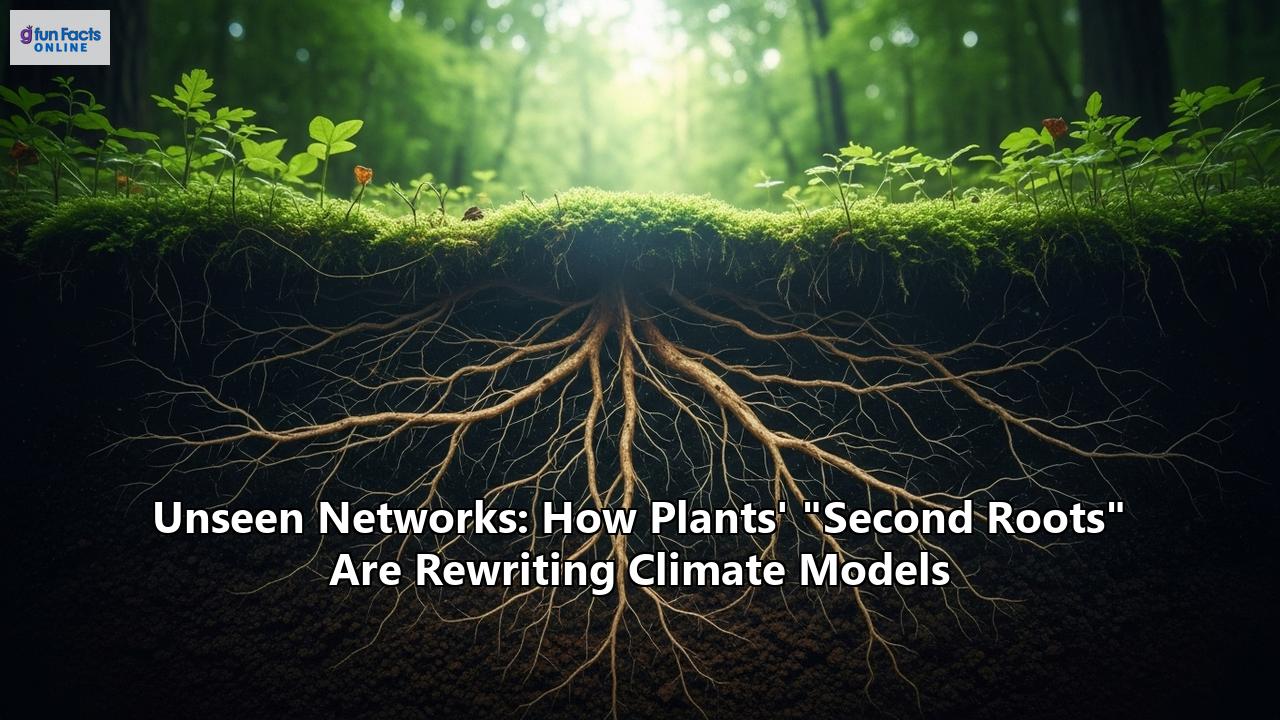
Beneath our feet lies a hidden, sprawling universe of fungal threads, a biological superhighway that scientists are increasingly recognizing as a critical player in the global climate system. This intricate network, often called the "Wood Wide Web," is formed by mycorrhizal fungi, ancient organisms that have been in a symbiotic partnership with plants for over 400 million years. Acting as a second set of roots, these fungi extend the reach of plants, foraging for nutrients and water in exchange for carbon. This underground alliance is so fundamental that it involves an estimated 80% to 90% of all land plant species. Now, groundbreaking research reveals that this unseen network doesn't just help plants grow; it actively shapes the Earth's ability to store carbon, forcing a major rewrite of the climate models we rely on to predict our future.
The Underground Architects: What Are Mycorrhizal Fungi?
Mycorrhizal fungi are not a single entity but a vast and diverse kingdom. They form symbiotic associations with the vast majority of terrestrial plants, creating a critical link between the living world above ground and the soil below. In this partnership, plants, through photosynthesis, convert atmospheric carbon dioxide (CO2) into sugars. They then allocate a significant portion of this carbon—estimated to be between 5% and 20%—to the fungi. In return, the fungi extend their vast network of microscopic filaments, called hyphae, far into the soil, acting as a root system extension that is vastly more efficient at absorbing vital nutrients like phosphorus and nitrogen, as well as water.
Scientists primarily focus on two main types of these fungal partners, whose distinct strategies have profound implications for the carbon cycle:
- Arbuscular Mycorrhizal (AM) Fungi: These are the most common type, forming associations with the majority of plant species, including most crops, grasses, and many tropical trees. They penetrate directly into the plant's root cells to exchange resources. AM fungi are known for producing a sticky, carbon-rich compound called glomalin, which acts like a powerful glue, binding soil particles together into stable aggregates.
- Ectomycorrhizal (ECM) Fungi: Primarily partnering with woody plants like pines, oaks, and beeches, which dominate temperate and boreal forests, ECM fungi form a sheath around the plant's root tips. They are unique in their ability to "mine" nutrients by producing enzymes that can break down complex organic matter in the soil, accessing nitrogen that is unavailable to AM fungi.
The Carbon Connection: A Fungal Superhighway into the Soil
The role of these fungi goes far beyond simply helping individual plants. They are major engineers of the soil's carbon cycle. The sheer scale of their operation is staggering; recent estimates suggest that mycorrhizal fungi sequester approximately 13 gigatons of CO2 equivalent each year, which is about 36% of the annual CO2 emissions from fossil fuels.
This carbon sequestration happens through several key mechanisms:
- Building Living Networks: The carbon received from plants is used to build and maintain the fungi's extensive underground hyphal networks. This living biomass represents a significant, though temporary, carbon reservoir.
- The Necromass Pathway: Fungal hyphae have a short lifespan. When they die, their remains, known as necromass, become a key component of soil organic matter. There is growing evidence that this fungal necromass is a more significant contributor to stable, long-term carbon storage than dead plant matter itself.
- Soil Aggregation: AM fungi, through their production of glomalin, are master soil builders. This "super glue" creates stable soil aggregates that protect organic matter, rich in carbon, from being decomposed and released back into the atmosphere as CO2. By locking carbon away inside these tiny soil fortresses, they ensure its stability for longer periods.
Why Climate Models Are Playing Catch-Up
For decades, climate models that predict global warming have treated soil as a simple, passive "black box." They could account for the carbon in dead leaves and roots, but they largely missed the dynamic, living component of the soil ecosystem—the fungi. This omission has led to significant uncertainties in predicting how much carbon our planet's ecosystems can actually store.
The problem is that different fungal networks behave very differently. Ecosystems dominated by ECM fungi, like the vast boreal forests, tend to store carbon more effectively. Because ECM fungi can mine their own nitrogen, they slow down the overall decomposition process, allowing organic matter to accumulate. In contrast, AM-dominated ecosystems have a faster carbon turnover.
New research is making it clear that failing to account for these fungal-specific traits is no longer an option. Studies are showing that incorporating mycorrhizal processes into earth system models significantly improves their accuracy in predicting soil carbon dynamics, especially in response to rising atmospheric CO2.
A Fungal Revolution in Climate Science
The latest science is revealing just how much these fungal networks influence ecosystems and our climate.
- Differing Responses to CO2: Studies have shown that plants associated with ECM fungi may increase their biomass by around 30% under elevated CO2 conditions, while plants partnered with AM fungi show almost no change. This suggests that the type of fungi in a forest could determine how well that forest responds to climate change.
- The Nitrogen Trade-Off: Recent findings indicate that in nitrogen-rich environments, often caused by agricultural runoff and pollution, ECM-associated trees become less efficient. They have to "pay" more carbon to their fungal partners for the nutrients, leaving less energy for their own growth. This could explain why AM-associated trees, like maples, are beginning to outcompete ECM-trees, like oaks and pines, in some temperate forests, a shift that has major implications for long-term carbon storage.
- A Fragile Alliance: These vital networks are themselves under threat from climate change. Rising temperatures, altered rainfall patterns, and deforestation can disrupt the delicate plant-fungi symbiosis. Some studies predict that warming could trigger abrupt, large-scale shifts in fungal communities, particularly in sensitive regions like the boreal forests, potentially turning them from carbon sinks into carbon sources.
The Future is Fungal
Understanding this hidden world is more than an academic exercise; it's a critical frontier in our fight against climate change. By accurately modeling the role of these "second roots," scientists can provide more reliable predictions about the future of our planet. This knowledge underscores the importance of preserving our natural ecosystems, not just for the trees we can see, but for the intricate, life-sustaining fungal networks thriving unseen in the soil beneath them. These silent partners are fundamental architects of the global carbon cycle, and their health is inextricably linked to our own.
Reference:
- https://imafungus.pensoft.net/article/140187/
- https://www.mdpi.com/1424-2818/3/1/8
- https://fas.dartmouth.edu/news/2024/11/belowground-fungi-help-some-trees-more-others
- https://bg.copernicus.org/articles/21/1391/2024/
- https://bigfootmyco.com/ask-dr-mike-can-soil-fungi-fight-climate-change/
- https://rd2.co.nz/wp-content/uploads/2023/10/qt4631w0n8_noSplash_c61de6f6bf5814f4896fd7128973d237.pdf
- https://bpb-us-e2.wpmucdn.com/faculty.sites.uci.edu/dist/a/467/files/2015/04/Treseder_2016_Botany.pdf
- https://bg.copernicus.org/articles/19/1469/2022/
- https://www.plant-ecology.com/EN/10.17521/cjpe.2023.0075
- https://www.indogulfbioag.com/post/carbon-sequestration-and-mycorrhizae
- https://www.researchgate.net/publication/323994630_10_Mycorrhizal_Fungi_and_the_Soil_Carbon_and_Nutrient_Cycling
- https://pmc.ncbi.nlm.nih.gov/articles/PMC11442127/
- https://cdnsciencepub.com/doi/10.1139/cjss-2024-0048
- https://sefs.uw.edu/2024/09/new-research-led-by-assistant-professor-claire-willing-sheds-light-on-how-mycorrhizal-fungi-shape-plant-community-structure-and-diversity/
- https://ecoevorxiv.org/repository/object/8615/download/16648/
- https://www.regenerativeviticulture.org/mycorrhizal-mycelium-as-a-global-carbon-pool/
- https://academic.oup.com/ismej/article/19/1/wraf074/8116035
- https://pmc.ncbi.nlm.nih.gov/articles/PMC6071827/
- https://www.creamjournal.org/pdf/CREAM_14_1_5-1.pdf
- https://www.researchgate.net/publication/370014333_Niche_modelling_predicts_that_soil_fungi_occupy_a_precarious_climate_in_boreal_forests