
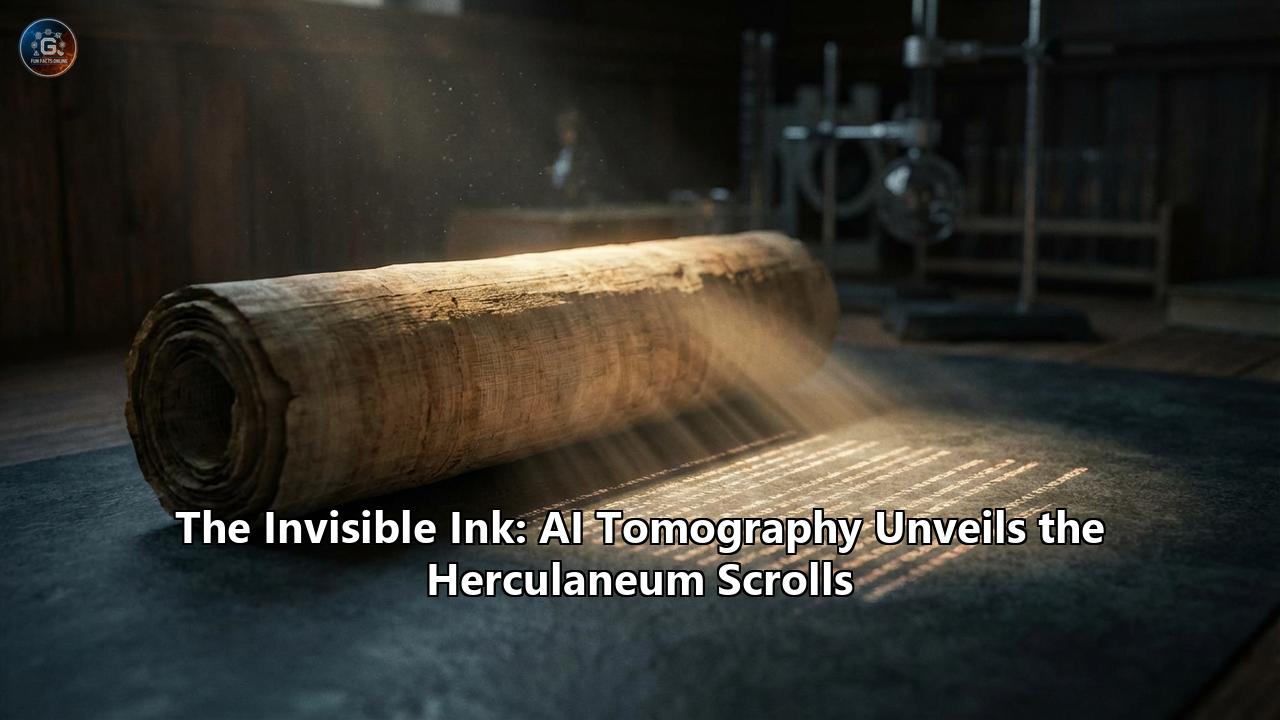
The air in the Bay of Naples is thick with the ghost of a memory, a trauma two thousand years old that still vibrates in the soil. To walk the ruins of Herculaneum is to walk a grave that was sealed in a single, terrifying afternoon. We know the story of Pompeii, the city of ash, frozen in a grey snapshot of panicked flight. But Herculaneum, the wealthier, seaside resort town to the west, met a different fate. It was not buried by falling ash, but swallowed by a pyroclastic surge—a superheated avalanche of gas and mud that hit the city at hurricane speeds, sealing it under sixty feet of volcanic rock.
For nearly two millennia, this rock was a tomb. But it was also a fortress. Inside one specific villa, believed to be the summer retreat of Julius Caesar’s father-in-law, the heat that destroyed life also performed a miracle of preservation. It carbonized a library. nearly 2,000 scrolls of papyrus were instantly turned into lumps of charcoal, fused together by 600-degree heat, then locked in an airtight embrace of tuff.
They looked like burnt logs. For centuries after their discovery in the 1750s, they were treated as such—often discarded or used as kindling by workmen who didn't understand what they were holding. When the realization finally dawned that these "logs" were the only surviving library from antiquity, the tragedy only deepened. To open them was to destroy them. Every attempt to peel back a layer resulted in a pile of black dust. The wisdom of the ancients was right there, physically present, yet tantalizingly out of reach—a Schrödinger’s library that existed only as long as you didn't try to read it.
Until now.
We are living through a quiet revolution in archaeology, one that smells not of dust and dirt, but of ozone and server farms. Through the convergence of high-energy particle physics, advanced X-ray tomography, and artificial intelligence, the "Invisible Library" is finally speaking. The Herculaneum Scrolls are being read, not by unrolling them physically, but by virtually unwrapping them inside a digital void.
This is the story of the Vesuvius Challenge, the unlikely band of geeks and scholars who cracked the code, and the resurrection of a philosophy that has been waiting 2,000 years to remind us how to live.
Part I: The Villa of the Papyri
To understand the magnitude of the breakthrough, we must first understand the scale of the loss. The classical world is a puzzle with 99% of the pieces missing. We estimate that we have recovered perhaps one percent of all Greek and Latin literature. The rest—the lost plays of Sophocles, the missing books of Livy, the treatises of Aristotle—rotted away in damp cellars, burned in the fires of conquest, or were scraped off parchment to make room for prayer books.
The Villa dei Papiri in Herculaneum was an anomaly. Owned by Lucius Calpurnius Piso Caesoninus, a wealthy Roman statesman and patron of the arts, the villa was a center of Epicurean thought. When Vesuvius erupted in 79 AD, the library was being packed up. Scrolls were found in travel cases, ready to be moved. They never made it.
When well-diggers accidentally punched through the roof of the buried villa in 1750, they found a treasure trove of bronze and marble statues—the finest ever discovered. But the scrolls were the true prize. Early explorers, realizing the "charcoal" had writing on it, tried everything to open them. They used knives, mercury, and a strange machine invited by a priest named Antonio Piaggio that used silk threads and gravity to slowly, painfully pull the scrolls open at a rate of millimeters per day.
These methods were heroic but destructive. The scrolls that were successfully unrolled were often torn or fragmented, their text legible only in patches where the black ink stood out against the black papyrus—a distinction of "black on black" that is a nightmare for the human eye.
By the 20th century, the remaining scrolls—hundreds of them—were deemed too fragile to touch. They sat in the National Library of Naples, a "closed archive" in the most literal sense. They became a symbol of the limits of human knowledge. We could send men to the moon, but we couldn't read a book that was sitting right in front of us.
Part II: The Digital knife
Enter Dr. Brent Seales. A computer scientist at the University of Kentucky, Seales is a man who looks at a damaged object and sees a data problem. In the early 2000s, he began developing a technique he called "Virtual Unwrapping." The concept was theoretically simple but computationally excruciating.
If you can’t open the scroll, you scan it. You use a CT scanner (Computed Tomography), similar to what doctors use to find a tumor, but with much higher resolution. The scan creates a 3D block of data—a "voxel" grid—representing the density of the object.
Inside this block, the layers of papyrus are wound in a complex spiral, distorted by the heat and pressure of the eruption. They aren't flat sheets; they are crinkled, twisted, and fused, like a newspaper that has been soaked in water, crumpled into a ball, and then baked in an oven.
Seales’ software, the "Volume Cartographer," was designed to trace these layers. It finds the single sheet of papyrus winding through the chaos, models its surface, and then digitally "flattens" it.
In 2015, Seales proved the tech worked. He virtually unrolled the En-Gedi scroll, a lump of charcoal found in an ancient synagogue in Israel. The software revealed it to be a copy of the Book of Leviticus, the oldest biblical text found since the Dead Sea Scrolls.
But Herculaneum was the "boss fight."
The ink used on the En-Gedi scroll contained metal (iron gall ink), which shows up bright white on an X-ray scan because metal is denser than carbon. The Herculaneum scrolls, however, were written with carbon-based ink (soot and gum arabic) on carbon-based papyrus. Carbon on carbon. In a standard X-ray, the ink is invisible. It has the same density as the paper.
For years, this seemed like a wall. Seales suspected that even if the density was the same, the structure might be different. Perhaps the ink sat on top of the fibers in a way that could be detected with a powerful enough machine.
In 2019, Seales took a few scrolls to the Diamond Light Source in the UK, a particle accelerator (synchrotron) that generates X-rays 10 billion times brighter than the sun. The resulting scans were massive, terabytes of data, capturing details down to the micron. But to the human eye, they still looked like static.
The data was there. But no human could see it. It was a job for Artificial Intelligence.
Part III: The Silicon Valley Intervention
By 2023, Seales had the scans and the method, but the progress was slow. He was an academic working with academic funding timelines. The problem needed a burst of energy—and money.
Nat Friedman, the former CEO of GitHub, had become obsessed with the scrolls during the pandemic. He saw the potential for a "moonshot" moment. Partnering with entrepreneur Daniel Gross and Seales, they launched the Vesuvius Challenge in March 2023.
The pitch was pure Silicon Valley: "Here is the data. Here is the code. Here is a million dollars. Go."
They released the high-resolution scans of two rolled scrolls (Scroll 1 and Scroll 2) and several open fragments to the public. The goal? Read four passages of text from the inside of the unopened scrolls.
The internet responded. Machine learning engineers, college students, and physics PhDs from around the world descended on the data. The Discord server for the Vesuvius Challenge became a hive mind of problem-solving, a place where particle physics met PyTorch.
The breakthrough didn't come from a professor. It came from a former physicist named Casey Handmer.
Part IV: The Crackle Pattern
Handmer was staring at the images of the open fragments—pieces of papyrus that had broken off and could be photographed with infrared light (which makes the ink visible) and also scanned with X-rays. He was looking for a "ground truth," a correlation between what the X-ray showed and what the eye could see.
Most people were training AI models to look for subtle density shifts. Handmer looked for texture. He noticed that where the ink sat on the papyrus, the fibers of the paper seemed to be disturbed. The ink, as it dried 2,000 years ago, had created a tiny, cracked surface—a "crackle pattern" resembling the mud in a dried-up lakebed.
It was faint. Almost hallucinatory. But it was there.
Handmer wrote a blog post about the "crackle" and shared it on the Discord. It was the Rosetta Stone.
Luke Farritor, a 21-year-old undergraduate at the University of Nebraska, took Handmer’s observation and fed it into a machine learning model. He trained a convolutional neural network to hunt for this specific texture in the 3D voxel data.
One night in August 2023, Farritor was at a party. His phone buzzed. His code had finished running on a segment of Scroll 1. He checked the image.
Floating in the black-and-white static were three clear Greek letters: Pi, Omicron, Rho.
Porphyras."Purple."
It was the first word read from inside an unopened Herculaneum scroll. The word "purple" (or "purple dye") was likely a reference to robes or cloth, a symbol of wealth in the ancient world. But the meaning was secondary to the fact that it existed. The invisible ink had been found.
Part V: The Floodgates Open
Farritor won the "First Letters" prize, but the race was on for the Grand Prize: reading four continuous passages.
Enter Youssef Nader, an Egyptian biorobotics student in Berlin. Nader developed a more sophisticated architecture, a domain-adaptation model that could take the faint signals Farritor found and amplify them, cleaning up the noise.
The competition was fierce but collaborative. In the spirit of open science, competitors shared their methods. Nader, Farritor, and a Swiss robotics student named Julian Schilliger (who had built a tool to automate the tedious segmentation of the papyrus sheets) eventually joined forces.
On February 5, 2024, the Vesuvius Challenge announced the winners of the $700,000 Grand Prize. The team had deciphered over 2,000 characters from Scroll 1.
It was not just a word. It was a philosophy.
The text was a previously unknown work by Philodemus of Gadara, the Epicurean philosopher who was the "patron saint" of the Villa’s library. The passage was a meditation on the nature of pleasure.
Philodemus wrote about music, food, and the good life. In the decoded text, he asks whether things that are scarce are more pleasurable than things that are abundant. (Spoiler: He argues they are not. "As in the case of food," he writes, "we do not immediately believe things that are scarce to be absolutely more pleasant than those which are abundant.")
It was a voice speaking clearly across twenty centuries, discussing the psychology of consumerism and desire in a way that felt startlingly modern.
Part VI: The 2025 Breakthroughs and "On Vices"
The Grand Prize was just the end of the beginning. The success proved the concept, but the Vesuvius Challenge had a bigger goal for 2024 and 2025: Scale.
Scanning the scrolls is expensive and slow. Segmentation—unwrapping the digital layers—was still largely manual. To read the entire library, the process needed to be automated.
Throughout 2025, the team focused on "Auto-Segmentation." Using the prize money and new funding, they improved the AI to trace the layers of the scroll without human intervention. The "ink detection" models became more robust, able to read text that was more damaged or written with fainter ink.
In mid-2025, a massive breakthrough occurred with PHerc. 172.
This scroll, scanned at the Diamond Light Source, turned out to have a different physical composition than Scroll 1. The ink was slightly denser, perhaps due to a different recipe or a quirk of the carbonization process. The AI tore through it.
Researchers recovered the title of the work—a rare and precious find, as titles were usually written at the very end of the scroll (the center), which is the hardest part to read.
The title was "On Vices and their Opposite Virtues and the People in Whom They Occur and About What Things."
It was another work by Philodemus, part of his massive multi-volume magnum opus on ethics. The text decoded from PHerc. 172 was a scathing critique of the "traits of the flatterer" and the "arrogant man." It offered a window into the social dynamics of the Roman elite—the very people who lived in the Villa.
We were no longer just reading fragments; we were reading books.
Part VII: The Man in the Villa: Who Was Philodemus?
To understand why this matters, we have to talk about Philodemus.
Before the scrolls were read, Philodemus was a footnote in history. We knew him mainly through references in other texts, often dismissive. Cicero, the great Roman orator, knew him and had a complicated relationship with him (and with Philodemus's patron, Piso).
But the Herculaneum library reveals Philodemus as a towering intellectual figure, the bridge between Greek philosophy and the Roman world.
He was an Epicurean. Today, "Epicurean" means someone who likes fancy food and wine. But the ancient philosophy was different. Epicurus taught that the goal of life was ataraxia—freedom from anxiety. He believed the gods didn't care about us, that the soul died with the body, and that the pursuit of simple, sustainable pleasures (friendship, learning, moderate comfort) was the key to happiness.
It was a radical, almost atheistic worldview in a deeply superstitious time. And it was popular among the Roman aristocracy, who were stressed, ambitious, and constantly killing each other for power. The Villa of the Papyri was a sanctuary, a place to escape the politics of Rome and talk about the nature of death and pleasure.
The texts we are decoding are the lecture notes and polished treatises of this community. They are the self-help books of the Roman Empire. They discuss how to be a good king, how to handle anger, how to manage wealth, and how to appreciate music.
One fascinating discovery from the recent decoding involves Philodemus’s theory of music. Unlike the Stoics, who thought music influenced your moral character (i.e., listening to "bad" music made you a bad person), Philodemus argued that music was just… physics. It was sound. It could make you feel emotion, but it couldn't change your soul. It’s a debate that feels eerily similar to modern arguments about video games or rap lyrics.
Part VIII: The Master Plan and the Lower Depths
As of February 2026, the project has moved into an industrial phase. The "Master Plan," outlined by Nat Friedman and Brent Seales, involves building a dedicated scanner at the Villa itself. Transporting scrolls to the UK is risky and legally complex. The solution is to bring the particle accelerator (or a compact, high-flux version of it) to the mountain.
But the most tantalizing prospect isn't the scrolls we have. It's the scrolls we don't have.
Archaeologists have long suspected that the Villa of the Papyri has not been fully excavated. In the 18th century, the tunnels dug by the Swiss engineer Karl Weber were narrow and dangerous. They found the scrolls in a specific room, but Roman libraries were typically divided into two sections: Greek and Latin.
Almost every scroll opened so far has been in Greek.
Where is the Latin library?
It is highly probable that somewhere in the unexcavated lower levels of the Villa, buried under 20 meters of rock, lies a second room containing the Latin masterpieces of the time. The lost poems of Ennius? The missing histories of Rome? Early drafts of Virgil?
The success of the Vesuvius Challenge has reignited the push to excavate. But "excavation" in 2026 doesn't necessarily mean shovels. It means drilling boreholes and lowering slim, fiber-optic scanners. It means using muon tomography (using cosmic rays to map density) to find the voids where the rooms are.
If the Latin library is found, it would be the greatest archaeological discovery since Tutankhamun. And this time, we have the technology to read it immediately.
Part IX: Beyond Vesuvius
The impact of this technology extends far beyond Herculaneum. The "Seales Method"—AI-driven CT decipherment—is a universal key for locked texts.
Museums all over the world are sitting on "unreadable" objects.
- Mummy Cartonnage: Ancient Egyptians used recycled papyrus to make the papier-mâché cases for mummies. These scraps often contain tax receipts, letters, and fragments of literature. We can now read them without dissolving the mummy case.
- Medieval Book Bindings: Parchment from older, "heretical" or "outdated" books was often cut up and used to bind new books. Hidden inside the covers of a 15th-century accounting ledger might be a lost 7th-century poem.
- The invisible Library: There are thousands of documents that are simply stuck together, water-damaged, or too brittle to open. The output of the Vesuvius Challenge is open-source. The code that read Philodemus can be adapted to read a Civil War diary fused by mud, or a scorched letter from World War II.
Part X: The Immortality of Thought
There is a profound irony in the story of the Herculaneum Scrolls. The Epicureans believed that the soul was mortal, that we are just atoms in the void, and that death is the end. They did not believe in the afterlife. They believed in this life.
And yet, they have achieved a form of immortality that no Pharaoh could have bought with all the gold in Egypt.
Their thoughts were turned to stone by a volcano. They slept in the earth while empires rose and fell, while Christianity swept the globe, while the printing press was invented, while the atom was split. They waited until a species of hairless apes invented a machine that could accelerate electrons to the speed of light and a synthetic brain that could learn to see the invisible.
When we read Philodemus today, the connection is electric. It is a direct mind-to-mind transfer across 2,000 years. We are not just reading a text; we are witnessing the triumph of information over entropy.
The Vesuvius Challenge is more than a technical contest. It is a testament to human curiosity. We spent millions of dollars and countless hours of computing power not to find gold or oil, but to read a book about philosophy.
As the AI continues to churn through the terabytes of data, scrolling down the ancient columns of text, we are reminded of the durability of the written word. The fire could not burn it. The earth could not crush it. Time could not erase it.
The ink is invisible no more. The library is open. And the ancients have a lot to say.
Reference:
- https://historyagainstthegrainblog.com/2025/02/16/digital-history-in-the-news-the-herculaneum-scrolls/
- https://www.neh.gov/news/students-decipher-2000-year-old-herculaneum-scrolls
- https://kaggle.curtischong.me/competitions/Vesuvius-Challenge---Ink-Detection
- https://www.smithsonianmag.com/smart-news/these-ancient-scrolls-have-been-a-tantalizing-mystery-for-2000-years-researchers-just-deciphered-a-title-for-the-first-time-180986639/
- https://www.popularmechanics.com/science/archaeology/a45547681/ancient-herculaneum-scroll-from-vesuvius-words-revealed/
- https://medium.com/@babunow99/the-unveiling-of-ancient-wisdom-907a7f74dd4e
- https://en.wikipedia.org/wiki/Herculaneum_papyri
- https://europe.factsanddetails.com/article/entry-965.html
- https://archaeologymag.com/2025/02/ai-reveals-first-look-inside-herculaneum-scroll/
- https://time.com/6326563/vesuvius-challenge-herculaneum-papyri-ai/
- https://www.photonicsonline.com/doc/unwrapping-the-herculaneum-papyri-with-infrared-imaging-and-ai-0001
- https://bigthink.com/the-past/vesuvius-challenge-ai/
- https://www.understandingai.org/p/a-volcano-scorched-hundreds-of-roman
- https://www.timesofisrael.com/in-breakthrough-parts-of-herculaneum-scroll-buried-by-vesuvius-eruption-deciphered/
- https://archaeologymag.com/2023/10/21-year-old-student-deciphered-herculaneum-scrolls/
- https://dig.watch/updates/ai-unlocks-secrets-of-2000-year-old-herculaneum-scroll
- https://www.denisonforum.org/current-events/ai-resurrects-2000-year-old-writings-in-1-million-vesuvius-challenge/
- https://the-past.com/news/reading-a-new-herculaneum-scroll/
- https://news.artnet.com/art-world/herculaneum-scrolls-deciphered-2381126