
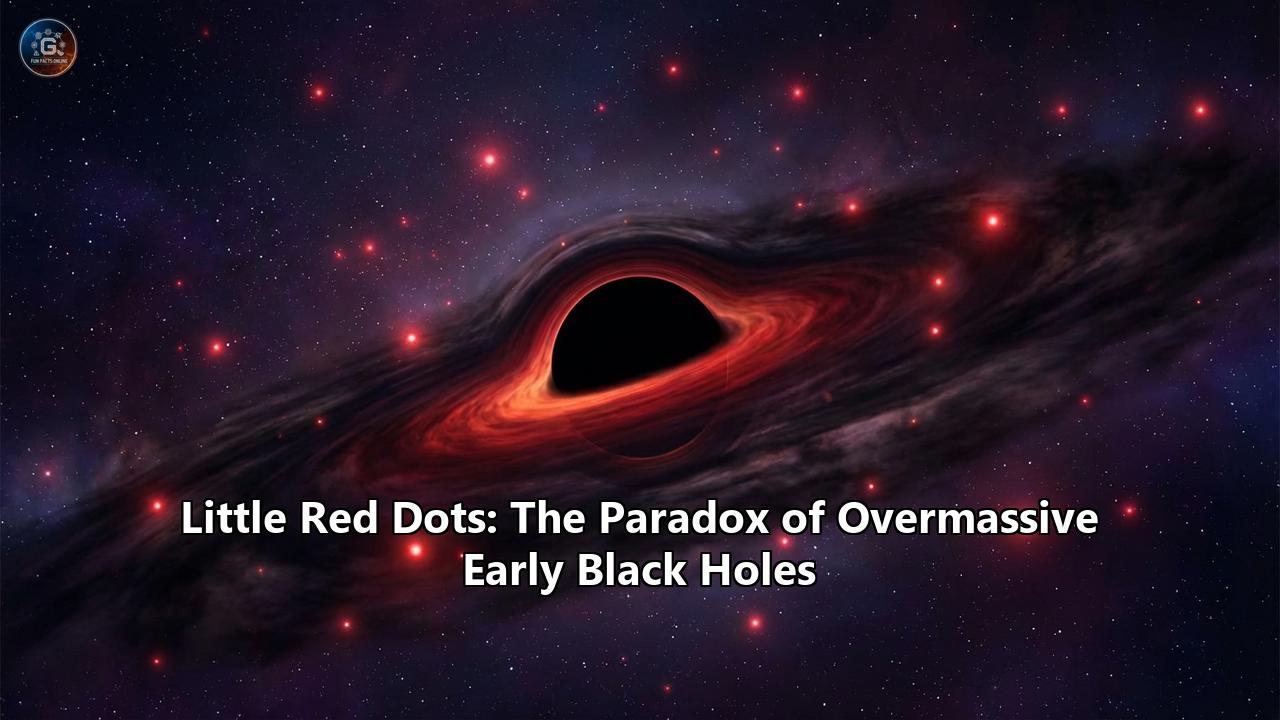
In the deep, ancient dark of the cosmos, something is glowing where it shouldn’t be.
For decades, astronomers believed they understood the rhythm of the early universe. The story went like this: vast clouds of neutral hydrogen collapsed to form the first stars, which clustered into small, messy galaxies. Within the hearts of these galaxies, black holes eventually formed and grew, feeding on gas and dust. In this "standard model" of cosmic evolution, the galaxy came first, and the monster in the middle grew up alongside it, a symbiotic relationship where the black hole’s mass remained a tiny, predictable fraction—typically 0.1%—of the galaxy’s total bulk.
Then came the James Webb Space Telescope (JWST).
Within its first year of operations, JWST peered further back in time than any human eye had ever seen, targeting the epoch known as the "Cosmic Dawn," less than a billion years after the Big Bang. It expected to find faint, ragged clumps of infant stars. Instead, it found hundreds of bright, compact, crimson spheres.
They were initially dismissed as quirks of data or typical dust-shrouded galaxies. But as spectra trickled in, a startling realization took hold. These were not normal galaxies. They were tiny, point-source objects emitting light with an intensity that defied physical models. They were nicknamed "Little Red Dots" (LRDs), and they have since become the center of the biggest controversy in modern astrophysics.
The paradox they present is chilling: these dots appear to host supermassive black holes that are far too big, far too early. Some seem to be almost as massive as the galaxies they inhabit, upending the 0.1% rule and suggesting that in the infant universe, the monsters might have formed before the cradles.
The Anatomy of a Mystery
To understand why Little Red Dots are so baffling, one must look at how they appear to the sensors of the JWST.
In the "eyes" of the telescope, these objects present a unique, contradictory signature known as a "V-shaped" spectral energy distribution.
- The Blue Wing: In the ultraviolet and visible light wavelengths, they show a faint, blueish glow. This is the signature of a small, young host galaxy—a cluster of baby stars, unpolluted by heavy metals, shining clearly.
- The Red Wing: In the near-infrared, the spectrum shoots upward violently. The light becomes incredibly intense and red. This is not the redness of old, dying stars, but the redness of distinct attenuation—light that has been processed through thick layers of dust and gas, or light that has been stretched by extreme cosmological redshift.
This "red excess" is so compact that it cannot be a galaxy distributed over space. It originates from a point source—a singular region of space smaller than a few light-years across.
When astronomers broke this light down using spectroscopy (the "fingerprint" of elements), they found the smoking gun: Broad Line Emission. specifically, broad Hydrogen-alpha (Hα) lines. In astrophysics, broad lines are the signature of speed. They indicate gas swirling at thousands of kilometers per second. There is only one engine in the universe capable of whipping gas around at those speeds within such a confined space: the accretion disk of a Supermassive Black Hole (SMBH).
But here lies the problem. To produce the luminosity observed in these Little Red Dots, the black holes powering them would need to be millions, perhaps billions, of times the mass of the Sun. And they are existing at a time—600 to 800 million years after the Big Bang—when the universe was barely out of its infancy.
"It’s like walking into a nursery and finding a toddler who is seven feet tall and weighs 300 pounds," says one researcher involved in the COSMOS-Webb survey. "It doesn’t fit our understanding of how things grow."
The Impossible Ratio: The "Overmassive" Paradox
In the local universe (the modern epoch we live in), there is a strict law known as the Magorrian Relation. It states that the mass of a central black hole is tightly correlated to the mass of its host galaxy’s central bulge. If you weigh the galaxy, you can guess the weight of the black hole, and vice versa. The black hole is always the junior partner, roughly 1/1000th of the galaxy's mass.
The Little Red Dots violate this law flagrantly.
In many LRDs, the black hole appears to be 10%, 50%, or even nearly 100% of the host galaxy’s stellar mass. This is not a "relationship"; it is a dominance. It suggests that these black holes did not grow inside galaxies. It implies they might have formed first, acting as gravitational anchors around which the galaxy later coalesced.
This "Overmassive Black Hole" scenario forces cosmologists to confront two uncomfortable questions:
- How did they get so big so fast? Standard accretion (eating gas) has a speed limit known as the Eddington Limit. If a black hole eats too fast, the radiation pressure blows the food away. To reach these masses in 600 million years, these black holes would have to break the speed limit of the universe continuously since the moment of the Big Bang.
- Where are the X-rays? Active Galactic Nuclei (AGN)—eating black holes—are famous for screaming in X-rays. Yet, when astronomers pointed our best X-ray telescope, Chandra, at these Little Red Dots, they saw nothing. The dots are X-ray silent.
A monster that is too big to exist, eating faster than physics allows, and hiding in a cloak of silence.
The Leading Suspects
As the astrophysics community scrambled to explain the LRDs, the debate split into warring factions, each proposing a different solution to the paradox.
1. The Super-Dusty Baby Quasar (The "Cocoon" Theory)
The current leading hypothesis, bolstered by research published in late 2024 and early 2025, is that we are looking at a unique phase of black hole evolution that effectively no longer exists in the modern universe.
In this model, the black hole is indeed there, but it is not as massive as the raw luminosity suggests. Instead, it is "cocooned" in an incredibly dense sphere of gas and dust. This cocoon does two things:
- It blocks the X-rays completely, explaining the silence.
- It reprocesses the high-energy radiation from the black hole into the infrared (red) light we see.
Crucially, recent simulations suggest that the "broad lines" used to weigh these black holes might be deceptive. Typically, broad lines mean high gravity (and thus high mass). But in the LRDs, the gas might not just be orbiting; it might be part of a massive, dust-driven outflow—a wind blowing outward. If we mistake this wind speed for orbital speed, we vastly overestimate the mass of the black hole.
A groundbreaking 2025 study led by researchers at the University of Manchester and the Max Planck Institute suggests that once you correct for this "cocoon effect," the black holes shrink. They are still massive—perhaps 100,000 solar masses—but they are no longer "impossible." They are merely "heavy seeds," growing vigorously in a dust shell.
2. The Heavy Seed Scenario
If the black holes are not optical illusions, we must rewrite the history of seed formation.
Standard theory says black holes start as "Light Seeds"—the remnants of the first stars (Pop III stars), weighing perhaps 10 to 100 solar masses. Growing from 100 to 1,000,000,000 solar masses in a few hundred million years is mathematically difficult.
The Little Red Dots offer the strongest evidence yet for "Heavy Seeds" (Direct Collapse Black Holes). In this scenario, vast clouds of pristine gas in the early universe did not fragment into stars. Instead, kept hot by background radiation, they collapsed monolithically, directly into a black hole weighing 10,000 to 100,000 solar masses in a single day.
If LRDs are these Heavy Seeds, the paradox of "too big, too fast" vanishes. They didn't need to grow fast; they were born big.
3. The "Exotic" Imposters: Supermassive Stars?
A minority of astronomers propose an even wilder alternative. What if there is no black hole at all?
Some models of the early universe allow for the formation of Supermassive Stars—titans weighing 10,000 to 100,000 times the mass of the Sun. These stars would be so luminous they would burn through their fuel in a cosmic blink of an eye. Their spectral signature—a cool, red photosphere with broad emission lines from stellar winds—could look suspiciously like an obscured black hole.
If LRDs are actually supermassive stars, they would be the "missing link" of stellar evolution, the precursors that eventually collapse to form the Heavy Seed black holes discussed above.
The "Gray" Hole Solution: A New Phase of Matter?
The most recent twist in the LRD saga comes from the study of their "colors."
Standard Quasars (active black holes) are blue. They are exposed accretion disks.
Standard Galaxies are white or yellow (starlight).
Dusty Galaxies are red.
Little Red Dots are distinct because they are point-source red. The "Cocoon" model mentioned earlier explains this best. It posits that the LRDs are a transition phase.
- Phase 1: A Heavy Seed black hole forms in a dense gas cloud.
- Phase 2 (The LRD Phase): The black hole eats voraciously. It is buried in food. The density of the gas is so high that light essentially bounces around inside the cloud, shifting to red, before escaping. This is the "Little Red Dot."
- Phase 3: The black hole grows large enough that its "feedback" (winds and jets) blows the cocoon away.
- Phase 4: The object becomes a visible, blue Quasar—the giants we see in the slightly older universe.
This timeline implies that JWST has captured a specific biological stage of the universe: the metamorphosis of black holes. We are seeing them in the womb.
Why This Matters: Rewriting the Cosmic Dawn
The existence of Little Red Dots forces a revision of the "Galaxy First" model.
If these objects are indeed "overmassive" relative to their hosts, it suggests that Black Hole First evolution is real. In the pockets of the early universe, gravity collapsed gas into black holes before it collapsed gas into stars. These black holes then acted as the "seeds" for galaxy formation, their gravity pulling in the dark matter and gas that would eventually birth the Milky Way and its cousins.
It implies that the universe was a far more violent, top-down place than we imagined. It wasn't a slow buildup of structure. It was an era of monsters, born from the dark, shaping the cosmos by brute force.
The Road Ahead
The mystery of the Little Red Dots is far from solved. The "Cocoon" hypothesis is currently the most attractive because it saves our understanding of physics (we don't need to break the Eddington limit), but it requires proof.
That proof will come from two sources:
- Longer Exposure Spectroscopy: JWST needs to stare at these dots longer to detect faint lines of oxygen and neon, which can distinguish between a black hole's accretion disk and a supermassive star's surface.
- Variability: Black holes flicker as they eat. Stars generally do not (on short timescales). If LRDs flicker over the course of months or years, the Supermassive Star theory dies, and the Black Hole theory wins.
Until then, these Little Red Dots remain the most provocative objects in the sky. They are red warning lights on the dashboard of our cosmology, signaling that the early universe was stranger, denser, and more monstrous than we ever dared to dream. The paradox of the overmassive black hole is not just a statistical anomaly; it is a glimpse into the dark, violent birth of the galaxies we call home.
Reference:
- https://www.sciencealert.com/mysterious-red-dots-in-early-universe-could-be-seeds-of-supermassive-stars
- https://www.youtube.com/watch?v=tQlsy5m3crc
- https://ista.ac.at/en/news/baby-quasars-growing-supermassive-black-holes/
- https://www.space.com/astronomy/black-holes/james-webb-space-telescopes-mysterious-little-red-dots-may-be-black-holes-in-disguise
- https://www.youtube.com/watch?v=_hMtHLr8G4o
- https://en.wikipedia.org/wiki/Little_red_dot_(astronomical_object))
- https://www.reddit.com/r/cosmology/comments/1e85omd/nobody_can_explain_1000s_of_strange_little_red/
- https://www.404media.co/strange-little-red-dots-in-space-have-a-mind-boggling-explanation-scientists-discover/
- https://arxiv.org/html/2506.04350v1
- https://www.mpg.de/25316826/black-hole-stars
- https://www.sci.news/astronomy/little-red-dots-14486.html