
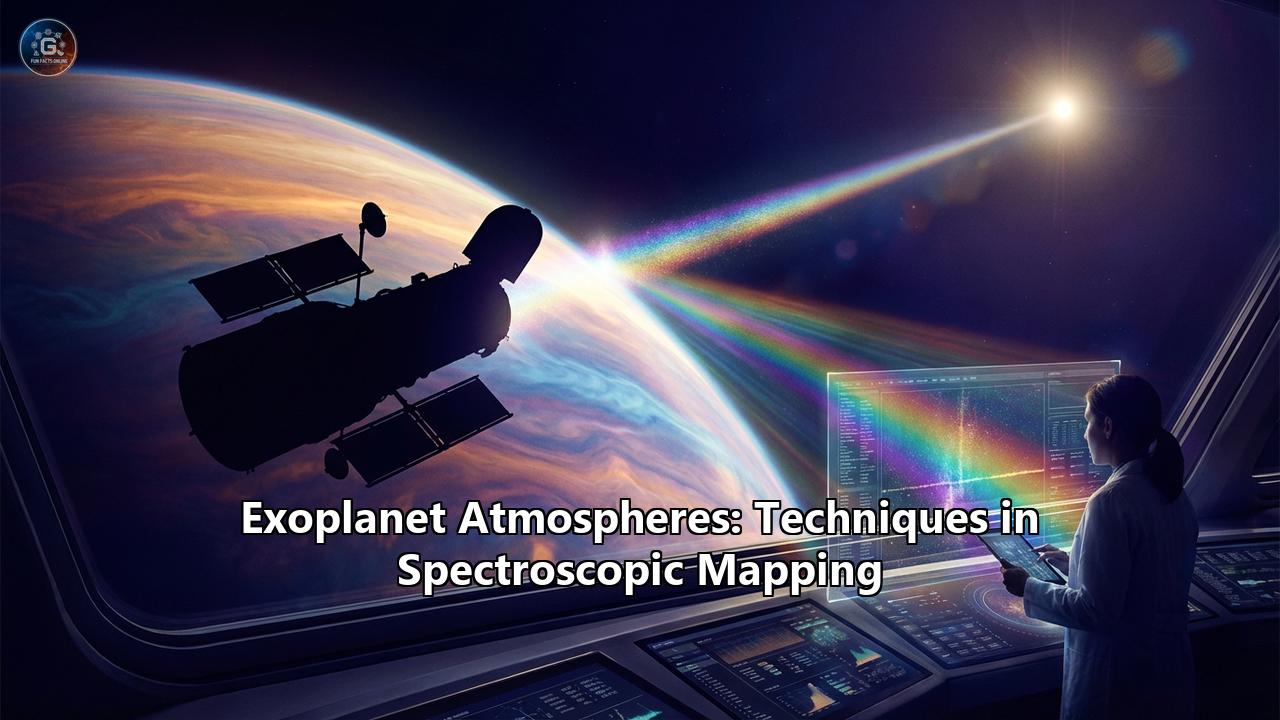
The night sky, once a tapestry of silent pinpoints, has begun to speak. For millennia, we looked up and wondered if other worlds existed. Today, we know they are there—thousands of them, orbiting stars both near and far. But the question has shifted from "Are they there?" to "What are they like?"
We have entered the golden age of exoplanet characterization. No longer satisfied with merely weighing and measuring these distant worlds, astronomers are now sniffing their air, tasting their clouds, and mapping the winds that whip around their equators. This is the era of atmospheric spectroscopy, a discipline that blends quantum physics, fluid dynamics, and extreme-precision engineering to decode the faint chemical fingerprints of worlds trillions of kilometers away.
This article explores the cutting-edge techniques used to map exoplanet atmospheres, from the physics of light interacting with gas to the statistical wizardry that extracts signal from noise. We will journey from the scorching iron rains of ultra-hot Jupiters to the tenuous, hopeful hazes of habitable-zone super-Earths, detailing the instruments, methods, and controversies that define this explosive field of science.
I. The Photon’s Journey: The Physics of Atmospheric Sensing
To understand how we map an atmosphere we cannot see, we must first understand the messenger: light. Every photon collected by our telescopes tells a story of its origin and the obstacles it faced on its journey to Earth.
1.1 The Fingerprint of Elements
At the heart of spectroscopy lies the quantum nature of matter. Atoms and molecules are picky eaters; they only absorb or emit light at specific, quantized energy levels. A water molecule ($H_2O$), for instance, vibrates and rotates in specific ways. When a photon of the exact right energy (wavelength) hits it, the molecule absorbs that photon and jumps to a higher energy state.
To an observer, this absorption looks like a missing slice of light in a spectrum—a dark line or "absorption feature." Conversely, if that molecule drops to a lower energy state, it emits a photon, creating a bright "emission line." By spreading the light from a star into a rainbow (a spectrum), we can read these lines like a barcode, identifying exactly which chemical species—water, methane, carbon dioxide, sodium—are present in the intervening gas.
1.2 Radiative Transfer: The Layer Cake of Atmospheres
An exoplanet's atmosphere is not a single, uniform shell. It is a complex, 3D structure with varying temperature, pressure, and composition. The light we observe is the result of radiative transfer—the passage of radiation through these layers.
- Optical Depth ($\tau$): This measures how opaque a medium is. We typically see down to an optical depth of $\tau \approx 1$. In a "clear" atmosphere, we see deeper; in a cloudy one, our view is blocked high up.
- Pressure Broadening: In deep, high-pressure layers, atoms collide frequently, blurring their energy states and making spectral lines wider. Higher up, in the vacuum of the upper atmosphere, lines are sharp and narrow. This difference allows astronomers to probe different altitudes by looking at the shapes of spectral lines.
1.3 The Scale Height ($H$)
A crucial concept in transmission spectroscopy is the atmospheric scale height ($H$), which dictates how "puffy" an atmosphere is. It is defined as the vertical distance over which the atmospheric pressure drops by a factor of $e$ (approx. 2.718).
$$ H = \frac{k_B T}{\mu g} $$
Where:
- $k_B$ is the Boltzmann constant.
- $T$ is the atmospheric temperature.
- $\mu$ is the mean molecular weight of the gas.
- $g$ is the planet's surface gravity.
This equation reveals a fundamental truth: Hot planets with light gases (Hydrogen/Helium) and low gravity are the easiest to study. Their atmospheres are vast and extended (large $H$), creating big, easy-to-detect signals. Small, cool, rocky worlds with heavy atmospheres (like Earth’s $N_2/O_2$ mix) have tiny scale heights, making their atmospheric rings vanishingly thin and difficult to probe.
II. Transmission Spectroscopy: The Terminator View
Transmission spectroscopy is the workhorse of exoplanet atmospheric science. It relies on a geometric coincidence: the planet passing directly in front of its star, an event known as a transit.
2.1 The Method
As a planet transits, it blocks a portion of the starlight, causing a dip in brightness. However, the planet is not a solid disk. It has a semi-transparent atmosphere.
- At wavelengths where the atmosphere is transparent, light passes through, and the planet appears smaller (smaller transit depth).
- At wavelengths where the atmosphere is opaque (e.g., due to water vapor absorption), the atmosphere blocks the light, making the planet appear effectively larger (larger transit depth).
By measuring the transit depth ($\delta$) as a function of wavelength ($\lambda$), we build a transmission spectrum. The change in transit depth is approximately:
$$ \Delta \delta \approx \frac{2 R_p H}{R_^2} $$
This equation tells us that the signal we are looking for is proportional to the area of the atmospheric annulus ($2\pi R_p H$) relative to the area of the star ($\pi R_^2$).
2.2 What We See: The Terminator
Transmission spectroscopy probes the terminator region—the twilight zone dividing day and night. This is a dynamic region where cool night-side air meets hot day-side air, often driving powerful winds.
- Cloud Decks: One of the biggest challenges in transmission spectroscopy is clouds. A high-altitude cloud deck acts like a floor, preventing us from seeing the deep atmosphere. In the spectrum, this looks like a flat line—a featureless wash that hides the chemical signatures below.
- Rayleigh Scattering: In clear atmospheres, shorter wavelengths (blue light) are scattered more strongly than long wavelengths (red light) by small particles or gas molecules. This creates a characteristic slope in the spectrum (the "blue sky" effect), which can tell us about the mean particle size in the upper atmosphere.
2.3 Case Study: WASP-39b
In 2022, the James Webb Space Telescope (JWST) turned its eye to WASP-39b, a "hot Saturn" orbiting a Sun-like star. The resulting transmission spectrum was a revelation. It didn't just show water vapor; it showed a clear signal of Sulfur Dioxide ($SO_2$).
This was the first concrete evidence of photochemistry in an exoplanet atmosphere. High-energy ultraviolet light from the star was smashing into water ($H_2O$) and hydrogen sulfide ($H_2S$) molecules, triggering a chemical chain reaction that created $SO_2$. This marked a shift from simply cataloging molecules to understanding the active chemical engines driving these alien environments.
III. Emission Spectroscopy: The Day-Side Glow
While transmission spectroscopy looks at light filtering through the atmosphere, emission spectroscopy looks at the light emitted by the planet itself.
3.1 The Secondary Eclipse
When a planet passes behind its star (a secondary eclipse), the system's total brightness drops. By measuring the difference between "Star + Planet" (before eclipse) and "Star only" (during eclipse), astronomers can isolate the thermal glow of the planet's day side.
This technique is primarily performed in the infrared, where planets are brightest relative to their stars.
3.2 Thermal Profiles and Inversions
An emission spectrum acts like a thermometer for the atmosphere.
- Absorption Features: If temperature decreases with altitude (like in Earth's troposphere), atoms higher up are cooler than the deep layers. They absorb radiation from the hot interior, creating absorption lines.
- Emission Features: If temperature increases with altitude (a thermal inversion or stratosphere), the upper layers are hotter than the deep layers. These hot molecules glow brightly, creating emission peaks instead of absorption troughs.
In our solar system, ozone causes Earth's thermal inversion, and complex hydrocarbons do the same for Jupiter. In ultra-hot Jupiters (planets hotter than 2000K), astronomers hunted for years to find the culprit. Theory suggested Titanium Oxide (TiO) and Vanadium Oxide (VO)—gases that are incredibly efficient at absorbing visible starlight, heating up the upper atmosphere.
Recent observations of planets like WASP-121b have confirmed these thermal inversions, though the specific chemical driver is still a topic of heated debate, with candidates ranging from TiO to atomic metals like Iron (Fe) and Magnesium (Mg).
IV. Phase Curves: Mapping the Globe
Transits and eclipses are fleeting moments. To understand the full climate of a world, astronomers stare at a system for an entire orbital period (or more), measuring the phase curve.
4.1 The Physics of Phase Curves
As an exoplanet orbits its star, it shows us different phases, just like the Moon.
- Phase 0.5 (Secondary Eclipse): We see the fully illuminated day side.
- Phase 0.0 (Transit): We see the dark night side.
By monitoring the infrared brightness throughout the orbit, we can map the temperature distribution of the planet.
4.2 Hotspots and Winds
Most hot Jupiters are tidally locked, meaning one side permanently faces the star. You might expect the hottest point (the hotspot) to be directly under the star (the substellar point).
However, phase curves often show the hotspot is offset to the East. This is evidence of massive equatorial super-rotation—winds screaming at thousands of kilometers per hour, dragging the superheated gas from the day side onto the night side before it has time to cool down.
4.3 Case Study: WASP-43b
WASP-43b is a Jupiter-sized world with a short 19-hour orbit. Using the Hubble Space Telescope (HST) and recently JWST, astronomers constructed a phase curve that revealed a night side shrouded in eternal clouds and a day side scorching hot but lacking methane. The temperature difference between day and night is so extreme that it challenges our models of atmospheric circulation. The mapping revealed that while the day side is 1,250°C (2,282°F), the night side plunges to 600°C (1,112°F), suggesting that despite the fierce winds, the atmosphere struggles to redistribute heat efficiently.
V. High-Resolution Spectroscopy: The Doppler Detective
While space telescopes like JWST excel at capturing wide-wavelength (broadband) spectra, ground-based telescopes like the Very Large Telescope (VLT) in Chile use a different superpower: spectral resolution.
5.1 The Cross-Correlation Technique
Instruments like ESPRESSO or CRIRES+ split light into hundreds of thousands of tiny color channels (Resolution $R > 100,000$). At this resolution, molecular bands break down into forests of thousands of individual lines.
The signal from the planet is buried in noise and overwhelmed by the Earth's own atmosphere (telluric lines). However, the planet is moving fast—orbiting its star at hundreds of km/s. This induces a large Doppler shift in the planet's spectrum, while Earth's atmosphere remains stationary and the star moves slowly.
Astronomers use a technique called Cross-Correlation:
- Take a theoretical template of a molecule (e.g., Carbon Monoxide).
- Slide this template across the noisy data.
- When the template aligns with the thousands of Doppler-shifted lines from the planet, a strong "peak" emerges from the noise.
5.2 Measuring Winds and Isotopes
This technique is so precise it can measure:
- Wind Speeds: By measuring the Doppler broadening of the lines, we can detect winds moving towards or away from us at the planet's limb.
- Isotopes: In 2021, astronomers detected Carbon-13 ($^{13}CO$) in the atmosphere of a super-Jupiter. The ratio of $^{12}C$ to $^{13}C$ is a tracer of where the planet formed in the protoplanetary disk (closer or further from the star). This proved that high-res spectroscopy is not just about weather; it's about planetary archaeology.
VI. From Photons to Abundances: The Art of Retrieval
How do we turn a squiggly line on a graph into a statement like "This atmosphere is 20% water"? This is the domain of Atmospheric Retrieval.
6.1 The Inverse Problem
We have the effect (the spectrum) and want to find the cause (the atmosphere). This is a classic "inverse problem." To solve it, astronomers use Bayesian inference algorithms (like Nested Sampling).
- The Forward Model: A computer code (e.g., POSEIDON, TauREx, NEMESIS) generates a synthetic spectrum based on a set of parameters (temperature, $H_2O$ abundance, cloud opacity, etc.).
- The Comparison: The code compares this synthetic spectrum to the real data.
- The Loop: The algorithm tweaks the parameters millions of times, wandering through "parameter space" to find the combination that best fits the data.
6.2 Chemically Consistent vs. Free Retrieval
- Free Retrieval: The algorithm is allowed to adjust the abundance of every gas independently. This is flexible but can lead to physically impossible solutions (e.g., an atmosphere made entirely of trace gases).
- Chemically Consistent: The algorithm uses laws of chemistry (equilibrium) to constrain the mix. If you turn up the temperature, the code automatically knows that Methane ($CH_4$) should break down into Carbon Monoxide ($CO$). This constrains the solution but relies on the assumption that our chemical models are correct—a dangerous bet on alien worlds.
VII. A Menagerie of Worlds: Specific Case Studies
7.1 The Ultra-Hot Jupiters: WASP-76b & WASP-121b
These planets orbit so close to their stars that their years last only days. They are tidally locked, with day-side temperatures exceeding 2,400°C—hot enough to vaporize metal.
- WASP-76b: High-resolution spectroscopy detected neutral Iron (Fe) vapor on the day side. Crucially, the signal disappears on the night side. The leading theory? Iron vaporizes in the day-side heat, rides the super-rotation winds to the cooler night side, condenses into liquid droplets, and falls as iron rain.
- WASP-121b: Here, the heat is so intense that water molecules are torn apart (thermal dissociation) on the day side, only to recombine on the night side. This constant breaking and reforming of bonds drives a violent energy cycle unknown in our solar system.
7.2 The M-Dwarf Challenge: TRAPPIST-1
The TRAPPIST-1 system contains seven Earth-sized worlds. They are the prime targets for finding life. However, JWST observations of the innermost planets (TRAPPIST-1b and c) have been sobering.
- Thermal Emission: Observations showed the planets radiating heat exactly like bare rocks. If they had thick atmospheres ($CO_2$ or $H_2O$), the heat would be redistributed.
- The Conclusion: These inner worlds are likely airless, stripped by the violent flares of their host star. The focus has now shifted to TRAPPIST-1e, f, and g, which orbit further out in the habitable zone. The hunt is on to see if they held onto their atmospheres.
7.3 The Hycean Controversy: K2-18b
K2-18b is a "mini-Neptune" in the habitable zone. In 2023, a team using JWST reported the detection of Methane and Carbon Dioxide, but crucially, a lack of Ammonia. They interpreted this as evidence of a Hycean World—a planet with a liquid water ocean beneath a hydrogen atmosphere.
- The Twist: The team also reported a tentative detection of Dimethyl Sulfide (DMS). On Earth, DMS is produced almost exclusively by marine life (phytoplankton).
- The Skepticism: Subsequent analysis in 2024 and 2025 has cast doubt on the DMS signal, suggesting it may be a misinterpretation of Methane features or simply noise. Furthermore, newer climate models suggest the "ocean" might be too hot to be liquid, potentially being a supercritical fluid (a mix of gas and liquid). K2-18b represents the "messy middle" of exoplanet science—where data is good, but interpretation is fiercely debated.
7.4 The Eyeball Ocean: LHS 1140 b
Emerging as a new darling of the field in mid-2024, LHS 1140 b is a super-Earth that appears to be a true "water world." Unlike K2-18b, its density suggests it is not a puff-ball gas planet but a rocky world with a substantial water layer (10-20% by mass).
Because it is tidally locked, models suggest it could be a "Snowball Earth" with a single, open ocean of liquid water facing the star—an iris of habitability on a frozen eyeball. JWST transmission spectra have hinted at a nitrogen-rich atmosphere, making it one of the most compelling targets for looking for a true "secondary atmosphere" like Earth's.
VIII. The Future Horizons
We are just getting started. The roadmap for the next two decades is filled with observatories designed to crack the code of life.
8.1 ARIEL (2029)
While JWST is a sniper, taking deep detailed shots of specific targets, ESA's ARIEL mission is a survey machine. It will conduct the first large-scale chemical census of ~1,000 exoplanets.
The Goal: To move from "stamp collecting" (individual case studies) to "population statistics." ARIEL will tell us if there are trends—e.g., "Do all planets with metallicity X have water?"—that relate atmospheric chemistry to planet formation.8.2 The ELT and ANDES
On the ground, the Extremely Large Telescope (ELT) is being built in Chile. With a 39-meter mirror, it will dwarf current observatories. Its instrument, ANDES, will use high-resolution spectroscopy to detect Oxygen ($O_2$) in the atmospheres of Earth-like planets orbiting nearby stars.
- Reflected Light: Unlike transmission spectroscopy, ANDES will eventually target the reflected light from non-transiting planets, opening up the search to our nearest neighbors like Proxima Centauri b.
8.3 Habitable Worlds Observatory (HWO)
NASA's next flagship after Roman. HWO (planned for the 2040s) is designed with one goal: Direct Imaging of Earth-twins. It will block the star's light and take a spectrum of the faint blue dot next to it, looking for the "biosignature triad": Oxygen, Water, and Methane together.
Conclusion: The Great Decoupling
We are witnessing a historic decoupling in human knowledge. For all of history, "knowing a place" required "going to a place." We knew about Mars because we sent rovers. We knew about the Amazon because we walked through it.
Spectroscopic mapping allows us to know these worlds—their winds, their rains, their chemistry—without ever leaving our orbital backyard. We are exploring the galaxy not with starships, but with light.
The maps we are drawing are fuzzy today, like the early maps of the New World, filled with sea monsters and blank spaces. But the resolution is improving every year. From the iron rains of WASP-76b to the potential oceans of LHS 1140 b, the universe is no longer a silent void. It is singing, and for the first time in history, we have the ears to hear it.
Reference:
- https://www.youtube.com/watch?v=eLrCGU7dEE4
- https://hycean.group.cam.ac.uk/articles/hints-of-biological-activity-outside-the-solar-system/
- https://tech.hindustantimes.com/tech/news/was-it-life-new-findings-complicate-distant-planets-story-as-scientists-debate-what-signals-really-mean-71749627313000.html
- https://astrobiology.com/2024/07/webb-telescope-finds-a-potentially-habitable-icy-world.html
- https://www.livescience.com/space/extraterrestrial-life/no-the-james-webb-space-telescope-probably-didnt-detect-signs-of-alien-life-but-it-soon-could
- https://www.youtube.com/watch?v=yc0757j2R8s
- https://news.umich.edu/astronomers-find-surprising-ice-world-in-the-habitable-zone-with-jwst-data/
- https://news.ucr.edu/articles/2024/05/02/webb-telescope-probably-didnt-find-life-exoplanet-yet
- https://earthsky.org/space/ocean-world-lhs-1140-b-exoplanets-astrobiology/
- https://www.astronomy.com/science/new-study-revisits-signs-of-life-on-k2-18-b/
- https://www.space.com/james-webb-space-telescope-alien-ocean-lhs-1140b
- https://www.cnrs.fr/en/press/james-webb-space-telescope-provides-first-hints-evidence-existence-ocean-exoplanet