
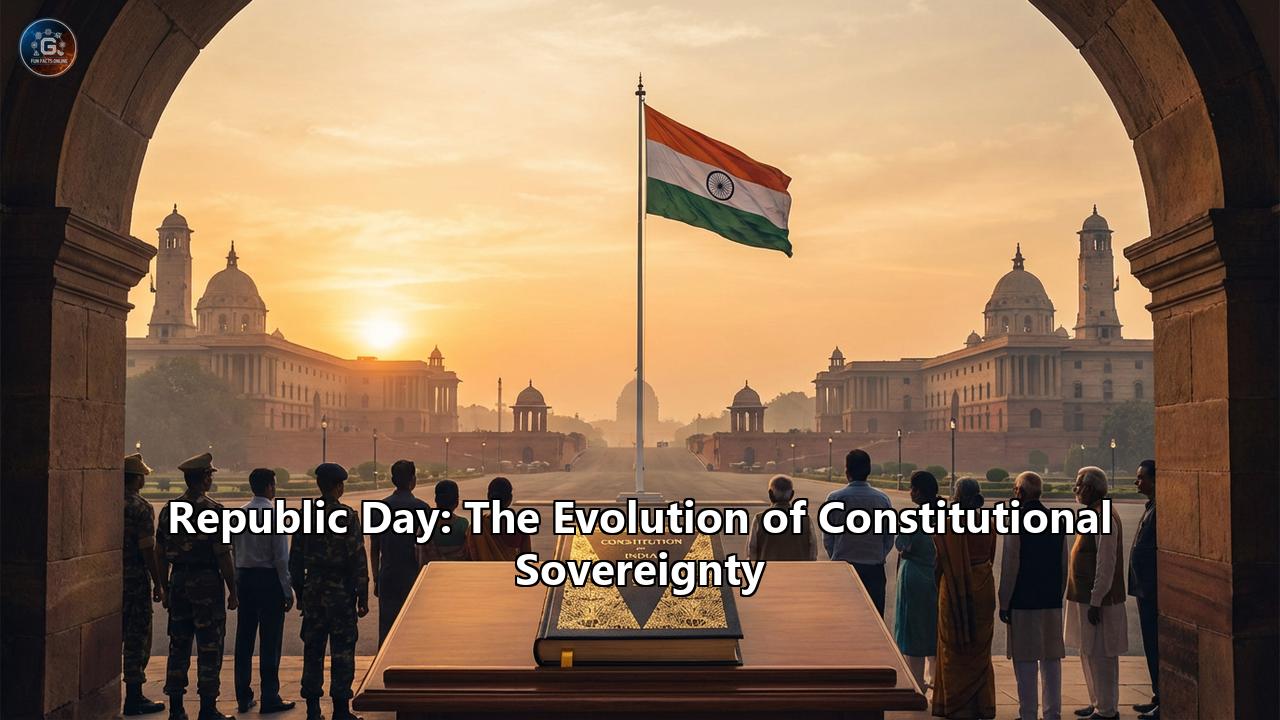
The dawn of January 26, 1950, was not merely a change of dates but a seismic shift in the destiny of a civilization. It was the moment when an ancient land, bruised by two centuries of colonial extraction, formally transformed into a modern nation-state governed not by the whims of a crown but by the codified will of its people. Republic Day is often reduced to the spectacle of the parade—the rhythmic thud of boots on Kartavya Path, the roar of Rafale jets, and the vibrant tableaux rolling down the avenue. However, beneath the pageantry lies a profound narrative of Constitutional Sovereignty—a concept that has not remained static but has evolved dynamically through seven decades of legal battles, geopolitical shifts, and internal churning.
To understand Republic Day is to understand the journey of India’s sovereignty from a political slogan in 1930 to a complex, living legal reality in the 21st century. This article explores that evolution, tracing the arc from the banks of the Ravi River to the data centers of the digital age.
Chapter 1: The Genesis of Sovereignty – Why January 26?
The choice of January 26 for Republic Day was a deliberate act of historical reclamation. To the untrained eye, August 15 (Independence Day) and January 26 (Republic Day) might seem like two holidays celebrating the same freedom. But they represent two fundamentally different stages of sovereignty.
The Distinction: Freedom vs. Self-RuleAugust 15, 1947, marked the transfer of power. The British left, but India remained a "Dominion" under the British Crown for nearly three years. King George VI was still the head of state, and the government ran under the modified provisions of the Government of India Act, 1935. India was free, but it was not yet supreme.
January 26, 1950, was the moment of severance. It was the day India ceased to be a Dominion and became a Republic. The office of the Governor-General (held by C. Rajagopalachari) was abolished and replaced by the President of India (Dr. Rajendra Prasad). This transition symbolized the shift from "Political Sovereignty" (freedom from foreign rule) to "Constitutional Sovereignty" (rule by one’s own supreme law).
The Ghost of 1930The date was a homage to the Purna Swaraj (Complete Independence) resolution. In December 1929, at the Lahore session of the Indian National Congress, a young Jawaharlal Nehru declared that the time for begging for "Dominion Status" was over. On the banks of the Ravi River, under the midnight sky, the tricolor was hoisted, and January 26, 1930, was designated as the first "Independence Day."
For the next 17 years, Indians pledged independence on this date. When actual independence came on August 15 (chosen by Lord Mountbatten to coincide with the anniversary of the Japanese surrender in WWII), the emotional weight of January 26 was left hanging. The Constituent Assembly, therefore, waited two months after completing the draft in November 1949 to enforce the Constitution on January 26, 1950, turning a pledge of the past into the reality of the present.
Chapter 2: The Architecture of the Republic
The Indian Constitution is the longest written constitution in the world, but its length is less important than its intent. It was designed as a tool for social revolution. Dr. B.R. Ambedkar, the Chairman of the Drafting Committee, envisioned the Constitution not just as a legal document but as a weapon to dismantle the hierarchies of caste and class that had plagued India for millennia.
The "We, The People" RevolutionThe Preamble begins with "We, the People." In a country that had been ruled by monarchs, moguls, and viceroys for centuries, establishing the people as the ultimate sovereign was revolutionary. Sovereignty in India does not reside in the Parliament, nor in the Judiciary, but in the Constitution, which in turn derives its authority from the people.
The Sovereign ParadoxDuring the drafting debates, a tension emerged: How much power should the State have? A sovereign state needs the power to hold the nation together (essential in the wake of Partition), but a democratic republic needs to limit that power to protect the individual.
This balance was struck through:
- Fundamental Rights (Part III): A "Magna Carta" for citizens that the State could not easily infringe upon.
- Directive Principles (Part IV): A moral obligation for the State to pursue social justice.
- Emergency Provisions: A controversial fail-safe that allowed the Union to turn unitary in times of crisis—a feature that would later test the very limits of constitutional sovereignty.
Chapter 3: The Crisis and Resurrection of Sovereignty (1970-1980)
Constitutional sovereignty is not a static rock; it is a river that changes course. The most significant evolution occurred during the 1970s, a period that defined the "Basic Structure" of the Indian Republic.
The Battle for Supremacy: Parliament vs. JudiciaryIn the early decades, the Parliament believed it represented the "will of the people" and thus could amend any part of the Constitution. The Supreme Court initially agreed (Shankari Prasad case, 1951). However, as the government began to push radical land reforms and nationalization policies, the Court began to push back, fearing that a majoritarian Parliament could strip away Fundamental Rights.
This conflict culminated in the Kesavananda Bharati case (1973).
In a historic 7-6 split verdict, the Supreme Court laid down the Basic Structure Doctrine. It ruled that while Parliament has the power to amend the Constitution, it cannot alter its "basic features"—such as secularism, federalism, the rule of law, and judicial review.
- Significance: This was the moment the Judiciary declared that the Constitution is sovereign over the Parliament. The "soul" of the document was placed beyond the reach of transient political majorities.
The resilience of this doctrine was tested when Prime Minister Indira Gandhi imposed a National Emergency. During this period, the 42nd Amendment was passed (often called the "Mini-Constitution"). It sought to make Parliament supreme, stripped courts of review powers, and added "Socialist" and "Secular" to the Preamble.
While the addition of "Secular" and "Socialist" remained, the 44th Amendment (1978), passed by the Janata Government, reversed the draconian aspects. It restored the balance, reinforcing that in the Indian Republic, no leader and no government is above the Constitution.
Chapter 4: The Parade – A Spectacle of Soft and Hard Power
The Republic Day Parade is the most visible manifestation of Indian sovereignty. But the parade itself has evolved from a sombre military review to a vibrant carnival of Indian power and culture.
1950-1954: The Irwin Stadium YearsThe first Republic Day parade in 1950 was not held at the majestic Rajpath. It took place at the Irwin Amphitheatre (now Major Dhyan Chand National Stadium). It was a relatively modest affair. President Rajendra Prasad rode in a horse-drawn carriage. There were no jets screaming overhead, no massive floats. It was a solemn affirmation of the new state.
1955: The Move to RajpathIn 1955, the parade moved to Kingsway (Rajpath, now Kartavya Path). This was symbolic. Kingsway was the centerpiece of British imperial power. By marching Indian troops down this avenue, the Republic was symbolically "conquering" the structures of its former colonizers.
Evolution of Themes- The Soviet Era Influence: In the 60s and 70s, the parade heavily emphasized heavy military hardware (tanks, missiles), reflecting India’s reliance on Soviet defense imports and the need to project strength after the 1962 and 1965 wars.
- The Cultural Turn: Over time, the Tableaux became as important as the tanks. They allowed the diverse states of the Union to project their identity on a national stage. This was "Federalism on Parade"—a reminder that the Indian Republic is a "Union of States."
- Nari Shakti (Women Power): In recent years (2020s), the parade has shifted focus to women’s representation. From all-women biking contingents to female officers leading regiments, the parade has become a platform to signal social progression.
Chapter 5: Diplomacy on the Dais – The Chief Guests
A unique tradition of Republic Day is the invitation of a "Chief Guest"—a head of state or government from another country. This is not merely ceremonial; it is a calculated diplomatic signal. The choice of guest reveals the geopolitical direction of India’s sovereignty.
The 1950s-60s: The Non-Aligned EraThe first Chief Guest in 1950 was President Sukarno of Indonesia. This was a deliberate signal of anti-colonial solidarity. India was leading the Non-Aligned Movement (NAM), and inviting Sukarno (and later leaders like Tito of Yugoslavia) signaled that the Indian Republic stood with the "Global South."
The Cold War TiltAs the Cold War deepened, the guest list began to reflect India’s strategic anxieties. The invitation to Marshal Ye Jianying of China (1958) was a failed attempt at Hindi-Chini Bhai Bhai before the 1962 war. Later, the frequency of Soviet/Eastern Bloc leaders reflected India's tilt towards the USSR.
The Post-1991 ShiftThe economic liberalization of 1991 changed the guest list.
- 1995: Nelson Mandela’s visit was an emotional reconnection with Africa and a celebration of democracy.
- 2015: The invitation to Barack Obama was a watershed moment. It signaled the end of Cold War hesitations and the embrace of a strategic partnership with the USA.
- The "Act East" Signal: In 2018, India invited all 10 ASEAN leaders. This was an unprecedented display of diplomatic "centrality" in the Indo-Pacific region.
- 2023 & 2024: The invitations to Egypt’s President Sisi and France’s President Macron reflect a new "multipolar" strategy—building partnerships across the Gulf and Europe independent of the US-China binary.
Chapter 6: Federalism – The Friction in the Republic
Republic Day has arguably become a flashpoint for federal friction. The selection of state tableaux is often marred by controversy.
- The Tableaux Politics: In recent years, opposition-ruled states have frequently complained that their tableaux proposals (often featuring local icons or themes critical of the center) are rejected. The Center argues this is due to "expert committee" selection, but the optics suggest a struggle over who gets to define the national narrative.
- Sovereignty of States: This reflects the deeper constitutional debate. Is India a unitary state with federal features or a federal state with unitary bias? The Supreme Court in S.R. Bommai (1994) ruled that Federalism is a basic feature. Republic Day brings this legal abstraction into the living rooms of millions, showing that the "Union" is a constant negotiation.
Chapter 7: New Frontiers – Digital Sovereignty
In the 21st century, the greatest threat to sovereignty is not a foreign army crossing the border, but data crossing servers.
The Indian Constitution is now being interpreted to cover "Digital Sovereignty."
The Puttaswamy Judgment (2017)When the Supreme Court declared Privacy a Fundamental Right (Article 21), it essentially expanded the Republic’s protection to the digital body of the citizen.
India is now asserting "Data Sovereignty"—the idea that data generated by Indian citizens is a national asset and should be stored/processed within India (Data Localization). This is the new meaning of Swaraj in the age of Big Tech. The "Republic" is no longer just a territory on a map; it is a digital jurisdiction.
Conclusion: The March Continues
As we look toward 2047 (the centenary of independence), the concept of Constitutional Sovereignty continues to evolve.
- It has moved from Political Sovereignty (1950s) – removing the British.
- To Social Sovereignty (1970s-90s) – using the state to uplift the marginalized (Mandal Commission era).
- To Economic Sovereignty (1991-2010s) – liberalizing while protecting national interests.
- To Technological Sovereignty (2020s) – building "Atmanirbhar" (self-reliant) tech stacks (UPI, Aadhaar) to avoid dependence on foreign tech giants.
Republic Day is the annual audit of this journey. When the tricolor unfurls on January 26, it does not just celebrate a document written in 1950. It celebrates the audacity of a billion people agreeing to be bound by a single book—a book that promises that in this diverse, chaotic, ancient land, the Rule of Law will always be King.
The evolution of sovereignty is the story of India trying to find its own definition of power—one that is not just about ruling, but about empowering. The parade passes, the jets land, but the Republic marches on.
Reference:
- https://www.jetir.org/papers/JETIR1905H12.pdf
- https://www.hindustantimes.com/india-news/r-day-a-look-at-chief-guests-over-the-decades-how-they-impacted-bilateral-ties/story-2slbiyEn7Dk3CIIgpOJIdI.html
- https://en.wikipedia.org/wiki/Delhi_Republic_Day_parade
- https://en.wikipedia.org/wiki/Republic_Day_(India))
- https://www.techpolicy.press/indias-search-for-digital-sovereignty/
- https://www.journalofpoliticalscience.com/uploads/archives/4-1-3-565.pdf
- https://www.youtube.com/watch?v=6LEEm3Uw9s0
- https://byjus.com/free-ias-prep/42nd-amendment-act/
- https://vajiramandravi.com/upsc-exam/44th-constitutional-amendment-act/
- https://www.drishtijudiciary.com/to-the-point/ttp-constitution-of-india/44th-constitutional-amendment-act-1978
- https://www.nextias.com/blog/indian-republic-day/
- https://diplomatist.com/2025/12/03/digital-sovereignty-and-ai-governance-indias-emerging-paradigm/
- https://www.forumfed.org/document/current-issues-in-indian-federalism/
- https://www.hinducollegegazette.com/post/cracking-pillars-of-federal-fort-challenges-in-indian-federal-policy
- https://www.apnilaw.com/upsc/indian-constitution/44th-amendment-act-1978-how-did-it-restore-democracy-in-india/
- https://sleepyclasses.com/the-42nd-amendment-how-it-transformed-the-indian-constitution/
- https://en.wikipedia.org/wiki/Forty-second_Amendment_of_the_Constitution_of_India
- https://testbook.com/articles/chief-guest-of-republic-day
- https://en.wikipedia.org/wiki/List_of_chief_guests_at_the_Delhi_Republic_Day_parade
- https://www.outlookindia.com/national/republic-day-history-significance-parade-chief-guests-all-you-need-to-know
- https://timesofindia.indiatimes.com/india/from-obama-to-macron-republic-day-chief-guests-over-the-years/photostory/117527098.cms
- https://telanganatoday.com/rewind-republic-day-chief-guests-and-foreign-policy
- https://www.thehindu.com/news/national/republic-day-parade-tracing-india-annual-military-display-and-its-costs-1950-2024/article69120460.ece